
BUSINESS
Saudi Arabia Parks Crude in Korea Past a Shut Strait
The June oil MoU expands Saudi crude already stored in Korea’s reserve, a location hedge that cannot replace cargoes still forced through Hormuz.

Saudi Arabia and South Korea signed an oil-and-gas memorandum on June 14 that expands Saudi crude stored inside Korea’s strategic reserve. Energy Minister Prince Abdulaziz bin Salman and Kim Jung-kwan, Korea’s minister of trade, industry and resources, put their names to it in Riyadh after a two-day visit that also locked in crude and naphtha volumes through December. The Strait of Hormuz, which carries about a fifth of the world’s oil and gas, had already been all but shut since late February.
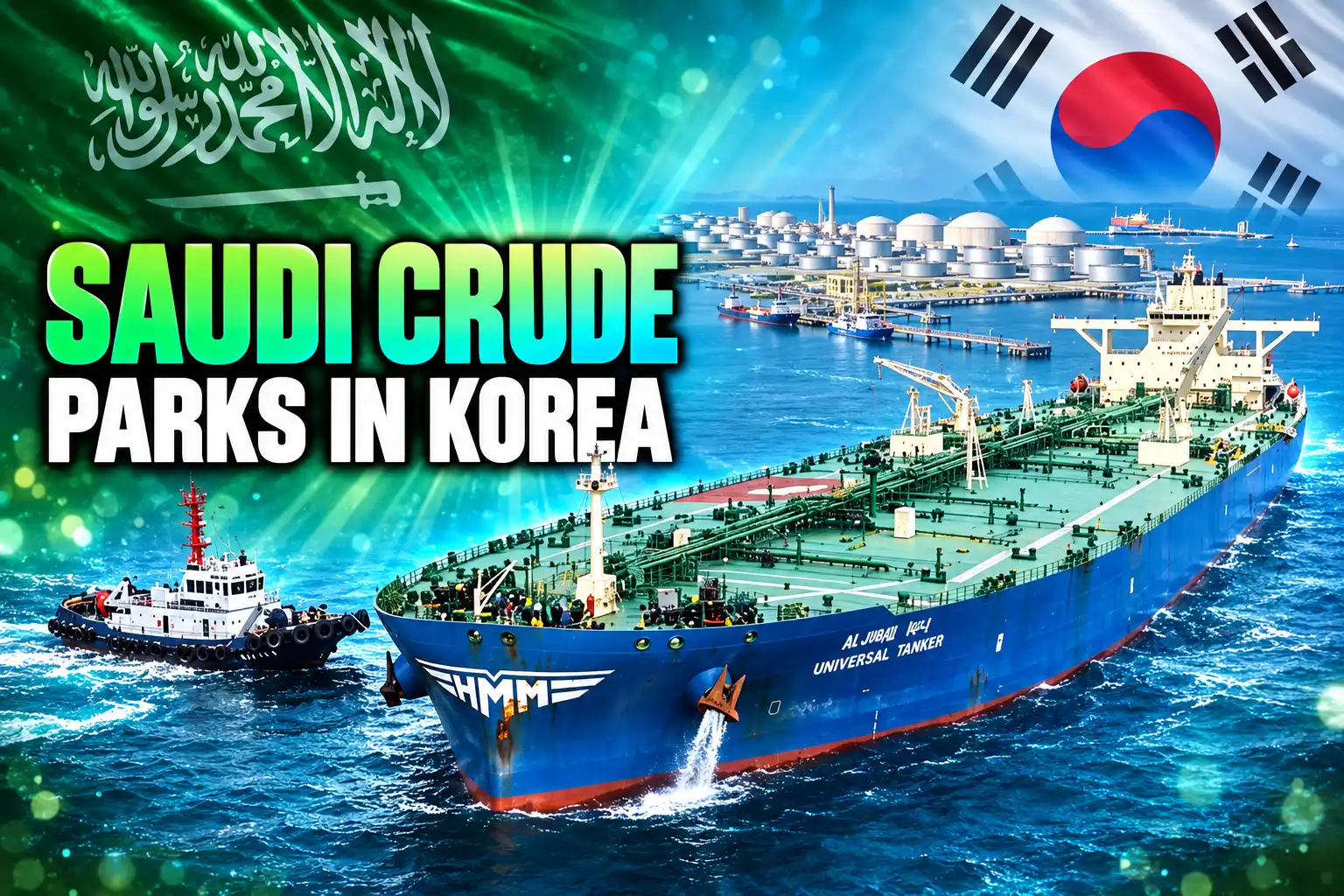
The paper does not name a new volume. The only Saudi stock with a public figure in Korea remains 5.3 million barrels sitting at Ulsan, barrels that do not need to cross Hormuz again.
Saudi Barrels Sit Past the Hormuz Chokepoint
Korea National Oil Corp signed that Ulsan deal with Aramco on October 23, 2023, for five years. The oil, mostly Arab Light, sits in KNOC tanks at the southeastern port. Seoul has first rights to buy it in a supply shock, and KNOC collects rent. In ordinary weeks Aramco can sell the same barrels to Korean plants or to other buyers in the region.
The first cargo was 2 million barrels. For Aramco, Ulsan is a warehouse next to demand. For Seoul, it is a call option on crude that has already finished the Gulf voyage. That dual use is the product the June memorandum wants to grow.
It is still a thin buffer. The U.S. Energy Information Administration put Korean strategic oil at 79 million barrels in December 2025, a government and national-oil-company tally that sits beside, and is larger than, the Ulsan lease. Against the 72.82 million barrels of crude Korean refiners took in during May, 5.3 million barrels is just over two days of plant intake.
The same EIA note records 82 million barrels of Saudi oil in on-land tanks at home that month and states those figures exclude leased crude storage sites in South Korea, Okinawa, and Japan’s Kiire terminal. The barrels that matter in a Hormuz shock are the ones already east of the Strait.
The Barrels Already Sitting in Ulsan
Kim’s trip was not a courtesy call. A presidential special envoy had gone to the Gulf in April, when Saudi Arabia pledged to put Korean crude and naphtha first. The June 13 and 14 visit was the follow-up, and the two energy ministers agreed to keep stable supplies through the end of 2026.
Nine days before the signing, Vice Minister Moon Shin-hak sat down in Seoul with Mohammed Y. Al Qahtani, Aramco’s downstream president, to talk about medium-term resource security. The ministry posted the meeting itself.
Vice Minister Moon Shin-hak of #MOTIR met with Mohammed Y. Al Qahtani, Downstream President of #Aramco, Saudi Arabia’s state-owned oil company, in Seoul on June 5, 2026, to discuss strengthening medium- and long-term resource security cooperation. pic.twitter.com/6nr3ptVPKj
— MOTIR – Korea (@MOTIRKoreaEng) June 9, 2026
Naphtha is the quieter half of that supply talk. Korea imports about 45 percent of the naphtha its chemical plants burn, and 77 percent of those imports usually come from the Middle East. A shut Gulf does not only idle gasoline tanks. It starves crackers.
What the Riyadh Memorandum Leaves Unsaid
The Saudi Press Agency said the memorandum covers petroleum and gas and their derivatives, refining and petrochemicals, and energy investment, including more Saudi crude in the Korean Strategic Petroleum Reserve. It also floats crude pipelines that link production to export points, plus digital work, research, and sustainability projects.
Korea’s ministry listed seven workstreams and was clearer that this was a medium-term frame, not a cargo list.
THE SEVEN WORKSTREAMS IN THE OIL MOU
- Stockpiling: More Saudi crude held in Korean tanks, with no new barrel count attached.
- Pipelines: Joint work on lines that move crude from fields to export terminals.
- Digital tools: AI and digital conversion in energy and resource work.
- Cleaner operations: Technology meant to cut cost and environmental load.
- Chemicals: Development and use of petrochemical materials.
- Access kit: Plants and hardware that make energy resources easier to reach.
- Company deals: Direct business-to-business projects on both sides.
Kim also saw Investment Minister Fahad Al-Saif and Industry and Mineral Resources Minister Bandar Al-Khorayef. He asked for help finishing a Hyundai Motor and Public Investment Fund car plant due to start full output in 2027, and International Maritime Industries, the HD Korea Shipbuilding & Offshore Engineering and Aramco yard that covers 4.96 million square meters, about 700 soccer fields. The two sides also flagged sulfur, phosphate rock, bauxite, and rare earths, with talk of shared mineral surveys and geological maps.
This visit to Saudi Arabia was significant because it reaffirmed stable supplies of key national resources, including crude oil and naphtha, amid continued global supply chain instability and laid the groundwork for medium- and long-term resource cooperation.
Kim Jung-kwan, Minister of Trade, Industry and Resources, MOTIR statement
None of that writes a tanker into next month’s program. A memorandum can name stockpiling and still leave the gauge on the Ulsan tanks where KNOC and Aramco left it in 2023.
Korean Refiners Bought Around the Strait All Spring
Korean plants did not wait for new tanks. In May they lined up 72.82 million barrels of crude, 87.7 percent of the 83.05 million-barrel five-year monthly average, according to KNOC figures. Feedstock managers at Ulsan and Seosan plants, including S-Oil, said the barrels that arrived were light and medium sour grades moved via the Red Sea and via Fujairah and the Gulf of Oman, routes that avoid Hormuz.
KOREA’S TOP CRUDE SUPPLIERS IN MAY 2026
| Supplier | May 2026 | Change from May 2025 |
|---|---|---|
| Saudi Arabia | 18.84 million barrels | down 28.4% |
| United States | 15.02 million barrels | down 19.6% |
| United Arab Emirates | 13.15 million barrels | up 105.2% |
The UAE jump is the tell. Those extra Abu Dhabi barrels were the Hormuz workaround in physical form, not a change in Korean taste. For January through July, Saudi Arabia still led with 173.18 million barrels, 30.9 percent of imports, down from 33.2 percent a year earlier. The United States supplied 113.17 million barrels, 20.2 percent, up from 16.4 percent. The Middle East’s share of Korean crude fell to 62.1 percent from 68.8 percent. In 2025 that share had been about 70 percent.
On October 2, Korea Customs Service sat GS Caltex, HD Hyundai Oilbank, SK Energy, S-Oil, Hanwha TotalEnergies Petrochemical, KNOC, and the Korea Petroleum Association in a room in Seoul to ease paperwork for non-Middle East crude. The ministry’s longer plan, approved in September, is to cut any single region’s share of crude below 50 percent by 2035.
September’s Hit on the East-West Line
The memorandum’s pipeline line is not abstract. Most Saudi crude is produced in the east. The East-West line, about 1,200 km from Abqaiq to Yanbu on the Red Sea, is the route that lets those barrels leave the kingdom without a tanker threading Hormuz. From Yanbu, a cargo bound for Korea has taken about 50 days via the Suez Canal and the Cape of Good Hope since the war began.
THE DATES THAT SHAPED THE STORAGE HEDGE
- February 28, 2026: The United States and Israel go to war with Iran, and tanker traffic through Hormuz collapses.
- March 11, 2026: The International Energy Agency agrees to put 400 million barrels of emergency oil on the market, later confirmed at 426 million, with Korea’s 22.5 million-barrel share.
- June 5, 2026: MOTIR’s vice minister meets Aramco’s downstream president in Seoul on resource security.
- June 14, 2026: Abdulaziz and Kim sign the oil-and-gas memorandum in Riyadh.
- September 11, 2026: Drone strikes halt the East-West line, cutting the Red Sea outlet the June text had in mind.
- September 23, 2026: Kim chairs a resource security council that approves 20 million barrels of extra Korean tank space by 2030, including joint stocks with producers.
Korea’s 22.5 million-barrel IEA slice is more than four times the Ulsan Aramco stock. That is the gap a joint tank farm is supposed to narrow, and it is also the measure of how small 5.3 million barrels looks once a war has started. The IEA called the March release its largest ever and still said regular Hormuz transit was the thing that would actually restock the market.
After the pipeline was hit, traders described a burst of Saudi sales to Asia, Korean plants among the buyers, with some cargoes moved through Hormuz and by ship-to-ship transfer off Oman. Pre-positioned oil in Ulsan cannot stand in for those cargoes. It can only cover the days before the next one ties up. The wider fight that shut the Strait includes Iranian strikes that widened the Gulf war, and that is the risk the tanks are built against.
Okinawa Already Leases Tanks to Aramco
Korea is copying a Japanese model, not inventing one. On November 12, 2025, the Japan Organization for Metals and Energy Security renewed a tank lease with Aramco that began in 2010. JOGMEC rents Aramco 13 national stockpiling tanks at the Okinawa CTS base, enough for about 1.3 million kiloliters, or 8.2 million barrels in Okinawa tanks, for three years. In an emergency, Japan gets first claim on that oil. In quiet months, Okinawa is Aramco’s Asian hub.
Ulsan works the same way: rent for the host, a nearby shop window for Aramco, and a preferential call for the government if tankers stop. The June memorandum is an attempt to make that Korean version larger. It still needs a filling order.
20 Million Extra Barrels by 2030
Three months after Riyadh, Kim’s resource security council approved the first long-term resource plan under a 2025 law. The oil piece is blunt. Korea will add 20 million barrels of stockpiling capacity by 2030, the first tank expansion after a plan that ran from 2014 to 2025. The new space is meant for government oil and for joint international stocks with producing countries, the exact structure the June MoU describes and the 2023 Ulsan lease already uses.
The plan also wants more condensate on hand so domestic plants can make naphtha if Gulf supply fails again. That is the chemical-industry lesson from the same shock that sent Kim to Riyadh.
Tanks in Ulsan only hold oil that has already arrived. A memorandum can invite more of those barrels. It cannot load them in Ras Tanura, walk them around a mined strait, or keep a 1,200 km pipeline from being hit. The hedge Seoul bought on June 14 is location. The next test is whether anyone actually fills the extra steel.

Ninja Theory Staff Face Redundancy After Two Xbox Sales Collapse

Amazon Sells the MacBook Air at Its Pre-Hike Price

U.S. Slows Jet Parts to Squeeze China’s Flying Fleets

PEGI Pulled the GTA 6 Age Rating After Cocaine Details

Northwestern’s Smaller Ryan Field Gave Penn State Nowhere to Hide

Aramco Crash Kills 14 Two Days After Oil Restart

Salah Captained Egypt to Their First World Cup Win

Apple Labor Day Deals Hide June’s Memory Price Hike

Palworld 1.0.4 Adds Palpedia Search After the 1.0 Launch

Zelda’s 40th Switch 2 Ships Without a Zelda Game
-
 BUSINESS3 months ago
Aramco Crash Kills 14 Two Days After Oil Restart
-
 NEWS4 months ago
Salah Captained Egypt to Their First World Cup Win
-
 NEWS1 month ago
Apple Labor Day Deals Hide June’s Memory Price Hike
-
 GAMING4 weeks ago
Palworld 1.0.4 Adds Palpedia Search After the 1.0 Launch
-
 GAMING4 weeks ago
Zelda’s 40th Switch 2 Ships Without a Zelda Game
-

 NEWS3 months ago
El Niño Puts Israel’s Needed Winter Rain on a Flood Clock
-

 BUSINESS8 months ago
Egypt Bets EGP 638 Billion Can Open Sinai to Investors
-

 ENTERTAINMENT4 weeks ago
King Charles Letter Keeps Harry and Meghan as Private Citizens