
SCIENCE
Pyramids Booby Traps: What Builders Used to Seal a Tomb
Pyramids booby traps were stone seals and curse texts, not blades or darts. See how blocks worked, why gold went in, and why robber crews still got through.

A sinking tile and a swinging blade are what people picture when they look up pyramids booby traps. Egyptian pyramids hold no device built to cut, stab, or poison someone who walks in, and the closure was heavy stone set after the funeral.
Ritual doorways stood in the chapel for relatives who brought food, and some walls carried a written threat. The sections that follow separate each of those features from the film version, then cover the goods, the curse lines, and the trials that show how crews still got in.
What Counts as a Pyramid Booby Trap?
A booby trap in the film sense is a hidden mechanism that springs when you step, pull, or lean. Poison darts, a spiked pit under a false floor, and a rope snare are the usual props, and none of them has been found in an Egyptian pyramid.
“Booby traps are unknown to Egyptologists,” says Rolf Krauss, an independent Egyptologist who has written widely on the pyramids. A tomb large enough to hide such a device cannot be entered and robbed by one person, he adds, and only a team could do that work. Catch one or two people and the rest of the crew is still in the passage with chisels.
“No, they didn’t use booby traps in the pyramids, but they could make it damn difficult to get in,” says Reg Clark, an independent Egyptologist. The barrier he points to is the mass of the pyramid and the kind of stone in it. What you can still walk up to is a blocked passage, a dropped slab, and fill packed into a shaft.
Stone Seals That Closed the Burial
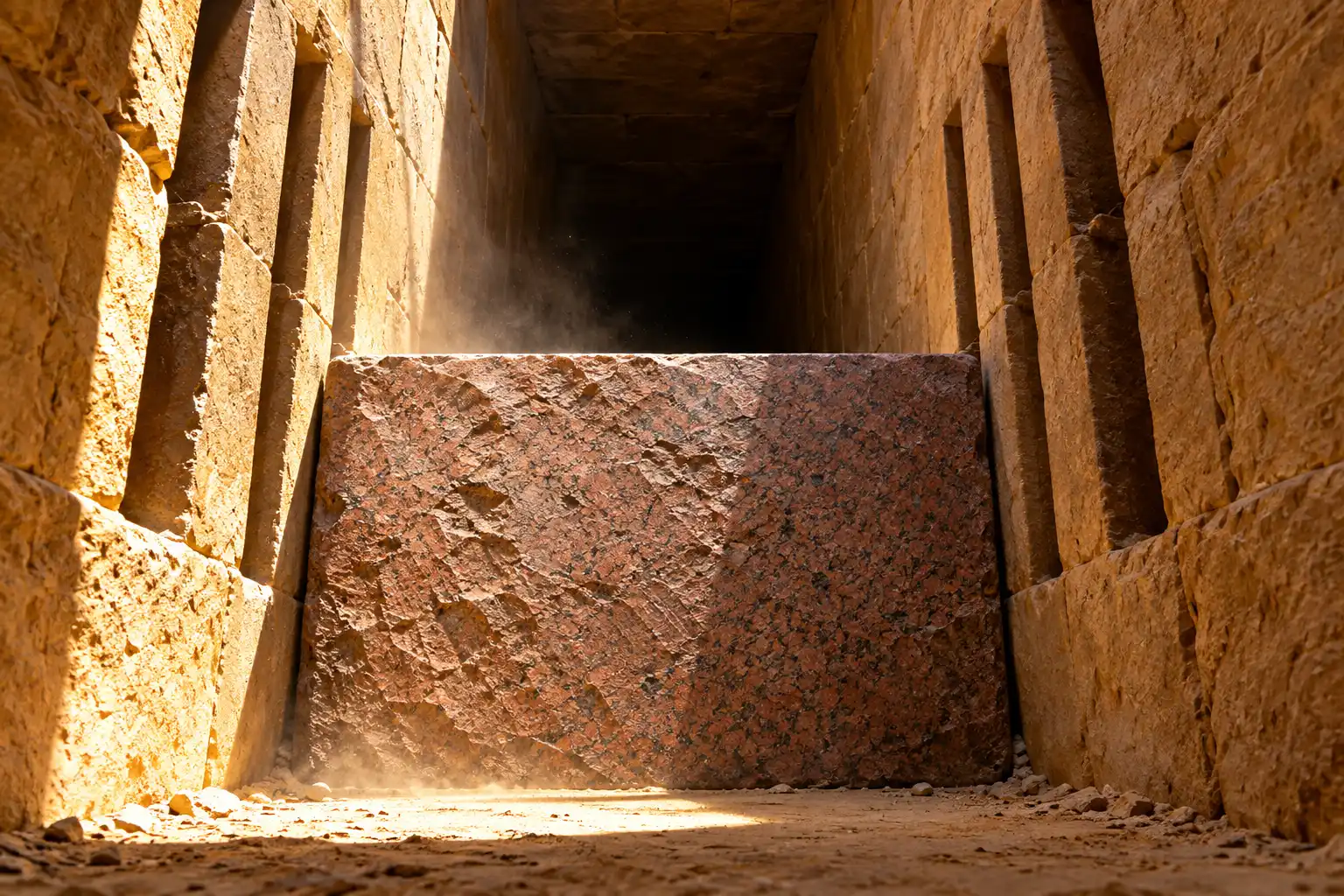
After the funeral, workers closed the way in. Entrances were covered, corridors were packed, and in some pyramids a stone slab was lowered in grooves so that it sat across the passage. That slab is a portcullis: a gate of stone, dropped once, not a blade waiting on a catch.
Sliding stone blocks closed some burial chambers, and spells of magical protection were written in some of the pyramids, David Ian Lightbody, an Egyptologist at the University of Vermont, explains. The block is a door you shut. The spell is a sentence on the wall. Neither one is a spring.
Granite Plugs and Dropped Slabs
In the Great Pyramid at Giza, granite plugs remain in the ascending passage, and the small room before the King’s Chamber carries vertical grooves for further slabs. A slab in that setting is lowered from above after the body and the goods are inside. It is not cocked to fall on the next person who touches a plate.
One person does not shift a block of that size, and a group still needs tools and time. How the largest of those blocks were raised is debated in rival studies of how it was built. Robbers who knew the plan often left the granite alone and cut through the softer stone beside it.
- The timing: The slab drops after the burial, as a door shut for good, not as a weapon left on a trigger.
- The material: Granite in a tight limestone passage is there to resist chisels, levers, and fire.
- The bypass: A tunnel in the softer stone beside the plug reaches the chamber without anyone lifting the block.
That bypass is why a perfect groove can sit undamaged while the burial beyond it is empty. The defense failed beside the stone, not by some secret catch inside it.
The Sekhemkhet Shaft Collapse
The danger in a blocked shaft is the stone and the fill, which move while people are clearing them. In the 1950s, at the Third Dynasty pyramid of Sekhemkhet at Saqqara, workmen under the Egyptian archaeologist Zakaria Goneim were clearing the main passage when backfill and blocking stones in a construction shaft above the corridor came down, killing one worker and injuring two.
A CLOSED SHAFT CAN FALL IN
Clearing ancient fill is a building hazard. At Sekhemkhet the blocking material fell on the crew from a shaft over the corridor. That is a collapse during digging, and it is not a loaded weapon left by the builders.
That accident is the example Clark gives for a plain point: the blockings of passageways and shafts can harm a person inside. You are in a closed building that can fall in, the way any old shaft can, and the harm arrives because the fill lets go.
False Doors and Passages That Go Nowhere
Egyptians planned a royal tomb among the houses of eternity with a chapel above the burial chamber, and they left that chapel open for offerings. The burial itself sat below, shut away with the body. Visitors were supposed to reach the chapel and stop there.
A false door looks like a doorway cut in stone, with jambs and a drum, and it does not open onto a room. From the Third Dynasty onward, chapel walls carry false doors built for the ka, the aspect of a person that comes forward for bread and beer. The door was set on the west wall, the direction tied to death and the next life, with an offering place in front of it.
Some pyramid corridors stop short of the burial chamber. In the Great Pyramid, passages exist that never reach the king’s chamber, and their purpose is still unclear. It is not established that they were cut to send a thief the wrong way. A change of plan and a deliberate trick can leave the same dead end in the stone.
A deep hole in some plans is a simple obstacle in the floor. The robber walks back out the way they came, and the hole does not release a weapon. Slowing someone down, or making them turn around, is a different job from injuring them.
Curse Lines Cut Into Tomb Walls
Words on stone are the other famous threat, and they do not move. A curse inscription promises bad luck or punishment from the gods for anyone who disturbs the burial. The pressure those lines apply is fear, in a world where the gods were expected to police a tomb. There is no catch, no weight, and no poison in the sentence.
“Hollywood has turned standard architectural features like sliding portcullis blocks, shafts, and sand filled chambers into objects of horror,” says Emily Teeter, an expert on Egyptian and Nubian antiquities at the University of Chicago. On a false door, the same wall can carry a curse against harm and a blessing for the person who brings an offering. The text is doing chapel work: leave the tomb intact, and keep the food coming.
Many of the stronger curse formulas that survive sit on private tombs of the Old Kingdom, not on the inner walls of a king’s pyramid. A king had priests and a household assigned to guard and feed the cult. A private person had the inscription, and little else, once the mourners went home.
Goods a Pharaoh Needed After Death
The objects in the chamber are not bait in a trap. They are the household, moved underground, because the next life was this life going on. The sealed room held the body, and it held what the dead king was expected to keep using.
WHAT WENT INTO THE BURIAL
- Furniture: Beds, chairs, and boxes were there so rest and storage did not stop.
- Food and drink: Bread, fruit, and wine were set against hunger and thirst.
- Weapons and travel: Daggers and chariots were included for defense and for getting about.
- Images and spells: Paintings told the life he had lived, and spells were written to keep him safe.
- Divine figures: Statues of gods were placed for blessing and protection.
Egyptians spoke of gold as the flesh of the gods, the metal of the sun god Ra and of a body that should not decay. A gold surface on a mask or a shrine was doing religious work. That is also why later thieves burned gilded wood: the flame freed the metal, and the object itself could be left behind.
Why Did Royal Seals Still Fail?
A seal works against a stranger who has one night and a small chisel. It works poorly against people who built the tomb or guarded it. Many looters either helped build the tomb or paid someone who did, says Betsy M. Bryan, an emeritus Egyptologist at Johns Hopkins University. Stonecutters knew which rock was soft, and some left a gap on purpose.
Evidence from the Old, Middle, and New Kingdoms shows crews working for a long time on a tunnel toward a burial they believed was rich. Patience beats a single slab. When the state was short of guards and pay, that work got easier, and the paperwork of the arrests got thicker.
A Mason’s Confession in Court
The clearest voices are the robbers themselves. A mason named Amenpanufer told a court around 1110 B.C.E. that the crew “took our copper tools and forced a way into the pyramid of this king through its innermost part.” They stripped gold, amulets, and jewels, set fire to the coffins, stole the furniture, and divided what they took.
Penalties named for the crime include a beating, the loss of a hand, and execution, and impalement is one form of that execution on record. Stealing from the king was treated as an offense against the ruler and the gods. The trials did not end the digging. A later sheet from this run of hearings is Papyrus Mayer A from the Theban trials, kept at National Museums Liverpool.
Theft Before Any Seal Existed
Some gold never met a seal. When a mummy was unwrapped in modern times, jewelry placed on the body was already gone, and resin from embalming still held the shape of a piece that was missing, as the Egyptologist Aidan Dodson describes it. The undertakers who prepared the body had the last private hour with the gold. No portcullis can stop a theft that happens before the coffin is shut.
This was a system built on burying money, even entire households, underground, and while the architects only had one shot at building an impenetrable tomb, the robbers had all the time in the world to figure out how to get in.
Maria Golia, author of A Short History of Tomb-Raiding
The pyramid complex of Djoser was packed with debris to choke the route to the burial chambers. Debris is a closure, and anyone with time can dig it out, which is the pace the court confessions describe. In the New Kingdom, kings left the obvious pyramid for a hidden rock-cut tomb, and people who knew those chambers still emptied them.
How to Read a Story About Pyramid Traps
Use this split when a film, a game, a novel, or a tour guide shows you a trap. Match the picture to the feature it was borrowed from, then ask what that feature was built to do.
| If the story shows | You are looking at | What it was for |
|---|---|---|
| Swinging blades, darts, or a pressure plate | A film or game set | No pyramid example is known |
| A granite slab in grooves | A portcullis or plug | Shut once after the burial |
| A carved door that does not open | A false door in a chapel | Offerings and the spirit’s passage |
| A pit or a filled shaft | An obstacle or construction fill | Slow entry, or close the route |
| A threat cut in hieroglyphs | A curse text | Fear, and a push to leave the cult intact |
| A tunnel that skirts the hard stone | A robber’s bypass | The usual way in, once someone knew the plan |
When a guide on site says a passage was designed to get you lost, ask what the excavators found at the end of it. In the Great Pyramid the side passages are real, and the intent behind them is still an open question. A collapse, an abandoned plan, and a trick can look the same once the lamps are out.
Facts You Can Repeat About Pyramid Traps
The stone, the chapel door, and the court record are the three checks against any pyramid story. Seals went in after the funeral, false doors served offerings, and crews with copper tools and inside knowledge still reached the gold.
The goods were a household for a king whose life was expected to continue, which is why the metal and the furniture were worth both the burial and the risk of a trial. Start from the object in front of you, and the film version drops away.
Frequently Asked Questions
What Does Papyrus Mayer A Say About Tomb Robbers?
Papyrus Mayer A is a court sheet from Thebes, dated inside the text to years 19 and 20 of Ramesses XI, whose reign National Museums Liverpool places at about 1103 or 1099 to 1070 or 1069 BC. It holds short reports on the examination of the accused in two series of thefts, one from gilded portable shrines and one from tombs in the royal necropolis, and an earlier stage of the same judges’ inquiry sits on a British Museum papyrus written in the same hand. The sheet is a prosecution record, and it describes break-ins and questioning, not a blade or a sprung floor.
Did a False Door Ever Have a Moving Part?
Most false doors are solid stone and were never built to swing. A few, including the door of Hesire, included a movable wooden panel, and that panel still belonged to the offering chapel. It did not drop a block, fire a point, or open a route into a hidden spring. The carving remains a place for the spirit and the food, even in the rare cases where a wooden piece could shift.
Why Did Kings Abandon Pyramids for Hidden Tombs?
In the New Kingdom, circa 1550 to 1070 B.C.E., kings were buried in hidden rock-cut tombs rather than in pyramids that stood in plain sight. Hiding the door did not stop theft. The crews who cut the chambers lived at Deir el-Medina, beside the Valley of the Kings, so the people with the best map slept next to the work. The makers of those hidden tombs carried the plan home, which is why secrecy did not hold.
Were Snakes or Poison Part of an Egyptian Burial?
Snakes, poison needles, and dart slots are film props, and no pyramid passage has produced them. What the buildings do contain are sand-filled spaces, vertical shafts, and dropped slabs, all of them parts of how a burial was closed or how the pyramid was put up. Later retellings turn those parts into weapons. A sand-filled space is part of the architecture, not a hopper that dumps on a visitor.
Did Tomb Robbers Only Strike When the Government Was Weak?
Theft is on record in strong reigns as well as in years of weak government. Tutankhamun’s tomb was entered and partly stripped during the 18th Dynasty, and the bags of loot left in the antechamber read as a crew interrupted before it could finish. The thick batch of trial papyri comes from the late 20th Dynasty because officials then wrote down a purge of the necropolis, not because earlier kings were left in peace.
A dropped slab can still be walked around by someone who helped set it. The record that remains is a tunnel in the soft stone, a burned coffin, and a list of names in a trial papyrus.

Cook Hands Democrats the House as Crypto’s Bill Stays Dead

Wicker’s Broken Bed Was the Short Story’s Punch Line

Nvidia’s $500 Billion Financing Plan Draws a $180 Sell

Maserati Bets the Grecale V6 Can Fill Porsche’s Gap

EV Cable Theft Follows the Old Railway Copper Playbook

Aramco Crash Kills 14 Two Days After Oil Restart

Salah Captained Egypt to Their First World Cup Win

Zelda’s 40th Switch 2 Ships Without a Zelda Game

Apple Labor Day Deals Hide June’s Memory Price Hike

El Niño Puts Israel’s Needed Winter Rain on a Flood Clock
-
 BUSINESS5 months ago
Aramco Crash Kills 14 Two Days After Oil Restart
-
 NEWS5 months ago
Salah Captained Egypt to Their First World Cup Win
-
 GAMING2 months ago
Zelda’s 40th Switch 2 Ships Without a Zelda Game
-
 NEWS3 months ago
Apple Labor Day Deals Hide June’s Memory Price Hike
-
 NEWS4 months ago
El Niño Puts Israel’s Needed Winter Rain on a Flood Clock
-

 GAMING2 months ago
Palworld 1.0.4 Adds Palpedia Search After the 1.0 Launch
-

 BUSINESS9 months ago
BAE’s 60-Year Saudi Franchise Now Runs Through Taif
-

 NEWS4 months ago
Saudi Visa Routes Split Nigerian Travelers Into Two Speeds