
NEWS
An Unknown Prince Left Egypt’s Largest Pink Granite Door
Saqqara’s 4.5-meter pink granite false door names a lost son of Userkaf, then shows how Saite restorers later stored Djoser’s family inside his tomb.

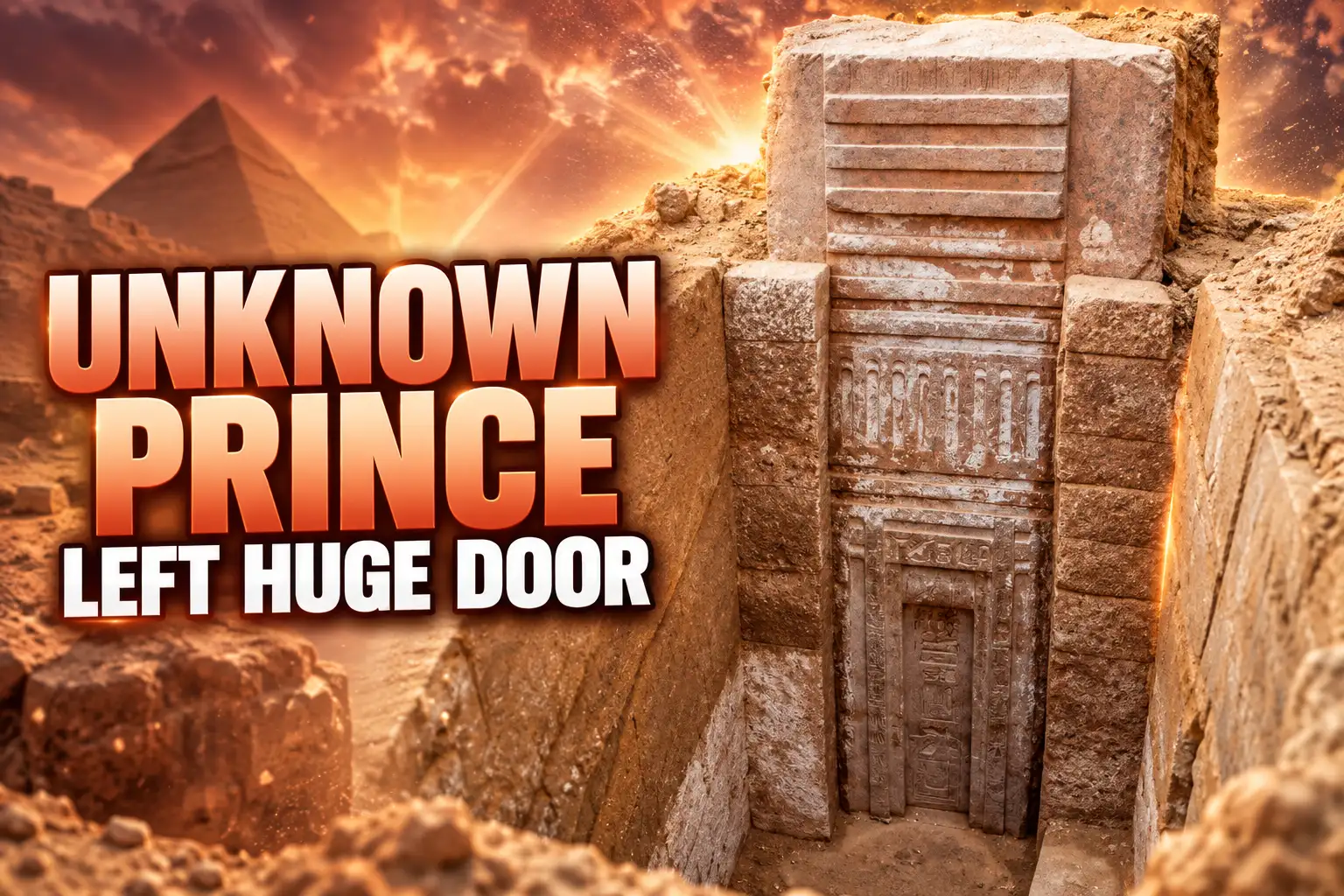
Egyptian archaeologists at Saqqara have uncovered the tomb of Prince Userefre, a son of King Userkaf whom specialists had not previously identified. A pink granite false door 4.5 meters high stands in the tomb, the first of that size in that stone recorded in Egypt.
The joint mission of the Supreme Council of Antiquities and the Zahi Hawass Foundation for Antiquities and Heritage announced the find on April 18, 2025. The burial chamber has not been reported found.
Scholars Had Not Heard of Prince Userefre
Userefre, also spelled Waser-If-Re, is named on the door as the son of Userkaf, founder of the Fifth Dynasty, who reigned about 2465 to 2458 B.C. Ronald Leprohon, professor emeritus of Egyptology at the University of Toronto, who was not on the dig, put the gap in the record in one line.
Previous to this discovery, we didn’t even know he existed.
Ronald Leprohon, professor emeritus of Egyptology, University of Toronto
Leprohon said the name may mean “Re is powerful,” tying the prince to the sun god who dominated Fifth Dynasty kingship. Userkaf built a sun temple and set his own pyramid at Saqqara beside Djoser’s Step Pyramid. Until this tomb, the sons attached to him in standard lists were Sahure, who became king, and a daughter, Khamaat. Userefre was not among them.
The door lists offices that put him inside government, not only the royal house. Dr. Mohamed Ismail Khaled, secretary-general of the Supreme Council of Antiquities, read the titles as hereditary prince, governor of the Buto and Nekhbet regions, royal scribe, minister, judge, and chanting priest. Zahi Hawass, the former antiquities minister who leads the excavation, said a prince with those titles is why a door of this stone and scale was cut for him.
TITLES CUT INTO THE DOOR
| Title on the door | How the ministry renders it |
|---|---|
| Hereditary Prince | Royal heir, named as Userkaf’s son |
| Governor of the Buto and Nekhbet Regions | Provincial office in two named districts |
| Royal Scribe | Court writing office |
| Minister | Senior government post |
| Judge | Legal office |
| Chanting Priest | Temple ritual role |
Tourism and Antiquities Minister Sherif Fathy said an all-Egyptian team made the find and that it helps show how Fifth Dynasty ritual and rank were arranged. The granite is the part of that rank a visitor can still measure.
The Granite Had to Come From Aswan
Khaled called the slab the first pink granite false door of this magnitude found in Egypt. It is 4.5 meters (14.8 feet) high and 1.15 meters (3.8 feet) wide. Hawass, writing separately to specialists, said it was also the first false door of this kind recorded at Saqqara.
Most false doors of this era were limestone, which could be cut near the cemetery. Pink and red granite were not local. Melanie Pitkin, senior curator at the Chau Chak Wing Museum at the University of Sydney, who was not on the mission, said the stone had to be quarried at Aswan, about 400 miles (644 km) south of Saqqara, which made it costlier and kept it for royalty and the high elite.
A round pink granite offering slab sits in front of the door, carved with hieroglyphs, where food and drink would have been set down. Nearby the team found a red granite offering table 92.5 cm (3 feet) across, inscribed with lists of ritual offerings. Both pieces are the same hard southern stone as the door, so the chapel was finished as a granite set, not a limestone tomb with one showpiece bolted on.
Moving a 4.5-meter block that far meant barges on the Nile, a royal quarry claim, and a workforce the palace was willing to spend on a son who was also minister and judge. The door is less a curiosity than a shipping record in stone.
How a False Door Was Meant to Work
The slab does not swing. It was never a gate in the building sense. Old Kingdom chapels treated a carved doorway on the west wall as the point where the dead could come forward and take offerings, a belief the Metropolitan Museum of Art spells out on a Fifth Dynasty false door where offerings were left in the tomb chapel of Raemkai.
WHAT THE CARVED DOOR DID
- The niche: A recessed panel stood in for the opening of a real doorway, so the dead could pass in form only.
- The meeting place: Relatives set food, drink, and prayer in front of the slab, where the dead were thought to come forward.
- The west wall: Chapels put that symbolic door on the west side, the direction Egyptians tied to the land of the dead.
- The offering table: Lists of bread, meat, and drink on the granite table named what the cult was supposed to keep supplying.
A visitor who wants the ordinary limestone version of the same idea can look at false doors in a Userkaf-era chapel built for Nikauhor, a judge and priest of Userkaf’s sun temple, and his wife Sekhemhathor. Those niches are the standard Fifth Dynasty kit. Userefre’s door is that kit cut from Aswan granite at palace scale.
The theology is not new. The bill of materials is.
Thirteen Statues Sit on a High-Backed Bench
North of a lintel, the mission found a group of 13 pink granite statues seated on a high-backed bench, a grouping Khaled called the first of its kind in the Saqqara area. Statue heads set higher than the rest are read as the wives of the tomb owner, seated in the center. To his left are two headless statues. In front of them lay another black granite statue, upside down, about 1.35 meters tall.
Headless court figures are a familiar wreck in reused tombs. Later occupants, robbers, or restorers often took the faces. The bench still does one job the door already advertised: it shows a household large enough, and rich enough, to be carved in the same granite as the prince’s threshold.
The eastern facade has a second entrance with pink granite shoulders. It names the tomb owner and his titles again, and it carries the cartouche of King Neferirkare, a later Fifth Dynasty ruler. That cartouche is easy to fold into the Late Period reuse story, and some early accounts did so. It fits a simpler timeline just as well. A son of Userkaf who served as minister could still have been alive, and still finishing a tomb, under a king who came after his father.
Djoser’s Family Arrived in the Late Period
The find that does not belong to the Fifth Dynasty is a statue group of King Djoser, his wife, and their ten daughters. Hawass said the mission had not found a statue group of Djoser’s family before. Initial study placed the figures in a room beside Djoser’s Step Pyramid, then in Userefre’s tomb during the Late Period. The mission said it would keep working to learn why they were moved.
This is the first time we find a statue group of King Djoser’s family.
Zahi Hawass, archaeologist and former minister of antiquities, at the Saqqara announcement
Inside another chamber stood a black granite statue of a standing man, 1.17 meters tall, with the owner’s name and titles on his chest. The mission dates that figure to the 26th Dynasty, the Saite line that ruled from the Delta city of Sais, and reads it as proof the tomb was used again in the Late Period. That reuse sits about two thousand years after Userkaf’s reign.
The move is less odd once Saite habit is in view. Dynasty 26 treated early kings as models. Hawass has described Saite engineers cutting a 50.5-meter south entrance into Djoser’s pyramid so they could clear the shaft and reach the royal sarcophagus, work he tied to that dynasty’s veneration of older periods. Livius notes that Saite rulers copied older Egyptian art and texts as a matter of program, not of chance. Parking Djoser’s family in a Fifth Dynasty prince’s granite chapel fits that program: Old Kingdom sculpture was being gathered, restored, and set where later priests could use it.
THE TOMB ACROSS TWO KINGDOMS
- Third Dynasty: Djoser builds the Step Pyramid at Saqqara, with a family statue group later stored nearby.
- 2465 to 2458 B.C.: Userkaf founds the Fifth Dynasty; Userefre’s granite chapel belongs to this court.
- Reign of Neferirkare: A second entrance carries that king’s cartouche with the prince’s titles.
- 26th Dynasty: A black granite statue is added, and Djoser’s family group is moved into the tomb.
- April 18, 2025: The Supreme Council of Antiquities and the Hawass foundation announce the tomb.
Saqqara was already a deep cemetery by Userkaf’s day. By the Saite centuries it was also a restoration yard. Userefre’s chapel got used as both.
A Second Door Names King Neferirkare
The eastern granite doorway is easy to skip because it is not 4.5 meters of pink slab. It may be the cleaner Fifth Dynasty clue. If the cartouche is original to the build, Userefre’s career did not end when Userkaf died. The prince would have held office while the dynasty’s sun-temple kings were still stacking smaller pyramids and larger cults at Saqqara and Abusir.
That reading keeps the 26th Dynasty evidence where it belongs, on the black granite man and the imported Djoser group, and stops treating every later name in the tomb as a squatters’ mark. The chapel can be a working prince’s tomb first and a Saite storeroom second. Both can be true in the same rooms without the second erasing the first.
Hawass has said only part of the complex is open. The team is still looking for the room that would settle whether Userefre was buried here at all.
The Burial Chamber Has Not Been Found
When the ministry described the tomb, the burial chamber was still ahead of the excavators. Later accounts through 2025 repeated that the chamber had not been located. Recirculation of the find into 2026 still offered no report that the room, or a body, had turned up. The open questions are the ones the mission itself named: where Userefre was laid, and why Djoser’s wife and ten daughters were carried across the necropolis into a Fifth Dynasty minister’s chapel.
WHAT WE KNOW
- The owner: Hieroglyphs name Userefre as Userkaf’s son and list six court and temple titles.
- The door: Pink granite, 4.5 meters by 1.15 meters, with a pink granite offering slab and a 92.5 cm red granite table.
- The reuse: A 1.17-meter black granite statue is dated to the 26th Dynasty; Djoser’s family group was moved in during the Late Period.
WHAT IS UNCONFIRMED
- The burial: The chamber, coffin, and body have not been reported found.
- The motive: The mission has not said why the Djoser statues were taken from beside the Step Pyramid.
- The wives: The 13 seated granite figures are read as the owner’s household; two are headless, and that reading can still shift.
The door that drew the cameras still stands where the cult left it, a granite threshold that never opened. The prince it names was missing from the family tree until the inscriptions were read, and the kings who reused his rooms left Djoser’s daughters on the floor of a tomb they did not build. The next fact that would change the story is underground, in a chamber the mission has not yet opened.

Ninja Theory Staff Face Redundancy After Two Xbox Sales Collapse

Amazon Sells the MacBook Air at Its Pre-Hike Price

U.S. Slows Jet Parts to Squeeze China’s Flying Fleets

PEGI Pulled the GTA 6 Age Rating After Cocaine Details

Northwestern’s Smaller Ryan Field Gave Penn State Nowhere to Hide

Aramco Crash Kills 14 Two Days After Oil Restart

Salah Captained Egypt to Their First World Cup Win

Apple Labor Day Deals Hide June’s Memory Price Hike

Palworld 1.0.4 Adds Palpedia Search After the 1.0 Launch

Zelda’s 40th Switch 2 Ships Without a Zelda Game
-
 BUSINESS3 months ago
Aramco Crash Kills 14 Two Days After Oil Restart
-
 NEWS4 months ago
Salah Captained Egypt to Their First World Cup Win
-
 NEWS1 month ago
Apple Labor Day Deals Hide June’s Memory Price Hike
-
 GAMING4 weeks ago
Palworld 1.0.4 Adds Palpedia Search After the 1.0 Launch
-
 GAMING4 weeks ago
Zelda’s 40th Switch 2 Ships Without a Zelda Game
-

 NEWS3 months ago
El Niño Puts Israel’s Needed Winter Rain on a Flood Clock
-

 BUSINESS8 months ago
Egypt Bets EGP 638 Billion Can Open Sinai to Investors
-

 ENTERTAINMENT4 weeks ago
King Charles Letter Keeps Harry and Meghan as Private Citizens