
BUSINESS
OCC Finalizes GENIUS Act Rules and Leaves Rewards Open
The OCC’s GENIUS Act stablecoin rules take effect January 18, 2027, keeping the issuer yield ban while reviewing third-party rewards case by case.

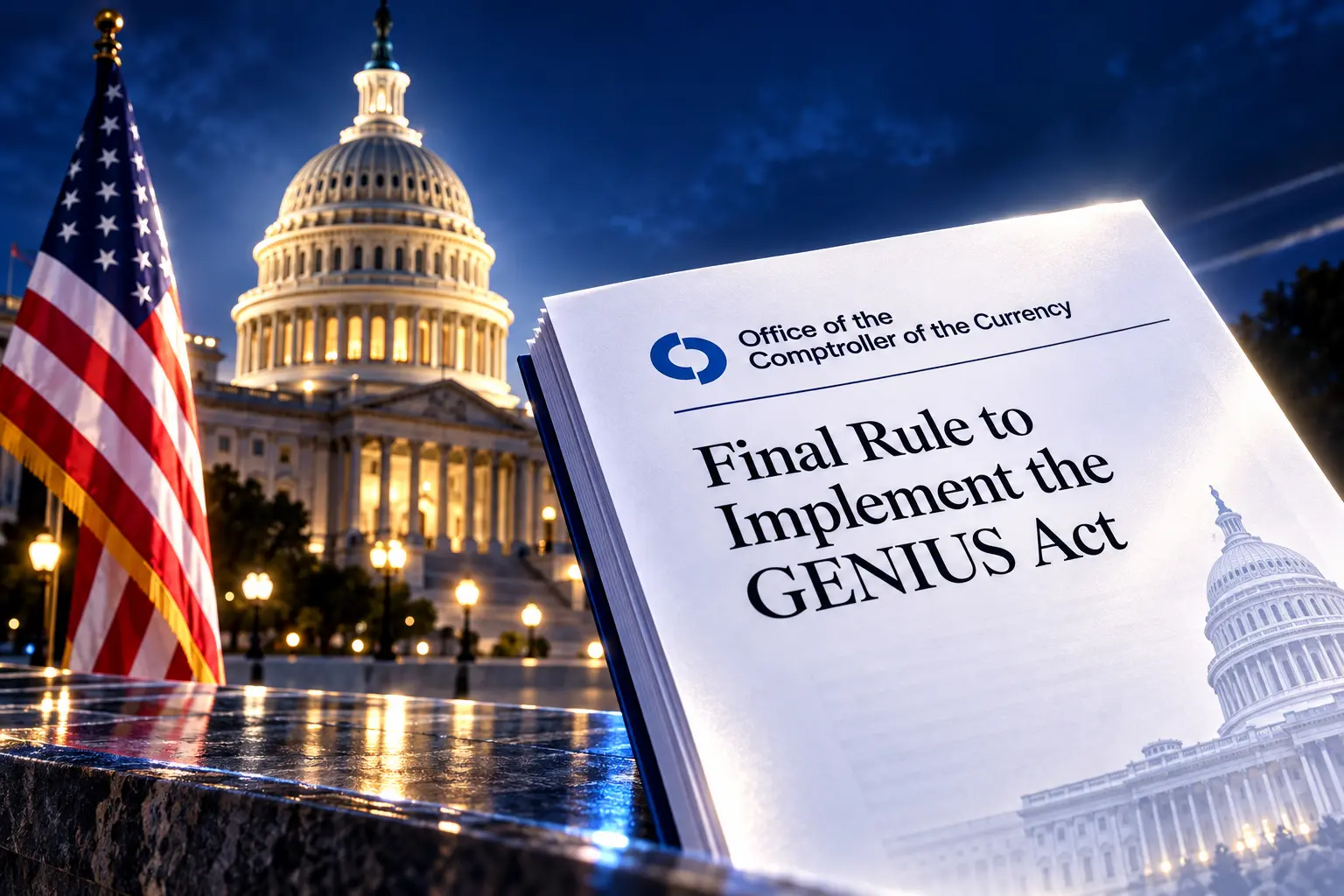
The Office of the Comptroller of the Currency issued its final GENIUS Act stablecoin rules on October 21, 2026, with an effective date of January 18, 2027. The package keeps the statutory ban on issuer-paid interest and drops a proposed presumption that would have treated many third-party rewards as unlawful.
The OCC Finished First and Left the Yield Fight Open
Comptroller of the Currency Jonathan V. Gould, the 32nd person to hold the office, presented the action as the start of a supervised industry, not a pause. In the agency’s final rule to implement the GENIUS Act, he said the OCC was giving payment stablecoin issuers “a clear, practical framework for payment stablecoin innovation, with strong standards for reserve backing, redemption, and risk management.”
Secretary of the Treasury Scott Bessent went further in the same release, comparing the law to President Abraham Lincoln’s National Currency Act of 1863 and calling the GENIUS Act “a watershed moment in American finance.” The OCC is the first federal banking regulator to finish its GENIUS Act rule. The Federal Reserve and the Federal Deposit Insurance Corporation have issued proposals. Treasury is still writing its piece.
Most of the new standards sit in a fresh part of the Code of Federal Regulations, 12 CFR 15, covering activities, reserve assets, redemption, risk management, audits, custody, applications, foreign-issuer exams, revocation, and capital. The package also amends the OCC’s capital, prompt-corrective-action, fee, and practice rules in 12 CFR 3, 6, 8, and 19. Bank Secrecy Act, anti-money-laundering, and Office of Foreign Assets Control sanctions rules are not in this document. Those will come in a separate rulemaking with Treasury.
Gould posted the same message from his official account the morning the rule went out, tying the project to the OCC’s original brief over nationally chartered banks and a uniform currency.
At the @USOCC, we have worked diligently and expeditiously to deliver the GENIUS Act final rule ahead of schedule to support President Trump's vision and @SecScottBessent's leadership to grow the economy and lead the global digital currency revolution.
Today marks the birth of…
— Comptroller Jonathan V. Gould (@USComptroller) October 21, 2026
The agency said it received hundreds of comments on the February 25, 2026 proposal, which ran in the Federal Register on March 2, 2026, from crypto firms, community bankers, trade groups, and academics. The loudest fight in those files was not the 1:1 reserve math. It was whether rewards paid by exchanges and other partners count as the interest Congress told issuers not to pay.
Banks Say the Rule Preserves Crypto’s Status Quo
Rob Nichols, president and CEO of the American Bankers Association, did not treat the finished rule as a win. He said the OCC had taken “several positive steps,” then objected to the decision to abandon the proposal’s yield test.
The result is a final rule that will preserve the status quo for crypto platforms despite Congress’s clear intent to protect local lending.
Rob Nichols, President and CEO, American Bankers Association statement
Nichols argued that by dropping safeguards aimed at affiliates, exchanges, and other distribution partners, issuers can still deliver “economically equivalent yield while technically avoiding the statutory prohibition.” In the association’s preserve the status quo for crypto platforms statement, he said those gaps threaten “the funds banks use to make the loans that drive the U.S. economy,” and that waiting to act after deposit flight would be the wrong sequence.
That charge is the hangover from the statute itself. A Congressional Research Service overview of Public Law 119-27 notes that issuers are barred from paying interest to holders, that “holders” is undefined, and that the Act includes no restriction against exchanges paying interest to customers. Banks have spent the year trying to close that gap in market-structure talks, including the broader crypto market bill that stalled in the Senate. The OCC, writing that it must implement the GENIUS Act “as enacted” unless Congress passes something more, declined to wait for that bill.
What the Final Rule Requires of Issuers
From January 18, 2027, a person generally may issue a payment stablecoin in the United States only as a permitted payment stablecoin issuer, and the OCC’s rule tells those firms how to back, redeem, and report the coins. National banks and their subsidiaries, federal savings associations, federal branches, foreign issuers under OCC watch, federal qualified nonbank issuers, and certain state-qualified issuers all sit inside that net. The coins still need 1:1 reserves, and issuers still cannot pay interest themselves.
The GENIUS Act, signed July 18, 2025, already limited those reserves to cash, deposits at insured banks and credit unions, short-dated Treasury bills, Treasury-backed repos and reverse repos, government money market funds, central bank reserves, and similar government assets a regulator approves. Issuers above $50 billion in outstanding coins must file audited annual financial statements. Nonbank issuers below $10 billion can stay in a state regime the Stablecoin Certification Review Committee finds substantially similar to the federal one; above that line they move to federal supervision.
HOW THE FINAL RULE CHANGED THE FEBRUARY PROPOSAL
| Item | February 2026 proposal | October 21 final rule |
|---|---|---|
| Third-party yield | Rebuttable presumption that certain affiliate and partner payouts violated the interest ban | No presumption; each arrangement judged on its facts, with anti-evasion authority kept |
| Redemption spike | Automatic seven-day extra time when requests topped 10% of outstanding coins in a day | Two-business-day redemption kept; above 10% in 24 hours, notify the OCC within 24 hours and ask for more time |
| Capital floor | $5 million minimum, limited to an issuer’s first three years | $5 million minimum kept and applied past those first three years |
Issuers still have to honor redemptions within two business days. The OCC cut the automatic extra week that would have kicked in on a 10% run and replaced it with a notice-and-request process the agency can grant or refuse. Payment stablecoins remain uninsured and, under the Act, are not securities or commodities. Holders get priority over other claims against the issuer in bankruptcy, on a ratable basis, against the required reserves.
Existing Issuers Get a 12-Month Waiver Path
The statute does not give today’s issuers a built-in runway. Beginning January 18, 2027, issuing a payment stablecoin in the United States without being a permitted issuer carries criminal penalties. The OCC says current U.S. issuers are likely to need relief while their files sit in the queue, and it has told them how to ask.
THE PATH FROM ENACTMENT TO THE JANUARY START
- July 18, 2025: President Donald Trump signs the GENIUS Act, Public Law 119-27. The Act’s own clock is 18 months, which lands on January 18, 2027.
- February 25, 2026: The OCC publishes its notice of proposed rulemaking, which appears in the Federal Register on March 2, 2026, at 91 Fed. Reg. 10202.
- October 21, 2026: The OCC issues the final rule, Bulletin 2026-50, plus waiver guidance and revised reporting forms, and says it finished ahead of a November target Gould had set.
- January 18, 2027: The Act and the final rule take effect. An issuer with a substantially complete OCC application pending that day may seek a waiver for up to 12 months.
Under section 5(f) of the Act and section 15.30(g) of the rule, a primary federal regulator may waive requirements for a subsidiary of an insured depository institution, or for a federal qualified issuer applicant, if a complete-enough file is pending on the effective date. The OCC’s waiver requests from existing U.S. issuers bulletin says the agency generally expects to grant those requests for firms already operating in the United States, unless review turns up a stronger reason to deny. It has not found a generally applicable reason to waive other duties. Issuers have had those 18 months to prepare.
New firms that are not already issuing in the United States should not count on the same treatment. The OCC says it generally expects them to start only after approval, the way it treats new bank charters. And the window is not open yet. Applications and waiver requests wait on Office of Management and Budget approval of the information collection on the forms. The agency will announce intake in a press release. An application alone will not let an existing issuer keep minting coins after January 18 if the waiver has not been granted.
How Third-Party Rewards Survive the Interest Ban
The GENIUS Act bars a permitted issuer from paying interest or making a payment “solely in connection with the holding, use, or retention” of a payment stablecoin. The February proposal went further and presumed that certain deals with affiliates and related third parties broke that ban unless the issuer proved otherwise. The final rule deletes that presumption because, the OCC wrote, “payment stablecoins are a nascent market” and a rebuttable presumption is not appropriate “at this time.”
The word doing the work is “solely.” A payment routed through an intermediary can still be the issuer paying the holder, in which case it stays inside the ban. A payment made at least in part for some other reason can fall outside the statutory language. Transaction-based payments that are not interest or yield, and that are not made solely for holding, using, or keeping the coin, “would not be prohibited,” the rule says. The OCC will apply the statute to the facts of each arrangement and can still pursue evasion.
WHAT THE YIELD BAN CATCHES AND WHAT IT LEAVES OPEN
- Issuer-paid interest: Direct yield or interest from the issuer to the holder remains off limits for both retail and institutional holders.
- Agent on the issuer’s behalf: A partner that pays holders solely for holding, using, or keeping the coin is treated as the issuer paying through an agent, and that structure stays in the danger zone.
- Third-party rewards with another purpose: A payout that is at least partly for something else, including some transaction rewards, can sit outside the ban and will be reviewed file by file.
- Programs that already exist: The OCC “declines to presume that rewards programs that predated the GENIUS Act comply,” and it says notice of those programs in 2025 is not the same as a congressional blessing.
There is no general safe harbor for DeFi wrappers, white-label partners, or legacy exchange programs. Platforms that already pay rewards for holding payment stablecoins, including regulated exchanges, still have to live with supervisory review rather than a blanket yes. That is the half-open door. Banks asked the OCC to harden the test. Crypto commenters warned a presumption would sweep in payments that are not solely for holding a coin. The agency chose delay-by-supervision over a bright line, while insisting it can still bring an evasion case when the facts support one.
AML Rules Wait on a Separate Treasury Rulemaking
The October 21 package does not finish the homework the Act assigned. Anti-money-laundering, Bank Secrecy Act, and sanctions standards remain on a separate track with Treasury. Until that rule lands, a firm can know how the OCC wants reserves, redemptions, and capital handled and still not have the full compliance map for illicit-finance controls.
Reporting is moving on its own form. Bulletin 2026-52 puts out revised weekly and quarterly reporting forms for public comment, with a 30-day window after Federal Register publication. Subject to OMB approval, the weekly form would first apply to the January 25, 2027 report date and the quarterly form to March 31, 2027. Once intake opens, the OCC has 30 days to say whether an application is substantially complete, 60 days to send back a file that still is not, and 120 days after a complete-enough filing to act. Gould said the agency will watch how the market develops and adjust supervision if it has to.
Gould Ties Payment Stablecoins to the 1863 Currency Act
Bessent’s Lincoln line and Gould’s claim that October 21 marked “the birth of a new industry” are the official story of a finished rulebook. The document the OCC actually published is stricter than that story on issuer yield, looser than banks wanted on partner rewards, and silent on the AML chapter that still has to be written. Existing issuers now have a defined, if unopened, path to a waiver of up to 12 months. They do not yet have a date when they can file.
The OCC will say in a later release when it starts taking applications and waiver requests. Until that notice, the January 18, 2027 start date is fixed, the interest ban on issuers is fixed, and the rewards programs that actually pay holders remain a facts-and-circumstances file, not a settled class.
Disclaimer: This article is news reporting and analysis of the OCC’s October 21, 2026 GENIUS Act rulemaking and related statutory provisions. It is for information only and is not legal, investment, tax, or compliance advice, and it is not a recommendation to hold, issue, redeem, or deal in any payment stablecoin or other digital asset. Readers who issue, custody, or hold these instruments, or who are weighing a license application, should consult a qualified banking, securities, or digital-asset lawyer and, where needed, a licensed financial adviser before acting. Figures, deadlines, and supervisory positions reflect the OCC releases, the GENIUS Act, and the other sources cited as of the dates on those documents and may change through later guidance, OMB action, waiver decisions, or the separate Treasury AML rulemaking.

Cook Hands Democrats the House as Crypto’s Bill Stays Dead

Wicker’s Broken Bed Was the Short Story’s Punch Line

Nvidia’s $500 Billion Financing Plan Draws a $180 Sell

Maserati Bets the Grecale V6 Can Fill Porsche’s Gap

EV Cable Theft Follows the Old Railway Copper Playbook

Aramco Crash Kills 14 Two Days After Oil Restart

Salah Captained Egypt to Their First World Cup Win

Zelda’s 40th Switch 2 Ships Without a Zelda Game

Apple Labor Day Deals Hide June’s Memory Price Hike

Palworld 1.0.4 Adds Palpedia Search After the 1.0 Launch
-
 BUSINESS4 months ago
Aramco Crash Kills 14 Two Days After Oil Restart
-
 NEWS5 months ago
Salah Captained Egypt to Their First World Cup Win
-
 GAMING2 months ago
Zelda’s 40th Switch 2 Ships Without a Zelda Game
-
 NEWS2 months ago
Apple Labor Day Deals Hide June’s Memory Price Hike
-
 GAMING2 months ago
Palworld 1.0.4 Adds Palpedia Search After the 1.0 Launch
-

 NEWS4 months ago
El Niño Puts Israel’s Needed Winter Rain on a Flood Clock
-

 BUSINESS8 months ago
BAE’s 60-Year Saudi Franchise Now Runs Through Taif
-

 BUSINESS8 months ago
Egypt Bets EGP 638 Billion Can Open Sinai to Investors