
NEWS
World Sells Banks a Human ID Suite With No Bank Signed
World launched World ID for banks at Money20/20 with fund partners, no named bank, and iris proofs that still begin at an Orb.

World rolled out World ID for banking and finance on October 18, 2026, at Money20/20 in Las Vegas, with no bank named as a customer.
The package was unveiled by World co-founder Alex Blania at Money20/20, which runs October 18 to 21. World says banks and funds can use it to check that a client, a colleague, or an AI agent is tied to a real person. The firms it named as design partners are investment houses and vendors, not a deposit-taking bank.
Three Older Products Arrive in One Bank Wrapper
World, the identity project co-founded by OpenAI chief Sam Altman, Alex Blania, and Max Novendstern, called the bundle World ID for banking and finance. It is the first time the company has wrapped World ID for a single industry. The parts themselves were already in the shop.
Tools for Humanity, the firm that builds the stack, joined Zoom’s independent software vendor program so the video check could sit in the Zoom App Marketplace. AgentKit, the piece that hands Proofs to software agents, remains in beta. The new work is the wrapping, plus a sales pitch aimed at wires, account recovery, and high-stakes calls.
THE THREE TOOLS IN THE BANK BUNDLE
- World ID app: An identity wallet, listed on the App Store and Google Play, where a person stores and presents cryptographic Proofs.
- World ID for Zoom: A meeting check, now generally available after a limited beta that began in April 2026, that adds a Human Badge to a Zoom tile.
- World ID for Agents: Developer tools, still in beta, that let a verified person delegate Proofs to an AI agent so the agent can show it is acting for a human.
Each Proof is a yes-or-no fact World says a bank can request without taking a copy of the underlying file. The company tells users they can present those Proofs without revealing anything else about themselves.
WORLD ID PROOFS AT A GLANCE
| Proof | How a person claims it | What World says it shows |
|---|---|---|
| Proof of Human | A one-time visit to an Orb | The holder is a real and unique human |
| Proof of Presence | A liveness check on a phone | The person is present in that moment |
| Proof of Attributes | An official government credential | A single fact such as age or nationality |
Proof of Human is the high-assurance step. World says data generated at the Orb is encrypted, sent to the phone, and deleted from the device. Orbs are also on site at the New York Stock Exchange, which World began advertising on October 15, 2026, as a place to claim that Proof for financial use.
THE NUMBERS WORLD PUT ON THE LAUNCH
- Proof of Human holders: More than 18 million people, World said on October 18, 2026.
- App availability: The World ID app is listed in 150+ countries on the App Store and Google Play.
- Agent tools: AgentKit is still in beta, including the bank-facing agent story.
The bank wrapper does not mint a new credential. It asks a regulated firm to treat those existing Proofs as an extra gate on money movement and on the software that will soon try to move money for customers.
The Named Partners Do Not Take Deposits
World listed Bain Capital, OpenExchange, Outtake, Pantera Capital, and VanEck Funds as initial design partners “utilizing the technology.” The October 18 notice gave no price, no rollout calendar, and no charter of a bank that has switched the suite on for customers.
VanEck is the only finance firm World had already named among testers of the Zoom beta in April 2026. Bain and Pantera are known as allocators of capital, including crypto, not as lenders that open checking accounts. OpenExchange and Outtake are vendors in markets and AI, not deposit-takers.
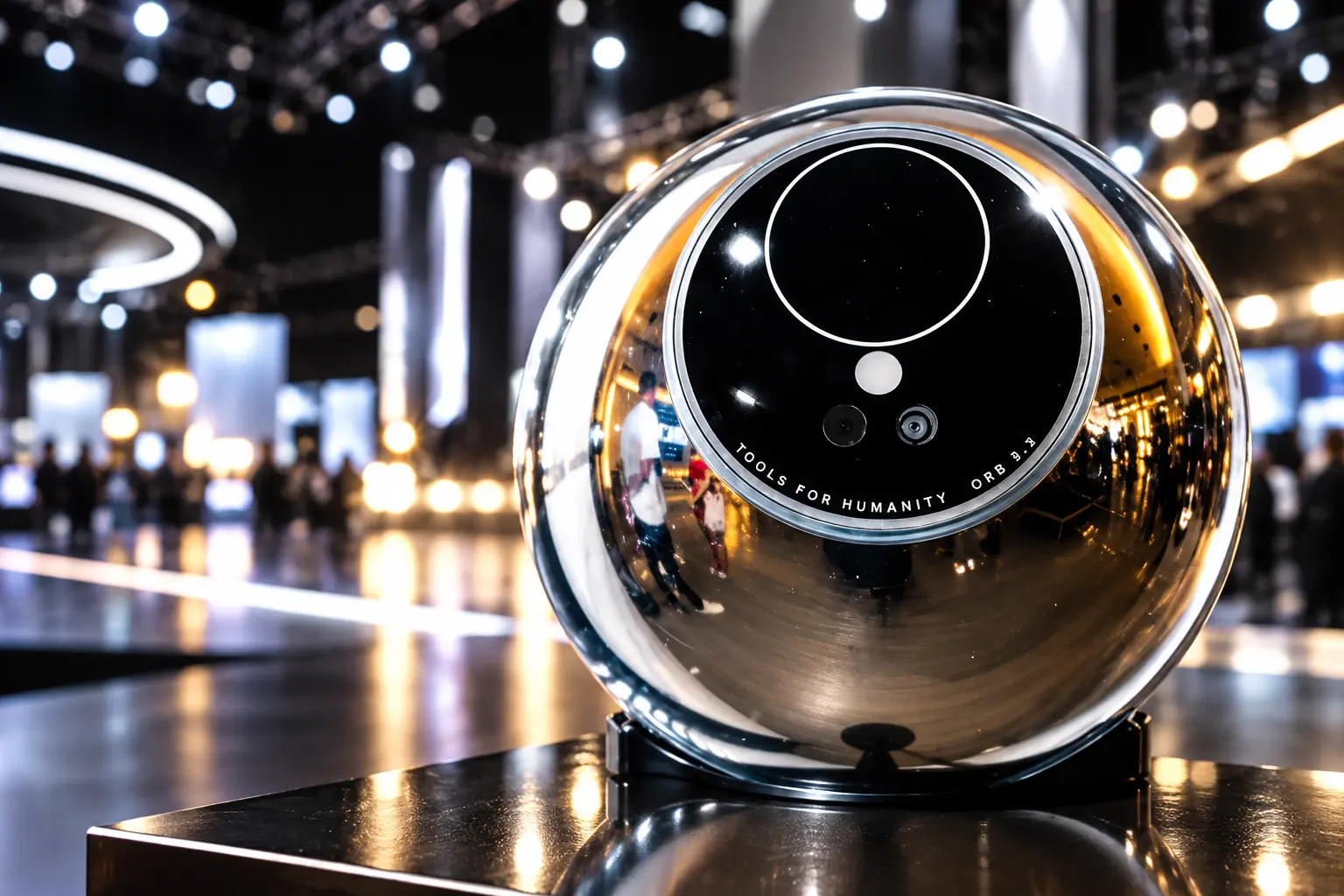
A World spokesperson said the financial firms will keep Orb devices in their offices so employees who have never been scanned can enroll. That is a physical bottleneck dressed up as a software launch. A compliance team that wants the Human Badge on a trading-floor Zoom still has to walk staff up to a steel ball and take an iris image first.
Worldcoin, as the project was called until October 2024, spent years paying people in tokens to stare into those balls in public halls. The bank tour now asks the same hardware to sit next to a Bloomberg terminal. The partner list makes that shift look further along than a customer list would.
A $25.6 Million Deepfake Call Does the Selling
World’s own announcement opens with the Arup case. In January 2024, a finance worker in the Hong Kong office of the London engineering firm Arup joined a video meeting that appeared to include the UK-based chief financial officer and other colleagues. Hong Kong police later said every other person on that call was fake. The employee made 15 transfers totaling HK$200 million ($25.6 million) to five local accounts.
Arup said its systems were not breached and that the firm’s finances were not put at risk. The money still left. That is the clip World is playing for payments executives this week in Las Vegas, because a fake face on a call is now cheap enough to use on a real wire desk.
The Deloitte Center for Financial Services, in a May 29, 2024 note, said generative AI could push U.S. fraud losses to $40 billion by 2027, up from $12.3 billion in 2023. That forecast covers a wide set of FBI fraud types that generative AI could magnify, not deepfake video alone. Deloitte also flagged a dark-web trade in scamming software priced from $20.
On November 13, 2024, the U.S. Treasury’s Financial Crimes Enforcement Network issued a deepfake media fraud alert after seeing more suspicious-activity reports about synthetic IDs used to beat new-account checks. World cited that warning in its bank post. FinCEN’s director put the burden on the firms that already file those reports.
While GenAI holds tremendous potential as a new technology, bad actors are seeking to exploit it to defraud American businesses and consumers, to include financial institutions and their customers.
Andrea Gacki, Director, Financial Crimes Enforcement Network, November 13, 2024
World used the same Arup figure when it posted the launch from its official account. The post is the pitch in the company’s own words, including the five design partners and the claim that Proofs can sit behind a transfer or a sensitive conversation.
In 2024, an employee at engineering firm Arup transferred $25.6 million after joining a video call where every other participant was a deepfake. Since then, AI has advanced significantly and is making impersonation increasingly convincing, causing challenges for financial… pic.twitter.com/J06gnULw8H
— World (@worldnetwork) October 19, 2026
A Human Badge can tell a meeting that the face on the tile matches an Orb record. It cannot tell the bank that this person is allowed to send the wire, or that the person intended the amount on the screen. Those are still permission and process problems. World is selling the who. Banks still own the allowed-to-do-what.
Every Proof Still Starts at an Orb
Proof of Presence can be a phone selfie. Proof of Attributes can be a government ID check that reveals only the fact requested. The high-stakes Proof, the one World wants on large transfers and recovery flows, still begins with an iris scan at an Orb. That is the same step that set off data-protection cases on four continents after the 2023 public launch.
World says the scan is one-time, that the image is not kept on the Orb, and that a bank can receive a Proof instead of a photocopy. Privacy authorities in several countries treated the collection itself as the harm, including the way people were induced to enroll with tokens, and they did not wait for a bank use case to act.
ORB ORDERS ON THE BOOKS
- August 2023: Kenya pauses Orb verification and opens a government review of the 2023 collection drive.
- March 2024: Spain’s data protection authority orders a halt to collection and processing; Portugal bans collection on similar grounds.
- May 2024: Hong Kong’s Privacy Commissioner for Personal Data orders Worldcoin to cease iris and face scanning in the city, after 8,302 people were scanned.
- January 2025: Brazilian regulators ban the project over paid biometric collection; they later restated the ban with a daily fine if scanning resumed.
- May 2025: Kenya’s High Court finds the 2023 iris collection unlawful, including the failure to complete a proper impact assessment and the use of tokens as inducement.
- October 2025: The Philippines’ National Privacy Commission orders Tools for Humanity to halt operations over consent and the treatment of vulnerable groups.
- November 2025: Thai authorities shut down iris collection and call for the biometric files to be deleted.
- January 20, 2026: Kenya’s Office of the Data Protection Commissioner confirms that Tools for Humanity has deleted the biometric data collected from Kenyan citizens.
Germany’s Bavarian data office had already ordered some stored iris data deleted in December 2024. Indonesia suspended collection in May 2025. The map is uneven, and World still enrolls people in countries that never issued a halt, including through U.S. Orb sites. A bank that puts an Orb in a New York office inherits that history the moment a supervisor asks why the firm is scanning irises to join a Zoom call.
The privacy pitch to banks is that they can confirm a human without storing another stack of documents. The catch for a counsel’s office is simpler than the cryptography. The credential only exists because someone stood in front of a camera ball, and several governments have already said that step went too far.
How World ID for Zoom Checks a Face
World ID for Zoom is generally available in the Zoom App Marketplace after the April 2026 beta. A participant verifies once at an Orb, links the World ID app to a Zoom account, then, on a call, the app plus a live selfie are checked against the Orb-verified person tied to that account. A Human Badge appears on the tile if the match holds. World says Zoom does not receive personal information during that check.
Any participant can demand a check during a meeting. Hosts will soon be able to require a Proof of Presence in a waiting room before anyone enters, World said, which means that rule is not live yet. VanEck ran the Zoom check in the beta. World also plans to show the setup at Zoom’s Zoomtopia event and at Cloudflare Connect.
The match World describes is visual. It compares the Orb record, a selfie, and the meeting video. A cloned voice on the same call is outside that description. For a payments team, the badge is a face check bolted onto a process that still needs dual control, call-back numbers, and a rule that a video meeting cannot by itself release a large transfer.
April 2026 is when World also announced consumer hooks with Tinder and Docusign, putting the same Proof of Human on dating and documents. The bank suite is the same credential with a Money20/20 badge on the box. A lender that adopts the Zoom tile is, in practice, asking counterparties and staff to join that wider network, including people who enrolled years earlier in a mall for tokens.
An Agent Can Borrow a Human Badge
World ID for Agents is the part of the launch that looks past the Arup video. AgentKit lets a person delegate selected Proofs to an autonomous agent. The agent can then transact and show that a real human sits behind the request, World says, without handing over that person’s private file. The company already pointed builders to tools from Okta, Vercel, Exa, and Browserbase that can ask whether an agent has a human behind it.
Sandro Herbig, president of Tools for Humanity, framed the whole bank package as a response to firms that now want Proofs the way they once wanted passwords.
As AI becomes increasingly prevalent in all aspects of our lives, enterprises are requesting individuals provide ‘Proofs’ about themselves to help mitigate fraud and increase trust.
Sandro Herbig, President, Tools for Humanity
If agents start calling bank APIs, a cryptographic tag that says “this bot is bound to a scanned human” is a new kind of customer due diligence. It is also a new kind of failure. A real person can delegate a sloppy instruction. A stolen phone with an unlocked World ID app can delegate a clean-looking Proof. The bank still has to decide what an agent is allowed to do, at what limit, and with whose second factor.
World wrote that delegated Proofs could become standard in financial services that must meet consumer-protection rules. That is a bid to sit under agent commerce, not only under fraud ops. It is also why a beta toolkit is being sold in the same breath as a generally available Zoom badge. One product is ready for a meeting. The other is a wager that banks will let software hold a human’s keys.
The KYC File Stays at the Bank
World’s examples for banks are human-binding approvals on ACH and wire transfers, tighter account recovery, and checks when a client walks into a branch or opens an account. The company says a firm can confirm a person is human, or confirm age or nationality, without keeping another copy of the passport. It does not say the suite replaces the customer identification program a bank already runs under the Bank Secrecy Act.
That gap is the live product. A Proof of Human is a uniqueness check. A KYC file is a legal identity, a sanctions screen, a beneficial-owner chart, and a paper trail a supervisor can reconstruct. Mixing them up is how a Human Badge becomes a false sense of clearance on a $25.6 million instruction. World is not claiming it will file the SAR. FinCEN still wants the bank to do that.
For now the suite is available, the Zoom tile is in the marketplace, and AgentKit is in beta. The Orbs at the NYSE are a showroom. The design partners can test workflows. Until a named bank puts the badge on a real wire desk, with a published rule for who must scan and who may refuse, World ID for banking and finance remains a conference product with a serious fraud clip and a biometric enrollment step that several governments have already thrown out.

Cook Hands Democrats the House as Crypto’s Bill Stays Dead

Wicker’s Broken Bed Was the Short Story’s Punch Line

Nvidia’s $500 Billion Financing Plan Draws a $180 Sell

Maserati Bets the Grecale V6 Can Fill Porsche’s Gap

EV Cable Theft Follows the Old Railway Copper Playbook

Aramco Crash Kills 14 Two Days After Oil Restart

Salah Captained Egypt to Their First World Cup Win

Zelda’s 40th Switch 2 Ships Without a Zelda Game

Apple Labor Day Deals Hide June’s Memory Price Hike

Palworld 1.0.4 Adds Palpedia Search After the 1.0 Launch
-
 BUSINESS4 months ago
Aramco Crash Kills 14 Two Days After Oil Restart
-
 NEWS5 months ago
Salah Captained Egypt to Their First World Cup Win
-
 GAMING2 months ago
Zelda’s 40th Switch 2 Ships Without a Zelda Game
-
 NEWS2 months ago
Apple Labor Day Deals Hide June’s Memory Price Hike
-
 GAMING2 months ago
Palworld 1.0.4 Adds Palpedia Search After the 1.0 Launch
-

 NEWS4 months ago
El Niño Puts Israel’s Needed Winter Rain on a Flood Clock
-

 BUSINESS8 months ago
BAE’s 60-Year Saudi Franchise Now Runs Through Taif
-

 BUSINESS8 months ago
Egypt Bets EGP 638 Billion Can Open Sinai to Investors