
BUSINESS
Trump’s Bombardier Threat Lands First on Kansas Shops
Trump threatened a U.S. sales ban on Bombardier jets, a step that would hit Kansas defense shops and Texas-built wings first.

President Donald Trump threatened on Sept. 7 to bar Bombardier from selling jets in the United States unless the Canadian planemaker builds them there. No executive order, tariff schedule, or FAA action came with the post.
Bombardier answered from Montreal by pointing at Texas-built wings, a supply chain of about 2,800 U.S. firms, and a Wichita defense shop that already employs more than a thousand people in a state Trump carried by about 16 points in 2024.
Wichita Already Does the Defense Work
The loudest U.S. reply did not come from a jet broker on either coast. It came from Sen. Jerry Moran, a Kansas Republican, who said he called the Trump administration the same afternoon to put Wichita on the map before a social-media ban hardened into policy.
The presence of Bombardier in Wichita supports a local workforce of more than a thousand employees, who contribute their talent and expertise to our nation’s defense and aerospace capabilities.
Jerry Moran, U.S. senator from Kansas, Sept. 7, 2026 statement
Bombardier Defense is based in Wichita, and crews there have been doing structural modification work on Canadian-built Global aircraft for special-mission customers. The same campus houses a service and completion centre and the company’s U.S. flight-test work, which is why a local workforce of more than a thousand sits inside a fight that looks, from Washington, like a Canada problem.
Moran said he would keep working so those manufacturing operations remain in Kansas and grow. He called Wichita the Air Capital of the World, a title the city has used for generations of airframe and defense shops, and he did not endorse a sales ban.
A new-sale freeze would not move final assembly out of Canada. It would put political weather on a Kansas line that modifies Globals already bought by governments, including the United States, and that services a fleet already flying from U.S. airports.
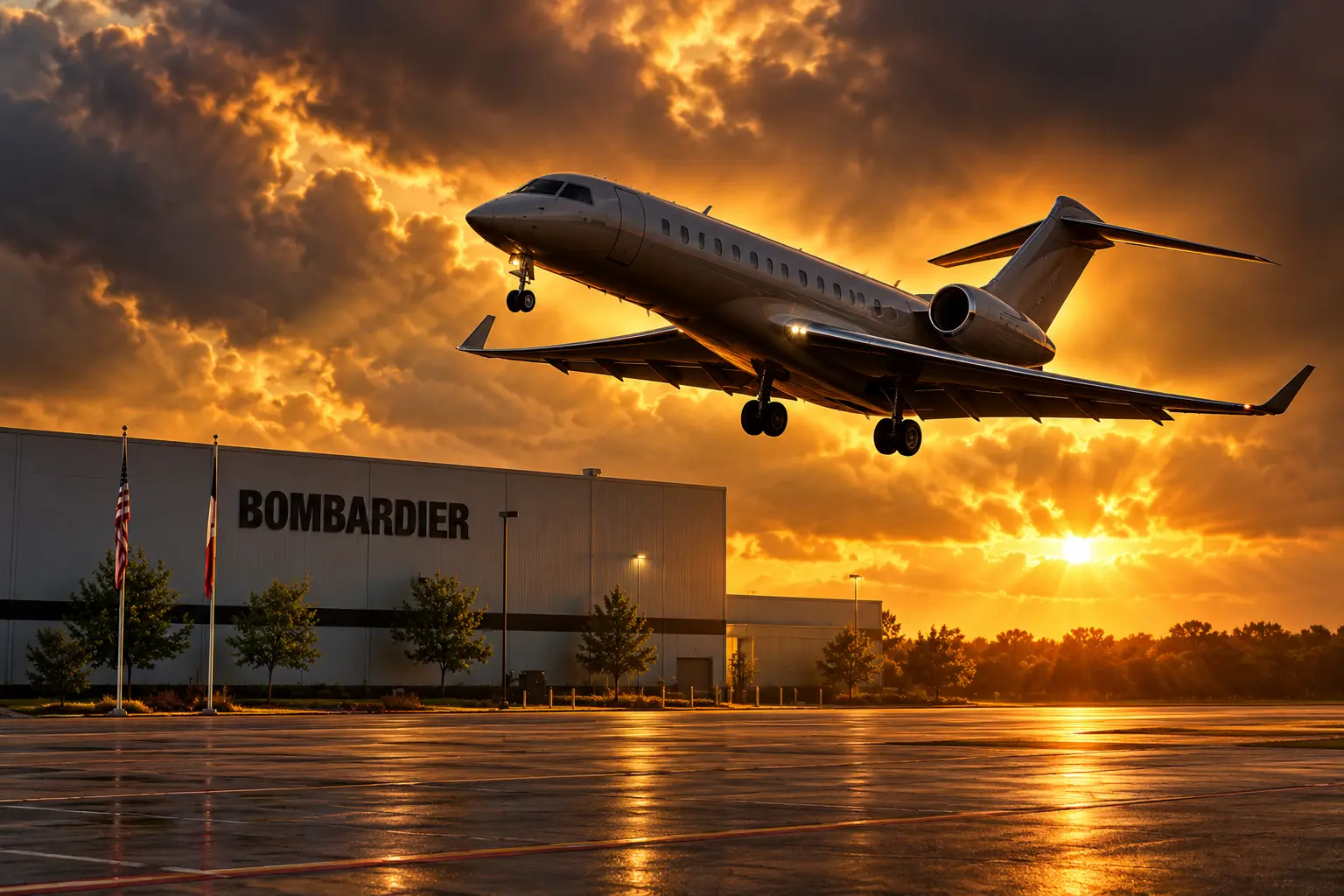
Where the Wings and the 2,800 Suppliers Sit
Trump wrote that Bombardier must “build here” and stop treating America like a “piggybank,” and he said the company’s products “aren’t good enough.” Bombardier’s Sept. 7 statement never named him. It listed U.S. sites in Kansas, Texas, Arizona, Florida, Connecticut, Illinois, Delaware, California, New Jersey, and Washington, D.C., plus direct jobs in more than 20 states, and it said aircraft are built with U.S. engines, avionics, and other systems.
The load-bearing line was the factory south of Dallas. Wings for what Bombardier calls the world’s fastest business jet are made by American workers at Red Oak, Texas, and flight-control parts come from a Los Angeles-area plant. Those wings are the same family used on the Global 7500 and the Global 8000, which takes GE Aerospace Passport engines and is assembled in Canada, with other structure built in Mexico.
That is already a North American jet, not a crate that arrives finished from Quebec. Stopping U.S. deliveries would idle the Texas wing shop even if Europe and the Middle East kept buying, because Red Oak exists to feed new aircraft, not to decorate a press release.
BOMBARDIER’S U.S. SITES NOW IN THE FIGHT
| Site | Work | Status |
|---|---|---|
| Wichita, Kansas | Defense headquarters, flight test, service, special-mission mods | Open, more than a thousand workers |
| Red Oak, Texas | Wings for the Global 7500 and Global 8000 | Open |
| Los Angeles area | Flight-control components | Open |
| Dallas, Tucson, Hartford, Miami Opa-Locka | Heavy maintenance and service | Open |
| Fort Wayne, Indiana | New 64,500 sq ft service centre, hangar for up to six jets, about 100 jobs | Due in the second half of 2026 |
The company said its aircraft support tens of thousands of U.S. jobs through that footprint and a chain of 2,800 American companies across 47 states, with more than $2.5 billion spent on suppliers each year. It traces the U.S. story to Learjet in Wichita and the first business jets to enter service, and it said it still plans to invest in the people and towns where it already operates.
Paul Sislian, Bombardier’s executive vice president for aftermarket services and strategy, said in October 2025 that the United States is a key market with nearly 3,000 aircraft in operation. Customers also use Mobile Response Teams run from 20 U.S. locations, and a parts hub in Chicago, which is why a sales fight leaks into maintenance hangars rather than stopping at the factory gate.
The Air Force Flies Nine of These Jets
The hidden ledger is not only civil aviation. The U.S. military already flies Bombardier-based aircraft, and Wichita is where some of that work is done.
U.S. PROGRAMS ALREADY ON BOMBARDIER AIRFRAMES
- E-11A BACN: The Air Force uses modified Global-series jets as high-altitude communications gateways, a role Bombardier calls Wi-Fi in the sky, and the company handed over its ninth Global aircraft to the Air Force at Hanscom Air Force Base in Massachusetts.
- Army HADES: The Army picked the Global 6500 for its High Accuracy Detection and Exploitation System, and Bombardier handed over the first prototype airframe at its U.S. headquarters in Wichita on Nov. 25, 2024.
- Sierra Nevada follow-on: Lead integrator Sierra Nevada Corporation, which modifies HADES jets in Hagerstown, Maryland, purchased a fourth Global 6500 at its own expense on Jan. 13, 2026 to speed the program.
The ninth BACN jet was celebrated on Sept. 10, 2025, and announced on Sept. 22, 2025. Jean-Christophe Gallagher, Bombardier Defense’s executive vice president for aircraft sales, tied that delivery to a long U.S. military relationship rather than to a trade talking point.
At Bombardier Defense, we are honored to see our reliable, high-performing Global aircraft serve the United States Air Force in critical missions worldwide through the BACN program.
Jean-Christophe Gallagher, executive vice president, Aircraft Sales and Bombardier Defense, Sept. 22, 2025
A civil sales ban would not automatically ground E-11As or HADES airframes already on contract. It would still put the company that supplies those airframes, and the Kansas shop that modifies them, into a political argument the Pentagon did not file.
Boeing’s Last Fight Gifted Airbus a Jet
Washington has already used trade law on this firm. In 2017 Boeing told the Commerce Department that Bombardier had dumped CSeries jets at Delta Air Lines with Canadian subsidies, and Commerce later set a combined duty of 292 percent on those aircraft, a rate that would have killed U.S. deliveries.
On Oct. 16, 2017, Bombardier handed Airbus a 50.01 percent stake in the CSeries program for a symbolic one Canadian dollar and agreed to assemble U.S.-bound jets in Mobile, Alabama, so the planes would no longer be imports. The U.S. International Trade Commission then voted unanimously on Jan. 26, 2018 that Boeing had not been injured, and the duties never stuck. The jet was rebranded as the Airbus A220. Bombardier later left commercial aviation and now builds Challenger and Global business jets.
The 2017 case was supposed to protect Boeing. It handed Europe a 100- to 150-seat airliner and an Alabama assembly line. A 2026 sales ban aimed at Montreal would again travel through U.S. plants, this time in Texas and Kansas, and through U.S. engines on the wing.
Trump had already used Bombardier as a lever this year. On Jan. 29, 2026 he accused Canada of blocking Gulfstream’s G500, G600, G700, and G800, said the United States would decertify Global Express jets, and threatened a 50 percent tariff on Canadian-built aircraft. Transport Canada certified the G500 and G600 on Feb. 15, 2026 and the G700 and G800 on Feb. 23, 2026. The Global 8000 itself received an FAA type certificate in December 2025. Certification is an airworthiness file, not a switch on a trade desk, and none of those February approvals produced a Bombardier factory move.
Ottawa Picked a Swedish Radar on a Canadian Jet
The political fuse is also a defense-procurement fight. On May 27, 2026, Prime Minister Mark Carney said Canada would buy Saab GlobalEye early-warning aircraft, built on Bombardier’s Global 6500, instead of Boeing’s E-7 Wedgetail or L3Harris’s Aeris X. The Department of National Defence has described a need for six of those jets and a program costing more than 5 billion Canadian dollars.
Carney said Saab and Bombardier’s work turns a modern jet into a surveillance aircraft, and he put about 3,000 Canadian aerospace jobs on the line, with at least one third of a planned fleet of 40 or more aircraft, including export orders, produced in Canada over 15 years. The airframes have 20 percent U.S. content. Ottawa is also reviewing a planned buy of 88 U.S. F-35 fighters after a firm order for 16, and Saab has offered to build Gripen jets in Canada.
That is the other hidden stakeholder: a Canadian government that is already routing surveillance flying through Bombardier metal, and a U.S. industry that still supplies a fifth of those airframes. A White House ban on Bombardier sales would land in the same week Ottawa is trying to put more of its defense dollars into Canadian plants.
Canada’s Counter-Tariffs Are Now in Force
The jet post did not arrive in a vacuum. Trade talks between Washington and Ottawa collapsed on Aug. 21, 2026 after Carney called last-minute U.S. terms unfair and uneconomic and U.S. Trade Representative Jamieson Greer said Canada walked away from terms agreed earlier that week. Fifty percent U.S. tariffs on $20 billion of Canadian goods took effect on Aug. 22.
THE TRADE CLOCK FROM AUGUST TO SEPTEMBER
- Aug. 21, 2026: Canada suspends talks; Carney sends negotiators home.
- Aug. 22, 2026: U.S. 50 percent tariffs on $20 billion of Canadian goods take effect.
- Sept. 7, 2026: Trump posts that Bombardier may no longer sell in the United States; Bombardier and Moran answer the same day.
- Sept. 8, 2026: Canadian counter-tariffs take effect at 12:01 a.m. on $27.6 billion of U.S. imports.
Finance Canada said the new counter-tariffs covering $27.6 billion use rates of 15, 25, and 50 percent, matched to U.S. Section 232 and Section 338 duties, and that steel and aluminum counter-tariffs rise from 25 percent to 50 percent. The list concentrates on steel and aluminum, dairy, appliances, farm equipment, pulp and paper, plastics, and electronics, with 50 percent also on furniture and clothing. Auto tariffs already in place stay. Trump posted a day before that clock hit zero, and he claimed more than half of Bombardier’s revenue comes from the United States.
If that revenue share is even roughly right, a closed U.S. market is an existential civil-aviation problem for Montreal. It is also a utilization problem for Red Oak, for the 2,800 suppliers, and for a Fort Wayne hangar that was sold to Indiana as a Midwest service hub for a fleet already on U.S. ramps.
No Executive Order Followed the Threat
Trump’s words were absolute. “NO MORE SELLING BOMBARDIER IN THE UNITED STATES!” he wrote. “If they want our Market, they must build here, and stop treating America like a ‘piggybank.’” Absolute language is not an order. Aircraft cannot be pulled from a U.S. ramp by a post, and FAA type certificates do not expire because a trade fight got louder.
WHAT WE KNOW
- The post: Trump demanded a U.S. sales stop on Sept. 7 and said Bombardier lives off American buyers, airports, and service.
- The company: Bombardier listed U.S. plants, 2,800 suppliers, over $2.5 billion a year in supplier spend, and a Fort Wayne opening later in 2026.
- The senator: Moran contacted the administration the same day and pledged to keep Kansas operations in place.
WHAT IS UNCONFIRMED
- An order: No executive order, tariff schedule, or Commerce action has been published against Bombardier sales.
- A factory move: Bombardier has not announced a U.S. final-assembly line for Global or Challenger jets.
- Contract freezes: There is no public evidence that U.S. civil or military customers have paused Global deliveries.
Fort Wayne is still scheduled to open in the second half of 2026 with about 100 jobs, and Moran is still telling the White House that Wichita’s defense and aerospace payroll is already American. Until someone signs an order, the people cutting wings in Red Oak and modifying Globals in Kansas remain inside the market Trump says he wants built here.

Christa Pike Survived the Execution Tennessee Would Not Pause

Musk’s Oligarch Charge Hits a Queue of Three

Circle Puts USDC and EURC Into SAP Pay Workflows

Ring’s First Smart Lock Skips Home Wi-Fi for Sidewalk

GTA 6 Puts Cash Back on the Story Path

Salah Captained Egypt to Their First World Cup Win

Aramco Crash Kills 14 Two Days After Oil Restart

Zelda’s 40th Switch 2 Ships Without a Zelda Game

Apple Labor Day Deals Hide June’s Memory Price Hike

Palworld 1.0.4 Adds Palpedia Search After the 1.0 Launch
-
 NEWS5 months ago
Salah Captained Egypt to Their First World Cup Win
-
 BUSINESS4 months ago
Aramco Crash Kills 14 Two Days After Oil Restart
-
 GAMING1 month ago
Zelda’s 40th Switch 2 Ships Without a Zelda Game
-
 NEWS2 months ago
Apple Labor Day Deals Hide June’s Memory Price Hike
-
 GAMING1 month ago
Palworld 1.0.4 Adds Palpedia Search After the 1.0 Launch
-

 NEWS4 months ago
El Niño Puts Israel’s Needed Winter Rain on a Flood Clock
-

 BUSINESS8 months ago
BAE’s 60-Year Saudi Franchise Now Runs Through Taif
-

 BUSINESS8 months ago
Egypt Bets EGP 638 Billion Can Open Sinai to Investors