
NEWS
Vlatacom’s vMOAB-4T Puts Heavy Air Burst on Transports
Serbia’s vMOAB-4T is a 3,700 kg cargo-ramp air-burst bomb, a MOAB-style export for air forces that already fly C-130s and lack bombers.

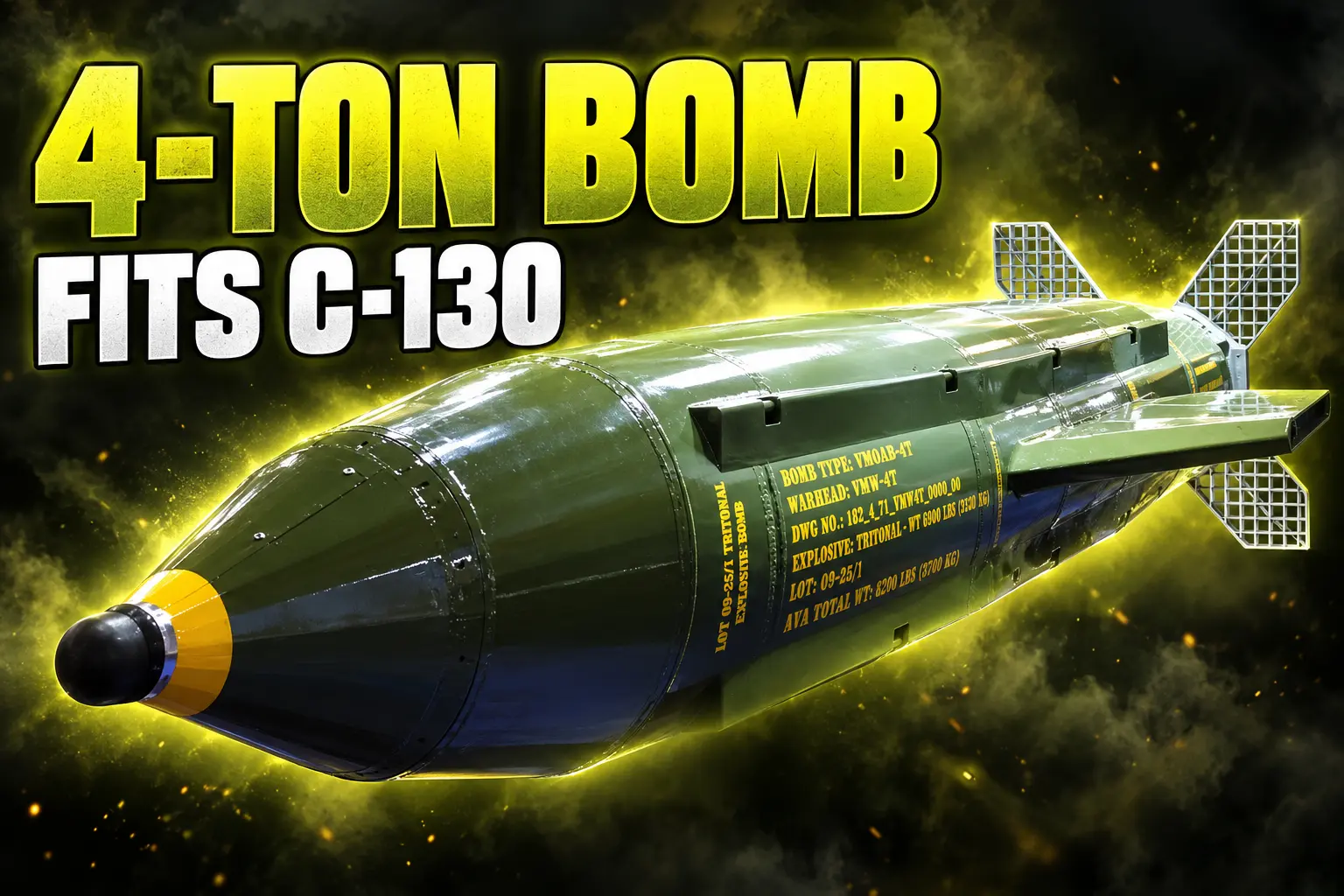
Vlatacom Institute rolled a 3,700-kilogram guided air-burst bomb onto the floor at Partner 2025 in Belgrade, sized to leave a C-130 ramp. The vMOAB-4T is the lightest of a 4-ton, 7-ton, and 10-ton family the private Serbian shop says it can build.
A year after the 23 to 26 September 2025 show, no government has confirmed a contract, a test date, or a stockpile. The second effect is the one that lasts: any air force that already flies a Hercules can shop for a heavy blast bomb without buying a bomber.
Vlatacom Showed a 3,700-Kilogram Air-Burst Bomb
The floor item carried the class name vMOAB-4T, a nod to the American Massive Ordnance Air Blast. Markings on the exhibition model gave a more precise mass than the 4-ton label. The round was listed at 3,700 kilograms all-up, with 3,100 kilograms of Tritonal, an 80 percent TNT mix with aluminum powder.
THE BELGRADE MOCK-UP
- The class: 4-ton vMOAB-4T, with 7-ton and 10-ton versions described as later members of the same family.
- The fill: 3,100 kilograms of Tritonal inside a fragmenting case designated vMW-4t.
- The fuze: a vPSK-M23 proximity set, programmed to burst 10 to 15 meters above the ground.
- The drop kit: a vSAP-4t sled built for the rear ramp of a C-130 or C-17.
That height band is the whole point of an air-burst round. Detonate on the dirt and a large share of the shock goes into the soil. Burst at 10 to 15 meters and the blast and fragments sweep trenches, parks of trucks, radar pads, and light buildings. The company lists command posts and other soft or medium-fortified surface sites as the aim points, not deep bunkers.
Guidance is a combined GNSS and inertial unit. Four moving grid fins sit on the tail, the same compact control surfaces the US used on its own outsized bomb so a fat body can still steer after it leaves a cargo bay. Vlatacom did not publish a circular error probable or a glide range. The bomb still has to be released over the target area; the fins then walk it onto the aim point.
A Parachute Yanks the Bomb Off the Ramp
The drop copies the old cargo-extraction method used for palleted loads, then adds a guided fall. A crew does not hang this round on a fighter pylon. They roll the sled into the hold, open the ramp, and let a chute do the dangerous work.
THE RAMP DROP SEQUENCE
- Load: The bomb sits on the vSAP-4t sled inside the cargo bay of a C-130 or C-17.
- Extract: A parachute on the cradle deploys and pulls sled and bomb out through the rear ramp.
- Orient: The chute holds the warhead end toward the ground so the body is not tumbling.
- Separate: A second stage dumps the sled, and the bomb is free in air.
- Steer: Four grid fins extend and the GNSS/INS unit flies the round to the programmed point.
- Burst: The vPSK-M23 fuze fires the Tritonal fill at the set height, 10 to 15 meters up.
That sequence is why the design matters to air forces that own transports and do not own strategic bombers. A fighter needs a hardpoint, software, and a flight-clearance campaign before it can carry a new store. A cargo ramp needs a sled, a chute, and a crew that already knows how to kick pallets. Vlatacom is selling the second path.
The same path has a hard limit. A C-130 opening its ramp over a target is a slow, loud aircraft in contested air. The American original was built for that kind of drop from special-operations Hercules aircraft, and it was used where air defenses were already down. A buyer who treats the Serbian round as a cheap substitute for a penetrating bomber weapon is buying the blast, not the access.
21,000 Pounds Versus 3,700 Kilograms
The name is a claim. The American GBU-43/B MOAB is still a different weight class. Air Force figures put that weapon at 21,000 pounds, with 18,700 pounds in the BLU-120/B warhead. The Air Force Research Laboratory Munitions Directorate at Eglin built it in nine weeks for the 2003 Iraq campaign. First flight was 11 March 2003. IOC followed in April 2003. The only combat drop came in April 2017, against an ISIS cave complex in Afghanistan, from the ramp of an MC-130.
WEIGHT CLASS COMPARED
| Weapon | Published weight | Explosive fill | Delivery | Status |
|---|---|---|---|---|
| vMOAB-4T | 3,700 kg marked | 3,100 kg Tritonal | C-130 or C-17 ramp, vSAP-4t sled | Concept shown 23 to 26 September 2025 |
| vMOAB 10-ton class | 10-ton family member | Not published | Same cargo-ramp method | Announced, not shown as hardware |
| GBU-43/B MOAB | 21,000 lb | 18,700 lb BLU-120/B | MC/C-130 ramp, GPS/INS | In service; combat use April 2017 |
The planned 10-ton Serbian class would sit in the same mass band as the American bomb. The item on the Belgrade floor does not. Converted, 21,000 pounds is about 9,525 kilograms, more than two and a half times the marked mock-up. Length and diameter for the US round are 30 feet and 3.3 feet. Vlatacom did not post matching dimensions for the 4-ton model.
Both weapons are air-burst tools for soft and medium surface targets. Neither is a bunker buster. The US Massive Ordnance Penetrator is a different bomb, carried inside a B-2. Vlatacom’s brochure language stays with shock, fragments, and a cargo hold. The 7-ton and 10-ton members of the family exist as a roadmap, not as weighed hardware on a stand.
Who Vlatacom Built the Bomb For
A company representative at the show would not name a customer. Luka of Dunav Intel, a Belgrade open-source shop that covers the Serbian industry, wrote that Vlatacom also declined to name the country where it said testing had occurred.
VLATACOM representatives specified that testing of the Vila-1 and the Serbian-made MOAB took place in an allied country that they cannot disclose.
Luka, Dunav Intel, on X
Dunav Intel added that the tests allegedly ran in a friendly Arab state. That is an analyst claim, not a government statement. Neither Belgrade nor Cairo has announced a sale. The Egypt and Nile dam rumor spread in the same week as the unveil and has stayed unconfirmed.
WHAT WE KNOW
- The hardware shown: One 4-ton-class mock-up at Partner 2025, marked 3,700 kilograms, with a cargo-ramp sled and grid-fin tail.
- The family: Vlatacom says 7-ton and 10-ton versions will follow the same architecture.
- The platforms named: C-130 and C-17 as reference aircraft for the ramp drop.
WHAT IS UNCONFIRMED
- The buyer: No state has said it ordered the bomb, including Egypt.
- The tests: No public range report, film with a date-stamp, or official trial communique.
- The heavy variants: The 7-ton and 10-ton rounds have not been displayed as complete weapons.
The market Vlatacom is actually addressing is larger than one unnamed capital. Super Hercules aircraft already fly in 27 Super Hercules operator countries, with more than 570 deliveries on Lockheed’s September 2026 fact sheet. Older C-130H and C-130K fleets stretch that list further. Each of those air arms already trains to shove pallets out a ramp. That is the customer pool, whether or not Cairo ever signs.
Egypt Already Flies the Airplane That Would Drop It
Egypt is in the rumor because the airplane fit is real, not because a contract is public. Cirium counted 26 C-130Hs in Egyptian service when Cairo ordered two stretched C-130J-30 Super Hercules aircraft on 5 September 2024, through a US Foreign Military Sale. Lockheed delivered the H-models between 1976 and 1990, starting with six jets bought in June 1976. Egypt became the 23rd nation on the Super Hercules list with that 2024 order.
The September 2026 Lockheed sheet still marks those Egyptian C-130J-30s as not yet delivered. A much larger American package sits behind the two-jet buy. On 25 January 2022 the Defense Security Cooperation Agency told Congress of a possible $2.2 billion sale of 12 C-130Js and related gear, transmittal 21-26. The two aircraft on order are not that 12-ship case, and no public price has been attached to the pair.
A US-origin Hercules fleet is also a political constraint. End-use rules travel with Foreign Military Sale aircraft. Hanging a foreign 3,700-kilogram bomb on an American airframe is a policy problem as much as an engineering one, even if the ramp geometry works. That is the objection the Egypt rumor keeps running into, and it does not need a named official to be obvious: the jet that can physically drop the round may not be cleared to do it.
An Identity Shop With a Heavy-Bomb Catalog
Vlatacom is a strange parent for a MOAB copy. The Belgrade company calls itself the first private ICT research institute in Serbia, a status it took in 2015 after a 2011 research-and-development certification from the Ministry of Science. It lists more than 150 staff, including 4 university professors and 15 PhDs, and says it puts about 25 percent of gross income back into its own research.
The published product line is e-ID systems, biometric scanners, number-plate cameras, safe-city kits, over-the-horizon radar, and high-grade cryptography. The about page names long-running work in Southeastern Europe, Africa, Asia, and Latin America. ISO 9001 dates to 2006, ISO 27001 to 2012. Deputy chief executive Mladen Nijemcevic was the face of the stand at Partner 2025. None of that reads as a classic bomb factory.
The heavy-ordnance catalog is a recent overlay. At the same fair the institute showed the Vila-1 loitering munition, a tube-launched hybrid with a 300 to 500 kilogram warhead. By April 2026 Vlatacom said Vila-1 and Vila-2 were about 80 percent complete, with a finish date at the end of 2026 and serial work slated for national industrial partners. Yugoimport, the state arms trader, handles export paperwork for Serbian weapons. The vMOAB-4T sits in that same turn: an ICT lab designing the kit, and the state’s export house as the likely shopfront if a buyer ever appears.
Palletized Strike Is a US Program of Record
Serbia is not inventing cargo-bay attack. The US Air Force Research Laboratory has spent years proving that airlifters can throw weapons without a bomb bay. Rapid Dragon is the experiment name for palletized munitions from cargo aircraft, set up in December 2019. A live cruise-missile shot from a pallet followed in December 2021 at Eglin. Test loads have used a six-weapon layout on the C-130 and a nine-weapon layout on the C-17, still with no change to the airframe.
On 1 April 2026 that experiment became Dragon Cart, a program of record under the Air Force Life Cycle Management Center’s Combat Readiness Directorate, with a fielding goal of 2027. The US version throws standoff cruise missiles, not a 3,700-kilogram gravity bomb. The shared idea is the one Vlatacom is trying to productize for export: the ramp is the launcher.
This program provides the operational ambiguity, adversary deterrence and additional command options to maximize operational effects.
JiaJia Lee, Dragon Cart program manager, Air Force Life Cycle Management Center
A cruise-missile pallet and a Tritonal air-burst bomb are not the same store. One can be released far from the target. The other still needs the transport near the aim point. What they share is the customer they create: a mobility fleet that can, on paper, do strike work that used to belong to bombers. The US is fielding that idea as Dragon Cart. Vlatacom put a gravity-bomb version of it on a stand in Belgrade and waited for a name on the order form.
A year after Partner 2025, that name is still blank. The institute has not posted a range, a CEP, a live-drop date, or a buyer. The 3,700-kilogram mock-up remains what it was on the floor: a cargo-ramp bomb looking for an air force that already owns the airplane.

Ninja Theory Staff Face Redundancy After Two Xbox Sales Collapse

Amazon Sells the MacBook Air at Its Pre-Hike Price

U.S. Slows Jet Parts to Squeeze China’s Flying Fleets

PEGI Pulled the GTA 6 Age Rating After Cocaine Details

Northwestern’s Smaller Ryan Field Gave Penn State Nowhere to Hide

Aramco Crash Kills 14 Two Days After Oil Restart

Salah Captained Egypt to Their First World Cup Win

Apple Labor Day Deals Hide June’s Memory Price Hike

Palworld 1.0.4 Adds Palpedia Search After the 1.0 Launch

Zelda’s 40th Switch 2 Ships Without a Zelda Game
-
 BUSINESS3 months ago
Aramco Crash Kills 14 Two Days After Oil Restart
-
 NEWS4 months ago
Salah Captained Egypt to Their First World Cup Win
-
 NEWS1 month ago
Apple Labor Day Deals Hide June’s Memory Price Hike
-
 GAMING4 weeks ago
Palworld 1.0.4 Adds Palpedia Search After the 1.0 Launch
-
 GAMING4 weeks ago
Zelda’s 40th Switch 2 Ships Without a Zelda Game
-

 NEWS3 months ago
El Niño Puts Israel’s Needed Winter Rain on a Flood Clock
-

 BUSINESS8 months ago
Egypt Bets EGP 638 Billion Can Open Sinai to Investors
-

 ENTERTAINMENT4 weeks ago
King Charles Letter Keeps Harry and Meghan as Private Citizens