
NEWS
Russia Hits Kyiv After Witkoff and Kushner Talks
Witkoff and Kushner won a three-day pause on the capitals, not a ceasefire. Russia then struck Kyiv as winter energy talks stayed open.

Russian strikes on Kyiv killed 3 people and injured 19 on Sept. 8 after a three-day pause on the capitals. Steve Witkoff and Jared Kushner had just shuttled between Vladimir Putin and Volodymyr Zelenskyy with a winter energy file, not a ceasefire.
City authorities logged the deaths in the capital. Local officials across the country reported at least 5 people killed and 63 injured in the same wave. Poland scrambled jets and briefly shut Lublin Airport while the missiles were still in the air.
Only the Capitals Got Three Quiet Days
The quiet was never a countrywide halt. Kremlin spokesman Dmitry Peskov said Putin ordered Russian forces not to strike Kyiv for three days from midnight, and he tied that order to the American visit. He did not say other Ukrainian cities were covered, and he left the exact midnight unclear.
Zelenskyy answered the same day, Sept. 5. After a call with the U.S. side, he said Ukraine would halt airstrikes on “the cities involved in the negotiating process,” and would refrain from striking Moscow through the end of Sept. 7. Ukraine had asked for a broader pause from Sept. 5 to Sept. 8. Russia did not take that offer and kept firing elsewhere on Sept. 5, including drones at the airports in Kyiv and Boryspil that Zelenskyy called a demonstrative reply to the envoys’ travel plans.
Witkoff’s office later described the arrangement in one line: both sides agreed to a three-day no-shoot policy so the talks could happen. The talks were on Sept. 5 in Moscow and Sept. 6 in Kyiv. Overnight into Sept. 8, Kyiv was back under ballistic missiles, cruise missiles, anti-ship missiles and jet-powered Shahed drones.
THE THREE DAYS THE CAPITALS WENT QUIET
- September 5, 2026: Witkoff and Kushner meet Putin in Moscow. Peskov announces a three-day halt on strikes against Kyiv. Zelenskyy pledges a halt on Moscow through Sept. 7. Russian drones hit the Kyiv and Boryspil airports.
- September 6, 2026: The envoys hold their first talks in Kyiv, joined by national security advisers from the United Kingdom, Germany and France.
- September 7, 2026: Ukraine’s pledged halt on Moscow runs out. Witkoff’s office says the no-shoot window existed to enable the discussions, and that more three-way talks are being scheduled.
- September 8, 2026: A combined missile and drone wave hits Kyiv and other regions. Poland flies a preventive air operation and pauses Lublin Airport.
A pause shaped around two capital visits is a travel protocol. It is not a test of whether either army is ready to stop.
What Witkoff and Kushner Put on the Table
President Donald Trump sent the pair east with what he called an idea for peace and “a good chance that we’ll do it.” A White House official said the two sides discussed substantive plans for next steps, to be announced in the coming weeks. No text of that plan was released in Moscow or in Kyiv.
Zelenskyy, speaking on Sept. 7 after the Kyiv meetings, said the Americans came mainly to unblock diplomacy and also brought new ideas. He would not list every item. He did say the live conversation was about steps Russia and Ukraine might take before and during winter, and he named the sectors: energy facilities, grain shipments, electricity facilities, and oil and gas exports.
“We have different interests, Russia and we,” he said. Asked whether Washington wanted both a return to talks and a winter without another major energy war, he said that reading was very close to the reality of the conversations. The first aim, in his account, is to resume negotiations. The second is to make the coming winter unlike the last ones, when Russian strikes on Ukraine’s power system defined the season.
Kushner told reporters in Kyiv that he and Witkoff wanted to go back to a trilateral format the sides had used about six months earlier. Zelenskyy said Ukraine was ready for three-way meetings, with European partners in the room if Russia agreed. Witkoff said he was encouraged and that both countries would have to make compromises. A senior Ukrainian official, speaking without attribution because he was not cleared to talk publicly, said much of the Kyiv discussion was about how to get through the winter and what could still be done before then.
The U.S. team in those rooms was not only the two envoys. Officials from the National Security Council, the State Department and the Treasury Department sat in, which matches the other half of the Moscow agenda: large U.S.-Russia commercial projects discussed in the same hours as the war.
The Kremlin Counted Battlefield Gains Over Dinner
Putin received the U.S. representatives at the Kremlin on Sept. 5. It was their eighth trip to Russia and, the next day, their first official trip to Kyiv since Trump’s second term began. Presidential aide Yury Ushakov briefed afterward. He said Putin praised the mediation channel, sent good wishes to Trump, and thanked him for wanting a swift and mutually acceptable outcome.
The conversation lasted more than three hours, three hours and ten minutes, to be precise. It was substantive, constructive, exceptionally frank, and conducted in an atmosphere of trust. The discussion, which covered extremely serious matters, continued both during the working portion of the meeting as well as in an informal setting over dinner.
Yury Ushakov, presidential aide, Kremlin briefing, Sept. 6, 2026
Ushakov said the Russian side used those three hours and ten minutes to walk through its reading of the war. It highlighted advances in the combat zone, said it was confident the set objectives would be achieved, and stressed the need to address what Moscow calls the root causes of the conflict. Putin, he said, still wanted political and diplomatic work with Washington. Witkoff and Kushner undertook to carry Putin’s assessments into their meetings in Kyiv.
The Americans, Ushakov added, had prepared carefully and put forward a number of considerations on possible ways to a settlement, on top of their usual interest in ending the fighting early. The talks also covered economic issues, including prospects for major Russia-U.S. projects that could benefit both sides. Ushakov called the session timely and highly beneficial. He said the two presidents would keep personal contact, and that work through Witkoff and Kushner would continue.
That is the channel as Moscow described it on Sept. 6: open, economic, and still tied to battlefield terms. It is not a description of a ceasefire.
Seven Districts Burned After the Pause Lapsed
Ukraine’s Air Force said the overnight attack into Sept. 8 mixed ballistic missiles, cruise missiles, anti-ship missiles and jet-powered Shaheds. Zelenskyy wrote that Russia tried to plan the wave for as much harm to life as possible. He also said cruise-missile defense had held up and that ballistic missiles remained the hard problem, one he raises with partners every day.
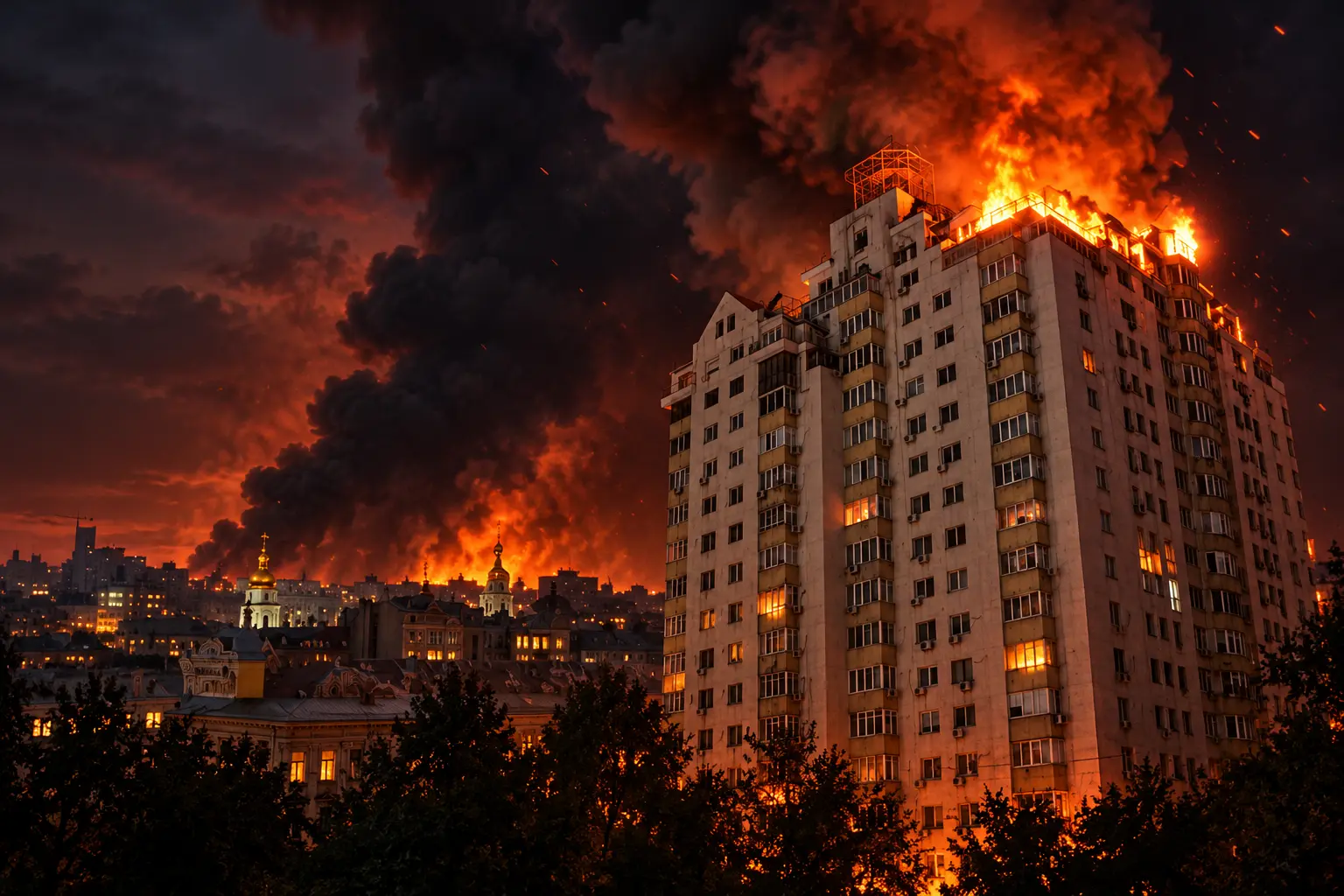
Kyiv Mayor Vitali Klitschko and the city military administration raised the capital’s toll through the morning and into the afternoon, to 3 killed and 19 injured. The State Emergency Service pulled 13 people from damaged buildings, including 10 from a five-story block in Solomianskyi district and 2 from a 16-story apartment house. Kyiv police said a foreign national was among the wounded. The city prosecutor opened a war-crime case.
THE KYIV DISTRICTS HIT OVERNIGHT
| District | What city officials reported |
|---|---|
| Solomianskyi | Both early fatalities; five-story and three-story housing on fire; later debris on a four-story office |
| Holosiivskyi | Fire at an educational site; debris on housing; blast damage high on a 26-story non-residential tower |
| Podilskyi | Warehouse and other non-residential fires; damaged vehicles |
| Shevchenkivskyi | Warehouse fires and damaged residential buildings; debris at the Tarasa Shevchenka metro entrance |
| Darnytskyi | Falling debris, a damaged car, and a wounded 29-year-old foreign national |
| Obolonskyi | Damage and falling debris |
| Dniprovskyi | Damage and a grass fire that crews contained |
The city military administration counted damage at 16 locations. Later tallies listed at least 14 high-rises plus a school, a clinic, a supermarket, a gas station, warehouses and shops. Around noon, with the all-clear still not holding, Klitschko said drone debris had hit a four-story office in Solomianskyi, started a fire, and forced people off the upper floors.
THE AIR FORCE TALLY AT 8:30 A.M.
- Ballistic missiles: 2 downed or suppressed while the attack was still running.
- Cruise missiles: 31 downed or suppressed.
- Drones: 142 downed or suppressed.
- Ground impact: strikes at 29 locations and debris at 9 more.
Those 175 aerial targets are the morning cut, not the end of the day. The same wave reached Odesa, Donetsk, Kherson, Zaporizhzhia, Kharkiv, Sumy, Chernihiv and Dnipropetrovsk oblasts. Russian drones twice struck a Kyiv-Sumy passenger train; the train was stopped in an alert and all 90 passengers and crew got off unhurt. Moscow, in a ministry account circulated the same day, described the Kyiv and Kyiv-region portion as a strike on UAV plants, storage sites and logistics. Kyiv’s own list is apartments, a school and a metro entrance.
Lublin’s Runway Stopped for Polish Jets
The spillover was immediate and procedural, which is how this war now meets NATO’s eastern edge. Poland’s Operational Command said long-range Russian aviation striking Ukraine had forced military aircraft into Polish airspace. It called the flying preventive and aimed at protecting airspace next to the threatened zone. Ground-based air defense and radar were raised to a higher state of readiness.
POLAND’S OVERNIGHT ALERT
- The flying: Polish military aircraft operated for several hours in national airspace.
- The alerts: The Government Centre for Security warned residents in Lublin and Subcarpathia that Polish aviation was up and that a Russian air attack was under way over Ukraine.
- The airport: The Polish Air Navigation Services Agency paused traffic at Lublin Airport so the jets would have a clear picture, then reopened the field at 7:42 a.m. local time.
- The finding: Command said after 8 a.m. that the operation had ended and that Polish airspace had not been violated.
No missile had to cross the border for Lublin’s civilian runway to stop. A capitals-only pause in Ukraine does not bind the air-defense clock in eastern Poland, and that clock ran again the first night the pause was over.
Zelenskyy Says Russia Expects Winter to Break Ukraine
The Sept. 8 wave landed on a city that had already been under a long aerial siege. Kyiv recorded 13 air-raid alerts on Aug. 27, the most in a single day since the full-scale invasion began on Feb. 24, 2022. From Aug. 27 to the eve of the envoy visits, 53 people were killed and 112 injured in Kyiv and Kyiv Oblast. The three quiet days on the capital sat inside that campaign, they did not end it.
Zelenskyy has already told partners he expects the war to run through this winter. He also said the U.S. side supports a separate winter package of air defense and energy help, including liquefied natural gas, not only missiles.
Russia really thinks that this winter can help them to break us.
Volodymyr Zelenskyy, President of Ukraine, Sept. 7, 2026
He said Moscow wants a strong kick from a winter offensive and from strikes on Ukrainian infrastructure, after which Ukraine would become more compromising. He added that Ukraine has already made the compromises it can, and that any diplomatic track would still need security guarantees and an economic support package. He also pointed the other way: when Russia hits Ukrainian electricity, Ukraine can hit Russia’s ability to sell oil and gas, and shocks to farm exports can lift global food prices.
WHAT THE WINTER FILE INCLUDES
- Energy facilities: Possible limits on strikes against power plants and related sites, a step tried and missed in earlier winters.
- Grain shipments: Safe movement of harvests that both sides can use as leverage.
- Electricity and fuels: Talks on electricity sites and on oil and gas exports, where the interests run in opposite directions.
- The U.S. package: Air-defense interceptors and LNG supply meant to keep Ukraine intact if the diplomatic track stalls.
Zelenskyy’s reading of Putin is that the Russian president needs Trump and does not want to upset him. Even so, he said Russia’s recent escalation does not look like a government preparing to ease off. The Sept. 8 mix, heavy on ballistic missiles that Ukraine still struggles to stop, is the practical form of that bet.
The Next Meeting Has No City and No Day
Witkoff’s office, on Sept. 7, still described the shuttle as progress toward more three-way talks. The post is the American record of what the pause was for.
At President Trump’s direction, United States negotiators visited both Moscow and Kyiv in order to facilitate additional dialogue to end the Russia-Ukraine War. Ahead of the trip, the Russians and Ukrainians agreed to a three-day no-shoot policy to enable these discussions to… pic.twitter.com/7oj7C2Qp2p
— Special Envoy Steve Witkoff (@SEPeaceMissions) September 7, 2026
Selling that travel window as a peace opening skips the design. It covered two cities so two meetings could be held. It did not cover the rest of Ukraine, and it did not outlast the visitors. Treating both capitals as matched bargainers also skips who flew the ballistic missiles at apartment blocks the night after the guests went home.
Zelenskyy wants September and October used to get people back in a room, and he has floated the U.N. General Assembly in New York later in September as a place for more U.S.-Ukraine talks. He has also said he hopes to see Trump around Sept. 20. Ushakov, for the Kremlin, already said the Witkoff-Kushner channel will continue and that the two presidents will stay in personal contact.
The next three-way session, if it is booked, will meet a war that is more than four and a half years old, a winter file that is still just a list of sectors, and a capital that was under ballistic fire on Sept. 8 the moment the visit-shaped pause had done its job.

Christa Pike Survived the Execution Tennessee Would Not Pause

Musk’s Oligarch Charge Hits a Queue of Three

Circle Puts USDC and EURC Into SAP Pay Workflows

Ring’s First Smart Lock Skips Home Wi-Fi for Sidewalk

GTA 6 Puts Cash Back on the Story Path

Salah Captained Egypt to Their First World Cup Win

Aramco Crash Kills 14 Two Days After Oil Restart

Apple Labor Day Deals Hide June’s Memory Price Hike

Zelda’s 40th Switch 2 Ships Without a Zelda Game

Palworld 1.0.4 Adds Palpedia Search After the 1.0 Launch
-
 NEWS5 months ago
Salah Captained Egypt to Their First World Cup Win
-
 BUSINESS4 months ago
Aramco Crash Kills 14 Two Days After Oil Restart
-
 NEWS2 months ago
Apple Labor Day Deals Hide June’s Memory Price Hike
-
 GAMING1 month ago
Zelda’s 40th Switch 2 Ships Without a Zelda Game
-
 GAMING1 month ago
Palworld 1.0.4 Adds Palpedia Search After the 1.0 Launch
-

 NEWS4 months ago
El Niño Puts Israel’s Needed Winter Rain on a Flood Clock
-

 BUSINESS8 months ago
Egypt Bets EGP 638 Billion Can Open Sinai to Investors
-
 BUSINESS8 months ago
BAE’s 60-Year Saudi Franchise Now Runs Through Taif