
BUSINESS
Jamnagar Turns Venezuelan Crude Into Diesel at a Seven-Year High
Licensed Merey is replacing costlier Urals at Jamnagar, then leaving Gujarat as diesel, while Treasury accounts still hold PDVSA’s sale proceeds.

Kpler estimates India’s Venezuelan crude arrivals at about 465,000 barrels a day in October 2026, more than double September’s 196,000. If the scheduled cargoes discharge on time, that would be the highest monthly flow since December 2019.
Every India-bound cargo lists Sikka, the port for Reliance Industries’ Jamnagar complex. The barrels are replacing costlier Russian Urals at a plant that turns extra-heavy crude into diesel the rest of the world will buy.
Sikka Is the Only Indian Destination on the Manifests
Ship-tracking compiled by Kpler shows the South American producer’s cargoes bound for India all naming Sikka. That port serves Jamnagar, which Reliance lists at 1.4 million barrels a day and calls the world’s largest single-site refinery.
Reliance has begun loading a 2-million-barrel cargo of Venezuelan heavy crude bought directly from Petróleos de Venezuela, the state oil company known as PDVSA. A company spokesperson did not immediately respond to requests for comment on the October programme.
September was less concentrated. Kpler data shared with markets put Reliance at 76% of India’s Venezuelan crude that month. The October fixtures are tighter: the current slate does not list another Indian port.
India resumed these purchases in February 2026, nine months after the last 2025 discharge at Sikka. Trade-flow records showed five very large crude carriers discharging there in 2025, the last in May. In May 2026, Kpler had Venezuela as India’s fifth-largest crude source at about 266,000 barrels a day, or 5.3% of imports, behind Russia, the UAE, Saudi Arabia and Brazil.
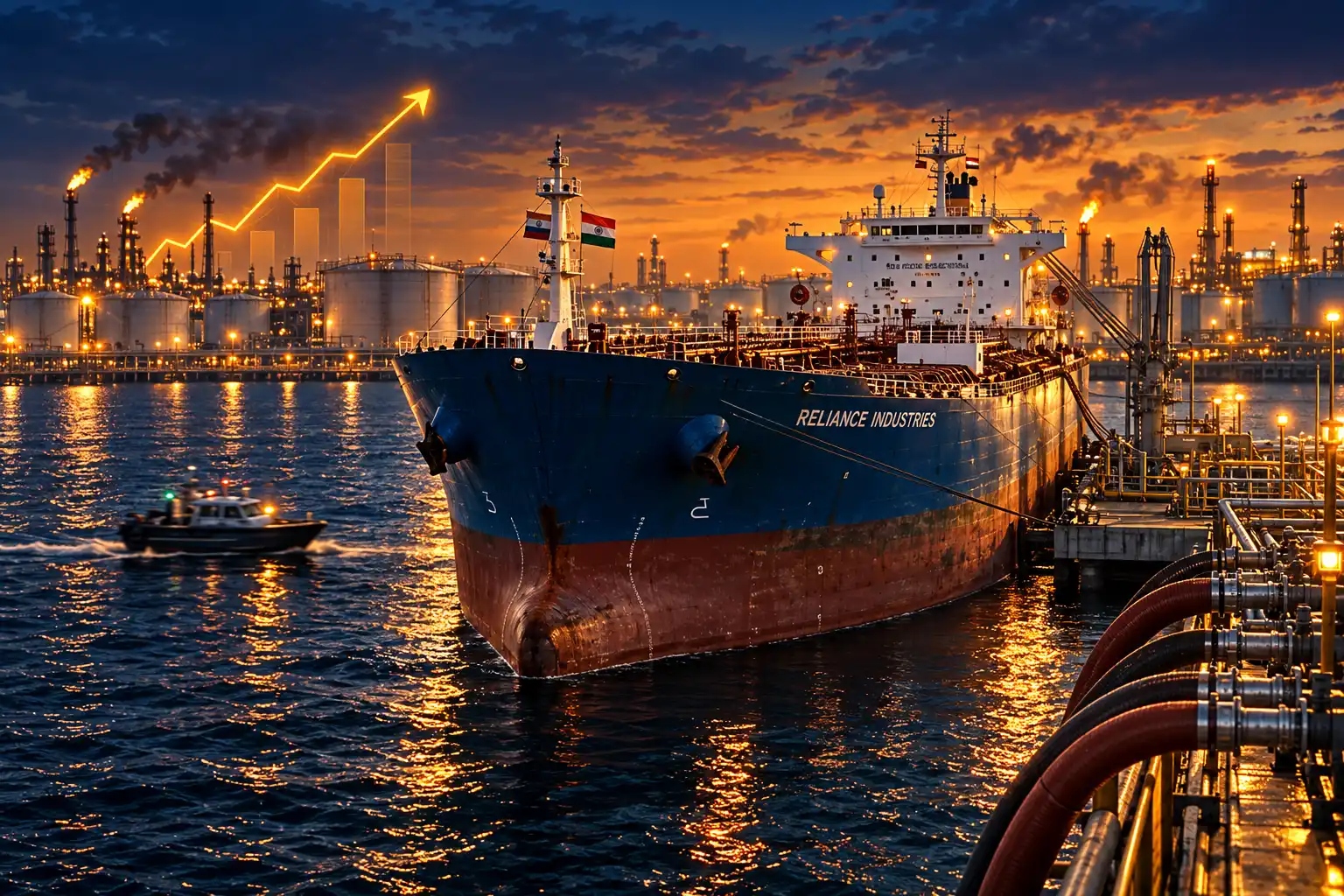
Russia’s Share of India’s Crude Fell to 35%
The pull is price, then politics. Venezuela’s flagship Merey has been offered at about $16 a barrel under Dated Brent in recent trader reports, while Russian Urals, India’s largest supplier for three years, has traded at about a $10 premium. Moscow’s share of India’s crude fell to about 35% in September from 56% in July, Kpler data show.
Traders put freight from Venezuela to India’s west coast at about $33 a barrel. That haul eats a large piece of the discount, which is why the grade still has to clear on yield, not on the headline spread alone. Sumit Ritolia, senior manager of modeling at Kpler, has said Venezuelan crude has become a larger part of India’s diversification since the start of 2026. He expects actual October deliveries closer to 350,000 barrels a day, because at least two tankers are due on 31 October and may not discharge inside the month.
THE SWITCH IN THE SLATE
| Measure | Reading | When |
|---|---|---|
| Merey versus Dated Brent | About $16 a barrel cheaper | Recent trader reports |
| Urals versus Dated Brent | About $10 a barrel premium | Recent trader reports |
| Russia’s share of India’s crude | 56% | July 2026, Kpler |
| Russia’s share of India’s crude | 35% | September 2026, Kpler |
| Freight, Venezuela to India’s west coast | About $33 a barrel | Trader estimates |
Indian officials still describe the buying as a commercial choice. Randhir Jaiswal, a foreign ministry spokesperson, said in February that energy security for 1.4 billion people is the government’s first priority and that India remains open to the commercial merits of any crude, including Venezuelan barrels.
Why Most Indian Refineries Cannot Use Merey
Merey is dense, high-sulfur crude with a high residue cut. It needs coking, hydrotreating and blending kit that most of India’s 23 refineries only have in limited amounts. Jamnagar was built to take those barrels and compare them, cargo by cargo, with grades such as Iraqi Basrah Heavy and Canadian Cold Lake.
That is the unglamorous reason India can sit near the top of Venezuela’s customer list while state-owned plants stay mostly out. The barrels are cheap on paper and expensive to run if the metal behind the jetty is wrong. Reliance’s complex can make that math work. Many others cannot, which is why a national “Indian” buying story keeps collapsing onto one private site in Gujarat.
Venezuelan crude is still crude. Diesel has to be made in a plant that can crack extra-heavy, high-sulfur oil, and Jamnagar is the Indian plant built for that job. A surge in Merey does not, by itself, fill tanks in Houston or Rotterdam.
Jamnagar Sold 489,000 Barrels a Day of Diesel in September
The second move happens after the crude clears customs. Jamnagar’s special economic zone unit is an export refinery rated at 700,000 barrels a day. Oil ministry data show it processed 757,000 barrels a day in April-August 2026. In September, maritime tallies put Reliance’s clean-fuel exports at 929,000 barrels a day, more than 70% of India’s total, with diesel at 489,000 barrels a day, gasoline at 195,000 and jet fuel at 101,000.
India’s wider refining system, about 5.2 to 5.6 million barrels a day across 23 plants, has made the country a regular net seller of fuels. Kpler put Indian fuel exports at a record 1.28 million barrels a day in 2025, with Reliance about 71% of that. Petroleum product exports were $21.7 billion in April-August 2026, up 36% from a year earlier, with private plants taking most of the gain.
The Observatory of Economic Complexity records India as the world’s second-largest exporter of refined petroleum in 2024, with $65.4 billion of refined petroleum, or 7.34% of global supply, behind only the United States. Net trade in the category was $56.7 billion.
WHERE THE 2024 FUEL EXPORTS WENT
- Netherlands: $14.9 billion, much of it through Rotterdam as a European hub.
- United Arab Emirates: $6.83 billion.
- Singapore: $4.8 billion.
- United States: $3.69 billion.
- Australia: $3.16 billion.
Those outlets are why a Venezuelan barrel that cannot be sold into some Western crude markets can still show up there as gasoil or jet. Once the crude has been sold and a blocked party’s interest is fully extinguished, U.S. guidance holds that the oil can be freely resold downstream, including by buyers that are not established U.S. entities.
Treasury Still Parks the Sale Proceeds
India is the largest destination outside the United States. It is not the largest destination. Tanker-tracking and PDVSA documents put September loadings to the United States at 629,000 barrels a day, up from 553,000 in August, against 253,000 to India, down from 297,000. Europe took 86,000, down from 260,000. Caribbean storage took 76,000. Venezuela’s total exports fell almost 9%, to 1.08 million barrels a day from 1.19 million, as traders pushed PDVSA for deeper discounts to cover higher freight. Chevron moved 283,000 barrels a day; trading houses moved 637,000.
Those Indian arrivals and those PDVSA loadings are not the same series. Kpler’s 196,000 barrels a day for September counts what reached India. The 253,000 figure counts what left Venezuela for India, and cargoes still on the water sit in the gap.
The ranking itself is a policy artifact. U.S. forces captured Nicolás Maduro in January 2026. Washington then licensed a controlled reopening of Venezuelan oil, including a general license in February that let Reliance buy directly. China, which had taken more than 70% of Venezuelan exports until December 2025, was down to 156,000 barrels a day in January after a U.S. naval blockade cut dark-fleet flows that had been running about 550,000 barrels a day. September destination lists named the United States, India, Europe and Caribbean storage.
Venezuelan crude has become an increasingly important part of India’s diversification since the start of the year.
Sumit Ritolia, senior manager of modeling, Kpler
The cash path is still American. OFAC’s General License 46E, issued on 28 September 2026, lets established U.S. entities lift, sell, store, refine and move Venezuelan-origin oil, provided contracts send disputes to the United States, the United Kingdom, France or Singapore, and provided monetary payments to blocked persons, other than local taxes, permits or fees, are made as payments into the Foreign Government Deposit Funds created under Executive Order 14373 of 9 January 2026. The same notice set of amended Venezuela oil general licenses still bars dealings with persons in Russia, Iran, North Korea, Cuba or China on the investment side.
Chris Wright, the U.S. energy secretary, has called Venezuela’s new hydrocarbon law a meaningful step, and not far enough to draw the large capital flows Washington wants. The licenses opened the tap. They did not hand Caracas the proceeds.
More Than $500 Million Still Stuck in Venezuela
The other Indian name in the fields is not a refiner. ONGC Videsh, the overseas arm of Oil and Natural Gas Corporation, holds 40% of the San Cristobal project and 11% of Carabobo, both with PDVSA. OPEC puts Venezuela’s proven crude reserves at about 303 billion barrels, the world’s largest.
ONGC said in an 18 August 2026 exchange filing that it received a U.S. government go-ahead in July 2026 and that framework talks on both assets were still open. Anupam Agarwal, ONGC’s director of finance, told investors the sanctions-related limits that had boxed the company in were gone.
Now we have full freedom to work on the Venezuela project because earlier we were restricting our operations there because of the sanction-related risks. Those risks are behind us.
Anupam Agarwal, director-finance, ONGC, on the first-quarter investor call
San Cristobal is producing 4,000 to 5,000 barrels a day, against a past peak of 45,000 to 50,000. ONGC has discussed investing about $200 million to lift output and to recover more than $500 million in dividends trapped for years, in cash or in crude. FY26 output at the field was about 0.265 million tonnes of oil equivalent, which the company has described as around one-tenth of potential. Operatorship talks with Venezuelan authorities were still running in late September.
If those dividends come back as barrels, they will look like imports. They are a collection exercise on an old joint venture, not a second Reliance.
The Same Trade Stopped in 2019 and Again in 2025
Before the 2019 sanctions, India took about 300,000 barrels a day of Venezuelan-origin crude, and Reliance was the second-largest individual buyer after China National Petroleum Corporation. The on-off cycle since then is the risk hidden in the October fixtures.
HOW THE TAP WAS TURNED
- 2019: U.S. oil sanctions hit PDVSA. India is still taking about 300,000 barrels a day that year, a flow later valued at a $7.2 billion peak in FY2019.
- November 2020: Kpler records India’s last Venezuelan crude import of that cycle. FY2022 and FY2023 fall to zero.
- October 2023: Washington grants a six-month sanctions relief window. Indian private refiners book cargoes again.
- April 2024: The relief expires. Indian buyers halt new purchases as the April 18 deadline approaches, given a voyage time of about 45 days.
- July 2024: Reliance receives a specific U.S. authorization and later restarts a crude-for-naphtha swap with PDVSA.
- May 2025: The last of five 2025 VLCCs discharges at Sikka. Direct buying fades again under sanctions pressure.
- January 2026: U.S. forces capture Maduro. Treasury sets up supervised deposit funds for Venezuelan sale proceeds.
- February 2026: India resumes imports. Reliance obtains a general license to buy Venezuelan oil directly.
- July 2026: ONGC Videsh receives its OFAC license for Venezuelan assets.
- September 28, 2026: OFAC issues General License 46E, replacing 46D, keeping oil trade open under U.S. payment and dispute rules.
FY2024 imports recovered only to $802 million, then $1.41 billion in FY2025, a fraction of the old peak. The October 2026 programme is large because the license is open and Urals are expensive, not because the political switch has been removed.
Two tankers are still due on India’s west coast on 31 October. If they miss the month, Kpler’s scheduled 465,000 barrels a day becomes Ritolia’s 350,000. Freight at about $33 a barrel will decide how long Merey’s $16 discount is worth the extra weeks at sea.

Cook Hands Democrats the House as Crypto’s Bill Stays Dead

Wicker’s Broken Bed Was the Short Story’s Punch Line

Nvidia’s $500 Billion Financing Plan Draws a $180 Sell

Maserati Bets the Grecale V6 Can Fill Porsche’s Gap

EV Cable Theft Follows the Old Railway Copper Playbook

Aramco Crash Kills 14 Two Days After Oil Restart

Salah Captained Egypt to Their First World Cup Win

Zelda’s 40th Switch 2 Ships Without a Zelda Game

Apple Labor Day Deals Hide June’s Memory Price Hike

Palworld 1.0.4 Adds Palpedia Search After the 1.0 Launch
-
 BUSINESS4 months ago
Aramco Crash Kills 14 Two Days After Oil Restart
-
 NEWS5 months ago
Salah Captained Egypt to Their First World Cup Win
-
 GAMING2 months ago
Zelda’s 40th Switch 2 Ships Without a Zelda Game
-
 NEWS2 months ago
Apple Labor Day Deals Hide June’s Memory Price Hike
-

 NEWS4 months ago
El Niño Puts Israel’s Needed Winter Rain on a Flood Clock
-
 GAMING2 months ago
Palworld 1.0.4 Adds Palpedia Search After the 1.0 Launch
-

 BUSINESS8 months ago
BAE’s 60-Year Saudi Franchise Now Runs Through Taif
-

 BUSINESS8 months ago
Egypt Bets EGP 638 Billion Can Open Sinai to Investors