
AUTO
Land Rover Bets $138,000 on a Familiar Electric Range Rover
The 2027 Range Rover Electric matches V8 SE pricing at $138,000, then gives up 2,205 pounds of towing. That is the wager, not a late-to-electric shrug.

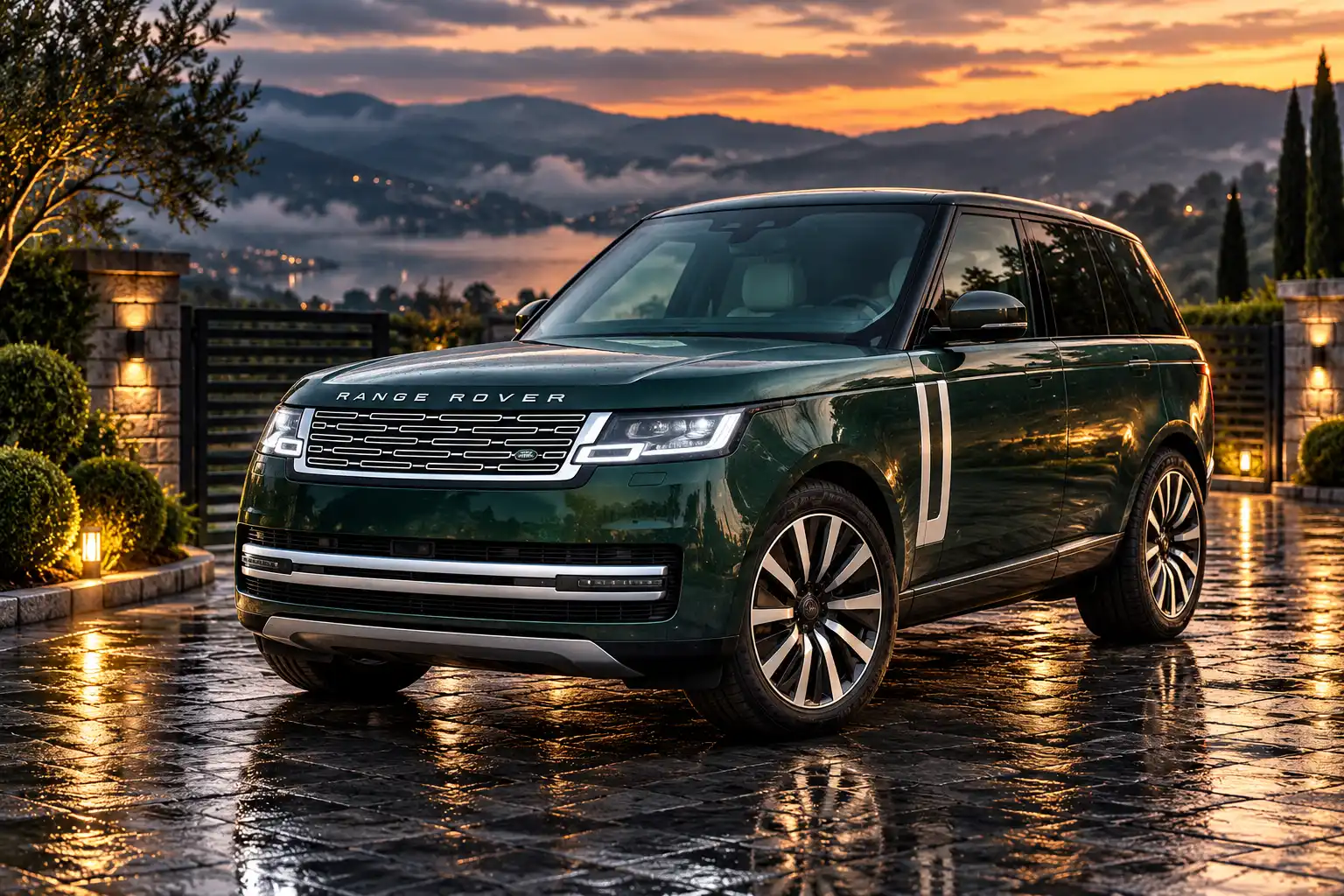
The 2027 Range Rover Electric opens at $138,000, matching the V8 SE, after JLR cut towing to 5,511 pounds. Orders opened on September 2, 2026. The dual-motor EV550 is built at Solihull beside the petrol and plug-in hybrid Range Rovers, on purpose, so the first battery model in 56 years still reads as a Range Rover in a driveway.
That is the wager. Keep the bread-box silhouette, the air suspension, and the badge, charge V8 money, and hope buyers do not miss a tonne on the hitch.
The Same Sticker as a Range Rover V8
U.S. pricing puts the EV550 SE on the same line as the P530 V8 SE: $138,000 before a $2,450 destination fee, or $140,450 to the door. The six-cylinder P400 SE undercuts both at $113,300. JLR did not ask EV buyers to pay a powertrain premium on the base five-seat short-wheelbase car. It asked them to pay V8 money for 542 horsepower, 627 pound-feet, and a quieter cabin.
The EV is the torque leader in the family, and it is a tenth quicker to 60 mph than the V8 on paper (4.3 seconds against 4.4). A 50 to 75 mph pass takes 2.7 seconds. Top speed is 124 mph. That is not why the sticker sits where it does. The sticker sits there because this is still sold as a Range Rover, not as a science project.
SE STICKER, THREE POWERTRAINS
| SE, standard wheelbase | P400 six | P530 V8 | EV550 |
|---|---|---|---|
| MSRP before destination | $113,300 | $138,000 | $138,000 |
| Power | 395 hp | 523 hp | 542 hp |
| Torque | 406 lb-ft | 553 lb-ft | 627 lb-ft |
| 0 to 60 mph | 5.3 seconds | 4.4 seconds | 4.3 seconds |
| JLR range or economy | 21 mpg | 19 mpg | 333 miles |
| Towing | 7,716 lb | 7,716 lb | 5,511 lb |
Above SE, the electric car copies the petrol ladder. Autobiography is $174,800, or $179,500 in long wheelbase. SV is $219,500 and $245,700. SV Black is $238,900 and $260,900. SV Ultra is $252,800, and $275,000 stretched. The electric-only First Edition starts at $176,700, or $179,150 with destination, and $181,400 in long wheelbase, in Belgravia Green, Santorini Black, or Varesine Blue. UK orders open from £154,070.
SV Ultra money buys materials, a 21-speaker audio set, 23-inch wheels, and Body and Soul rear seats that pulse with the music. The motors, pack, and 4.3-second claim do not change with the leather.
JLR Cut a Tonne From the Hitch
Gasoline Range Rovers are rated at 7,716 pounds. The plug-in hybrid sits at 6,614. The EV550 stops at 5,511 pounds, which is 2,500 kg, a full 2,205 pounds below the petrol figure. Rob Mckay, JLR’s head of public charging services, did not pretend the hitch is a footnote.
The majority will tow during their time with the vehicle.
Rob Mckay, Head of Public Charging Services, JLR
JLR said it had studied more than 360 million anonymised Range Rover journeys and that the electric rating would cover 97 percent of them. That sentence is doing a lot of work. It concedes the customer tows, then argues most trips still fit inside a one-tonne cut. Horseboxes, big twin-axle caravans, and plant trailers live in the other 3 percent, and those buyers are being told, politely, to keep the V8.
There are no low-range gears and no lockers. Traction management is electronic, and JLR says Integrated Traction Management can correct slip in 50 milliseconds, 100 times faster than the combustion setup. Sand mode turns brake regen off so the nose does not bury itself in a dune, a point Chief Engineer Lynfel Owen made during the launch. Wading is still 900 mm, about 35.4 inches. Single-pedal mode is rated to pull away on a 33-degree slope and to climb 45 degrees. The hardware that used to mean “Range Rover” on a tow ball is the piece that shrank.
Why the Range Rover Electric Arrived in 2026
JLR’s February 2021 Reimagine plan said the first of six Land Rover battery models would arrive in 2024. Customer cars then slipped toward late 2025, then into 2026, after the company said it wanted more testing and that global EV demand had softened. A cyberattack that began on August 31, 2025, halted production for about five weeks and piled more delay on a program that was already late. Order books finally opened on September 2, 2026, for a 2027 model year car.
By March 2025, JLR put 57,000 names on the waiting list and was hiring 150 maintenance technicians at Solihull and Wolverhampton. The wait was not empty. It was long. Martin Limpert, Range Rover’s managing director, later framed the extra time as a choice, saying the company took testing “even further than originally intended.”
FROM REIMAGINE TO ORDER BOOKS
- February 2021: Reimagine pledges six Land Rover battery models, the first in 2024.
- March 2025: JLR cites 57,000 waiting-list clients and 150 new EV plant roles.
- July 2025: Deliveries move out of late 2025 so testing can run longer and demand can settle.
- August 31, 2025: A cyberattack stops global production for about five weeks.
- September 2, 2026: Gaydon opens orders on the first electric Range Rover, a 2027 model.
Two years against the 2024 promise is the honest span. One year against the late-2025 plan is the span JLR prefers to discuss. Both can be true. The car that reached Scotland this autumn is the delayed one, not a different one.
Quiet Cabins on Single-Track Highland Roads
Land Rover’s global launch put the EV550 on northern Scotland’s single-track lanes, in a body more than seven feet wide, on 22-inch wheels and Michelin all-season tires. Several cars picked up punctures. The roads are sized for a Velar, not for a full-size Range Rover, and they made a poor theatre for 627 pound-feet. They made a decent theatre for noise, or the lack of it.
Launch notes from those days, published on October 20 and 21, 2026, keep landing on the same point: the electric car is calmer than the V8. An active sound program exists, including an aggressive setting, and it is easy to leave off. One-pedal driving will hold the SUV to a stop. Comfort mode on the air springs can feel loose enough to send a passenger to the grab handle. Dynamic firms it up without turning the thing into a sports car. The launch loop returned 32.5 kWh per 100 miles, or 3.1 miles per kWh, in mixed Highland use.
WHAT THE SCOTLAND LAUNCH ACTUALLY SHOWED
- On-road pace: The EV550 reached 70 mph without strain, then ran out of road before it ran out of motor.
- Hill climb: A rutted climb, with throttle, steer, and ride pre-set in Custom, was routine even on all-seasons.
- Mud and ruts: The traction system, in that mode, clawed back onto the track after the tires started to skate.
- Water: A crossing near 35 inches produced no drama in the 800-volt gear.
- Cabin: First Edition white leather, a cooled centre bin, dual glove boxes, and heated seats that stay on. Pivi Pro buried trip efficiency and the massage switch behind extra taps.
The ride height can drop for efficiency on tarmac and rise for dirt. Ground clearance sits 29 mm lower than the V8 in the default setting, with the same adjustable air springs and 7.3 degrees of rear steer. JLR puts kerb weight at about 2,885 kg, roughly 75 kg more than the plug-in hybrid, and says the centre of gravity is 88 mm lower than the V8’s. Twin-valve dampers from the Range Rover Sport SV are part of that package. The float people felt in Scotland is the remaining cost of keeping the Range Rover’s air-sprung gait on a heavier battery car.
What $83,990 Buys That $138,000 Does Not
A Dual-Motor Rivian R1S starts at $83,990, seats seven, and is rated to tow 7,700 pounds. That is $54,010 under the Range Rover EV SE, with a third row and 2,189 extra pounds on the hitch. Rivian’s Large pack is rated at 329 miles, close to JLR’s 333-mile real-world figure, and the Max pack is 410 miles for another $7,000. The Quad-Motor R1S, from $121,990, lists 1,025 horsepower and a 2.6-second 0 to 60 mph claim, still under the Range Rover’s opener.
The G 580 with EQ Technology goes the other way on price. It starts at $163,200 in the United States, plus a $1,350 destination fee, with 587 horsepower, 1,164 Nm, and a 239-mile EPA range. Mercedes quotes about 32 minutes from 10 to 80 percent on DC fast charge at 200 kW. The electric G-Class is not offered with a tow hitch. Four motors and a tank-turn trick do the off-road talking instead.
ELECTRIC SUVS AT THE RANGE ROVER PRICE
| Model | Start price | Power | Range claim | Towing | Seats |
|---|---|---|---|---|---|
| Range Rover EV550 SE | $138,000 | 542 hp | 333 miles (JLR real-world) | 5,511 lb | 5 |
| Rivian R1S Dual, Large | $83,990 | 533 hp | 329 miles | 7,700 lb | 7 |
| Mercedes G 580 EQ | $163,200 | 587 hp | 239 miles (EPA) | No hitch | 5 |
On a Dual-Motor R1S from $83,990, you are not buying a Range Rover grille. You are buying the row of seats and the trailer rating the Solihull car no longer matches. Bentley’s Torcal, from $218,000, is the other pole: 810 horsepower, 375 miles on WLTP, and 10 to 80 percent in 16 minutes at 400 kW, with no interest in a farm track. The EV550 sits in the middle with a five-seat cabin and a family face, which is exactly where JLR aimed it.
Volume at this price will stay small. A 333-mile real-world claim on a 2,885 kg luxury SUV is fine for the person who already parks a Range Rover. It is a weak pitch to anyone cross-shopping a 410-mile Rivian. The electric Range Rover is a lineup addition for people who want the same key, not a volume EV.
Solihull’s One Line for Petrol, Hybrid and Battery
JLR’s line in the Gaydon release is blunt: Range Rover first, electric second. The EV uses the same mixed-metal modular longitudinal architecture as the mild-hybrid, plug-in hybrid, and petrol cars, and it is assembled at Solihull, where Range Rover production has sat since 1970. An aerodynamically tightened grille, specific wheels, and a tailored underbody are the visible tells. The rest of the body is meant to vanish into a row of V8s.
Battery packs and drive units come from the Electric Propulsion Manufacturing Centre in Wolverhampton. Twin 260 kW permanent-magnet motors, which JLR says make 20 percent more torque than other motors of the same size, use silicon carbide inverters. The usable pack is 118.5 kWh, built as a double stack of 344 prismatic cells. Independent spec sheets list a 125 kWh nominal battery pack behind that usable figure, NMC chemistry, and an 800-volt bus that can split into two 400-volt strings for charging. JLR filed 300 patent applications on the program, including ThermAssist heat recovery. The propulsion warranty is eight years or 100,000 miles.
Physical testing ran the equivalent of 38 trips around the world, with more than 250,000 hours of virtual work, which JLR calls the heaviest Range Rover validation to date. Nine thousand Solihull manufacturing staff were trained for electrification, plus 1,500 more across the West Midlands. The factory still builds petrol Range Rovers on the same footprint. Flexible propulsion is the strategy, not a sunset date for the V8.
Matt Becker, JLR’s vehicle engineering director, said the brief was composure on every surface, from low-grip dirt to a fast road, and that the electric driveline’s speed of response is what lets the heavy car keep that calm. The Scotland drive supported the calm. It did not restore the missing tonne on the hitch.
Native NACS Makes a 22-Minute Stop Possible
JLR quotes 372 miles of WLTP range and up to 333 miles in real-world use, and it says a 350 kW public DC charger takes the pack from 10 to 80 percent in 22 minutes. At the peak rate, the car can add 137 miles in 10 minutes on the WLTP yardstick. North American cars get a native NACS port. Tesla lists JLR on the Supercharger list for NACS-equipped models, so the adapter dance is not part of this particular bet. The Range Rover app handles charge status, scheduled charging, and cabin pre-conditioning. An optional branded home charger is in the catalogue.
That plug is the practical half of the $138,000 claim. A five-seat luxury SUV that needs a CCS adapter in 2027 would have been a harder sell than a five-seat luxury SUV that already lost a tonne of towing. The 800-volt pack and the NACS door are how JLR keeps road-trip math in the conversation after the hitch rating leaves it.
Range Rover Electric is the result of a decade of considered engineering and technological development, setting a new benchmark for The Original Luxury SUV. Electric propulsion is perfectly suited to the exquisite refinement of Range Rover, elevating the sense of calm and secluded sanctuary for occupants.
Martin Limpert, Managing Director, Range Rover, Gaydon launch, September 2, 2026
Limpert is selling hush, and the Scotland roads backed him. JLR is still building the petrol Range Rover on the same Solihull line. The EV is the optional powertrain, at V8 money, with a 5,511-pound trailer rating for a customer base that, on JLR’s own numbers, mostly tows.

Cook Hands Democrats the House as Crypto’s Bill Stays Dead

Wicker’s Broken Bed Was the Short Story’s Punch Line

Nvidia’s $500 Billion Financing Plan Draws a $180 Sell

Maserati Bets the Grecale V6 Can Fill Porsche’s Gap

EV Cable Theft Follows the Old Railway Copper Playbook

Aramco Crash Kills 14 Two Days After Oil Restart

Salah Captained Egypt to Their First World Cup Win

Zelda’s 40th Switch 2 Ships Without a Zelda Game

Apple Labor Day Deals Hide June’s Memory Price Hike

Palworld 1.0.4 Adds Palpedia Search After the 1.0 Launch
-
 BUSINESS4 months ago
Aramco Crash Kills 14 Two Days After Oil Restart
-
 NEWS5 months ago
Salah Captained Egypt to Their First World Cup Win
-
 GAMING2 months ago
Zelda’s 40th Switch 2 Ships Without a Zelda Game
-
 NEWS2 months ago
Apple Labor Day Deals Hide June’s Memory Price Hike
-
 GAMING2 months ago
Palworld 1.0.4 Adds Palpedia Search After the 1.0 Launch
-

 NEWS4 months ago
El Niño Puts Israel’s Needed Winter Rain on a Flood Clock
-

 BUSINESS8 months ago
BAE’s 60-Year Saudi Franchise Now Runs Through Taif
-

 BUSINESS8 months ago
Egypt Bets EGP 638 Billion Can Open Sinai to Investors