
NEWS
Rabot Energy Bets €50 Million on Germany’s Renters
Rabot Energy’s €50 million Series B targets German renters, whose plug-in batteries can be stacked into a virtual power plant without solar or a landlord.

Hamburg supplier Rabot Energy closed a €50 million Series B on October 15 to turn rental wall sockets into a virtual power plant. Endeit led the round with the DeepTech & Climate Fonds, and the cheque is meant to take a plug-in home battery from early sales to a million homes.
The bill-cut is the pitch. The overlooked party is the renter who never got a roof or a basement pack, and who now owns the socket the plant would run through.
Endeit and DTCF Put €50 Million Behind Socket Batteries
Rabot Energy, a digital power supplier founded in Hamburg in 2021 by Jan Rabe and Maximilian Both, said it is turning millions of households into a virtual power plant with the new money. Existing backers HV Capital, High-Tech Gründerfonds, Bosch Ventures, CNI, Acurio Ventures and vent.io joined again.
Endeit, set up in 2006, invests from a fund of more than €300 million. DTCF, backed by the German Future Fund and the ERP Special Fund, writes cheques of up to €50 million and has a €1 billion plan. Sara Resvik, a partner at Endeit, said flexibility in Germany is becoming as important as building more wind and solar, and that Rabe’s team already runs a profitable core business that can shift demand at scale.
Dr Anne Hinze, senior investment manager at DTCF, said the firm is backing tariffs and a software layer that let households take money from a jumpy power market.
THE ROUND IN FOUR FIGURES
- The customers: More than 200,000 accounts in three and a half years, including around 15,000 commercial and industrial sites.
- The sales: Revenue has reached €200 million, and the firm says it supplied more than 600 million kilowatt-hours of renewable power.
- The saving: Customers cut a combined €45 million in 2025 versus default supplier tariffs, on the company’s own sums.
- The target: One million customers, with home batteries, car chargers and heat pumps tied into one pool.
That is a fivefold jump in accounts if the target holds. Most of the base is still a tariff book. The hardware is how those accounts stop walking out the door, and how they become dispatchable watts rather than names on a bill.
More Than Half of Germany Rents
Germany is the EU’s renter country. Destatis, drawing on Eurostat, found that 52.8% of people in Germany rented in 2025, the highest share in the bloc. France sat at 38.6%, Spain at 26.4%, Poland at 12.8% and Slovakia at 6.2%.
Home batteries in Germany grew up around owner-occupied houses with roof solar, a cellar, and an electrician on call. Tenants sat outside that loop. Landlord-run solar on apartment roofs, sold as Mieterstrom, still needs the owner to build the plant and keep the books. A balcony panel helps a little and still often needs a nod from the building.
Konrad Schade, managing director at Rabot Energy, said access to batteries had in practice been tied to the owner-occupied house. When the firm launched Rabot Flow in June 2026, it put the addressable group at about 45 million people in apartment buildings, a figure it derived from Destatis housing stock of 23.5 million multi-family dwellings and 1.9 people per home.
WHY THE OLD PACK NEVER REACHED A FLAT
- The wiring: A hard-wired cellar battery needs an electrician and a board the tenant does not control.
- The roof: Most storage offers assume solar on a house the occupant owns.
- The lease: Anything that alters the building usually needs the landlord, which kills walk-up sales.
- The meter: A dynamic tariff, the thing that makes cheap hours worth storing, needs an intelligent meter the household may not have.
A pack that sits on the floor, uses a normal socket, and leaves with the tenant cuts three of those four knots. The meter is the one that remains, and it is the brake on the whole trade.
What Rabot Flow Puts in the Wall
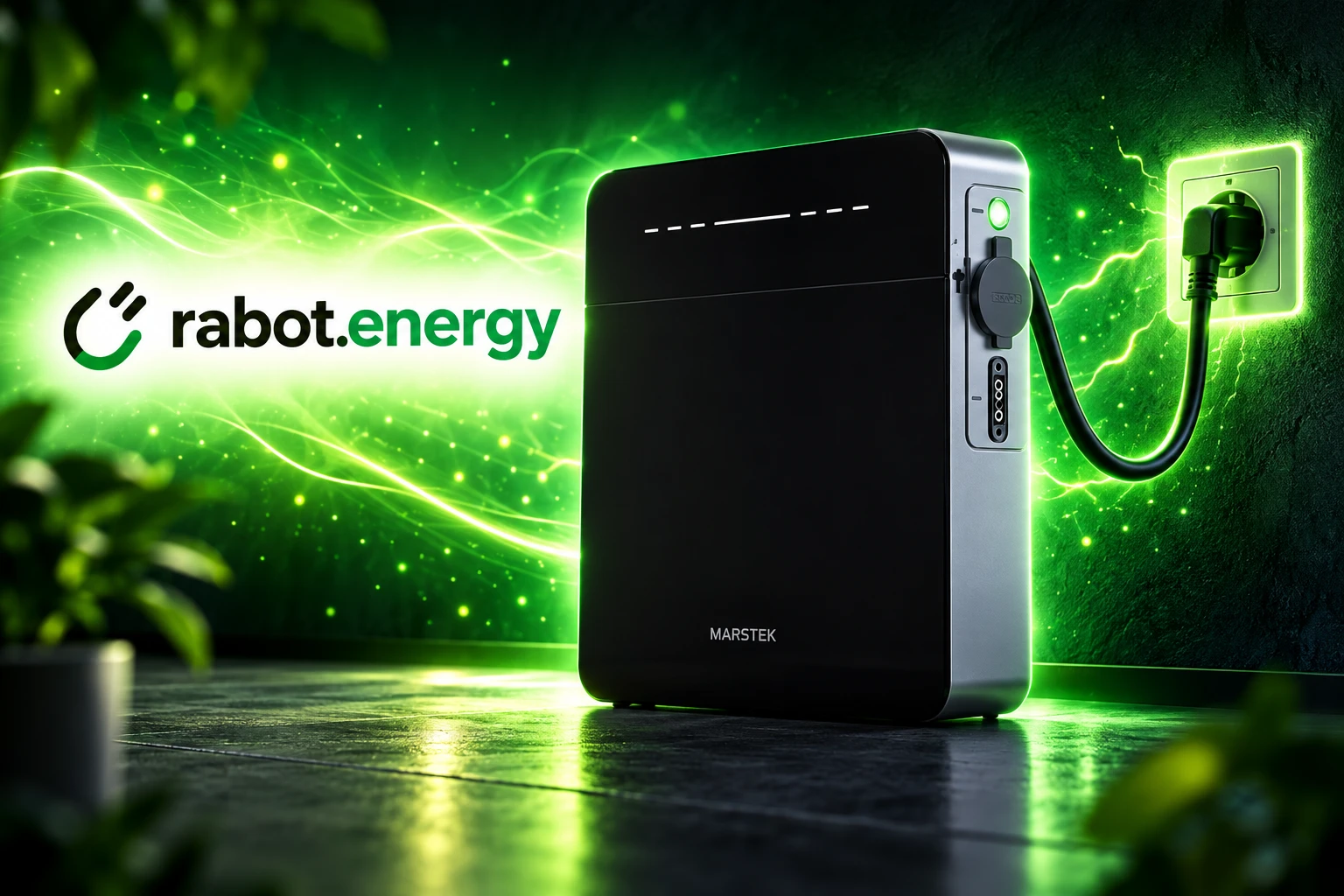
Rabot Flow is a bundle: a dynamic tariff, an intelligent meter, and a plug-in pack the firm sells as the Marstek Venus A 2.12 kWh battery. It is LiFePO4 chemistry with 90% usable depth. The list price is €499. With a €99 discount the buyer pays €400 once, plus a €100 new-customer bonus on the tariff. The company says the pack can be on site in three days, plugged into a standard socket, and switched on in the app in under two minutes. No roof solar, no electrician, no landlord sign-off.
The firm’s Series B note says the bundle can cut energy costs for an average household by 15%. On the product page it names a separate figure for the battery trade itself: up to €120 a year, paid out monthly, with a three-to-four-year payback. Those are two company claims on two bases, not one number restated.
Rabot’s software charges when exchange power is cheap and runs the home off the pack when it is dear. Unused stored power is sold back into the market. If a house cannot take a smart meter, the pack and the tariff still work, but the optimisation and the cash-out stop.
RABOT FLOW AND THE TIBBER PACK
| Spec | Rabot Flow (Marstek Venus A) | Tibber (EcoFlow STREAM Pro) |
|---|---|---|
| Capacity | 2.12 kWh | 1.92 kWh, up to 11.52 kWh with six units |
| Price | €400 with discount (€499 list) | €579 with a Tibber tariff |
| Solar input | Not used in Flow | 1,500 W |
| Landlord | Not required | Not required for the pack; solar needs consent |
| Named saving | Up to €120 a year | None stated |
Tibber, the Norwegian app supplier, already has more than 200,000 customers in Germany, on Rabot’s own comparison. Its pack can grow and can take balcony solar. Flow is the simpler renter product: one unit, one tariff, one app, and a monthly credit. That is also a tether. The optimisation only runs on Rabot’s dynamic tariff.
Power Went Negative for 573 Hours in 2025
The arithmetic only works if the exchange actually swings. The Bundesnetzagentur, using its SMARD platform, counted 573 hours of negative wholesale prices in 2025, out of 8,760. In 2024 the count was 457 hours out of 8,784. That is 116 more cheap hours in a year that was not a leap year.
The average day-ahead price still rose. It landed at €89.32 per megawatt-hour in 2025, up 13.8% from €78.51. Prices above €300 per megawatt-hour hit 40 hours, almost unchanged from 41 hours the year before. Renewables supplied 257.5 terawatt-hours, or 58.8% of the 437.6 terawatt-hours generated. Gas rose 6.4% to 60.6 terawatt-hours, 13.8% of the mix. Solar jumped to 74.1 terawatt-hours from 63.2.
A household on a fixed default tariff never sees those 573 hours. A household on a dynamic tariff with a 2.12 kWh buffer does, in slices. Since 2025 every German supplier has had to offer a dynamic tariff, but only to sites with an intelligent meter. Day-ahead trading moved to quarter-hour products in October 2025, which gives the software 96 prices a day to chase.
HTGF’s round note puts the grid argument in one line: every kilowatt-hour shifted this way cuts the need for gas at peak and helps stop renewable power from being thrown away. That is the investor case. The renter case is the credit on the bill.
A Million Homes Would Shift 0.8 Gigawatts
Rabot Energy says a million linked homes could shift up to 0.8 gigawatts of load when renewable output is high, which it compares with a conventional power-plant block. That is a company figure for power, not a sum of battery energy. The Series B is the cash to go from a tariff book of more than 200,000 toward that million, and to hang chargers and heat pumps on the same platform.
The next generation of power plants will not be built; it will be connected. Millions of households have enormous untapped potential to do more than simply consume energy and instead become an active part of the wider energy system. With our Series B, we are turning individual households into a network that helps stabilise the power system, accelerate the energy transition and, at the same time, significantly reduce our customers’ electricity bills.
Jan Rabe, CEO, Rabot Energy
HOW RABOT ENERGY GOT TO THIS ROUND
- 2021: Jan Rabe and Maximilian Both found the Hamburg supplier, later branded Rabot Energy, as a digital seller of renewable power.
- June 2026: Rabot Flow launches, pairing the dynamic tariff and a smart meter with the plug-in Marstek pack.
- October 15, 2026: The €50 million Series B closes, with Endeit and DTCF as new lead money beside the old bench.
A 2.12 kWh unit is a kettle and a laptop, not a house. Stacked across a million flats it becomes a peaking resource the system can call without pouring a foundation. The people who would host it are the same people the last round of home storage ignored.
The Same Wall Socket Already Has a Rival
Rabot is not alone in the socket. Tibber is already selling a plug-in pack in Germany. Octopus Energy and Ostrom sell dynamic tariffs in the same market. 1KOMMA5° builds solar, storage, heat pumps and chargers for houses that own a roof. The renter product is the gap those hardware firms still treat as a side door.
The shared problem is the meter. Dynamic prices and remote dispatch both need quarter-hour reads. Rabot has already sat with Tibber, Octopus Energy and Ostrom on a national smart-meter atlas, because none of those tariffs scale while analog discs still spin in the cupboard. Flow can ship in three days. A meter swap cannot.
So the €50 million is not only a VPP story. It is a bet that enough German tenants will put a €400 box on the floor, keep the tariff, and let software treat their sockets as a plant. If the meters lag, the plant stays a brochure. If they catch up, the next block of flexibility in the German system will live in rented flats, not in a new turbine hall.
Frequently Asked Questions
Do German Tenants Need Landlord Approval for a Plug-In Battery?
Rabot Energy says Flow needs no electrician and no landlord approval because it uses a normal household socket and is not a building alteration. Tibber’s EcoFlow pack follows the same rule when it is used alone; once balcony solar is clipped to that pack, the tenant needs the landlord’s consent. Both firms still require registration in the Marktstammdatenregister, and Rabot says it handles the grid-operator filing for Flow buyers.
When Did German Suppliers Have to Offer Dynamic Tariffs?
Every electricity supplier in Germany has had to offer a dynamic tariff since January 2025, but only to customers with an intelligent metering system. The tariff tracks the exchange, which has traded in quarter hours since October 2025, so a bill can carry 96 prices a day. Without that meter the supplier cannot match usage to those prices, which is why the pack’s monthly credit is tied to the meter as well as to the battery.
Can You Take Rabot Flow With You When You Move?
The company says the devices are built for a ten-year life and can be taken to a new flat, which is the point of a socket pack versus a wall-mounted cellar unit. Marstek, not Rabot, is the warranty issuer for ten years after the buyer registers in the Marstek app, on top of two years of statutory cover. The tariff itself can be cancelled monthly, so the hardware is portable even if the contract is not sticky by law.
How Long Is the Marstek Venus A Meant to Last?
Marstek rates the Venus A at more than 6,000 cycles at 25 C and says it should still hold at least 80% of capacity after 15 years. The pack is IP65-rated, runs under 30 dB, and is specified from -20 to 60 C. In a power cut it can feed up to 1,500 W through its own socket and switches in under 15 milliseconds, which covers a fridge or a router but not the rest of the flat’s wall outlets.

Cook Hands Democrats the House as Crypto’s Bill Stays Dead

Wicker’s Broken Bed Was the Short Story’s Punch Line

Nvidia’s $500 Billion Financing Plan Draws a $180 Sell

Maserati Bets the Grecale V6 Can Fill Porsche’s Gap

EV Cable Theft Follows the Old Railway Copper Playbook

Aramco Crash Kills 14 Two Days After Oil Restart

Salah Captained Egypt to Their First World Cup Win

Zelda’s 40th Switch 2 Ships Without a Zelda Game

Apple Labor Day Deals Hide June’s Memory Price Hike

Palworld 1.0.4 Adds Palpedia Search After the 1.0 Launch
-
 BUSINESS4 months ago
Aramco Crash Kills 14 Two Days After Oil Restart
-
 NEWS5 months ago
Salah Captained Egypt to Their First World Cup Win
-
 GAMING2 months ago
Zelda’s 40th Switch 2 Ships Without a Zelda Game
-
 NEWS2 months ago
Apple Labor Day Deals Hide June’s Memory Price Hike
-

 NEWS4 months ago
El Niño Puts Israel’s Needed Winter Rain on a Flood Clock
-
 GAMING2 months ago
Palworld 1.0.4 Adds Palpedia Search After the 1.0 Launch
-

 BUSINESS8 months ago
BAE’s 60-Year Saudi Franchise Now Runs Through Taif
-

 BUSINESS8 months ago
Egypt Bets EGP 638 Billion Can Open Sinai to Investors