
AUTO
Mazda’s Electric Mule Keeps Rolling After the 2029 Delay
Mazda is still testing a two-row electric mule after delaying its U.S. battery car to around 2029 and cutting the 2030 mix to 15 percent.

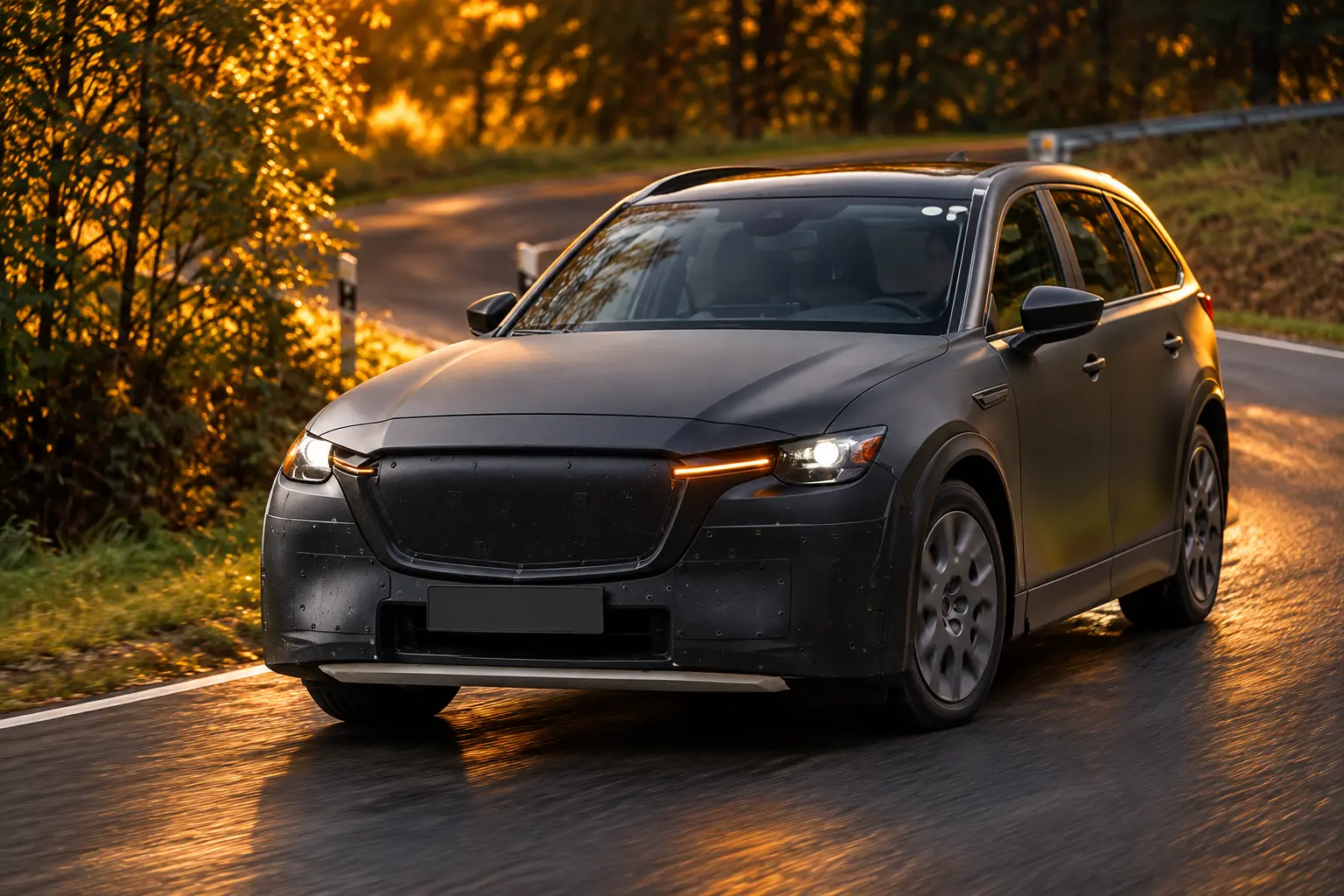
Mazda’s chopped electric test mule was photographed again in October 2026, a year after it first appeared in California. The closed grille and missing exhaust still mark it as a battery prototype. The calendar behind those photos already moved.
Mazda now aims to put its own dedicated electric vehicle on sale around 2029, and it has lowered the 2030 battery-car share of global sales to about 15 percent. American dealers still have no Mazda EV to sell.
This Mule Lost a Row and a Lot of Length
Spies first caught the vehicle near Mazda’s Irvine research center in November 2025. The same basic mule, or one built like it, was still circulating in October 2026. Little on the outside had changed, which is the tell on a program that is no longer racing a 2027 start of production.
The body started as a CX-90, Mazda’s largest three-row SUV. Engineers pushed the front wheels back, leaving the old arch outline visible and a long, awkward overhang. They also cut the rear, so the tail now reads more like a stubby CX-5 than the eight-seat flagship.
The track looks narrower than the production CX-90. The wheelbase is shorter. The short tail points to two rows and five seats, not the three-row cabin U.S. CX-90 buyers get. Calling it an electric CX-90 is a convenient nickname. The hardware under test is a midsize crossover on Mazda’s Skyactiv EV Scalable Architecture, the in-house platform first described in 2021.
Other clues are simpler. The grille and bumper intakes are blanked off. The wheels are aero covers. There are no exhaust tips. Yellow first-responder stickers mark it as an electrified vehicle. Mazda has declined to discuss the mule, saying only that U.S. teams regularly test new technology.
Mazda Cut Its 2030 Battery Mix to 15 Percent
On May 12, 2026, Mazda reported a hard year and a smaller battery bet. Global retail volume was 1.223 million vehicles, down 6 percent. Net sales were 4,918.2 billion yen, down 2 percent. Operating income fell 72 percent to 51.6 billion yen, and U.S. tariffs took 154.9 billion yen out of that comparison with the prior year.
The same presentation is where the EV plan shrank in public. Mazda said it would cut electrification spending to 1.2 trillion yen through 2030, about $7.9 billion at the 151 yen per dollar rate it used for that fiscal year. The 2022 figure was 1.5 trillion yen, a 20 percent reduction, after an inflation-era read nearer 2 trillion yen.
MAZDA’S BATTERY-CAR PLAN, THEN AND NOW
| Item | Earlier plan | May 2026 |
|---|---|---|
| First in-house EV | Japan production in 2027 | Around 2029 |
| 2030 global BEV share | 25 to 40 percent | About 15 percent |
| 2030 BEV volume | Tied to the higher mix | 200,000 to 250,000 a year |
| Electrification spend through 2030 | 1.5 trillion yen (later seen near 2 trillion) | 1.2 trillion yen |
| Partner EVs | Limited China work | Four vehicles with Changan |
President Masahiro Moro tied the slower timing to looser fuel-economy rules, U.S. tariffs, weaker global EV incentives, and unsteady demand. In January, after Japanese suppliers were told the in-house car would slip past 2027, a Mazda spokesperson said the company had not announced that date and would set timing after watching rules and customers in each market.
This information has not been announced by Mazda. We continue technological development of in-house BEVs based on our multi-solution strategy, and we will decide the introduction timing while closely monitoring regulatory trends in each country and changes in customer needs.
Mazda spokesperson, January 2026
Moro later said Mazda had not had to write off plants for the delay. The mule still moving is consistent with that claim. So is a launch that is no longer next year.
Why the MX-30 Lasted Two Years in California
Mazda’s last U.S. battery car was the MX-30, sold only in California from late 2021 and pulled in 2023. The 2023 model started at $34,110. It used a 35.5 kWh pack, and the government’s label gave it an EPA-estimated range of 100 miles, 92 MPGe combined, and 37 kWh per 100 miles. A 240-volt charge was listed at 5.3 hours.
When the car arrived, Mazda pitched it as an urban commuter and leaned on that 100-mile figure as if it were enough.
The MX-30 can easily be the ideal companion for daily commuting with an EPA estimated range of 100 miles on a full charge.
Mazda, U.S. MX-30 launch statement
Buyers did not agree. The pack was small, the rear doors were half-size, and rivals at a similar price went much farther. Mazda has not put another battery Mazda on U.S. lots since. The mule is supposed to be the answer to that gap. It is also the project Mazda just gave two extra years.
16 Percent of New U.S. Cars Were Hybrids
The market Mazda is watching is the one that formed after the $7,500 new-vehicle credit ended for vehicles acquired after September 30, 2025. Battery-electric vehicles were 12 percent of U.S. light-duty sales that September, according to the U.S. Energy Information Administration, then 6 percent in the first half of 2026.
Kelley Blue Book’s third-quarter 2026 count shows a small bounce, not a reset. Americans bought 266,630 new EVs, 6.5 percent of the market, up from 5.8 percent in the second quarter and 7.7 percent higher in unit terms. That quarter was still 38.6 percent below the year-earlier rush. Outside the United States, about one in four new cars is electric.
Hybrids took the demand the credit used to buy. EIA figures show hybrids reached a record 16 percent of U.S. light-duty sales in the second quarter of 2026, while plug-in hybrids slipped to 1.4 percent. Regular gasoline averaged $4.35 a gallon in the EIA survey for the week of October 5, 2026, which is the kind of pump price that sends shoppers toward a fuel-saving powertrain that still uses a hose.
U.S. MIX AFTER THE CREDIT
| Powertrain | Share | Period |
|---|---|---|
| Battery electric | 12 percent | September 2025 (EIA) |
| Battery electric | 6 percent | First half of 2026 (EIA) |
| Battery electric | 6.5 percent | Third quarter of 2026 (Kelley Blue Book) |
| Hybrid | 16 percent | Second quarter of 2026 (EIA) |
| Plug-in hybrid | 1.4 percent | Second quarter of 2026 (EIA) |
Stephanie Valdez Streaty, director of industry insights at Cox Automotive, called hybrids the clearest growth story in the electrified market. Mazda’s U.S. product list already follows that line.
The Hybrids Mazda Can Sell Right Now
Mazda’s American electrified page lists gas engines, one conventional hybrid, and two plug-in SUVs. There is no battery crossover. The three-row CX-90 starts at $39,300 with up to eight seats. The two-row CX-70 starts at $42,750. Both also come as plug-ins.
MAZDA’S U.S. ELECTRIFIED LOT, 2026
- CX-50 Hybrid: Starts at $34,750 and is rated at 38 mpg combined, using Toyota hybrid hardware rather than Mazda’s own upcoming system.
- CX-70 PHEV: Starts at $44,450, with 61 MPGe, a 32-mile electric range, and 520 miles of total range for five seats.
- CX-90 PHEV: Starts at $50,695, with 56 MPGe, a 27-mile electric range, 500 miles of total range, and seven seats.
Mazda rates those plug-ins at up to 323 horsepower on premium fuel and says nightly charging can cover many errands on electricity alone. The high-voltage pack is warranted for 96 months or 100,000 miles. That is the product Americans can actually order: a plug-in hybrid CX-90 and CX-70, plus the CX-50 Hybrid, while the battery mule stays a science project.
The next hybrid is the one Mazda is building for itself. A CX-5 hybrid is due in 2027 with a Mazda four-cylinder and Mazda’s own hybrid gear, replacing the borrowed Toyota system in the CX-50. The CX-5 is the brand’s volume SUV. Putting the new hardware there is a clearer 2027 event than an in-house EV that has already slipped twice.
Europe Can Buy the Changan Electric Mazdas
Mazda is not out of the battery business everywhere. The May 12 deck says the company will launch four jointly developed electric vehicles with Changan Automobile on a short timeline, and it will put money into hybrids, large-platform SUVs, and engines built for an electrified era. The first of those partner cars are already on sale: the Mazda 6e sedan and the CX-6e SUV, sold in China as the EZ-6 and EZ-60.
They ride on Changan’s EPA platform, use lithium iron phosphate packs in the SUV, and are built in China. Europe and Australia get them. The United States does not. Tariffs on Chinese-built electric vehicles keep those Mazdas off American lots, which is why the Irvine mule exists at all. It is the Japan-designed, Hofu-bound answer Mazda still wants for a market that will not take Nanjing metal.
That split is the part the spy photos hide. In Europe, Mazda already has a battery SUV to park next to the new CX-5. In China, the partner cars are ordinary inventory. In the United States, the only electric Mazda most shoppers have touched is a three-year-old MX-30 memory, and the only new electrified metal is a hybrid or a plug-in that still needs gasoline in the tank.
A later U.S. battery car also leaves Mazda’s engineers on the engines that still pay the bills. The CX-90 and CX-70 inline-sixes, the CX-50 Hybrid, and the 2027 CX-5 hybrid are the products tied to volume. The mule is insurance on a 15 percent future, not the main bet for 2027.
Still Driving Last Year’s Test Mule
HOW THE U.S. BATTERY CAR SLIPPED
- 2021: Mazda outlines the Skyactiv EV Scalable Architecture as a ground-up electric platform.
- December 2021: The MX-30 goes on sale in California with 100 miles of EPA range.
- 2023: Mazda ends U.S. MX-30 sales after two model years.
- September 30, 2025: The federal new-vehicle clean-vehicle credit stops for later acquisitions.
- November 2025: A chopped CX-90-bodied EV mule appears near Mazda’s California research center.
- January 2026: Suppliers hear a 2029-or-later in-house EV date; Mazda says it has not announced timing.
- May 12, 2026: Mazda locks in 1.2 trillion yen of electrification spending and a 15 percent 2030 BEV mix, and says it will optimize the in-house launch date.
- October 2026: The same style of mule is photographed again.
- 2027: Mazda plans a hybrid CX-5 with an in-house powertrain.
- Around 2029: Mazda’s own dedicated EV is now the working window.
The photographs will keep coming, because test cars have to put miles on a platform even when the showroom date moves. What they will not do is put a Mazda battery crossover in U.S. inventory next year. Until around 2029, the closest thing on a public road is still that shortened CX-90 shell, two rows, no exhaust, yellow stickers, and a launch date that already ran away from it.

Cook Hands Democrats the House as Crypto’s Bill Stays Dead

Wicker’s Broken Bed Was the Short Story’s Punch Line

Nvidia’s $500 Billion Financing Plan Draws a $180 Sell

Maserati Bets the Grecale V6 Can Fill Porsche’s Gap

EV Cable Theft Follows the Old Railway Copper Playbook

Aramco Crash Kills 14 Two Days After Oil Restart

Salah Captained Egypt to Their First World Cup Win

Zelda’s 40th Switch 2 Ships Without a Zelda Game

Apple Labor Day Deals Hide June’s Memory Price Hike

Palworld 1.0.4 Adds Palpedia Search After the 1.0 Launch
-
 BUSINESS4 months ago
Aramco Crash Kills 14 Two Days After Oil Restart
-
 NEWS5 months ago
Salah Captained Egypt to Their First World Cup Win
-
 GAMING2 months ago
Zelda’s 40th Switch 2 Ships Without a Zelda Game
-
 NEWS2 months ago
Apple Labor Day Deals Hide June’s Memory Price Hike
-

 NEWS4 months ago
El Niño Puts Israel’s Needed Winter Rain on a Flood Clock
-
 GAMING2 months ago
Palworld 1.0.4 Adds Palpedia Search After the 1.0 Launch
-

 BUSINESS8 months ago
BAE’s 60-Year Saudi Franchise Now Runs Through Taif
-

 BUSINESS8 months ago
Egypt Bets EGP 638 Billion Can Open Sinai to Investors