
NEWS
MapQuest Maps Flock Cameras Without a Way Around Them
MapQuest’s new surveillance layer paints eyeballs on Flock plate readers, mapping a 20-billion-scan network the app still cannot route around.

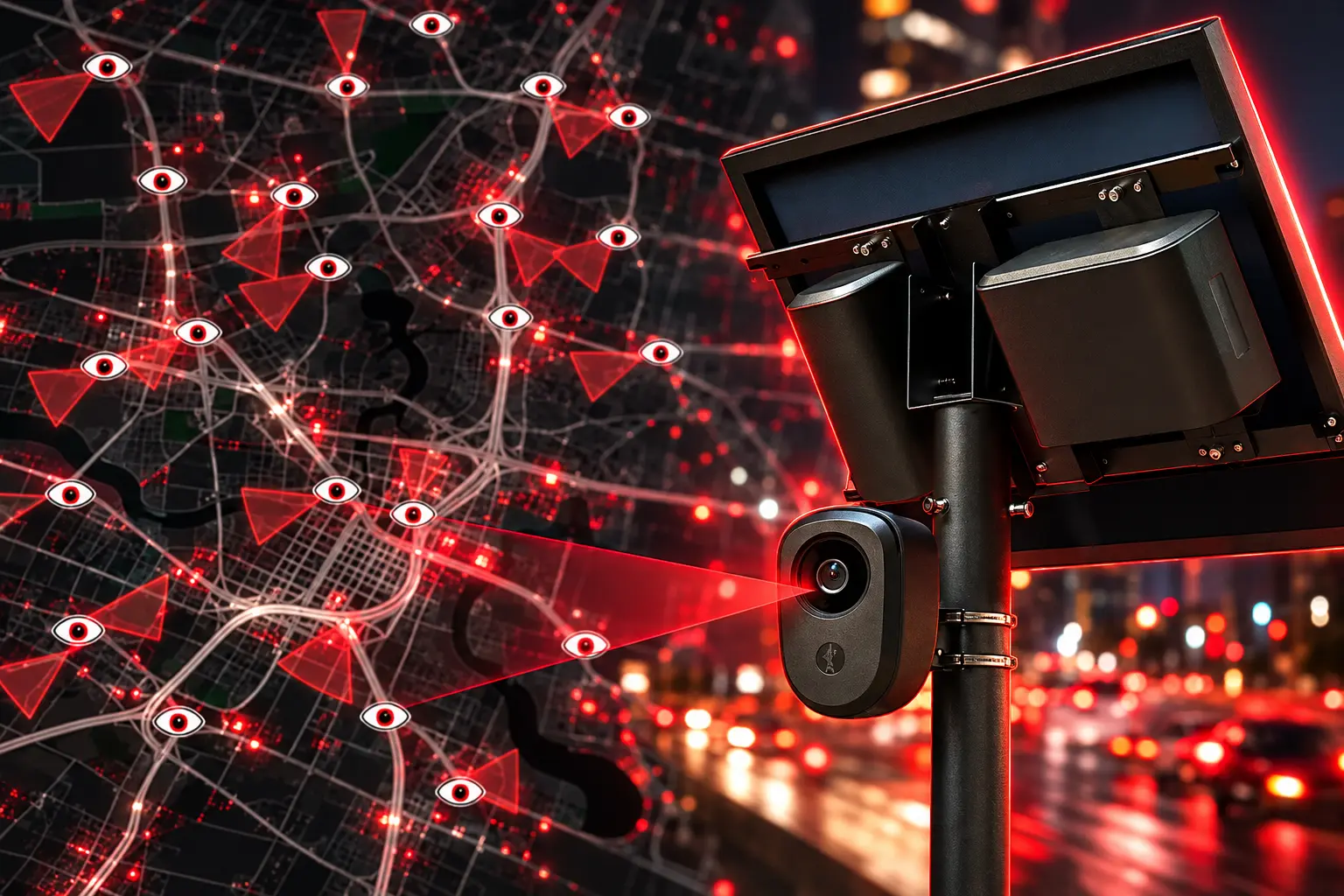
MapQuest added a Surveillance Layer to its iPhone and Android app on October 15, 2026, marking known Flock Safety plate readers as eyeballs on the map. The overlay sits next to traffic and incident toggles. It shows cameras. It does not bend the route around them.
The brand that just rode a lake-name fight back up the App Store is selling a picture of the dragnet, not a way out of it.
MapQuest Puts Eyeballs on License Plate Readers
MapQuest’s own post framed the update in six words: “The Roads Have Eyes!” The company told drivers to turn the layer on in Map Options to see known automated license plate readers from Flock Safety, Motorola Solutions (Vigilant), Genetec, Axis Communications, Axon, Leonardo (ELSAG), Neology, Rekor, PlateSmart, Ubicquia, Verkada, and other outdoor cameras that watch streets and public spaces. That is 11 named vendors, not a Flock-only list.
The Roads Have Eyes! 👁️
Turn on the Surveillance Layer in Map Options to see known license plate readers from Flock Safety, Motorola Solutions (Vigilant), Genetec, Axis Communications, Axon, Leonardo (ELSAG), Neology, Rekor, PlateSmart, Ubicquia, Verkada, and other outdoor… pic.twitter.com/xMurjtoHo9
— MapQuest (@MapQuest) October 15, 2026
Doug Berger, MapQuest’s general manager, said the request came from the people now opening the app.
We build around what drivers ask for, and showing surveillance camera locations is one of our users’ top three requests.
Doug Berger, general manager, MapQuest
The help center, dated October 19, 2026, walks through four taps and then stops. It never says who supplied the pins, how old they are, or what an eye is supposed to mean beyond “surveillance.” You open the app, tap the stacked-square Map Layers button under the compass at the bottom right, toggle Surveillance in Map Options, and close the menu. Eye-shaped markers then sit on the map. A how-to clip from the @MapQuest account on October 17 shows the same path. Some pins carry a shaded cone for the way the reader points.
HOW TO TURN THE LAYER ON
- Open the app: Launch MapQuest on a phone so the main map is on screen.
- Map Layers button: Tap the stacked-square icon at the bottom right, directly under the compass.
- Surveillance toggle: Slide Surveillance, last in the list, to On.
- Close the menu: Tap X; eye icons remain on the map until you switch the layer off.
If the row is missing, MapQuest says to update the app from the App Store or Google Play. That is the whole official manual. There is no switch for “avoid these points.”
Where the Eyes Come From
Volunteer mappers have been dropping plate-reader pins on OpenStreetMap for years. DeFlock, the best-known of those projects, feeds a public crowdsourced ALPR map on OpenStreetMap rather than a private company file. As of August 9, 2026, OpenStreetMap carried 138,351 features tagged as ALPRs worldwide, 127,878 of them in the United States. MapQuest’s help article does not credit that feed, or any other. Coverage of the launch said the company’s terms point at OpenStreetMap contributors, and that users can flag gear they spot.
Flock Safety sent a cease-and-desist over DeFlock’s name; the Electronic Frontier Foundation represented the project’s creator, and the map stayed up. By February 2025 DeFlock had already logged more than 16,000 locations. MapQuest’s move is not the invention of camera mapping. It is the first time a mass-market driving app put those pins one toggle from traffic.
WHAT WE KNOW
- The product: A mobile overlay of eye icons for known outdoor cameras and plate readers, live in the MapQuest app since October 15, 2026.
- The brands: MapQuest named 11 vendors, with Flock Safety first in the post, plus a catch-all for other outdoor cameras.
- The method: Locations are crowdsourced, and MapQuest describes the layer as a snapshot of known points, not a live census.
WHAT IS UNCONFIRMED
- The feed: MapQuest’s help page still does not name DeFlock, OpenStreetMap, or any other source as the official pipeline.
- Completeness: A blank stretch of road is not proof that no reader is there, and MapQuest has not published a coverage rate.
- Routing: Nothing in the official instructions says the app will plot a path that misses the eyes.
Treat a missing pin as a gap in a volunteer file, not a clean street. The people who walked up to poles and tagged them did the survey work. MapQuest put their dots next to the commute.
Twenty Billion Scans Leave Little Room to Dodge
Flock Safety, the Atlanta plate-reader firm at the center of the backlash, is the reason the eyeballs travel. Sen. Josh Hawley, a Missouri Republican, wrote to chief executive Garrett Langley on August 26, 2026, that the company “boasts more than 120,000 cameras across 49 states and more than 20 billion vehicle scans every month.” The ACLU’s Get the Flock Out campaign uses the same camera count. Chad Marlow, the ACLU senior policy counsel who runs that campaign, told the Senate Judiciary Subcommittee on Crime and Counterterrorism on September 23, 2026, that Flock, by its own admission, collects more than 20 billion scans a month.
That’s about 57 scans per person in America every month, and that is just Flock.
Chad Marlow, senior policy counsel, ACLU, Senate testimony, September 23, 2026
The cameras do more than grab a plate. The ACLU says an AI catalog then stores make, model, color, bumper stickers, and even scratches, and that any law-enforcement customer on the network can search the file. Flock says the system does not use facial recognition. It also says it has no official contract with ICE or Customs and Border Protection. Marlow’s campaign notes that a local department with a Flock login can still run a search for another agency, including ICE. About 75% of Flock’s police customers, he has said, join the firm’s National Lookup network, which stitches those local poles into something closer to a national plate index. Flock has said it serves more than 5,000 communities.
THE DRAGNET IN FOUR FIGURES
- The hardware: More than 120,000 Flock cameras, per the ACLU campaign and Hawley’s August 26 letter, across 49 states.
- The volume: More than 20 billion Flock plate scans a month, about 57 per person in the country, and that is Flock alone.
- The hit rate: The ACLU’s Fast Facts put fewer than 1% of cars scanned as tied to any crime or wrongdoing.
- The error: 1-in-10 Flock plate reads, the same campaign says, misread the state on the plate.
Marlow told the panel that Atlanta rolled out more than 5,000 Flock readers alongside Ring doorbells and saw no change in case closure rates in FBI crime data. He also said decades of studies find surveillance deters crime in public parking lots and, to a lesser degree, on public transit, and not as a general citywide effect. Flock has answered with city-by-city clearance comparisons; those pairings mix different towns and different police habits, and they do not shrink the scan count.
In November 2025 a Denver woman was accused of theft on Flock footage alone and used data from her own Rivian to fight the claim. New Hampshire law, which the ACLU holds up as a model, requires police to delete plate data not tied to a crime within three minutes. Flock’s own default retention, after years of a 30-day window, fell to 7 days in August 2026. Seven days of every car on a busy arterial is still a diary of who went where. An eyeball on a phone does not erase it.
A Lake Rename Fight Filled the Charts
The audience for those eyeballs did not arrive because MapQuest out-built Google on turn-by-turn. It arrived because the company refused a name change. On August 27, 2026, President Donald Trump signed an order directing the Interior Department to relabel Lake Ontario as Lake America in the U.S. geographic naming service. Google Maps followed for users in the United States, citing the Geographic Names Information System, and kept Lake Ontario for users in Canada. Apple Maps made the same U.S. switch. MapQuest posted a map of the lake with a four-word caption, “We’re not changing it,” the same line it had used on the Gulf of Mexico.
Berger said the call took minutes. “We took the same approach we did with the Gulf of Mexico: be part of the conversation, and give people an app that keeps the names they’re familiar with,” he said. Sensor Tower, the app-intelligence firm, counted 162,000 U.S. downloads and 184,000 global downloads in the week beginning August 24, 2026, each more than 10 times the prior week. U.S. daily downloads were up 128% day-over-day from August 26 to August 30. The iOS app hit No. 1 in Navigation in the United States, No. 4 among apps, and No. 8 overall, including games. MapQuest later put up billboards with directions to Lake Ontario and sold “We’re not changing it” mugs and shirts. Parent company System1 is a California advertising and consumer internet firm; the mapping brand dates to 1996.
FROM THE LAKE FIGHT TO THE EYEBALLS
- August 26, 2026: Hawley writes Flock’s chief about more than 120,000 cameras and more than 20 billion scans a month.
- August 27, 2026: Trump signs the order renaming Lake Ontario as Lake America.
- Week of August 24, 2026: MapQuest downloads jump more than tenfold, and the app leads U.S. Navigation charts.
- September 23, 2026: Marlow testifies at Hawley’s “Always Watching” hearing; Flock, Axon, Motorola, and Verkada chiefs decline to appear.
- September 30, 2026: Hawley introduces the Stop Flock Abuse Act, with a 10-day deletion cap.
- October 1, 2026: Rep. Alexandria Ocasio-Cortez files the Ban Flock Act.
- October 15, 2026: MapQuest ships the Surveillance Layer and the “Roads Have Eyes” post, bundled with a Spooky Season app update.
Google and Apple will follow a federal gazetteer on a lake. They have not followed MapQuest onto a camera overlay. The new users who arrived for a familiar shoreline are now the people Berger cites as asking, in his top three, to see the poles.
Contract Cancellations Ahead of the Overlay
The layer landed on a network that was already losing cities while it was still adding cameras. Marlow told senators that more than 200 localities had ended Flock relationships in the prior 18 months, and that in August 2026 terminations ran at more than three per day. Tempe, Arizona, stopped using ALPRs. Los Angeles let its Flock agreement expire. Denver dropped Flock and then signed with Axon, a swap Marlow called a miss because the fight is about plate readers, not one logo. Vermont has banned ALPR use effective July 1, 2027. Texas and Florida governors have issued orders aimed at funding and deploying the gear. Flock has said new city deals still outrun the exits, which is how a company can be both the most-cancelled vendor in local hearings and the owner of more than 120,000 live units.
Congress now has several bills on the same hardware, filed in the two weeks before MapQuest’s toggle went live. They do not agree on the remedy.
THREE BILLS, THREE LEVERS
| Bill | Who filed it | What it would do |
|---|---|---|
| Flock-Off Act | Rep. Thomas Massie (R-Ky.), September 2, 2026 | Block federal money for installing and running ALPRs and biometric surveillance cameras. |
| Stop Flock Abuse Act | Sen. Josh Hawley (R-Mo.), September 30, 2026 | Force deletion of driver data after 10 days, ban sales to third parties, require written search approval and audit logs, and bar facial recognition on ALPR networks. |
| Ban Flock Act (H.R. 10691) | Rep. Alexandria Ocasio-Cortez (D-N.Y.), October 1, 2026, with Sens. Bernie Sanders and Jeff Merkley | Bar federal agencies from using ALPRs or their data, withhold grants from state and local governments that use them, and create a right to sue the federal government over ALPR rights violations. |
The Ban Flock Act as introduced is the closest match to the language in MapQuest-era explainers about a federal ban and a freeze on aid. Hawley’s bill writes a 10-day clock into law after Flock had already moved its default to 7 days. On October 17, Rep. Pat Harrigan, a North Carolina Republican, added a House bill that would require warrants for most searches, delete records within 24 hours, and bar queries aimed at political or religious bumper stickers. None of those texts is law. The cameras MapQuest just drew are still scanning while the bills sit in committee.
What the Overlay Still Cannot Do
Turning the layer on paints eyeballs, and on some pins a cone, along a planned drive. It does not reroute around those points, it does not claim every camera is marked, and a blank highway is not a clean bill of health. Testers who opened the update in the days after October 15 keep running into the same gap: the app will show you the reader you are about to pass. It will not offer the next street over.
That is the joke hiding in the comeback. The company that once filled glove boxes with printed turn lists has a new trick for a new crowd, and the trick is a legend for other people’s hardware. DeFlock’s own maps already try privacy-minded routes. MapQuest shipped the picture, not the detour. Flock’s file still holds the plate, the time, the place, and the stickers on the bumper, searchable by any department on the share list, for as long as that department’s retention clock runs. Seven days of 57 scans per person is a lot of diary for a pair of cartoon eyes to cancel out.
The political product is real. A No. 1 navigation app now makes the poles visible to people who would never open an OSM editor. City fights, ACLU pages, and Senate letters all get easier when the commute itself is tagged. The driving product is thinner. You can see the reader. Your plate still goes in the log. MapQuest’s overlay documents a net that already closed, then leaves the route line right through it.

Cook Hands Democrats the House as Crypto’s Bill Stays Dead

Wicker’s Broken Bed Was the Short Story’s Punch Line

Nvidia’s $500 Billion Financing Plan Draws a $180 Sell

Maserati Bets the Grecale V6 Can Fill Porsche’s Gap

EV Cable Theft Follows the Old Railway Copper Playbook

Aramco Crash Kills 14 Two Days After Oil Restart

Salah Captained Egypt to Their First World Cup Win

Zelda’s 40th Switch 2 Ships Without a Zelda Game

Apple Labor Day Deals Hide June’s Memory Price Hike

Palworld 1.0.4 Adds Palpedia Search After the 1.0 Launch
-
 BUSINESS4 months ago
Aramco Crash Kills 14 Two Days After Oil Restart
-
 NEWS5 months ago
Salah Captained Egypt to Their First World Cup Win
-
 GAMING2 months ago
Zelda’s 40th Switch 2 Ships Without a Zelda Game
-
 NEWS2 months ago
Apple Labor Day Deals Hide June’s Memory Price Hike
-
 GAMING2 months ago
Palworld 1.0.4 Adds Palpedia Search After the 1.0 Launch
-

 NEWS4 months ago
El Niño Puts Israel’s Needed Winter Rain on a Flood Clock
-

 BUSINESS8 months ago
BAE’s 60-Year Saudi Franchise Now Runs Through Taif
-

 BUSINESS8 months ago
Egypt Bets EGP 638 Billion Can Open Sinai to Investors