
NEWS
Maccabi Tel Aviv’s Belgrade Home Drew 1,555 Fans in Four Nights
Maccabi Tel Aviv promised Europa League home nights with fans at Partizan Stadium, then drew 1,555 people in four matches and ran into Amsterdam on the road.

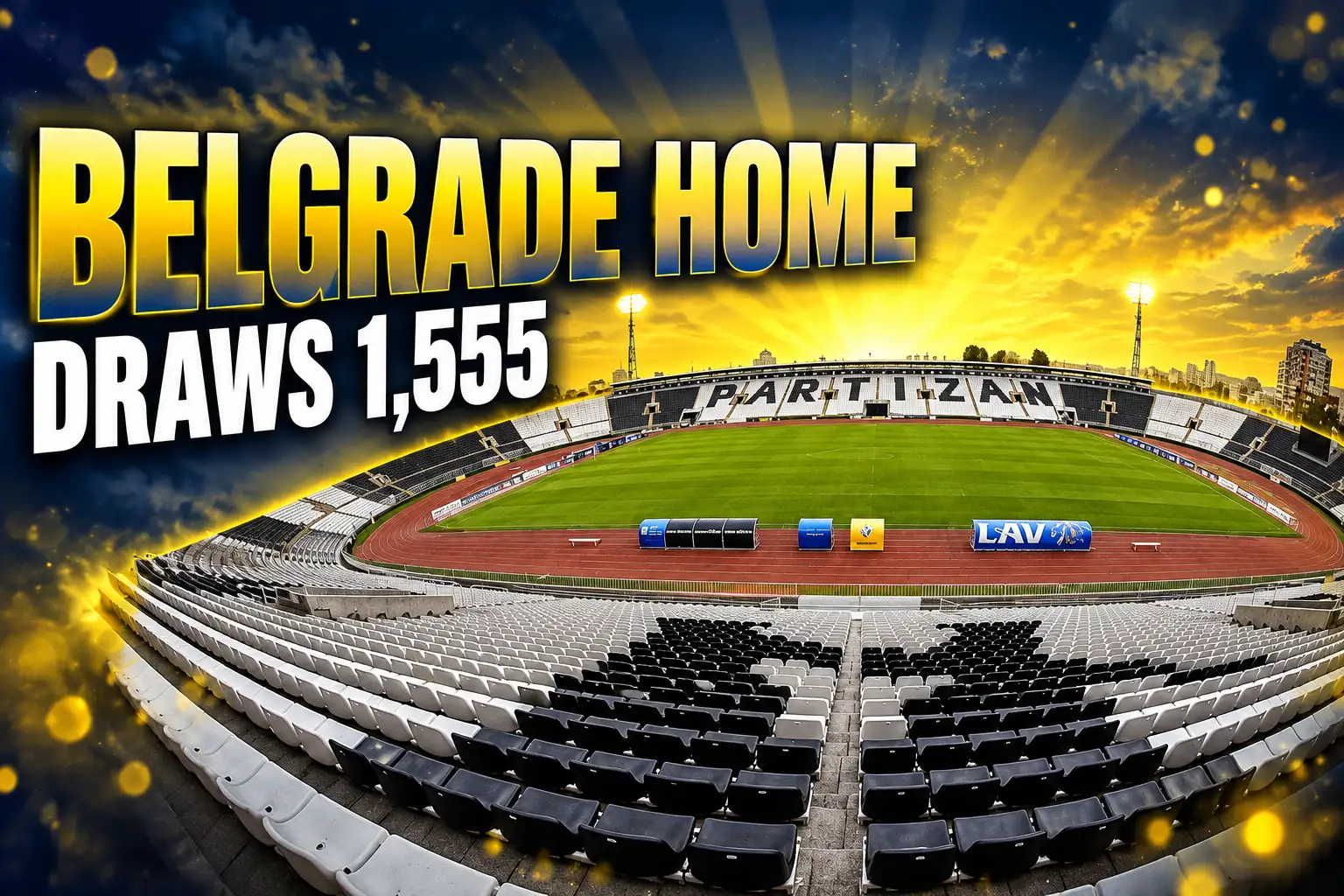
Maccabi Tel Aviv’s four Europa League home games at Partizan Stadium drew 1,555 fans, filling 1.2% of the listed 32,710 seats. The club had promised a Belgrade home with supporters after UEFA barred matches in Israel in October 2023. The stands stayed almost empty, and the season’s worst night came on the road in Amsterdam.
Four Home Nights, 1,555 People
On September 11, 2024, Maccabi Tel Aviv said it would stage its league-phase home matches at Partizan Stadium “with fans,” after Partizan Belgrade FC and the Serbian Football Association signed off. Midtjylland, Real Sociedad, RFS of Riga and Porto were the listed visitors. Ticket details, the club said, would follow.
🏟️🔵🟡
מכבי תל אביב תארח את משחקי הליגה האירופית באצטדיונה של פרטיזן בבלגרד, בסרביה עם קהל. ההחלטה התקבלה אחרי אישורים של פרטיזן בלגרד וההתאחדות לכדורגל הסרבית.
פרטים בנוגע להליך מכירת הכרטיסים למשחקי הבית יפורסמו בהמשך.Maccabi Tel Aviv will host the UEL League Phase home… pic.twitter.com/8Oznspd1N8
— Maccabi Tel Aviv FC (@MaccabiTLVFC) September 11, 2024
The turnstiles never caught up with that wording. Transfermarkt’s Europa League attendance table logged 1,555 spectators across four matches at Partizan Stadium, an average of 389, or 1.2% of listed capacity, the lowest fill rate among the grounds it ranked that season.
THE FOUR BELGRADE HOME NIGHTS
| Date | Opponent | Score | Attendance |
|---|---|---|---|
| October 3, 2024 | Midtjylland | 0-2 | 200 |
| October 24, 2024 | Real Sociedad | 1-2 | 429 |
| December 12, 2024 | RFS | 2-1 | 253 |
| January 30, 2025 | Porto | 0-1 | 673 |
The only Belgrade win was the December night against RFS, when Idan Nachmias and Nemanja Stojić headed in the goals. Before the league phase even started, a playoff “home” leg had already drawn 270. An open stadium in October, then again in a Belgrade January, was a long trip for a crowd that still had Bloomfield in its head, and the people who posted under the club’s announcement said as much, asking first about Ajax tickets and calling a roofless winter pitch a weak sell.
UEFA Closed Israel After October 7
The venue problem did not begin in Serbia. After the October 7, 2023 attacks and the war that followed, UEFA first postponed fixtures scheduled in Israel, then made the halt open-ended.
HOW THE VENUE BAN WAS SET
- October 8, 2023: UEFA postpones all matches scheduled in Israel over the following weeks, including Israel’s European Qualifier against Switzerland.
- October 19, 2023: The UEFA Executive Committee decides that no competition matches will be played in Israel until further notice, and tells the Israel Football Association, Maccabi Haifa and Maccabi Tel Aviv to propose grounds outside the country.
- October 31, 2023: UEFA confirms Israel’s next qualifiers will be staged in Hungary, repeating that no UEFA competition matches shall be played in Israel until further notice because of the security situation.
- September 11, 2024: Maccabi names Partizan Stadium as its Europa League home, with fans permitted.
Israeli clubs still played their domestic fixtures at home. European nights were a different file. Bloomfield Stadium holds 29,400 in Tel Aviv, and none of those seats could be used for a UEFA tie while the ban held. Maccabi’s first qualifying “home” nights of 2024-25 were already on the road, including one logged at 34 people, before the club even reached Belgrade.
Why Serbia Said Yes
Hungary had already hosted Israeli national-team games. Serbia took the club nights, first in Belgrade, then in the smaller TSC Arena at Bačka Topola. Marko Begovic, an associate professor in sport management at Molde University and author of a book on sports policy in the Western Balkans, laid out why that pairing stuck.
WHY SERBIA FIT THE BRIEF
- The diplomacy: Serbia has stable ties with Israel and a record of cooperation that makes the hosting politically usable.
- The posture: Begovic said Serbia keeps a relative neutrality, with political ambiguity on both the Middle East and the war in Ukraine, so Belgrade can be sold as a compromise site.
- The grounds: The country has stadiums that meet UEFA rules, from Partizan’s listed 32,710 down to TSC Arena.
He also pointed to an older regional habit. Other former Yugoslav republics have hosted Israeli clubs in football and basketball, which he called part of the institutional memory of the old federation, a place that once lived through its own sporting ban in the 1990s. Serbian officials have described Israel as a close partner. For Partizan, the arrangement was a rental, not a derby. The Grobari were not the night’s story. The story was how few people came.
Five Weeks Later, Amsterdam Police Logged 62 Arrests
The first Belgrade night was October 3, 2024, a 0-2 loss to Midtjylland in front of 200. Five weeks later Maccabi went to the Johan Cruyff Arena. Ajax won 5-0 in front of 53,719, and the match was the least of it.
Amsterdam police said visiting supporters were attacked, abused and pelted with fireworks after the game. They logged 62 arrests, sent five people to hospital (all discharged the next day) and counted 20 to 30 more with light injuries. About 2,600 Maccabi fans were escorted to the ground. Israeli officials arranged extra flights home, including El Al departures that ran on the Sabbath. The Israeli embassy said hundreds of fans were attacked; the police numbers are the ones that sit on the record.
What happened over the past few days is a toxic cocktail of antisemitism, hooligan behavior, and anger over the war in Palestine and Israel, and other countries in the Middle East.
Femke Halsema, Mayor of Amsterdam
Dutch Prime Minister Dick Schoof called the violence antisemitic. Video from the days before the match showed some Maccabi supporters tearing down a Palestinian flag, chanting anti-Arab slogans and wrecking a taxi, which the police also logged. On December 24, 2024, an Amsterdam court sentenced five men to terms of up to six months. UEFA said it would study the reports. The next Europa League date, against Beşiktaş, was moved out of Istanbul after Turkish authorities refused to stage it, then played in an empty stadium in Debrecen, Hungary. Maccabi won 3-1. Coach Žarko Lazetić said they play football because of the fans, to give them pleasure and excitement and to be together. There was no one in the seats to hear it.
Bačka Topola Inherited the Empty House
Belgrade was not a one-season patch. For 2025-26 Maccabi listed its designated home nights at TSC Arena in Bačka Topola, a town in northern Serbia, again because UEFA still would not clear Tel Aviv. The gates stayed tiny.
THE TSC ARENA TURNSTILES
- Dinamo Zagreb: 255 on October 2, 2025, a 1-3 loss.
- Midtjylland: 487 on October 23, 2025, a 0-3 loss.
- Lyon: 320 on November 27, 2025, a 0-6 loss.
- Bologna: 81 on January 29, 2026, a 0-3 loss.
The club had already used the same ground for qualifying, including a 3-1 playoff win over Dynamo Kyiv in front of 115. Serbia remained the landlord because the politics still fit and the stadiums still passed. The football did not improve with the change of town. In the 2024-25 league phase Maccabi took 6 points from eight games, scored 8 and conceded 17, and finished the league phase in 29th. The two wins were Debrecen and the RFS night in Belgrade. Away from those two, the “home” games were a training pitch with UEFA branding.
UEFA’s Israel Venue Ban Outlasted the Belgrade Season
On February 17, 2026, UEFA said the October 2023 decision still stood. A February report that European soccer might return to Israel that June did not produce a cleared Tel Aviv calendar. Israeli clubs kept nominating grounds in Serbia, Hungary, Romania and, in August 2026, Batumi in Georgia. Away cities kept making their own calls, including closed doors and bans on visiting supporters, with the Amsterdam night still in the briefing notes.
UEFA President Aleksandar Čeferin, asked in 2025 about Israel’s place in the competitions, called it “a legitimate question” and also said that, in principle, he is not an advocate of stopping athletes from competing. The governing body kept the clubs in the draw and kept them off Israeli grass. Begovic’s warning sits next to that split: bans, he said, have not ended the wars they answer, and sport is being asked to do work it cannot finish.
Partizan Stadium did its narrow job. It gave Maccabi four legal home dates, a roof-optional pitch, and a paper agreement that supporters could come. They mostly did not. The 1,555 people who did walk in saw one win and three losses, then watched the season’s largest crowd, and its ugliest hours, happen somewhere else.
Frequently Asked Questions
Did Maccabi Tel Aviv reach the Europa League knockouts in 2024-25?
No. That season used a 36-team league phase, with the top eight going straight to the round of 16 and teams placed 9th to 24th going into a knockout playoff. Maccabi’s 6 points and 29th-place finish left the club in the group that went home after eight matches.
How many fans did UEFA expect for the Porto night in Belgrade?
Match organisers told Portuguese reporters they were planning for at most about 800 people in Partizan Stadium, including about 500 Porto supporters and 150 from Israel, plus a few late sales. The logged crowd was 673, the largest of Maccabi’s four Belgrade gates and still a speck in a 32,710-seat ground.
Where did Maccabi play European home games before Partizan Stadium?
The club’s 2024 qualifying “home” legs were already outside Israel, including a 3-0 win over Panevėžys logged at 34 people and a 3-0 playoff win over TSC logged at 270. Those nights came before the September 11, 2024 Belgrade announcement and showed the empty-house pattern before the league phase began.
Where has Maccabi hosted European games since leaving Belgrade?
The 2025-26 designated home matches were listed at TSC Arena in Bačka Topola. In August 2026 the club staged Europa League qualifying in Batumi, Georgia, drawing 1,012 against Sheriff Tiraspol, then was ordered to play the next home game behind closed doors and fined 40,000 euros (about $46,000) after fans lit fireworks.

Ninja Theory Staff Face Redundancy After Two Xbox Sales Collapse

Amazon Sells the MacBook Air at Its Pre-Hike Price

U.S. Slows Jet Parts to Squeeze China’s Flying Fleets

PEGI Pulled the GTA 6 Age Rating After Cocaine Details

Northwestern’s Smaller Ryan Field Gave Penn State Nowhere to Hide

Aramco Crash Kills 14 Two Days After Oil Restart

Salah Captained Egypt to Their First World Cup Win

Apple Labor Day Deals Hide June’s Memory Price Hike

Palworld 1.0.4 Adds Palpedia Search After the 1.0 Launch

Zelda’s 40th Switch 2 Ships Without a Zelda Game
-
 BUSINESS3 months ago
Aramco Crash Kills 14 Two Days After Oil Restart
-
 NEWS4 months ago
Salah Captained Egypt to Their First World Cup Win
-
 NEWS1 month ago
Apple Labor Day Deals Hide June’s Memory Price Hike
-
 GAMING4 weeks ago
Palworld 1.0.4 Adds Palpedia Search After the 1.0 Launch
-
 GAMING4 weeks ago
Zelda’s 40th Switch 2 Ships Without a Zelda Game
-

 NEWS3 months ago
El Niño Puts Israel’s Needed Winter Rain on a Flood Clock
-

 BUSINESS8 months ago
Egypt Bets EGP 638 Billion Can Open Sinai to Investors
-

 ENTERTAINMENT4 weeks ago
King Charles Letter Keeps Harry and Meghan as Private Citizens