
NEWS
Körber Takes a Stake in NAiSE, Founders Stay in Charge
Körber is buying a seat on NAiSE’s vendor-agnostic fleet software, which already runs mixed AGVs, AMRs and forklifts, while the Stuttgart founders keep control.

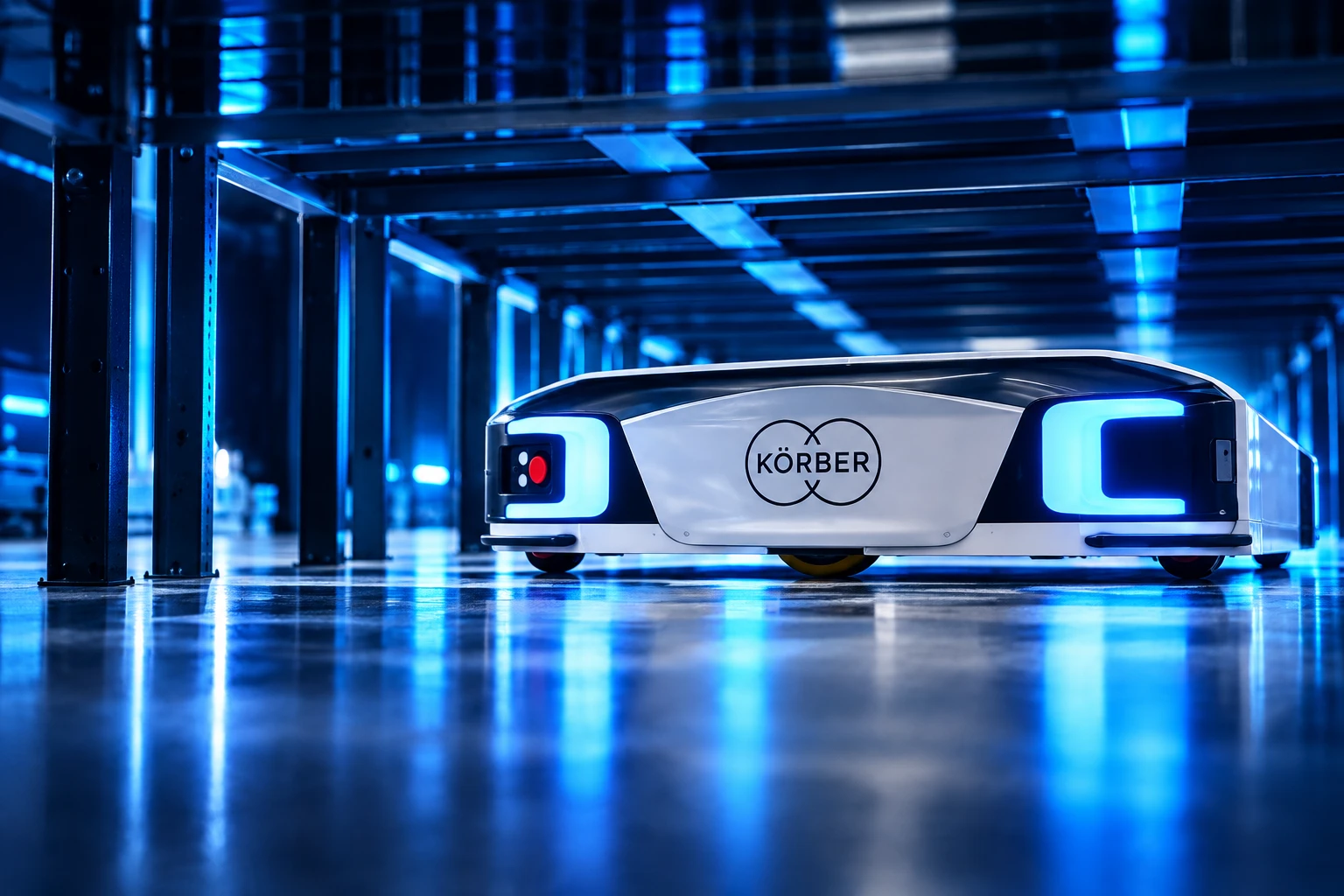
Körber is taking a stake in NAiSE, the Stuttgart software firm that runs mixed robot fleets from many makers on one control layer. The Hamburg group disclosed the deal on October 22, 2026, and left the three founders in operational charge. No price and no percentage were published.
NAiSE had taken no outside capital since 2017. Its first investor is a warehouse and manufacturing vendor whose other 2026 supply-chain deals were about taking control, not leaving it.
NAiSE Spent Nine Years Selling Independence
Kai Przybysz-Herz, co-founder and chief executive of NAiSE GmbH, put the condition in plain words when the stake was announced. The company, he said, picked a partner that would respect its independence and still help it scale abroad.
We deliberately chose a partner that respects our independence and also helps us scale internationally. Körber brings deep industrial experience, a global customer network and a genuine understanding of entrepreneurial thinking. For us, this is the foundation of our growth model.
Kai Przybysz-Herz, Co-Founder and CEO, NAiSE GmbH
He also said NAiSE stays under its own name and stays open to other system integrators and vehicle makers. That is not a courtesy line. The product NAiSE sells is a control layer that does not care which robot brand is on the floor, and which warehouse system sits above it.
Headquarters are in Stuttgart, with a showroom at the ARENA2036 research campus on Pfaffenwaldring. The platform already runs in plants in Europe, Asia, and North and South America. Support is delivered remotely from Germany. The software ships as a Docker instance, talks to factory systems over MQTT, REST, serial links and direct database access, and is sold as SaaS with an annual licence that scales with fleet size and modules.
Robert Libert and Raphael Kusumoto, the other founders, stay in operational management with Przybysz-Herz. Körber described itself as a strategic investor and sparring partner. NAiSE will keep trading with current and new partners as before.
What Körber Is Buying Besides Software
Körber’s October 22 statement, issued from Hamburg, said the group is expanding the software portfolio of its Business Area Supply Chain and turning an existing collaboration with NAiSE into a strategic partnership. Dr. Helena Garriga, the executive-board member who runs that business area, framed the purchase as a way to sell customers an end-to-end automation stack.
With NAiSE, we are gaining a partner that addresses the orchestration of mixed fleets with an approach that is vendor-agnostic, standardized and field-proven, exactly what the market needs today. Together with the founding team, we will unlock this potential and offer our customers an end-to-end automation solution.
Dr. Helena Garriga, Executive Board Member, Körber Business Area Supply Chain
The thing Körber could not build quickly sits below that sentence. Large plants now run automated guided vehicles, autonomous mobile robots and manned industrial trucks from several suppliers on the same floor. Each brand’s own fleet manager keeps those vehicles in a silo. NAiSE’s Fleet Management Software puts them on a shared control layer, and it does so whether the warehouse package behind it is a WMS, a WES or a WCS.
WHAT NAiSE ALREADY RUNS
- Live load: The software has already managed 61 vehicles on a single site, and NAiSE says that count is not a ceiling.
- Robot roster: The public network lists more than 28 robot brands already wired into the platform.
- Human floor: Forklifts and tugger trains join the same traffic picture through NAiSE’s own UWB locating kit or third-party RTLS, including omlox.
- Humanoid line: The company’s own FAQ already lists humanoid-robot integration on the product roadmap, alongside new AI models.
Garriga joined Körber’s board on September 1, 2024, after running a global business at Hitachi Energy. The NAiSE stake is a software move under her watch, not a robot-hardware buy.
More Than 28 Robot Brands Now Sit in One Map
NAiSE’s FAQ names a long compatibility list that mixes German truck makers, Chinese AMR volume players, and niche European platforms. Jungheinrich, Kuka, Hikrobot, Omron, Bosch Rexroth, KNAPP, AGILOX, Kärcher, Capra Robotics, Delta Electronics and Aumovio Mobile Robots all appear there, with locating and safety names such as Quuppa, Nokia, Pilz and Waveye beside them. Linde Material Handling’s AGVs are on the network too. Louis Vieira, head of sales for automation and intralogistics at Linde MH Germany, said those vehicles now run under NAiSE, so customers can choose an independent fleet-control system.
That roster is the hidden asset in the Körber deal. A Hamburg vendor that sells warehouse systems now has a documented path into plants that already bought someone else’s robots. The robot makers, in turn, get a route into Körber’s global accounts without surrendering their own fleet software.
WHO ALREADY SHARES THE FLOOR
| Partner | What sits in NAiSE | Why it matters on a mixed floor |
|---|---|---|
| Jungheinrich AG | AGVs and warehouse trucks | A core German hardware brand in the same aisle as rival AMRs |
| Kuka | Industrial robots | Puts a classic robot OEM under the same traffic logic as AMRs |
| Hikrobot | AMRs | Brings high-volume Chinese mobile robots onto a European control layer |
| Linde MH | L-MATIC and R-MATIC AGVs | Gives Linde customers a path off a single-brand fleet manager |
| Delta Electronics | D-Bot MAR and Dynamic Duo | Native VDA 5050 transport AMR, 500 kg payload, plus a cobot pairing |
| AUMOVIO | Mobile robots in live plants | Named customer results on travel and transport time |
Benedikt Branner, a smart factory specialist at AUMOVIO, said transport time on the ground floor fell by about 15 to 20 percent after NAiSE went in. Maximilian Schmid, a project manager for automation systems at the same company, put the travel-time gain at about 10 percent. Those are two different measures from one user, not a single blended saving.
On October 1, 2026, NAiSE held Intralogistics Wasen 2026 at ARENA2036, the mixed-fleet demo it has used to show robots, a forklift, locating kit and even a humanoid perception stack on one floor. Three weeks later Körber put capital behind that pitch.
VDA 5050 Is the Shop Floor’s Common Tongue
Mixed fleets only work if the vehicles can take orders from one master control. That is the job of VDA 5050, the interface written by the German Association of the Automotive Industry with VDMA and the Institute for Material Handling and Logistics at KIT. The current recommendation is VDA 5050 Version 3.0.0, dated March 2026. Older editions are no longer recommended. It is a recommendation, not a binding standard, and it covers talk between the master control and the robots, not the link up to ERP.
NAiSE says it speaks every existing VDA 5050 version at once, and that it also takes vehicles in through native interfaces and through MassControls. That driver layer is how a plant can run a VDA-compliant AGV beside an AMR that never implemented the spec. Interoperability has been the German shop-floor argument since VDA and VDMA started the work in 2017, the same year NAiSE was founded. Single-brand fleet managers still sell metal. The software above the metal is what a plant asks for once two brands share an aisle and refuse to share a map.
The NAiSE Intralogistics Platform splits that job into four modules that can run together or sit beside a customer’s own systems.
THE FOUR MODULES ON THE FLOOR
- Fleet Manager: One view of robots, forklifts, tugger trains and manual vehicles, with maps aligned so every machine navigates the same layout.
- Traffic Manager: Routing, conflict rules, doors, lifts, fire alarms and light curtains, so mixed traffic does not lock at a pinch point.
- Order Manager: A no-code link to ERP, WMS and MES that turns a business request into a transport job and assigns it across people and robots.
- Warehouse Manager: Live stock, handling units and station capacity, tied back to the same vehicles that move the goods.
A forklift guidance terminal puts human drivers into that same picture. Forklifts need a licence only if they take orders; traffic-only tracking does not add a seat. Languages in the product are English, German, Portuguese and Chinese. High-priority support tickets carry a first response inside two hours; low-priority tickets inside 24 hours.
Humanoids Are Already on NAiSE’s Roadmap
The Körber release said the partners will build new intralogistics cases, “including humanoid robotics.” That line reads like colour until it is set beside two other facts already on the record.
NAiSE’s FAQ, written for buyers rather than for this deal, already says the lab is deploying AI models and integrating humanoid robots. Waveye, the radar-perception firm on NAiSE’s partner list, has been in the Wasen demos. The control problem does not change if the next machine on the floor has legs instead of forks. Someone still has to assign the job, keep it out of the aisle, and stop it when a fire door drops.
Garriga’s other 2026 software move sits next to that problem. On March 17, 2026, Körber said it would build digital twins of warehouses with NVIDIA Omniverse libraries, using physics-accurate models to test layouts and to train advanced robotics, including humanoid systems in warehouses and parcel hubs, before those machines enter a live site. Stephan Seifert, Körber’s chief executive, said the twins let a customer design and tune an operation in software long before hardware goes in.
A twin that trains a humanoid still needs a live dispatcher once the machine is on the floor with yesterday’s AGVs and a manned forklift. NAiSE is that dispatcher. Körber did not say the NVIDIA work and the NAiSE stake are one product. Both sit in the same business area, under the same board member, in the same year, and both name humanoids.
Körber Leaves the NAiSE Founders in Charge
Körber is a privately held Hamburg technology group in manufacturing and supply chain. It closed 2025 with €3,116 million in 2025 sales, EBITA of €285 million, and 13,252 employees. Incoming orders were €3,354 million. Research and development spending was €199 million, 6.4 percent of sales.
The tone of its 2026 supply-chain file, until this stake, was control.
KÖRBER’S 2026 SUPPLY CHAIN FILE
- January 29, 2026: Buys the remaining shares in Godrej Körber Supply Chain Limited from Godrej & Boyce and makes the India business a wholly owned subsidiary.
- January 30, 2026: Signs a binding deal for a majority stake in Stellium, a Houston SAP supply-chain consultancy, to be run as Körber Stellium.
- March 17, 2026: Announces the NVIDIA collaboration on warehouse digital twins and physical AI, including humanoid training.
- October 22, 2026: Takes an undisclosed stake in NAiSE, leaves the founding team in charge, and writes independence into the public remarks.
Godrej and Stellium were majority or 100 percent moves. NAiSE is not. The difference is the product. A vendor-agnostic fleet layer that closed its door to Jungheinrich, Kuka, Hikrobot and Linde would stop being the product plants buy. Körber can plug NAiSE into its own warehouse suite and still need those other badges on the floor. That is why the light touch is the deal, not a kindness to a startup.
Rival Integrators Keep Their Seat at the Table
NAiSE will keep serving production logistics and related jobs on its own, and it will open its AGV and AMR partner list to joint customers and to new ones. Przybysz-Herz’s growth model depends on that door staying open. If Körber’s sales force becomes the only path in, the robot makers have no reason to keep certifying new models against a rival’s stack.
The next public date on NAiSE’s own calendar is LogiMAT 2027, at the Stuttgart Trade Fair Center on March 16. Between now and then the test is practical. A plant that already runs mixed iron will want to see a Körber-led project that still accepts a non-Körber robot, and a non-Körber integrator that still gets a full NAiSE licence. The founders still hold the keys. The Hamburg group just bought a seat at the same desk.

Cook Hands Democrats the House as Crypto’s Bill Stays Dead

Wicker’s Broken Bed Was the Short Story’s Punch Line

Nvidia’s $500 Billion Financing Plan Draws a $180 Sell

Maserati Bets the Grecale V6 Can Fill Porsche’s Gap

EV Cable Theft Follows the Old Railway Copper Playbook

Aramco Crash Kills 14 Two Days After Oil Restart

Salah Captained Egypt to Their First World Cup Win

Zelda’s 40th Switch 2 Ships Without a Zelda Game

Apple Labor Day Deals Hide June’s Memory Price Hike

Palworld 1.0.4 Adds Palpedia Search After the 1.0 Launch
-
 BUSINESS4 months ago
Aramco Crash Kills 14 Two Days After Oil Restart
-
 NEWS5 months ago
Salah Captained Egypt to Their First World Cup Win
-
 GAMING2 months ago
Zelda’s 40th Switch 2 Ships Without a Zelda Game
-
 NEWS2 months ago
Apple Labor Day Deals Hide June’s Memory Price Hike
-
 GAMING2 months ago
Palworld 1.0.4 Adds Palpedia Search After the 1.0 Launch
-

 NEWS4 months ago
El Niño Puts Israel’s Needed Winter Rain on a Flood Clock
-

 BUSINESS8 months ago
BAE’s 60-Year Saudi Franchise Now Runs Through Taif
-

 BUSINESS8 months ago
Egypt Bets EGP 638 Billion Can Open Sinai to Investors