
NEWS
How Fiber-Optic Drones Are Winning Israel’s War of Attrition
Israel set export records and eliminated Khamenei. Hezbollah’s unjammable fiber-optic drones keep killing IDF soldiers in the second War of Attrition.

Israel’s war of attrition with Hezbollah has found its defining weapon: a lightweight quadcopter connected to a fiber-optic cable that defeats every jammer Israeli forces have deployed. On June 5, 2026, the 59th anniversary of the Six Day War and the 44th anniversary of the First Lebanon War, Israeli troops hold Beaufort Castle for the first time in 26 years, defense exports closed 2025 at a record $19.2 billion, and Hezbollah’s fiber-optic drones are still killing soldiers in southern Lebanon.
The first War of Attrition, the three-year grinding campaign Egypt waged after losing the 1967 Six Day War, ran until August 1970. This one is in progress.
The Anniversaries That Won’t Let Go
June 5, 1967 ended six days later with a remapped Middle East. Israel pre-empted Arab armies on three fronts, eliminated their air forces within hours, and seized the Sinai Peninsula, the West Bank, the Golan Heights, and Gaza. The swift victory became a benchmark for decisive force. What followed drew far less attention: Egypt’s subsequent War of Attrition from 1967 to 1970, three years of artillery duels, commando raids, and aerial combat along the Suez Canal that produced significant casualties and changed no borders. It ended in a ceasefire that merely set the stage for the 1973 Yom Kippur War.
June 5, 1982 opened the First Lebanon War, launched to drive Palestine Liberation Organization (PLO) rocket units off positions used to shell northern Galilee towns. Israeli forces captured Beaufort Castle in some of the conflict’s bloodiest early fighting. The Israel Defense Forces (IDF) held a southern Lebanon security zone for 18 years. Prime Minister Ehud Barak ordered an overnight withdrawal in May 2000. Hezbollah celebrated the retreat as proof that sustained attrition could force Israel out, and subsequent events largely bore that reading out.
That 2000 withdrawal arguably contributed to the Second Intifada; the 2005 Gaza disengagement helped set conditions for the 2006 Second Lebanon War. Prime Minister Yair Lapid’s October 2022 maritime agreement with Lebanon, which granted Hezbollah’s Iranian sponsors a favorable boundary for offshore gas fields, came 13 months before October 7, 2023. Jerusalem Post columnist Liat Collins, writing on this week’s anniversary, framed the pattern directly: every pullback had been seen by adversaries as a victory and had given them “a taste for more.”
Defense Minister Israel Katz spoke at a memorial for fallen soldiers of the 1982 war this week: “Our heroic soldiers have captured Beaufort once again and will remain there as part of the security zone in Lebanon.” The Golani and Israeli flags above the ramparts carry tactical weight. They are also the third set of flags planted on that hilltop since 1982.
A Ledger of Spectaculars
The scale of what Israel has accomplished since October 2023 is genuinely difficult to process. On September 17 and 18, 2024, thousands of Hezbollah pagers and hundreds of walkie-talkies exploded across Lebanon, killing senior operatives and collapsing much of the organization’s command network. Ten days later, on September 27, Hassan Nasrallah, Hezbollah’s secretary-general, was killed in an IDF airstrike on the organization’s Beirut headquarters. Most of his successors followed in rapid strikes through late 2024.
Operation Rising Lion, launched in June 2025, struck Iran’s nuclear enrichment facility at Natanz, killed senior Islamic Revolutionary Guard Corps (IRGC) officers, and opened a 12-day conflict ending in a U.S.-brokered ceasefire. Nine months later, Operation Roaring Lion, a joint U.S.-Israeli campaign, began on February 28, 2026; Supreme Leader Ali Khamenei was killed in the opening strikes. A ceasefire with Iran took effect on April 8, 2026, after 40 days of combat.
Israel’s Defense Ministry published its 2025 export report on June 2, showing:
- $19.2 billion in defense exports, up approximately 30 percent year over year, the fifth consecutive annual record
- $10 billion in government-to-government deals, also a record
- 53 percent of contracts classified as “mega-deals” valued over $100 million each
- Surveillance and electro-optical systems rising from 6 percent to 22 percent of total deal volume, as buyers sought combat-proven technology
- Europe accounting for 36 percent of exports; Asia-Pacific, 32 percent
France blocked Israeli companies from displaying offensive weapons at a Paris defense fair the same week the figures were published. The ministry credited demand growth partly to the performance of Israeli systems during Operation Rising Lion. European governments that had publicly restricted weapons transfers to Israel were among the top buyers.
Why the Fiber-Optic Drone Is Winning
A Cable That Defeats the Jammer
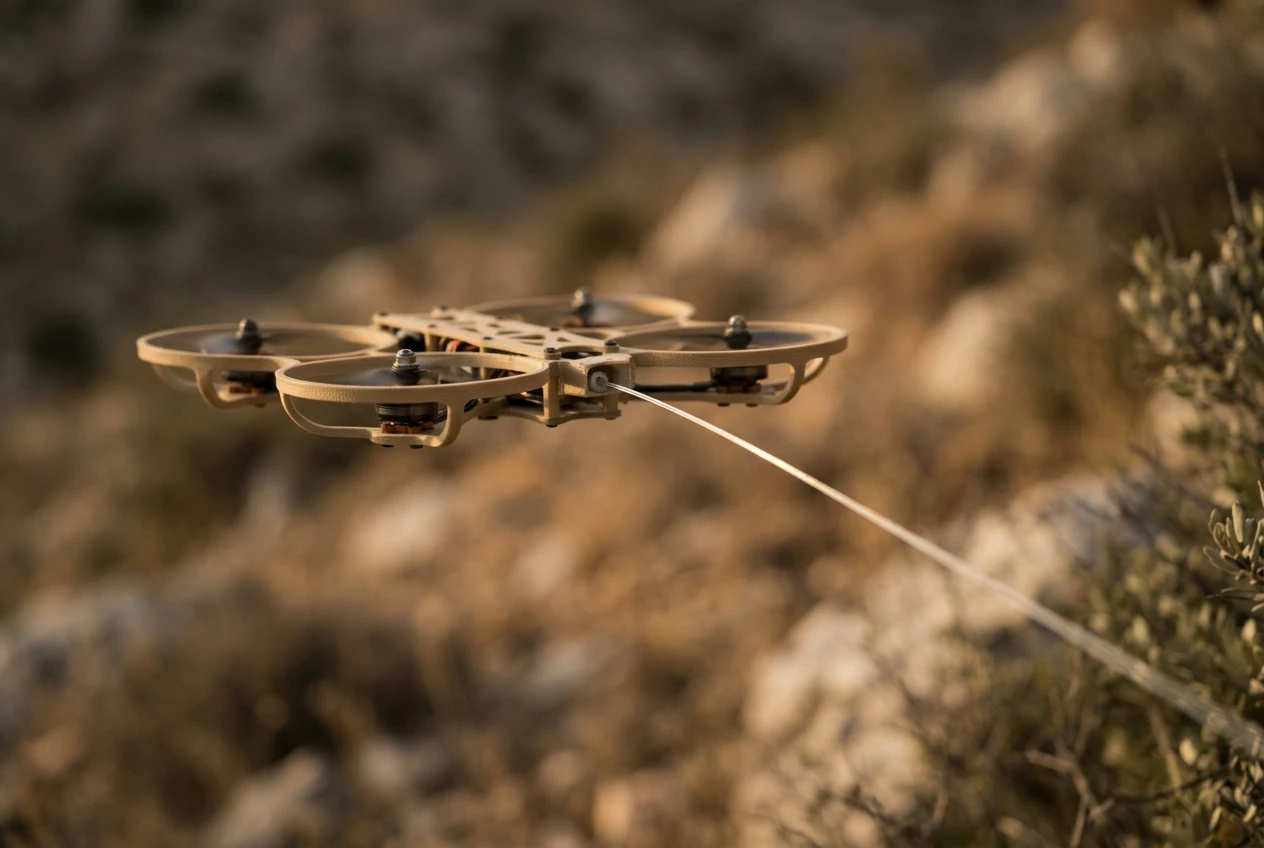
Hezbollah’s first-person view (FPV) attack drones, assembled in southern Lebanon workshops for a few hundred dollars each, have become the IDF’s most urgent unsolved tactical problem. They operate through a physical fiber-optic cable, not radio frequencies or satellite signals. The cable extends up to 15 kilometers, feeding a high-resolution video stream directly to the operator. Because no wireless signal enters the air, Israel’s electronic warfare jamming systems have nothing to intercept. The fibreglass airframe emits almost no thermal or radar signature, leaving early-warning sensors without a target.
| Feature | Radio-Controlled FPV Drone | Fiber-Optic FPV Drone |
|---|---|---|
| Control signal | Radio frequency | Physical fiber-optic cable (up to 15 km) |
| Electronic jamming | Vulnerable | Immune, no wireless signal to intercept |
| Radar and thermal signature | Small but detectable | Near-zero (fibreglass frame) |
| Launch-site detection | Possible via triangulation | Undetectable |
The drones have also bypassed the Trophy active protection system on Israeli Merkava tanks, designed to intercept incoming projectiles. The FPV operator steers manually via live camera feed into turret joints, track links, or exposed crew positions, using uncompressed optical video that leaves no electronic trace for jamming systems to act on.
From Ukraine to Southern Lebanon
The technology was adapted from Ukraine, where Russian forces deployed fiber-optic-tethered FPV drones to operate through heavily jammed environments along contested front lines. The Foundation for Defense of Democracies, in a May 2026 analysis, noted that Hezbollah did not develop this weapon but adapted it by observing battlefield developments in eastern Europe. In April 2026, a fiber-optic drone struck an armored unit near Taybeh, killing 19-year-old Sgt. Idan Fooks and wounding six others. Hezbollah then launched additional drones at the rescue helicopter that responded to evacuate the wounded.
Israeli defense officials told Israeli media they are concerned Hezbollah may have acquired drone variants with operational ranges approaching 60 kilometers, which would put Haifa within reach. For context: the pre-1967 borders placed Arab-controlled territory six kilometers from Ben-Gurion Airport. The argument for buffer zones predates fiber-optic cables by decades.
Netting and the $19 Billion Gap
The mismatch between Israel’s export ledger and its field response is stark. Israel Aerospace Industries, Rafael Advanced Defense Systems, and Elbit Systems, the country’s three largest defense firms, held a combined order backlog approaching $90 billion at the end of 2025. The country sells missile defense batteries, radar systems, electronic warfare suites, precision munitions, and surveillance drones to armies across Europe, Asia, and the Gulf. The current field-expedient answer to the unjammable quadcopter in southern Lebanon is netting over outposts.
Netanyahu told his cabinet on May 18 that “the best minds in the country” are working on the drone problem with no budget constraint, and approved a dedicated counter-drone spending program. The Defense Ministry divided the effort into parallel tracks:
- Short-range tactical radar systems for drone detection, with some units deployed in the field by late May 2026
- Acoustic detection arrays, under evaluation alongside optical sensor clusters
- Drone interceptor drones, in active testing
- Energy-based directed weapons designed to damage drone electronics, in development
In the end, there is no good solution for fiber-optic drones in Ukraine either.
The assessment came from an Israeli security source cited in defense reporting in late May 2026. The IDF has also been studying Hezbollah’s own published combat footage for approach-path patterns and running demonstrations with Israeli startups working on interception technology.
Israel built Iron Dome through the same iterative emergency cycle: a threat arrived, a development program mobilized, and within years the system was in global demand. The timeline for a workable fiber-optic countermeasure is the one question no official will commit to on record.
The Trump Constraint
On June 1, Netanyahu and Defense Minister Katz issued a joint statement announcing plans to strike Hezbollah targets in the Dahieh district of Beirut, citing repeated ceasefire violations. Iran’s Foreign Minister Abbas Araghchi warned that Israeli action in Lebanon would violate the U.S.-Iran ceasefire framework agreed in April 2026. Within hours, Trump called Netanyahu. Axios reported the exchange bluntly: Trump called Netanyahu “fucking crazy,” according to a U.S. official summarizing the call, and said the Beirut threats would “further isolate Israel around the world.” An Israeli official told Axios the strikes would not go ahead.
Trump’s concern follows his own strategic logic. His negotiations with Iran’s post-Khamenei government hinge on regional de-escalation, and the U.S.-Iran memorandum being negotiated reportedly calls for an end to the Lebanese fighting as part of any wider nuclear agreement. A large airstrike on Beirut’s southern suburbs would force Tehran to exit those talks.
Netanyahu issued a public statement after the call: Israel would attack Hezbollah targets in Beirut if ceasefire violations continued, and IDF operations in southern Lebanon would proceed regardless. The Lebanese Embassy in Washington said Hezbollah had accepted a U.S. proposal for a reciprocal halt, Israeli strikes on Dahieh stopping in exchange for Hezbollah ceasing attacks against Israel. By Tuesday morning, Hezbollah drones were still striking northern Israeli communities.
Beaufort, Again
Beaufort Castle was built by Crusaders in the 12th century on a rocky hilltop in southern Lebanon, roughly 700 meters above sea level, overlooking the Litani River and most of the terrain between the mountain ranges and the Israeli border. It changed hands between Crusaders, Mamluks, and the Ottoman Empire over several centuries. Palestinian fighters used it as a base before 1982. IDF forces captured it early in the First Lebanon War, held it for 18 years, and left in Barak’s 2000 withdrawal.
On May 31, 2026, the Golani Brigade planted its flag there again. Netanyahu called the recapture “dramatic.” The Institute for National Security Studies, in its post-Roaring Lion strategic assessment, concluded that Iran had “been damaged, but not defeated.” The assessment fits southern Lebanon as well: Hezbollah has lost most of its senior leadership, and its drone program keeps flying regardless.
Joseph Cedar’s 2007 film Beaufort documented the grinding experience of soldiers holding that ridge in the late 1990s, permanently exposed on a strategic hilltop under persistent threat. Netanyahu announced $4.5 billion to rebuild northern Israel’s war-battered communities this week, even as fresh Hezbollah drone strikes wounded four IDF soldiers the same day. The Golani flag flies above the Litani valley again.
The fiber-optic cable reels out below it.

Palworld 1.0.4 Adds Palpedia Search After the 1.0 Launch

Hersheypark Docks Tidal Force After 32 Years of Splashes

Trump’s Bombardier Threat Lands First on Kansas Shops

Nick Bosa Will Play the Rams on a Repaired Knee

Foremost Farms Will End 40-Pound Blocks in Marshfield

Apple Labor Day Deals Hide June’s Memory Price Hike

Russia Hits Kyiv After Witkoff and Kushner Talks
Trump’s Bombardier Threat Lands First on Kansas Shops

Hawaii Reran Its Iniki Playbook as Lowell Missed Kauai

King Charles Letter Keeps Harry and Meghan as Private Citizens
-
 NEWS2 weeks ago
Apple Labor Day Deals Hide June’s Memory Price Hike
-
 NEWS7 days ago
Russia Hits Kyiv After Witkoff and Kushner Talks
-
 BUSINESS6 days ago
Trump’s Bombardier Threat Lands First on Kansas Shops
-
 NEWS7 days ago
Hawaii Reran Its Iniki Playbook as Lowell Missed Kauai
-
 ENTERTAINMENT7 days ago
King Charles Letter Keeps Harry and Meghan as Private Citizens
-
 BUSINESS7 days ago
Foremost Farms Will End 40-Pound Blocks in Marshfield
-
 GAMING6 days ago
Palworld 1.0.4 Adds Palpedia Search After the 1.0 Launch
-

 TECHNOLOGY3 years ago
How to Stop Tiny Task from Slowing Down Your Computer