
NEWS
TeraCyte’s Bio Tokens Lead Israel’s Shared Biology AI Plan
TeraCyte chairs Israel’s NIS 70 million BioToken Factory, a shared live-cell AI layer that lists NVIDIA and Teva as partners.

Israel and industry partners pledged NIS 70 million (about $23.3 million) on July 12, 2026, for a shared biological AI platform and put TeraCyte’s chairman in charge of it. The Israel Innovation Authority named the project the Israel BioToken Factory Initiative, or IBFI, and listed NVIDIA and Teva Pharmaceutical Industries among six industry partners.
The masthead reads like a chip-and-pharma launch. The layer they agreed to build started as a TeraCyte bid to turn pictures of living cells into units an AI model can read.
TeraCyte Wrote the Bid a Year Before NVIDIA
In 2025, the Authority posted a September 2025 call for consortium partners under the same IBFI name. The note said a group that included TeraCyte Analytics, AI21, and CytoReason was forming a proposal for a foundation model in life sciences and medicine. Companies and labs that wanted in were told to file by September 22, 2025, and to write TeraCyte for details.
The July 2026 roster kept TeraCyte and CytoReason. It added NVIDIA, Teva, Sheba Medical Center, and MeMed. AI21, named on the organizing note, does not appear among the partners the Authority published with the launch. Yoav Nissan Cohen, TeraCyte’s CEO and chairman, is named chairman of the consortium.
That sequence is the part the NVIDIA-Teva headline buries. The national wrapper arrived after TeraCyte had already described Bio Tokens as math derived from living cells, not after a chipmaker invented a new biology file format.
HOW IBFI MOVED FROM A BID TO A LETTERHEAD
- August 2025: The Authority posts an IBFI organizing note led by TeraCyte Analytics, with AI21 and CytoReason named among the entrepreneurs assembling a bid.
- September 22, 2025: Deadline for other firms and research groups to ask to join that bid.
- June 23, 2026: NVIDIA, already a CytoReason backer, publishes a separate life-sciences agent toolkit under its BioNeMo brand.
- July 12, 2026: The Authority announces IBFI as a national consortium, with Nissan Cohen as chairman and NVIDIA and Teva on the partner list.
The Authority’s own post carried the same partner list in Hebrew the day of the launch.
רשות החדשנות מובילה השקעה של כ 70 מיליון ש"ח בהקמת תשתית ידע לאומית לפיתוח מודלי AI מבוססי מידע ביולוגי, המודלים יזרזו גילוי תרופות ויפתחו רפואה מותאמת אישית.
המאגד החדש שיוקם יקרא Israel BioToken Factory Initiative או בקיצור IBFI, ויפתח תשתית טכנולוגית משותפת שתאפשר לחברות,… pic.twitter.com/Kirz23Lo1V
— רשות החדשנות (@InnovationAut) July 12, 2026
Bio Tokens Start as Pictures of Live Cells
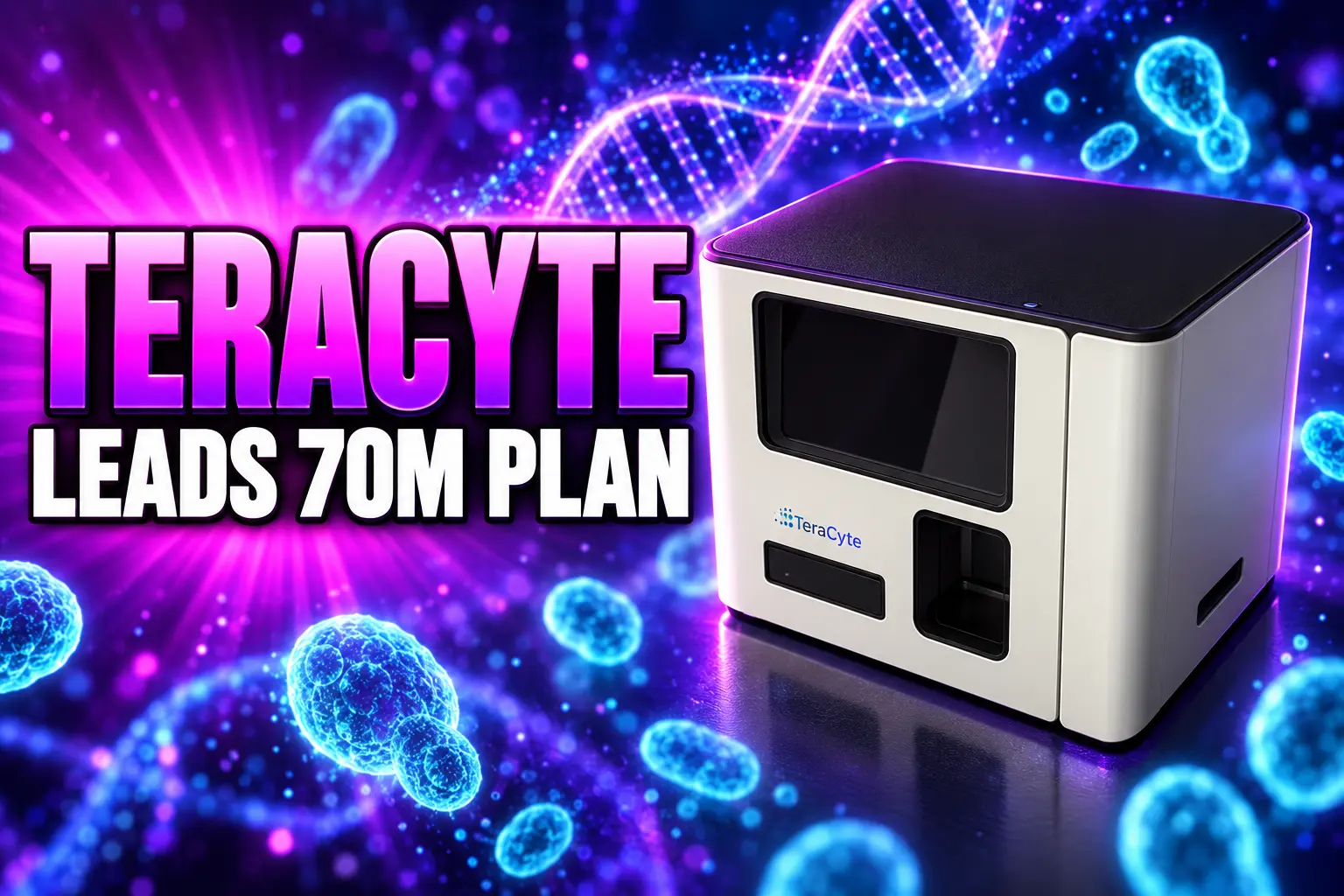
The 2025 organizing note did not talk about a generic data standard. It described a silicon imaging array, TeraCyte’s, that photographs millions of live cells and their contents at high resolution across time, depth, and spectrum. Those readings, the note said, would be turned into Bio Tokens, compact values meant for machine learning that stand in for cell activity, then stored beside the static molecular tables labs already use, genomics, transcriptomics, and proteomics.
The July launch kept the name and widened the claim. Bio Tokens, the Authority said, will be a standardized representation layer for different types of biological data. A second piece, the Factory Model, is supposed to let partners build, combine, run, and share AI models on that layer. Together they are meant to put molecular, cellular, dynamic, and clinical data in one computational frame.
Everyone is talking today about AI in biology, but biology still does not speak a language that AI can understand. IBFI was established to build the infrastructure and the language on which the next generation of biological AI will be based.
Yoav Nissan Cohen, Chairman of the Consortium, CEO and Chairman of TeraCyte, Israel Innovation Authority
Nissan Cohen’s second sentence in that statement is a product promise, not a completed tool. The launch note does not define the token alphabet, the lab standard, or how missing and conflicting measurements will be handled. Those are the engineering jobs the Factory Model is supposed to absorb, and they are still ahead of the consortium.
Dror Bin, CEO of the Israel Innovation Authority, put the same gap in public-sector language. He said the hard problem is no longer simply building more advanced models, but building the shared base that lets those models learn from the complexity of human biology, including a uniform representation of biological data, disease models, and clinical checks on the outputs.
Six Partners Share Work the Release Does Not Split
The Authority’s NIS 70 million investment with industry partners names six companies and four laboratory leads. It does not publish work packages, budgets per partner, or who owns the code. The public record is a roster, plus what each firm already sells.
WHO SITS ON THE IBFI ROSTER
| Partner | What it already does | IBFI seat |
|---|---|---|
| TeraCyte Analytics | Live-cell imaging on silicon; Bio Token concept in the 2025 bid | Chairman; named industry partner |
| CytoReason | Computational disease models used inside pharma R&D | Industry partner; its chief scientist is an IBFI investigator |
| MeMed | Host-response tests that read immune activity in blood | Industry partner |
| NVIDIA | Accelerated computing and the BioNeMo biology tool stack | Industry partner |
| Teva Pharmaceutical Industries | Drug development at commercial scale | Industry partner |
| Sheba Medical Center | Hospital records, clinical workflows, and an innovation arm | Healthcare partner |
Scientific work is led by Prof. Eran Segal and Prof. Nir Yosef of the Weizmann Institute of Science, Prof. Shai Shen-Orr of the Technion, and Prof. Assaf Zaritsky of Ben-Gurion University of the Negev. Shen-Orr is also co-founder and chief scientist of CytoReason, so one of the four academic seats is occupied by a person who already runs an industry partner.
Gila Gamliel, minister of innovation, science and technology, called the mix of technology firms, pharma, hospitals, and universities a force multiplier for AI-based medical tools. The Authority called the whole thing pre-competitive R&D, meaning partners are supposed to share basic tools before each one products a separate drug or test.
NVIDIA Already Sells a Biology Toolbox
Nineteen days before IBFI was announced, NVIDIA published its BioNeMo Agent Toolkit for life sciences. The company said the kit packages protein structure prediction, docking, generative chemistry, genomics, protein design, and biomarker work as skills an AI agent can call, and that more than 50 companies were already using it. Jensen Huang, NVIDIA’s founder and CEO, described BioNeMo as the scientific toolbox sitting next to frontier models.
That product line is why NVIDIA’s name on IBFI does not mean Israel is building a second BioNeMo. The Israeli project is trying to mint a common representation of local biological measurements, including live-cell images and hospital records, that models (NVIDIA’s or anyone’s) could consume. The chipmaker is a listed partner with a stack already in market. The missing input is Israeli biology in a form those tools will accept.
CytoReason makes the same point in money. On July 17, 2024, the company announced an $80 million CytoReason funding round that included NVIDIA, Pfizer, Thermo Fisher Scientific, and OurCrowd. It said six of the world’s top ten pharma companies already used its disease models. Kimberly Powell, then NVIDIA’s vice president and general manager of healthcare, said CytoReason had used NVIDIA systems to get more than 10x acceleration on inference workloads.
THREE CHEQUES, THREE SCALES
- IBFI, July 2026: NIS 70 million, joint, Authority plus industry, split unpublished.
- Three other flagships, November 2025: about NIS 180 million over three years for soil cleanup, diamond semiconductors, and materials testing.
- CytoReason, July 2024: $80 million private round, with NVIDIA already on the cap table.
The national biology grant is smaller than one listed startup’s last private round, and it sits in the same band as other Authority flagships rather than beside NVIDIA’s global life-sciences push. A public top-up for firms that can already raise private cash only pays off if the shared token layer is something none of them would fund alone. That is the charitable reading. The harder one is that a well-known roster bought a MAGNET-scale cheque.
What NIS 70 Million Does Not Settle
The Authority said it is investing NIS 70 million together with leading industry partners. It did not say how much is a grant, how much is company cash, or how many years the work runs. The November 2025 flagships were explicitly “over the next three years.” IBFI’s launch note has no term.
WHAT WE KNOW
- The name and date: IBFI was announced on July 12, 2026, as a pre-competitive national consortium.
- The two layers: Bio Tokens for representation, Factory Model for building and running models.
- The people: Nissan Cohen chairs it; Segal, Yosef, Shen-Orr, and Zaritsky lead the science.
- The money line: NIS 70 million, Authority and industry together, about $23.3 million at the conversion used with the launch.
WHAT IS UNCONFIRMED
- The split: How much of NIS 70 million is public grant versus company spend.
- The clock: Start date, end date, and any extension rules.
- Access: Whether labs and hospitals outside the six partners can use the Factory Model, and on what terms.
- Intellectual property: Who owns tokens, trained weights, and clinical outputs.
Those blanks are not a paperwork nit. A shared layer that only the founding six can touch is a private club with a national name. A layer other Israeli hospitals can join is closer to what Bin described. The July text supports either reading, which is why the next public document that matters is an access policy, not another partner logo.
No later Authority update through early October 2026 filled those fields. The July letterhead is still the record.
Cancer, Sepsis, and Seven First Targets
IBFI is not a named drug program. The Authority listed first uses that all need mixed biological and clinical data, which is another way of saying they need Sheba as much as they need a GPU.
FIRST USES THE AUTHORITY NAMED
- Oncology response: Predict how a patient will react to cancer treatment.
- Immune activity: Score how the immune system is behaving.
- Drug hypersensitivity: Flag patients likely to react badly to a medicine.
- Sepsis decisions: Support clinicians when infection spirals.
- Transplant rejection: Assess whether a graft is being attacked.
- Autoimmune disease: Study conditions where the immune system misfires.
- Drug discovery: Search for targets and candidates on the shared layer.
MeMed already sells a host-response test, MeMed BV, that reads three immune proteins, TRAIL, IP-10, and CRP, and returns a bacterial-versus-viral score in about 15 minutes, with U.S. Food and Drug Administration clearance. That is the kind of immune readout IBFI lists in public. It is also a finished product, which raises a practical question the consortium has not answered: what MeMed contributes to a shared pre-competitive layer versus what it keeps as a commercial assay.
TeraCyte, for its part, has described work through Sheba’s ARC innovation arm on predicting which cancer patients are likely to suffer adverse effects from treatment, using the patient’s own cells. If that study’s measurements become Bio Tokens that Teva and CytoReason can train on, the consortium has a live circuit. If they stay inside one vendor’s file format, IBFI is a press release around existing contracts.
Sheba’s Records Still Have to Enter the Factory
Every application on that list dies without comparable patient data. Sheba is the only hospital named as a partner, which concentrates both the opportunity and the risk. Models tuned on one center’s mix of age, ancestry, devices, and charting habits can look sharp on internal tests and fail the next hospital over. The Authority’s text promises clinical validation. It does not say who holds consent files, how identifiers are stripped, or whether a second Israeli medical center can join without a new bid.
Privacy rules, ethics boards, and the gap between a research hypothesis and a tool that changes a sepsis or oncology decision are the slow part of this story. Tokens and a factory do not shorten that on their own. They only make it possible to run the same representation across a genome table, a cell movie, and a discharge note, if those objects are allowed to meet.
Until Sheba’s records and TeraCyte’s cell pictures actually sit in one token layer that CytoReason, MeMed, and Teva can call, IBFI is a chairman, a roster, and NIS 70 million without a public rulebook. NVIDIA and Teva made the announcement travel. The bet is still whether TeraCyte’s language for living cells becomes a national format, or stays a company trademark with a government stamp.
Disclaimer: This article is news reporting on a government-industry research consortium and is for information only. It is not medical advice, not an investment recommendation, and not a judgment on any drug, test, or hospital protocol named here. Readers who are patients, clinicians, or investors should consult a qualified physician, clinical researcher, or licensed financial adviser before acting on any health or capital decision. Figures, partner lists, and project status reflect the Israel Innovation Authority’s July 12, 2026, announcement and related public statements and may change as the consortium publishes budgets, access rules, or results.

Christa Pike Survived the Execution Tennessee Would Not Pause

Musk’s Oligarch Charge Hits a Queue of Three

Circle Puts USDC and EURC Into SAP Pay Workflows

Ring’s First Smart Lock Skips Home Wi-Fi for Sidewalk

GTA 6 Puts Cash Back on the Story Path

Salah Captained Egypt to Their First World Cup Win

Aramco Crash Kills 14 Two Days After Oil Restart

Apple Labor Day Deals Hide June’s Memory Price Hike

Zelda’s 40th Switch 2 Ships Without a Zelda Game

Palworld 1.0.4 Adds Palpedia Search After the 1.0 Launch
-
 NEWS5 months ago
Salah Captained Egypt to Their First World Cup Win
-
 BUSINESS4 months ago
Aramco Crash Kills 14 Two Days After Oil Restart
-
 NEWS2 months ago
Apple Labor Day Deals Hide June’s Memory Price Hike
-
 GAMING1 month ago
Zelda’s 40th Switch 2 Ships Without a Zelda Game
-
 GAMING1 month ago
Palworld 1.0.4 Adds Palpedia Search After the 1.0 Launch
-

 NEWS3 months ago
El Niño Puts Israel’s Needed Winter Rain on a Flood Clock
-

 ENTERTAINMENT1 month ago
King Charles Letter Keeps Harry and Meghan as Private Citizens
-

 ENTERTAINMENT4 months ago
A Thousand and One Drops Off Riyadh’s October Calendar