
NEWS
The iPhone Duo Posts 18 Pro Speed in a Foldable
The iPhone Duo’s Geekbench 7 run matches the iPhone 18 Pro, showing Apple skipped the usual foldable speed penalty ahead of October 16 pre-orders.

The iPhone Duo posted a Geekbench 7 single-core score of 3,986 on October 14, two days before pre-orders open.
The listing, tagged iPhone19,4 and running iOS 27.1, pairs Apple’s A20 Pro chip with 12 GB of RAM and a multi-core score of 11,067. Those figures land with the iPhone 18 Pro family that uses the same chip.
Geekbench Puts the Duo Next to the 18 Pro
Geekbench 7 recorded a six-core CPU at 4.93 GHz and 11.30 GB of memory, the usual way the platform writes a 12 GB phone. The GPU is a seven-core Apple design. This run did not test it.
Apple put the same A20 Pro in the iPhone 18 Pro and iPhone 18 Pro Max, built on a 2-nanometer process. A single Duo upload sitting with those phones, and a little under the highest Pro uploads on the same platform, is what a shared chip looks like. It is not proof the foldable is slower. It is also not a record for the chip.
Folding phones have spent years shipping a flagship processor on the spec sheet, then cutting clocks once the inner screen and the hinge stack fill with heat. Buyers learned to read the candybar score and assume a tax on the folding model. This listing is Apple’s first public CPU sample saying that tax is not baked into the Duo.
It is still one sample. Scores move from test to test, and a burst CPU run says nothing about a long game on the 7.6-inch inner display. The useful comparison is other folding phones on the same Geekbench 7 CPU test, not a victory lap.
GEEKBENCH 7 CPU SCORES ON CURRENT FOLDABLES
| Phone | Chip | Single-core | Multi-core | What the figure is |
|---|---|---|---|---|
| iPhone Duo | A20 Pro | 3,986 | 11,067 | One Geekbench 7 listing, 12 GB |
| Xiaomi 18 Fold | Xring O3 | 2,149 | 9,033 | Independent review, default mode, 12 GB |
| Galaxy Z Fold 8 | Snapdragon 8 Elite Gen 5 | 2,595 | 6,637 | After five minutes of ordinary use, Ice Universe |
On those CPU numbers the Duo is not in a close fight. The open question is whether the inner screen, the second display engine, and the hinge still pull the clocks down after the test window that Geekbench uses.
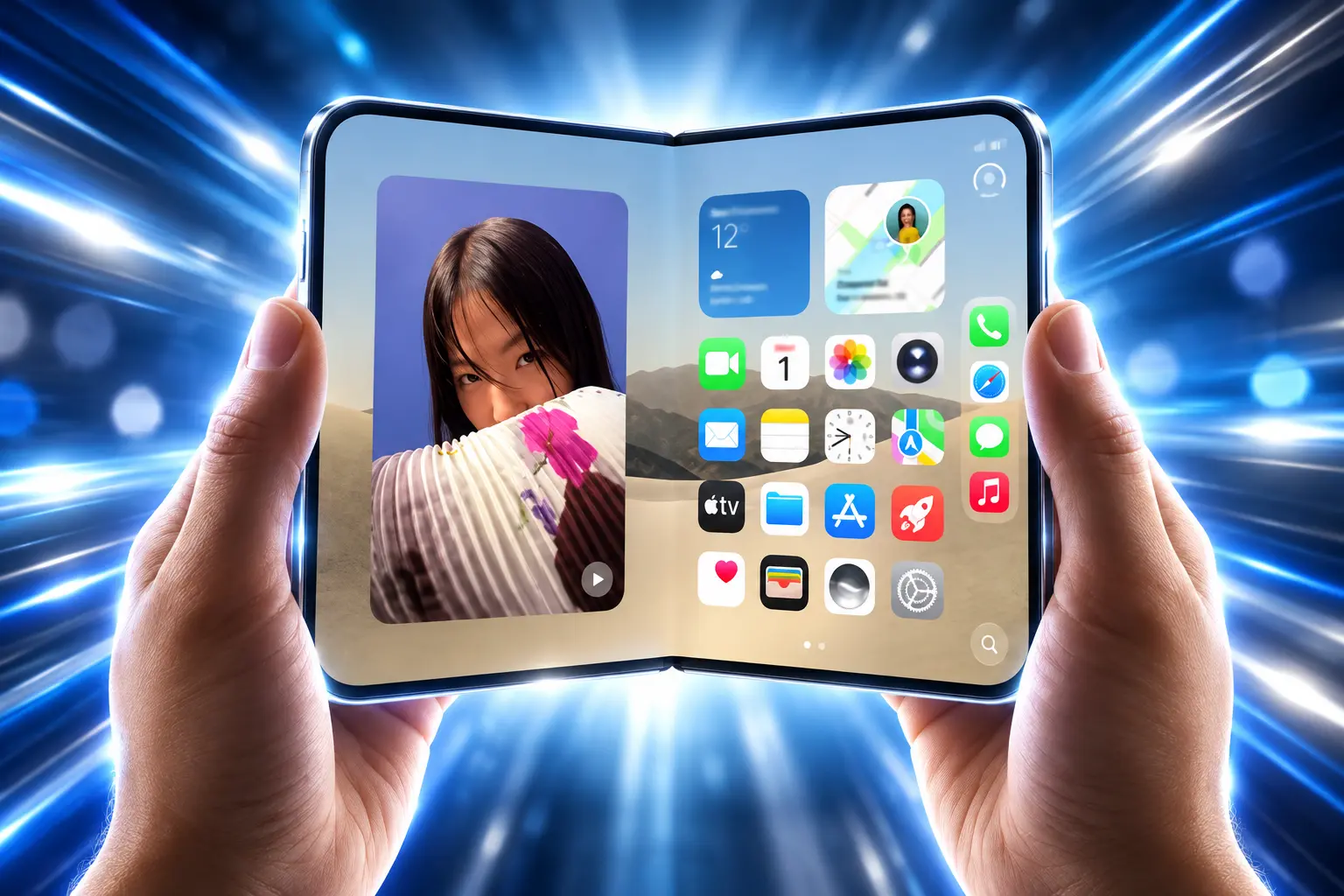
The Cooling Stack Is Built for a Pro Chip
Apple did not describe the Duo as a cut-down Pro. The September 9 newsroom post says the phone uses the A20 Pro from the iPhone 18 Pro models and ties that chip to a custom vapor chamber. A new package, drawn from M-series silicon, connects the die to that chamber so heat can leave the board instead of cooking the fold.
iPhone Duo delivers up to 35 percent better sustained performance than iPhone 17 Pro
Apple, September 9, 2026 newsroom
That up to 35 percent better sustained performance claim is the design brief. Apple also says the six-core CPU is up to 20 percent faster than A19 Pro, the seven-core GPU is up to 40 percent faster, unified memory bandwidth is 50 percent higher, and a Dual 16-core Neural Engine offers twice the on-device AI compute. A new display engine drives the inner and outer screens at the same time.
The mechanical side of that brief is heavy. The hinge uses more than 100 parts, supports the center of the inner display so it stays flat, and closes on a magnet array. The enclosure is grade 5 titanium in star white or night sky, with Ceramic Shield on the back, Ceramic Shield 2 on the outer display, and an IP68 rating. Closed, the 5.4-inch outer screen has 90 percent of the screen area of an iPhone 18 Pro. Open, the 7.6-inch inner screen is 50 percent larger than an iPhone 18 Pro Max. Both use ProMotion, Always On, and 3,000 nits of peak outdoor brightness.
Apple rates video playback at up to 31 hours on the inner display and 44 hours on the outer one, and it pairs the chip with a dual-battery layout. That is not a Geekbench screenshot. It is the hardware Apple says lets an A20 Pro live in a book that is the thinnest iPhone when opened. The October 14 listing is the first CPU check against that promise. GPU and long-session heat still sit with reviewers who get units after October 23.
Samsung Fold 8 Drops a Third of Its Multi-Core Score
The reason a median-looking Pro score on a foldable is news is that the rest of the category still pays. Ice Universe, a chip watcher who posts his own runs, put a Galaxy Z Fold 8 on Geekbench 7 against a Galaxy S26 Ultra that uses the same Snapdragon 8 Elite Gen 5 for Galaxy silicon.
He recorded about 3,102 single-core and 10,405 multi-core on the S26 Ultra. The Fold 8, with no apps in the background, landed at 2,825 and 7,997. After five minutes of ordinary use, no games, he ran it again and got 2,595 and 6,637. He put that multi-core drop at 36 percent versus the S26 Ultra, and at 58 percent of an A20 Pro multi-core result around 11,460.
A phone this expensive shouldn’t lose over a third of its multi-core performance after just five minutes of ordinary use.
Ice Universe (@UniverseIce), on X, September 16, 2026
That is the bargain Apple is trying to break. Other Fold 8 owners replied with their own Geekbench 7 screenshots, and the pattern was the same: the folding Galaxy is slower than the candybar that shares its chip family, and it gets slower after a few minutes in a pocket. For a product sold on split-screen work, that gap is the product.
The Duo listing at 11,067 multi-core sits close to the A20 Pro figure Ice used as his baseline, not at 58 percent of it. That is the second-order hit. If the first retail units hold those clocks with both screens on, Samsung’s foldable is no longer competing on “enough speed for a folding phone.” It is competing on a chip that already looks slower in the same test. The Fold 8 after five minutes of ordinary use is the baseline Apple just stepped over on paper.
Xiaomi Still Owns the Android Benchmark Charts
Xiaomi’s 18 Fold is the phone the Duo listing is being stacked against, because it is the current Android foldable that leads mixed-load charts. AnTuTu’s September Android flagship ranking put the 18 Fold first at an average 4,620,886 points on Xring O3 with 16 GB of LPDDR6 and 1 TB of storage. That chart does not include iPhones, and it is not Geekbench 7.
Xring O3 is a 10-core, 3-nanometer chip. Xiaomi published much higher Geekbench 6 figures at launch. In a Hong Kong review of a 12 GB Xiaomi 18 Fold, Geekbench 7 told a colder story: 2,149 single-core and 9,033 multi-core in default mode, then 2,762 and 8,564 in a performance mode that actually lost multi-core points. Those are the numbers that sit on the same version of the test as the Duo’s 3,986 and 11,067.
Single-core is the gap that shows up when you tap an app. The Duo’s listing is almost double that review’s default single-core score. Multi-core is closer, and Xiaomi still has the core-count and RAM advantage on paper, with 16 GB on the top 18 Fold and a 10-core layout against Apple’s six. If the argument is “most powerful foldable” across every test, AnTuTu still belongs to Xiaomi on Android. If the argument is whether a folding phone can feel like its own maker’s slab flagship, the Duo’s CPU sample is the one that matches its sibling.
Xiaomi also has a heat record the Duo has not faced in public. Independent testers have already had weeks with the 18 Fold. Apple’s phone is still a listing and a newsroom diagram. Until someone runs the same stress on a retail Duo, Xiaomi’s lead on Android charts and Apple’s lead on this CPU sample can both be true.
A 30 Percent Order Bump Still Caps Supply Under 10 Million
The silicon story would be simpler if Apple could build as many Duos as it builds Pro iPhones. It cannot. A source in Apple’s supply chain told a Chinese financial daily on October 10 that Apple had raised iPhone Duo orders by 30 percent, with the total still under 10 million units for 2026. Earlier production talk had sat in a 6 million to 7 million band. The new note does not publish the starting figure, so the only hard ceiling is that sub-10-million cap.
That order number is not a sales forecast. Counterpoint Research’s Ivan Lam has Apple selling about 6 million iPhone Duo units in 2026, enough in Counterpoint’s framing for about 25 percent of the global foldable market after a partial year. Jeff Pu of GF Securities cut his own 2026 shipment estimate from 7 million to 6 million in mid-September, pointing at the hinge. A person close to Foxconn’s line, speaking in mid-September, put Apple’s stocking target at 6 million to 8 million and final assembly yield at slightly above 60 percent as of September 17. Mature yield, that person said, could take six months to a year.
THE FALL 2026 ORDER SHIFT
- iPhone Duo: Orders up 30 percent, with the 2026 total still under 10 million units.
- iPhone 18 Pro: Orders down 10 to 15 percent.
- iPhone 18 Pro Max: Orders up 10 to 15 percent.
- Pro series combined: Unchanged, a mix shift rather than a cut in the whole Pro build.
An earlier account had Apple cutting both Pro models by at least 15 percent. The October 10 mix does not match that. It moves volume from the $1,199 iPhone 18 Pro to the iPhone 18 Pro Max and adds Duo units on top of a still-small foldable run. At a $1,999 starting price, $800 above the 18 Pro, every extra Duo is a richer ticket than either slab Pro. Yield still decides how many of those tickets exist on October 23.
THE DUO LAUNCH CALENDAR
- September 9, 2026: Apple unveils iPhone Duo with iPhone 18 Pro and iPhone 18 Pro Max.
- September 17, 2026: Foxconn final assembly yield sits slightly above 60 percent.
- October 10, 2026: Supply-chain source says Duo orders are up 30 percent and still under 10 million.
- October 14, 2026: iPhone19,4 appears on Geekbench 7 at 3,986 and 11,067.
- October 16, 2026: Pre-orders open at 5 a.m. Pacific.
- October 23, 2026: First sales in more than 70 countries and regions.
- October 30, 2026: A second wave reaches 28 more countries and regions.
The 30 percent bump and the 60 percent yield can both be true at once. Apple can ask for more units and still fail a large share of them on a hinge with more than 100 parts. The Geekbench listing does not change that math.
Friday Pre-Orders Start at $1,999 for a Tight Run
Pre-orders open at 5 a.m. Pacific on Friday, October 16. The phone starts at $1,999 for 256 GB, then $2,199 for 512 GB, $2,599 for 1 TB, and $3,199 for 2 TB. Apple’s 24-month installment figure on the base model is $83.29 a month. There are two colors, star white and night sky, a side-button Touch ID sensor, and a 48MP Dual Fusion camera system. Unlocking with Face ID is not part of the design.
What a buyer is actually paying for, if the Geekbench sample holds, is an iPhone 18 Pro-class chip in a folding body, not a slower cousin. Apple’s store page calls it a vapor-cooled A20 Pro chip, which is the short version of the newsroom thermal stack. The $800 jump over the 18 Pro is the hinge, the second display, the titanium, and that cooling. It is also a bet that people will pay Pro Max money, then some, for a phone Apple still cannot build in Pro volumes.
John Ternus, Apple’s CEO, called the Duo the most transformational change to iPhone since the original. The October 14 listing is smaller than that line. It says the first folding iPhone, on one CPU test, behaves like the Pro phones announced beside it. GPU, crease wear, and heat after a long session on the inner display are still ahead. So is a factory that was clearing a little more than six in ten finished units in mid-September.
Pre-orders open at 5 a.m. Pacific on Friday, October 16. The first phones are due October 23, and the hinge line at Foxconn still decides how many of those A20 Pro chips leave the building inside a Duo.

Cook Hands Democrats the House as Crypto’s Bill Stays Dead

Wicker’s Broken Bed Was the Short Story’s Punch Line

Nvidia’s $500 Billion Financing Plan Draws a $180 Sell

Maserati Bets the Grecale V6 Can Fill Porsche’s Gap

EV Cable Theft Follows the Old Railway Copper Playbook

Aramco Crash Kills 14 Two Days After Oil Restart

Salah Captained Egypt to Their First World Cup Win

Zelda’s 40th Switch 2 Ships Without a Zelda Game

Apple Labor Day Deals Hide June’s Memory Price Hike

Palworld 1.0.4 Adds Palpedia Search After the 1.0 Launch
-
 BUSINESS4 months ago
Aramco Crash Kills 14 Two Days After Oil Restart
-
 NEWS5 months ago
Salah Captained Egypt to Their First World Cup Win
-
 GAMING2 months ago
Zelda’s 40th Switch 2 Ships Without a Zelda Game
-
 NEWS2 months ago
Apple Labor Day Deals Hide June’s Memory Price Hike
-

 NEWS4 months ago
El Niño Puts Israel’s Needed Winter Rain on a Flood Clock
-
 GAMING2 months ago
Palworld 1.0.4 Adds Palpedia Search After the 1.0 Launch
-

 BUSINESS8 months ago
BAE’s 60-Year Saudi Franchise Now Runs Through Taif
-

 BUSINESS8 months ago
Egypt Bets EGP 638 Billion Can Open Sinai to Investors