
NEWS
Hyundai Rotem Offers Egypt a Wire-Free Hydrogen Tram Chain
Hyundai Rotem is selling Egypt a biogas-to-tram hydrogen chain for the new capital, a street layer China has not financed, with no tender yet.

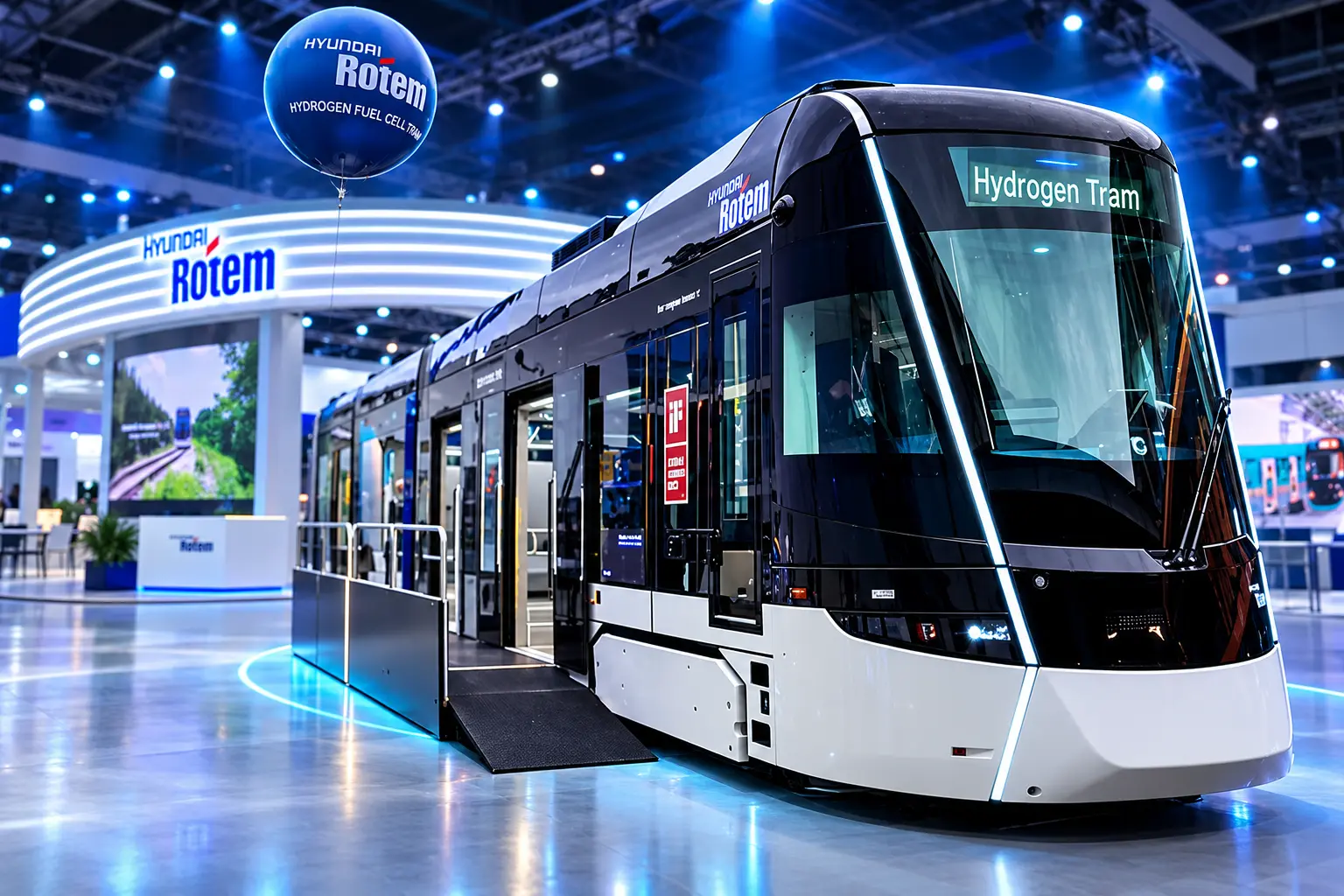
Hyundai Rotem used Egypt’s biggest transport fair in November 2025 to pitch a hydrogen street tram, and a biogas plant to fuel it, for the New Administrative Capital. The Korean rail builder still has no published tender to answer. The long ride into that city already runs on Chinese trains and Chinese loans.
What the company put on the floor in New Cairo was a full hydrogen chain under the HTWO brand, from waste gas to a catenary-free car. The paying work in Egypt remains electric metro sets and Alexandria trams.
A Street Map Inside a Finished Capital
TransMEA 2025 ran from November 9 to 11 at the Egypt International Exhibition Center in New Cairo. Hyundai Rotem opened its stand on the Sunday and kept it up through the Tuesday close, marking 30 years of Korea-Egypt diplomatic ties with a product that has not yet turned a wheel in Africa.
Visitors stepped into a VR cab set against the pyramids and the Sphinx, then past a 3D model of a hydrogen chain that starts with biogas and ends at a tram. Maps on the stand showed an inner-city line, labelled as an initial proposed alignment, from Al-Fattah Al-Aleem Mosque through the La Vista district and residential quarters R4 to R8 toward the government and diplomatic zone, with a finish at the Capital House precinct. Those drawings counted 29 stops and showed transfers onto the light rail and the monorail.
Company staff told guests the sheets were a proposal, not a contract. The New Administrative Capital covers 700 square kilometers east of Cairo, about 100 square kilometers larger than Seoul on the figures Rotem used, and is planned for more than six million residents. A street tram would run inside that grid, on roads that are already being paved, without a new web of overhead wire.
Based on our hydrogen technology capabilities that span from production to operation, we will promote an optimized comprehensive hydrogen solution for Egypt’s new administrative capital.
Hyundai Rotem official, TransMEA 2025, Cairo
That sentence is the offer. The car is the visible piece. The rest is a plant, a refuelling pad, and a long-term fuel price.
China Already Financed the Ride From Cairo
Riders already reach the new capital on steel that Korea did not supply. President Abdel Fattah El-Sisi opened the first stretch of the Cairo Light Rail Transit on July 3, 2022. The National Authority for Tunnels had signed a $1.24 billion build deal in August 2017 with China Railway Engineering Corporation and AVIC International. CRRC Qingdao Sifang supplied 22 six-car electric sets. The first two phases run about 70 kilometers with 12 stations, from the Adly Mansour interchange on Metro Line 3 out to the new capital and 10th of Ramadan City.
Further phases stay in that orbit. In early September 2026, Egyptian officials prepared two China-linked packages worth $665 million, including a $515 million fourth phase of 16 kilometers. The National Authority for Tunnels has also sought about $240 million from the Export-Import Bank of China for electromechanical work on that phase. The Export-Import Bank of China had already backed the opening stages and a $400 million third phase.
Alstom holds a different slice. A Franco-Egyptian group is building the East Nile monorail toward the same city, with new stations opening in stages through 2026, and Alstom is putting up an industrial complex at Borg El-Arab to make electrical gear and, later, rolling stock. In June 2026 an Alstom-led group took Egyptian National Railways work worth about €690 million, with Alstom’s share around €300 million, on freight and passenger corridors that do not include a hydrogen tram.
HOW THE NEW CAPITAL MOVES NOW
| System | Who built it | Status | What it connects |
|---|---|---|---|
| Light rail (LRT) | CREC, AVIC, CRRC Sifang trains | Running since July 3, 2022 | Greater Cairo to the new capital and 10th of Ramadan |
| East Nile monorail | Franco-Egyptian group led by Alstom | Opening in phases through 2026 | Eastern Cairo districts to the new capital |
| Hydrogen street tram | Hyundai Rotem (proposed) | Booth maps and a ministry file, no tender | Internal streets from the mosque axis to the government quarter |
A hydrogen tram would not replace those lines. It would fill the last gap, the short hops between ministries, housing blocks and parks where hanging new catenary on finished avenues is ugly and slow. That is the layer no Chinese concessional loan has claimed.
Why Rotem Is Selling Biogas With the Tram
Overhead wire is the expensive, ugly part of a classic tram. Hyundai Rotem’s car makes its own current with a fuel cell, so the city lays track and skips the poles. The five-module set is 35 meters long, with a 350-millimeter floor and a design speed of 70 km/h. Range on the Daejeon order is 200 km between fills. Hydrogen sits in two roof modules of 700-bar tanks, three cylinders of 175 liters in each module.
Egypt can make plenty of electrolytic hydrogen on the Red Sea for export. The National Low Carbon Hydrogen Strategy aims at 5.6 million tonnes a year by 2040, about 8 percent of the traded market, on roughly $60 billion of investment. That paper is written for ships and ammonia, not for a streetcar in the desert. A tram fleet needs a local, daily fill, close to the depot, at a price a city can live with.
Rotem’s answer at the Cairo stand was waste gas, the same chain HTWO publishes for Korean towns. In Chungju, a national waste-to-hydrogen project with Hyundai E&C and Hyundai Rotem turns about 60 tonnes of food waste into 500 kg of hydrogen a day. A small Rotem reformer is rated at 640 kg a day from biomethane or natural gas, at 99.97 percent purity. Steam reforming still uses water, but the feedstock is methane from bins and sludge, not a new electrolyzer farm on the Nile.
THE CHAIN ON THE CAIRO STAND
- Feedstock: Food waste, sewage sludge or landfill gas, treated and digested into methane-rich biogas.
- Upgrade: Impurities stripped and carbon dioxide separated until biomethane sits above 95 percent methane.
- Reform: A Rotem reformer plus a water-gas shift step makes hydrogen, then pressure-swing adsorption lifts purity to 99.97 percent or higher.
- Use: Compressed hydrogen moves to a depot pad and into the tram’s roof tanks, with no overhead line along the street.
In Daejeon, Rotem once offered to put biogas plants and charging pads in as private capital and to sell the city hydrogen at 4,344 won a kilogram, about half the open-market price, for 30 years. That is the commercial shape hiding under the Cairo VR headset: a fuel contract wrapped around a vehicle contract, so the ministry is not left hunting molecules after the cars arrive.
Shihab Adel, Hyundai Rotem’s sales and contracts manager in Egypt, said in January 2026 that a hydrogen tram proposal was still being prepared for the Transport Ministry and the National Authority for Tunnels. He named the new capital and coastal sites including El Alamein and Ras El Hekma, and said studies would have to pin down where the hydrogen would come from before anyone chose a route.
320 Metro Cars and 30 Alexandria Trams
The hydrogen file is a brochure. The factory work is not. On September 24, 2026, Transport Minister Kamel El-Wazir walked the InnoTrans halls in Berlin and sat down with Hyundai Rotem’s chief executive. The read-out covered manufacturing, delivery and testing of 30 tram units with eight years of spares and upkeep, plus 320 metro cars for Cairo Lines 2 and 3 with the National Egyptian Railway Industries Company. Hydrogen did not make the published list.
NERIC is the local plant in East Port Said, in the Suez Canal Economic Zone. On August 24, 2022, the National Authority for Tunnels signed a $656 million deal with Hyundai Rotem and NERIC for 40 trains, 320 cars, with a localisation floor of 30 percent, a two-year warranty and eight years of maintenance. Eight of those trains are for Line 2 and 32 for Line 3. By the Berlin meeting, six Line 2 trains had been delivered. Adel had said the first fully local train was expected between May and June 2026.
Alexandria is a separate, older kind of rail. Hyundai Rotem’s Raml-network deal, signed in June 2024 and running to April 2037, is worth 341.2 billion won for 30 cars about 65 meters long, conventional light-rail vehicles on a rebuilt coastal line, not fuel-cell sets. Track work on 13.2 kilometers of the Raml tram is due through June 2027, with average speed planned to rise from 11 km/h to 21 km/h once the line is fenced off from cars.
ROTEM’S EGYPT FILE, IN ORDER
- 2012: Supplies 180 wagons for Cairo Metro Line 1.
- 2012 to 2022: Delivers 624 train cars for Lines 2 and 3, a historic tally separate from the later 320-car plant deal.
- January 2022: Signs a memorandum with Orascom Construction and France’s Colas Rail to study a green hydrogen tram in the new capital.
- August 24, 2022: Signs the $656 million, 320-car localisation contract with NERIC.
- June 2024: Signs the 341.2 billion won, 30-car Alexandria Raml tram contract.
- November 9, 2025: Opens the TransMEA hydrogen stand and the 29-stop inner-capital map.
- January 2026: Adel says the hydrogen proposal is still being written for the ministry and the tunnels authority.
- September 24, 2026: El-Wazir and Rotem’s chief executive review the 30 trams and 320 metro cars in Berlin.
That timeline is why the biogas pitch can wait. Korea already has a factory partner, a localisation story the minister can take to cabinet, and two live production runs. The hydrogen tram is how Rotem stays in the room when the next street network is drawn.
Daejeon Ordered 34 Trainsets, and Ulsan Hit Pause
Egypt is being asked to copy a Korean city that has not opened yet. Daejeon signed on July 25, 2024, for 34 five-module trainsets for Daejeon Metro Line 2, a 293.4 billion won package that includes signalling and inspection. First delivery is scheduled in the second half of 2026. Production of all 34, with their systems, is due by the first half of 2028. Passenger service is planned at the end of 2028 on an 38.8-kilometer catenary-free loop with 45 stations, which the company calls the world’s longest single tram route without overhead wire.
DAEJEON LINE 2 ON PAPER
- Fleet: 34 five-module hydrogen trams, 35 meters long, 70 km/h design speed.
- Civil works: Groundbreaking on December 11, 2024, with opening aimed at the end of 2028.
- Fuel idea: Private biogas plants and pads, with a 30-year half-price hydrogen offer attached to the original bid.
Range: 200 km between hydrogen fills, after 5,000 kilometers of test running in Ulsan.
Ulsan, the other Korean name on early hydrogen-tram slides, stepped back on September 27, 2026. The city put a 41.4 billion won ($29.8 million), 4.14-kilometer tourism tram from Taehwagang Station to Jangsaengpo on long-term hold, citing weak ridership maths, operating losses and slow end-to-end times. Of 16 billion won budgeted that year, about 14.5 billion won was cut, leaving about 1.5 billion won for vehicle work. Shuttle buses will cover the gap for now.
Alstom, the other big name in Egyptian urban rail, told French interviewers in November 2025 that it was pausing further hydrogen-train development after state money for European hydrogen programs stopped, while still building the trains already on order. CRRC, meanwhile, rolled a 2,000 kW hydrogen hybrid locomotive out at InnoTrans 2026, the same Berlin show where El-Wazir met Rotem. The street-tram niche is still open. The home-market proof is not in daily service.
Four Years On, Cairo Still Has No Hydrogen Tender
The January 2022 memorandum with Orascom Construction and Colas Rail is the buried date. Three years and ten months later, Rotem was still showing maps at TransMEA. Two months after that fair, Adel was still talking about a proposal, not a bid. Ten months after the fair, the minister’s Berlin meeting stayed on metro cars and Alexandria trams. A Korean-side preliminary study for a hydrogen tram in the new capital appeared on a tender board on December 29, 2025. Egypt has not published a matching request for proposals.
WHAT WE KNOW
- The pitch: A catenary-free hydrogen tram plus a biogas-to-hydrogen chain, shown at TransMEA 2025 and framed for the new capital, with coastal cities added in January 2026.
- The maps: A 29-stop inner-city sketch from Al-Fattah Al-Aleem Mosque toward Capital House, with LRT and monorail transfers, labelled as an initial proposal.
- The live work: 320 metro cars with NERIC on a $656 million contract, six Line 2 trains already in Egypt, and 30 Alexandria trams on a 341.2 billion won deal.
WHAT IS UNCONFIRMED
- The tender: No Egyptian request for proposals for a hydrogen tram has been issued, and no route, fleet size or fuel-supply contract has been signed.
- The molecules: Whether Egypt would copy Chungju’s food-waste path, buy electrolytic hydrogen, or skip hydrogen and wire a classic tram is still a ministry choice.
- The competition: Chinese groups could yet bid a street line the way they bid the LRT, and Alstom’s Borg El-Arab plant is being built to make trams as well as metro cars.
Rotem’s official in Cairo promised an optimized hydrogen solution for a city that is already on the map. The solution on the stand was a streetcar that does not need wires and a reformer that does not need a coastal electrolyzer. The solution in the minister’s Berlin briefing was 320 metro cars and 30 trams that run on the grid Egypt already has.
Until the tunnels authority prints a hydrogen tram tender, the New Administrative Capital’s Korean hydrogen line lives on a booth map, a 2022 memo, and a proposal Adel said was still being written. The trains that are actually landing in Alexandria and Shubra are the electric ones.

Christa Pike Survived the Execution Tennessee Would Not Pause

Musk’s Oligarch Charge Hits a Queue of Three

Circle Puts USDC and EURC Into SAP Pay Workflows

Ring’s First Smart Lock Skips Home Wi-Fi for Sidewalk

GTA 6 Puts Cash Back on the Story Path

Salah Captained Egypt to Their First World Cup Win

Aramco Crash Kills 14 Two Days After Oil Restart

Apple Labor Day Deals Hide June’s Memory Price Hike

Zelda’s 40th Switch 2 Ships Without a Zelda Game

Palworld 1.0.4 Adds Palpedia Search After the 1.0 Launch
-
 NEWS5 months ago
Salah Captained Egypt to Their First World Cup Win
-
 BUSINESS4 months ago
Aramco Crash Kills 14 Two Days After Oil Restart
-
 NEWS2 months ago
Apple Labor Day Deals Hide June’s Memory Price Hike
-
 GAMING1 month ago
Zelda’s 40th Switch 2 Ships Without a Zelda Game
-
 GAMING1 month ago
Palworld 1.0.4 Adds Palpedia Search After the 1.0 Launch
-

 NEWS4 months ago
El Niño Puts Israel’s Needed Winter Rain on a Flood Clock
-

 BUSINESS8 months ago
Egypt Bets EGP 638 Billion Can Open Sinai to Investors
-

 BUSINESS8 months ago
BAE’s 60-Year Saudi Franchise Now Runs Through Taif