
NEWS
Go Eve’s £750,000 Bet on Vans That Will Not Restart
Go Eve’s £750,000 Innovate UK-backed project targets vans that will not restart, so sequential DockChain charging can stretch a depot’s existing grid connection.

Go Eve has raised £750,000 so DockChain can restart charging when a plugged-in van refuses to wake. The University College Dublin and Imperial College London spin-out already chains several bays off one DC fast charger. Innovate UK and private investors are paying for an 18-month push to make that sequence hold on mixed fleets, with production hardware due in 2027.
The sum is modest beside the £3 million seed round of April 2023, and it targets a failure that only showed up once vans stayed plugged in overnight.
The Grant Pays to Cajole the Vehicles
DockChain is already in the field. What the new money buys is custom hardware, firmware and software so a session can start, stop and start again without anyone pulling a cable. Fleet sites taught the company that vehicles do not treat a paused DC feed the same way. Some ignore the first handshake. Others will not resume after power is cut for a grid limit or a higher-priority van.
That sounds like a software nuisance. On a sequential system it is the whole product. If the next vehicle in line will not wake, the charger sits idle while a row of plugged-in vans wait, and the saving against a bay-by-bay install disappears. John Goodbody, co-founder and marketing director, put the lesson in plain terms.
We’ve already shown that fleets can serve more bays without multiplying the number of fast chargers, that’s where the immediate cost and rollout benefit comes from DockChain. Working with fleets has also taught us that vehicles don’t always behave exactly as expected at the charging connector. Some EVs need another attempt to start; others can be reluctant to restart charging after power flow is paused for grid, or priority reasons. This project tackles those practical issues so we can make DockChain more reliable and more flexible.
John Goodbody, co-founder and marketing director, Go Eve
The work is led from the engineering shop in Wolverhampton and is supported by Innovate UK’s Growth Catalyst Investor Partnerships programme, which pairs a grant with aligned equity from a selected investor partner. Existing DockChain units are due an upgrade once the new stack is ready. Go Eve is also looking for fleet sites with tight power, mixed charging priorities, or an interest in sending power back the other way.
Six to 20 Bays off One DC Charger
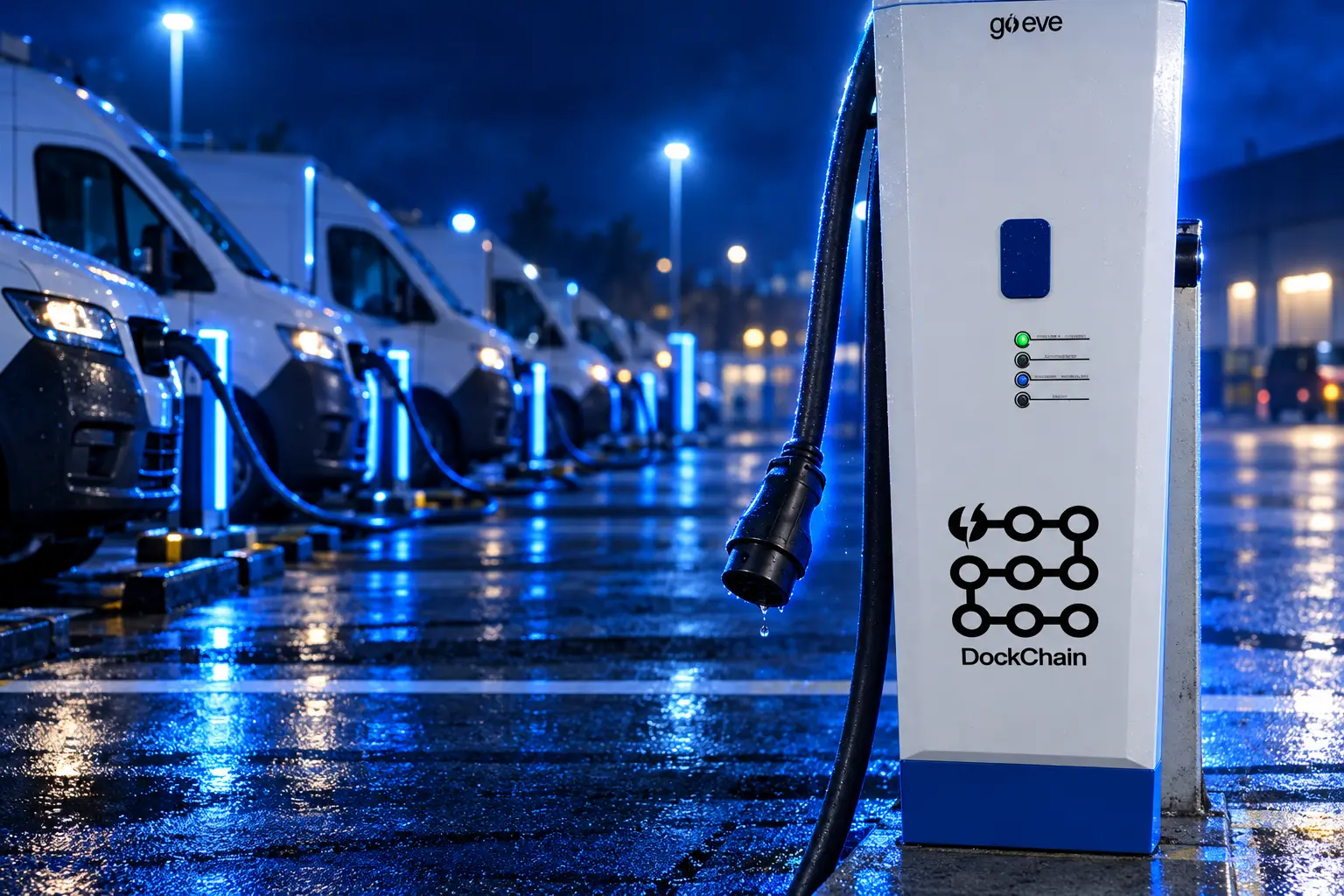
The mechanical idea is simple enough to sketch on a depot plan. A standard OCPP DC charger, 30 kW or above on OCPP 1.6J, feeds a backbone cable. Along that cable sit compact docks, each with switching and safety gear and a CCS or NACS inlet. Drivers plug in where they park. Software decides which inlet is live. Go Eve’s architecture note puts the span at 6 to 20-plus spaces per charger, depending on site power and how long vehicles dwell.
Wall-mount docks are rated from 150 A (60 kW) to 400 A (160 kW). A connector box can take the charger’s existing delivery cable so the unit can go back to stock if a warranty team arrives. The company says any OCPP-compliant DC charger will talk to the chain, and it has been matching docks to chargers in the 50 kW to 400 kW class. Dual-output cabinets can feed more than one chain, so two vehicles can take power at once without splitting current inside a single chain.
That last point is the split with hub-and-spoke satellite systems. Those cabinets share a pool of kilowatts across several dispensers at the same time. DockChain does not load-balance down a chain. The live vehicle gets the charger’s full DC output until the software moves on.
HOW GO EVE STACKS THE OPTIONS
| Setup | How power is used | Bays Go Eve cites | What the operator trades |
|---|---|---|---|
| AC / Level 2 | Many slow sessions | Many spaces | Hours, not minutes, for useful range |
| Standalone DC | Full power on one or two cables | 1 to 2 | Blocked bays and low utilisation |
| Hub-and-spoke satellites | Shared power across live dispensers | Typically 6 to 10 | Higher kit and cabling cost, variable rate per van |
| DockChain | Full power, one vehicle at a time | 6 to 20-plus | A queue, plus any van that will not restart |
Go Eve also ran its own 10-bay model on a single 150 kW charger, 30 Monte-Carlo runs with mixed arrival times, states of charge and charge curves. Mean active-time site power came out at 133.9 kW on DockChain against 144.8 kW on a hub-and-spoke layout. Mean time from arrival to target state of charge was 71.1 minutes against 89.5 minutes. The satellite layout used more of the available power. The sequential layout got vehicles back into service sooner, on this simulation. The company puts capex per kW delivered at 30 to 60% lower than hub-and-spoke. Those figures are Go Eve’s, not an independent test.
Depots Queue Behind Unused Grid Reservations
The reason a daisy-chain is even a conversation on UK yards is not the price of a wall box. It is the wait for a fatter supply. TwentyForty, the freight infrastructure body, says a new 18 to 36 months for a megawatt connection is routine in a constrained DNO region, and five years has been quoted in the worst weeks. Truck orders still close in months.
THE POWER GAP ON A WORKING DEPOT
- Overnight energy: Around 85% of the kWh that move a battery HGV still go in at the home depot, not at a public forecourt.
- Planning load: A 50-truck electric HGV depot charging overnight wants about 1 MW of connected load.
- What is there now: A mid-size commercial depot often sits on about 100 kW.
- The grant hole: The Depot Charging Scheme covers 70% of chargepoint hardware and civils, up to £1 million per organisation, and does not pay for the DNO upgrade.
DockChain does not magic 1 MW out of a 100 kW board. A 180 kW cabinet still draws 180 kW. What the chain changes is how many parked vans can reach that cabinet without a second foundation, a second grid application, and a second wait. First customer sites from November 2023 to April 2024 went live on 180 kW chargers at car-rental yards, office parks and van fleets. For operators who cannot get a larger connection this decade, multiplying bays on the cabinet they already have is the available move.
Goodbody has been saying the same thing in public: UK commercial fleets need to squeeze more out of kit and grid capacity they already own. Sequential charging is that squeeze, until a van’s onboard stack refuses to play.
Full Power, One Vehicle at a Time
Shared-power satellites have a clean answer to the same crowding problem. Later arrivals take a slice of the pool, so nobody waits for a free cable, and nobody gets the full nameplate for long. Sequential charging does the opposite. The first vehicle, or the one the rules pick, takes the lot. Everyone else stays plugged in and waits for a notification.
When several vehicles share current at once, each session can crawl. That is the complaint sequential charging is built to dodge, and it is also why a failed restart is so expensive. The cabinet cannot sneak a trickle to the next bay while it argues with the live inlet. The queue stops.
Go Eve Cloud sits on top of the charger’s OCPP stack and sets the order. Drivers see their place in line and a predicted start. Site staff get the admin view.
WHO GETS THE ELECTRONS FIRST
- Arrival order: First plugged in, first at full power, charged to the percentage set in the cloud or in the vehicle.
- Priority lists: Named vehicles, named users, or dedicated docks treated as a fast lane.
- State of charge: Lowest battery first, or a stepped lift that brings the whole yard to 50%, then 75%, then 80%.
- The depot clock: Time of day, dwell patterns, booking and delivery schedules, plus a feed for grid limits and V2X.
Those rules only matter if the vehicle accepts the next start. ISO 15118 and Plug & Charge are on the upgrade path. Until the firmware can retry a stubborn handshake on its own, a dispatcher is still one unplug away from the old valet problem.
Openreach Went First, Then Michigan
The science started as a UCD workaround for the limits of ordinary charging. Robert Shorten, now Go Eve’s head of R&D and professor of cyberphysical systems at Imperial, is named as the inventor. Pietro Ferraro, a research engineer at the company, is listed among the original inventors. Hugh Sheehy, a former oilman, is chief executive and co-founder. Goodbody came from Honda and Avis. Both universities hold a stake and still house teams in Dublin and London.
DOCKCHAIN FROM LAB TO LIVE BAYS
- February 2021: Go Eve agrees an exclusive licence for the UCD and Imperial work.
- November 2022: After a UK Department for Transport grant, the first high-power DC daisy-chain is demonstrated at Imperial College London.
- April 2023: £3 million of seed funding is raised to take the product through production design, certification and pilots.
- October 2023: A patent granted in October 2023 covers daisy-chaining from an EV, in hardware and software.
- November 2023 to April 2024: First UK and Ireland customer sites go live, including Openreach, on 180 kW chargers.
- November 2024: A revised design is shown and European CE marking follows.
- 18 September 2025: Intertek lists DockChain to UL 2202 (ETL 5033241) for the United States and Canada, and assembly starts in Dearborn, Michigan, with Goodwill Integrated Solutions.
Openreach was an early customer and now helps other fleets with install and service. Company photographs and case notes also show SAP’s Dublin office park and Stellantis headquarters in Detroit. Uptime EV Charger is the preferred US installer and built the first container-mounted system. Mid-Cour in Detroit and the Merlin Group, which reaches last-mile operators, are named as North American partners. Parkomat is integrating docks into robotic parking in Israel.
On the day of the UL listing Sheehy said the firm was raising $3.5 million (about £2.6 million at the time of that announcement) for North America. That round was an aim, not a closed figure in the September 2025 note. UL 2202 certification for North America still matters for this British grant, because the same dock family is what Wolverhampton now has to make restart on command. Sheehy’s line then was that more bays can reach rapid charging from a single power source, with less waiting and a lower install bill. The 2026 money is the admission that the source is the easy part. The vehicle is not.
Vehicle-to-Grid Remains a Side Bet
The same start-stop-restart work is what you need if a depot wants to sell power back. Pause a van for a grid event, then wake it to charge or to discharge. Go Eve’s software already lists a V2X requirements feed. The 18-month project will look at bidirectional charging and vehicle-to-grid services as a way for idle fleet batteries to earn when they are not on the road.
That market is no longer only a trial poster. Commercial V2G packages are live in the UK, still on a short list of cars and chargers, and still mostly aimed at household tariffs rather than a yard of vans. A bidirectional DockChain would have to talk to vehicles that already struggle to resume a one-way session. Treat V2G as an option on the same cable, not as the reason to buy the cable.
High-intensity satellite yards will still want a fat central power unit and simultaneous dispensers. Go Eve’s own comparison concedes that hub-and-spoke can edge sequential charging on theoretical energy throughput. The bet here is the other site: a depot, a rental row, an office car park, where the constraint is bays and a board rating, not peak megawatts.
Production Hardware Is Due in 2027
Wolverhampton has 18 months to turn retry logic into a box that manufacturing partners can ship. The company says a production-ready DockChain is due in 2027, with field units eligible for upgrades. That is a product date, not the end of the grant clock, and both can slip.
Trial operators are still being recruited, which tells you the restart problem is not a lab curiosity. It showed up where mixed fleets already plug in and leave the cable in. If the new firmware can wake the stubborn vans, one DC cabinet keeps covering a row of bays on the connection the depot already has. If it cannot, sequential charging remains a clever chain that still needs a person with a glove.

Cook Hands Democrats the House as Crypto’s Bill Stays Dead

Wicker’s Broken Bed Was the Short Story’s Punch Line

Nvidia’s $500 Billion Financing Plan Draws a $180 Sell

Maserati Bets the Grecale V6 Can Fill Porsche’s Gap

EV Cable Theft Follows the Old Railway Copper Playbook

Aramco Crash Kills 14 Two Days After Oil Restart

Salah Captained Egypt to Their First World Cup Win

Zelda’s 40th Switch 2 Ships Without a Zelda Game

Apple Labor Day Deals Hide June’s Memory Price Hike

Palworld 1.0.4 Adds Palpedia Search After the 1.0 Launch
-
 BUSINESS4 months ago
Aramco Crash Kills 14 Two Days After Oil Restart
-
 NEWS5 months ago
Salah Captained Egypt to Their First World Cup Win
-
 GAMING2 months ago
Zelda’s 40th Switch 2 Ships Without a Zelda Game
-
 NEWS2 months ago
Apple Labor Day Deals Hide June’s Memory Price Hike
-
 GAMING2 months ago
Palworld 1.0.4 Adds Palpedia Search After the 1.0 Launch
-

 NEWS4 months ago
El Niño Puts Israel’s Needed Winter Rain on a Flood Clock
-

 BUSINESS8 months ago
BAE’s 60-Year Saudi Franchise Now Runs Through Taif
-

 BUSINESS8 months ago
Egypt Bets EGP 638 Billion Can Open Sinai to Investors