
AUTO
Gemini Personal Intelligence Brings Gmail Into Android Auto
Google is rolling Personal Intelligence into Android Auto, so a Gemini phone setting can read Gmail aloud in the car, with Google built-in cars next.

Google began rolling out Personal Intelligence with Gemini on Android Auto on October 20, letting the assistant use Gmail, Calendar, Photos, Maps, YouTube and Search by voice. Gemini itself is now available globally on Android Auto and in cars with Google built-in. Personal Intelligence is the extra layer that knows your inbox, and it is opt-in.
Cars with Google built-in get that layer in the coming months. The first wave is limited to personal Google accounts for people 18 and older, and it excludes the European Economic Area, Switzerland, the United Kingdom and Nigeria.
The Same Gemini Switch Now Speaks in the Car
Karan Daryanani, Sr. Product Manager for Gemini, wrote that an assistant is more helpful when it knows the world and knows you. The car release is not a new inbox scan. It is the phone feature, already sitting in Gemini settings, speaking through the dash.
Apps stay disconnected until a driver turns Personal Intelligence on. It can be switched off in Gemini settings at any time. The part that changes the cabin is the carry-over rule.
If you’ve already enabled it in the Gemini app, it comes with you into the car. If you haven’t, you can set your preferences anytime in your Gemini settings.
Karan Daryanani, Sr. Product Manager, Gemini, Google blog
That is a desk decision with a road consequence. Someone who linked Gmail to Gemini on a couch in January now has that link in the speaker grille, with no second prompt on the car screen. Cars with Google built-in add one extra gate: personal replies go out only when the driver is in the car with the phone connected.
Google’s own announcement post puts the pitch in a short video, Gmail and Calendar included, and points drivers to the same blog note.
Personal Intelligence is now rolling out for Gemini on Android Auto and in the coming months to cars with Google built-in, so you can get even better hands-free help on the road.
With your permission, Personal Intelligence securely connects information from the Google apps you… pic.twitter.com/hd2iun4TMn
— Google (@Google) October 20, 2026
Leave the feature off and the car still does navigation, music, calls and generic questions. The answers just will not be tailored. That split is how Google sells a deep personal-data layer as a safety tool: you ask once, you keep your hands on the wheel, and Gemini does the digging you used to do on the lock screen at a red light.
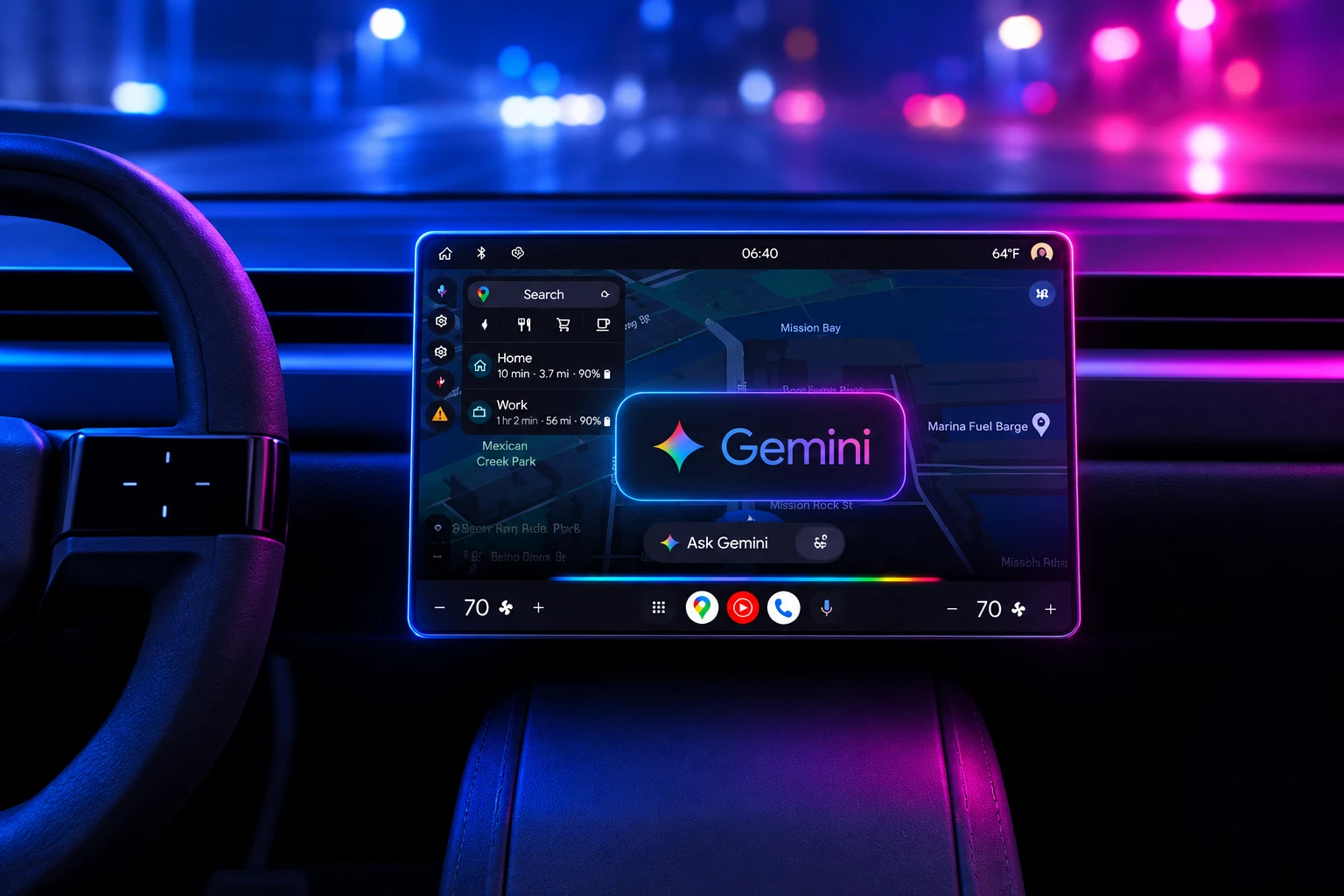
What Personal Intelligence Can Answer While You Drive
Personal Intelligence has two core strengths, Daryanani wrote. It retrieves a specific detail from an email, a photo or a saved place in Google Maps, and it reasons across those sources in one go. The demos are all voice prompts that used to mean glancing down.
WHAT GOOGLE SAYS YOU CAN ASK
- Flight details: On the way to the airport, ask “What’s my flight gate? And is my flight on time?” and skip the confirmation email plus a second search for delays.
- A restaurant stop: Say “Find me an indoor restaurant along my route that matches my usual vibe,” and a vegetarian driver gets a shortlist that already fits.
- An appointment: Say “Take me to my doctor’s appointment” without recalling the street address.
- A photo of a place: Say “Find the car wash from the photo I took last week and navigate there” instead of scrolling the camera roll.
- A leftover chat: Say “Take me to the coffee shop we were talking about yesterday” and Gemini is supposed to finish the digging.
The point of those lines is that the driver no longer has to feed context. The context is the Google account. Workspace, including Gmail and Google Calendar, sits next to Google Photos, Google Maps, YouTube and Search. Ask for a gate and a status in one breath and the model is meant to open the ticket thread, then check the flight, then speak both answers while the car is moving.
That is also why the feature is more than a nicer voice command. Generic Gemini in the car can already brainstorm and talk in ordinary language. Personal Intelligence is what lets it treat your mailbox, your camera roll and yesterday’s chat as one map.
The EEA, Switzerland, the United Kingdom and Nigeria Are Excluded
The global headline on the blog is wider than the footnote. Gemini is now available globally on Android Auto and in cars with Google built-in. Personal Intelligence is not. Google says it is rolling out to eligible personal Google accounts for users aged 18 and older, and not for Workspace business, enterprise or education users. It also excludes the European Economic Area, Switzerland, the United Kingdom and Nigeria.
WHO GETS THE IN-CAR LAYER
| Group | Personal Intelligence in the car |
|---|---|
| Personal Google accounts, 18 and older | Rolling out on Android Auto from October 20 |
| Cars with Google built-in | In the coming months, and only with the phone connected |
| European Economic Area, Switzerland, the United Kingdom, Nigeria | Not in this wave |
| Workspace business, enterprise and education accounts | Not supported |
The blocked list is the same privacy map Google has used for Personal Intelligence since the phone beta: a product that reads Gmail and Photos is being kept out of the strictest data regimes first. Drivers in Germany, France or Britain still get Gemini in the car for ordinary questions. They do not get the inbox layer on this timetable, and Google did not name a catch-up date.
Workspace accounts are out too, which keeps work mail off the dash even if a company phone is plugged in. The personal Gmail on that same handset is a different story, and that is the account the feature is built around.
Google Promised Gmail in the Car in April
Personal Intelligence started on phones, not in cup holders. On January 14, Josh Woodward, vice president for Google Labs and the Gemini app, launched it as a U.S. beta for eligible Google AI Pro and AI Ultra subscribers on personal accounts. He said people could personalize Gemini by connecting Google apps with a single tap, and that the company would expand over time to more countries and to the free tier. Google later opened the feature on phones beyond that paid beta before it ever reached Android Auto.
The car was already on the calendar. On April 30, Alankar Agnihotri, Senior Product Manager for cars with Google built-in, said Gemini was rolling out there as an upgrade from Google Assistant, starting with English in the United States. Near the end of that post he wrote that Gemini would, in the near future, expand to more languages and countries and give drivers the ability to safely access their info in apps like Gmail, Calendar and Google Home. October 20 is that access arriving, first through the phone projection path.
HOW GEMINI REACHED THE DASHBOARD
- 2020: Cars with Google built-in first hit the road, with a promise that the software would improve over time.
- 2025: Google begins putting Gemini on Android Auto, replacing Assistant for drivers who already switched on the phone.
- January 14, 2026: Personal Intelligence launches as a U.S. beta for AI Pro and Ultra subscribers on personal accounts.
- April 30, 2026: Gemini starts rolling out in cars with Google built-in, in English in the United States, with Gmail access described as near future.
- May 12, 2026: Google says more than 250 million Android Auto-compatible cars are on the road, and that Google built-in is in more than 100 models from 16 brands.
- October 20, 2026: Personal Intelligence begins rolling out on Android Auto; Gemini is called globally available on both Android Auto and Google built-in.
April’s built-in Gemini was already allowed to talk to the car, from owner’s manuals to a foggy windshield that should trigger heat and defrost. What it could not do, yet, was open the confirmation email. The October release fills that hole on Android Auto and schedules the same hole-filling for the built-in cabin.
More Than 250 Million Cars Already Run Android Auto
Guemmy Kim, senior director of product and user experience for Android for Cars, wrote in May that more than 250 million Android Auto-compatible cars were on the road. That is the pipe Google can reach without waiting on an automaker’s firmware train. Android Auto runs on the phone and projects navigation, media and now Gemini onto the car screen, which is why Personal Intelligence can ship there first: the model, the settings and the Gmail token already live on the handset.
Cars with Google built-in are a smaller, deeper set, more than 100 models from 16 brands in that May count, with Gemini wired into vehicle hardware. Those cars can already answer model-specific questions, such as how to prep for a car wash or how far the trunk should rise under a low garage ceiling. They will get Personal Intelligence in the coming months, Google says, and only while the signed-in phone is along for the ride.
Ford, GM, Honda, Nissan, Volvo and Polestar are among the brands that have shipped Google built-in in newer cars. The October post does not name which nameplates get the inbox layer first. It only splits the world in two: the phone projection fleet now, the embedded fleet later. For a lot of drivers the practical difference is simpler. If Gemini on the phone already has Personal Intelligence on, Android Auto does not ask again.
The promo films still look cleaner than many real Android Auto screens, which vary by head unit, patch level and wireless stack. The new reasoning layer does not fix a dim display or a flaky Bluetooth handshake. It only changes what the microphone is allowed to know.
A Family Car Makes Private Answers Public
On a phone, Gemini can show a gate number on a slab of glass you tilt away from the passenger. In a car, the same answer comes out of speakers aimed at every seat. “Take me to my doctor’s appointment” is a useful prompt. It is also a clinic name, a time and a relationship, spoken into a cabin that might hold a colleague, a child or a rideshare customer.
Google’s health guardrail does not solve that. Woodward wrote in January that Gemini aims to avoid making proactive assumptions about sensitive data like your health, though it will discuss this data with you if you ask. The driving demos are exactly those asks. The model is doing what it was told. The new risk is the room.
We don’t train our systems to learn your license plate number; we train them to understand that when you ask for one, we can locate it.
Josh Woodward, VP, Google Labs and the Gemini app, Google blog
Woodward also said Gemini does not train directly on your Gmail inbox or Google Photos library. It trains on limited information, such as specific prompts in Gemini and the model’s replies, after steps to filter or obfuscate personal data. The photos, the plate and the emails in his minivan example were referenced to deliver the reply, not ingested as training text. Google’s own write-up of the methodology and current limitations is the place it sends readers who want that argument in full.
The beta notes still matter in a moving car. Woodward said the model can over-personalize, stitching unrelated topics together, and that it can miss nuance around relationship changes such as divorces. Hundreds of photos at a golf course might convince it you love golf, he wrote, when you were there because you love your son. On a phone that is a wrong restaurant suggestion. Through the dash it is a wrong story told out loud, in front of whoever is buckled in.
A cabin is a shared room. That is the part the launch film does not stage. Apple still does not give CarPlay this kind of cross-app inbox reasoning, so Google is handing Android drivers a trick the other phone stack has not matched. The cost of that trick is a voice that can recite a flight, a clinic or a coffee chat from yesterday without checking who else is listening.
Drivers Can Limit Which Apps Gemini May Open
Google built Personal Intelligence with Personal Intelligence privacy controls as the off switch, and it repeats that no app is connected until you choose. You pick Gmail or skip it. You pick Photos or skip it. You can disconnect apps, delete chat history, regenerate a reply without personalization, or use a temporary chat that does not carry the personal layer. Those tools were designed for the Gemini app. They now decide what the car is allowed to say.
HOW TO SET IT BEFORE YOU DRIVE
- Open Gemini: Use the Gemini app on the Android phone that will connect to the car.
- Find the toggle: Go to Settings, then Personal Intelligence, then Connected Apps.
- Pick the apps: Link Gmail, Calendar, Photos, Maps or the others, or link none of them.
- Then pair the car: Connect the phone to Android Auto and ask by voice, or leave the feature off and keep generic Gemini.
If you already turned it on months ago, that list is not a setup guide. It is an audit. The same setting now follows you into Android Auto, and it will follow you into cars with Google built-in in the coming months, as long as the phone is in the car. Google has not named a ship date for that second wave. The Gemini setting on the phone is already the setting in the cabin.

Cook Hands Democrats the House as Crypto’s Bill Stays Dead

Wicker’s Broken Bed Was the Short Story’s Punch Line

Nvidia’s $500 Billion Financing Plan Draws a $180 Sell

Maserati Bets the Grecale V6 Can Fill Porsche’s Gap

EV Cable Theft Follows the Old Railway Copper Playbook

Aramco Crash Kills 14 Two Days After Oil Restart

Salah Captained Egypt to Their First World Cup Win

Zelda’s 40th Switch 2 Ships Without a Zelda Game

Apple Labor Day Deals Hide June’s Memory Price Hike

Palworld 1.0.4 Adds Palpedia Search After the 1.0 Launch
-
 BUSINESS4 months ago
Aramco Crash Kills 14 Two Days After Oil Restart
-
 NEWS5 months ago
Salah Captained Egypt to Their First World Cup Win
-
 GAMING2 months ago
Zelda’s 40th Switch 2 Ships Without a Zelda Game
-
 NEWS2 months ago
Apple Labor Day Deals Hide June’s Memory Price Hike
-
 GAMING2 months ago
Palworld 1.0.4 Adds Palpedia Search After the 1.0 Launch
-

 NEWS4 months ago
El Niño Puts Israel’s Needed Winter Rain on a Flood Clock
-

 BUSINESS8 months ago
BAE’s 60-Year Saudi Franchise Now Runs Through Taif
-

 BUSINESS8 months ago
Egypt Bets EGP 638 Billion Can Open Sinai to Investors