
NEWS
Gaza Food Bottles Join a Long, Intercepted Sea Route
Egyptians threw rice bottles toward Gaza in July 2025 on a 72-hour current promise. Oceanographers put the odds at 5 percent, and Gaza fishermen said none arrived.

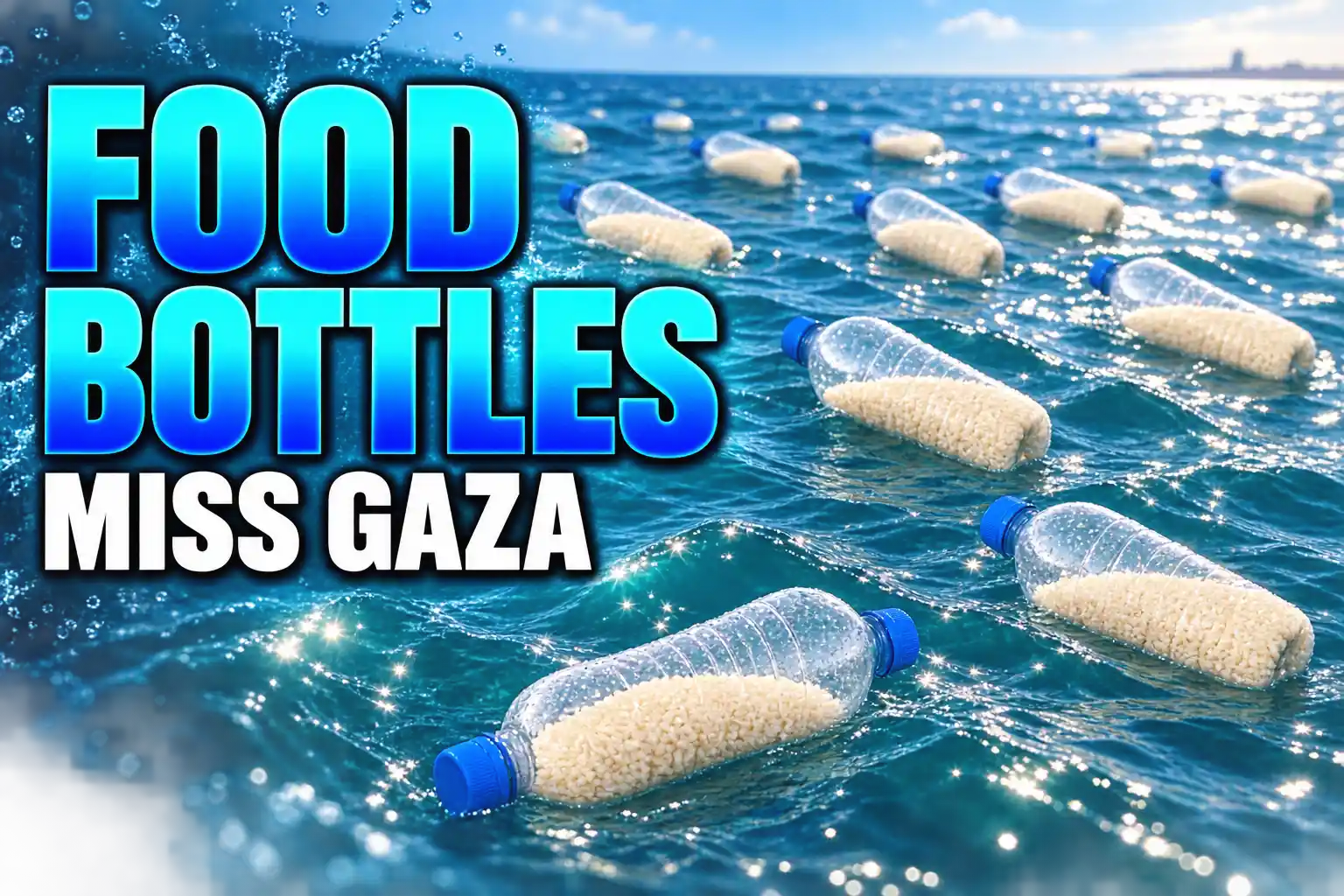
In late July 2025, Egyptians sealed rice, lentils and flour into plastic bottles and threw them into the Mediterranean toward Gaza. The campaign, called From Sea to Sea, a Bottle of Hope for Gaza, spread within days to Turkish, Libyan and Tunisian beaches.
The pitch was a three-to-four-day drift on an east-going surface current. An Egyptian oceanographer later put the chance of a landing at no more than 5 percent. Gaza’s fishermen’s union said nothing came ashore.
Damietta Sits 250 Kilometers From Gaza
Mohamed Aly-Hassan, an Egyptian engineering professor living in Japan, set the numbers that the beach launches followed. In a Facebook post he wrote that surface currents in the eastern Mediterranean flow from west to east, at a speed of up to 0.8km/h, and that sealed containers released from Damietta or east of Port Said could reach Gaza in 72 to 96 hours.
Damietta sits about 250 km west of Gaza in a straight line. At 0.8 km/h, that crossing takes 312.5 hours, which is 13 days, not three or four. In 96 hours the current he cited would cover 76.8 km. In 72 hours it would cover 57.6 km.
THE DAMIETTA CROSSING ON HIS FIGURES
| Measure | Figure |
|---|---|
| Straight-line Damietta to Gaza | 250 km |
| Speed Aly-Hassan cited | 0.8 km/h |
| Distance in 72 hours | 57.6 km |
| Distance in 96 hours | 76.8 km |
| Time for 250 km at 0.8 km/h | 13 days |
Those figures are a best case on a ruler line. Real bottles follow wind, waves and eddies, not a ruler. Researchers who compiled current speeds in the eastern Mediterranean from a deep mooring off Israel found surface flow that shifts with season and depth, which is a poor match for a kitchen-timer crossing.
Mohamed Aly-Hassan Wrote the Recipe From Japan
Aly-Hassan did not ask people to toss soda bottles from the surf line. He described a 25-litre plastic jerrycan as a “desperate cry of hope,” packed for buoyancy and released well offshore. Beach videos that followed used 1-litre and 2-litre water bottles instead, often filled with about a kilogram of dry food and thrown from the sand.
THE JERRYCAN METHOD HE POSTED
- The load: A sealed 25-litre can holds 6 to 8 kg of dry food, with an 8-litre air gap so it floats.
- The drop: Release at least 4 km from the coast, at a 60-degree angle to the northeast, to slip past opposing near-shore flow.
- The clock: 72 to 96 hours from Damietta or east of Port Said on a west-to-east surface current of up to 0.8 km/h.
- The call: He asked other Mediterranean states, including Libya, Tunisia, Algeria and Morocco, to copy the drop.
Families on the Nile Delta and in North Sinai still went to the water with whatever bottles they had. One man on a widely shared launch video said, “Forgive us, brothers,” as he threw. Another, filling bottles with flour and rice, said he was sorry he could not do more, and that the bottle might be a savior on Judgment Day.
6,000 Aid Trucks Sat on the Same Coast
The bottles went into the water in a week when food was already sitting on roads. On 1 August 2025, UNRWA commissioner-general Philippe Lazzarini said the agency had 6,000 trucks loaded with aid stuck outside Gaza, waiting for permission to enter. During a ceasefire earlier that year, UNRWA and other UN agencies had moved 500 to 600 trucks a day.
THE JULY 2025 TALLY
- Trucks waiting: Lazzarini put UNRWA’s backlog at 6,000 loaded trucks outside Gaza on 1 August 2025.
- Deaths at food lines: The UN human rights office counted 1,373 Palestinians killed while seeking food from 27 May to 31 July 2025.
- Where they died: 859 were killed near Gaza Humanitarian Foundation sites and 514 along UN or partner convoy routes, most by Israeli forces, OHCHR said.
- Two-day spike: OHCHR recorded 105 Palestinians killed and at least 680 injured on 30 and 31 July 2025 alone.
Lazzarini also said airdrops are at least 100 times more costly than trucks, and that trucks carry twice as much aid as planes. A bottle of rice is cheaper still, and it carries less than a single sack. Save the Children and Doctors Without Borders had already documented severe malnutrition in Gaza when the launches began. The UN human rights office called the hunger “human-made” and a direct result of Israeli policies that had cut life-saving aid.
Airdrops are at least 100 times more costly than trucks. Trucks carry twice as much aid as planes.
Philippe Lazzarini, UNRWA commissioner-general, 1 August 2025
The land route the bottles were meant to replace was measured in hours, not days, if crossings opened. The sea route civilians chose was the one no permit desk had to stamp.
Gaza’s Sea Route Has Been Getting Smaller
People have been trying to feed Gaza from the water for years. A few small boats reached the strip in 2008 and 2009, before the blockade hardened. Each later attempt has been stopped farther out, or with more force, or with fewer tons on board.
SEA ATTEMPTS FROM 2010 TO 2026
- 31 May 2010: Israeli commandos board the Mavi Marmara in international waters, killing 10 activists on a flotilla of more than 600 passengers.
- 2 May 2025: The Conscience, a Freedom Flotilla Coalition vessel, is struck by drones 14 nautical miles (25 km) off Malta.
- Early June 2025: Israeli forces intercept the Madleen about 160 km from Gaza and divert it to an Israeli port.
- 24 July 2025: Beach launches of rice bottles begin in Egypt and spread to Turkey and other North African coasts.
- 26 July 2025: Israeli forces seize the Handala in international waters before it can reach Gaza.
- 31 August 2025: Global Sumud Flotilla ships leave Barcelona; Israel intercepts the fleet in early October 2025.
- 2 October 2026: Sumud board member Sumeyra Akdeniz Ordu says 14 of those vessels are in Antalya for repair, with volunteers collecting boats left drifting after the interception.
The bottle was what remained when a ship drew a boarding party and a truck sat at a closed gate. It could not carry baby formula at scale, and it could not be arrested. It could be filmed. That is the pattern: the craft shrinks to whatever civilians can still put in the water.
Did Any of the Bottles Reach Gaza?
Ahmed Radwan, a professor of physical oceanography at Egypt’s National Institute of Oceanography and Fisheries, told the Sharara science podcast the probability of bottles reaching Gaza was “extremely low, no more than five per cent.” He pointed to North African currents and to local eddies off Marsa Matruh and Port Said. Those patterns, he said, often send floating objects to distant coasts, as far as Greece.
The Mediterranean is shaped by complex circulation systems, including the North African currents and local eddies off Marsa Matruh and Port Said.
Ahmed Radwan, professor of physical oceanography, National Institute of Oceanography and Fisheries, on the Sharara podcast
Radwan also warned that most bottles would add to plastic already in the basin. Anyone can pull daily sea surface current maps and see how quickly a surface track bends. A sealed jerrycan is still a piece of litter if it misses the one beach it was aimed at.
Zakaria Bakr, head of the General Syndicate of Fishermen and Marine Production Workers in Gaza, said in late August 2025 that no bottles had arrived. He called viral clips of landings “media propaganda,” and pointed to strong currents and maritime security barriers. Egyptian engineer Hesham Nagy put the success rate of ordinary bottles below one per cent and floated a different tool, polystyrene boxes with small rudders, each able to carry about 5 kg.
Clips claiming a wash-up still spread. They did not come with a named beach, a dated haul, or a fishermen’s union confirmation. Fourteen months later, no verified landing has been put on the record.
Machine-Made Photos Outran the Real Launches
The stills that traveled farthest were not the launch videos. They were pictures of young people holding bottles of white powder labeled for Gaza, some of them generated by machine. Community notes on those posts flagged warped thumbs, odd buoyancy, and texture tells. Fact-checkers reached the same finding: some of the most-shared images were fake, and real videos of families at the water also existed.
WHAT WE KNOW
- Real launches: Families in Egypt, and people in Turkey, Libya and Tunisia, filled bottles with rice, lentils, beans and flour and threw them from Mediterranean beaches in late July 2025.
- Real method paper: Aly-Hassan’s jerrycan recipe, with weights, air gap, drop distance and a 0.8 km/h current, is on the public Facebook post that started the copycat drops.
- Real expert verdict: Radwan’s 5 percent ceiling and Bakr’s report of no arrivals were given in August 2025, after the first wave of videos.
WHAT IS UNCONFIRMED
- Landings: No named Gaza beach, dated recovery, or fishermen’s union confirmation backs the wash-up clips that spread in late July 2025.
- Volume: There is no count of bottles actually released, so there is no way to score the campaign in kilograms.
The argument that followed the fakes was blunter than the oceanography. If a fence and a closed gate sit on the same coast as the throw, the bottle is a substitute for a walk to Rafah. That Egyptian split over symbolic sea aid is the political payload the current never had to deliver. The launches asked viewers to watch civilians do what states would not: move food toward Gaza, even if the food was going to miss.
Frequently Asked Questions
How much food was in the bottles people actually threw?
Beach videos used 1-litre and 2-litre water bottles that typically held about 1 kg of rice, lentils or other dry legumes. Aly-Hassan’s separate 25-litre jerrycan plan was built for 6 to 8 kg plus an 8-litre air pocket, and it required a drop 4 km offshore, which is not what the shoreline clips show.
Did any civilian boats reach Gaza before the bottle campaign?
Yes. Small Free Gaza Movement sailings in 2008 and 2009 reached the strip before the 2010 Mavi Marmara raid. From 2010 onward, including Freedom Flotilla II in 2011, the Marianne in 2015, the Women’s Boat to Gaza in 2016, and the 2018 Al-Awda sailing, Israeli forces intercepted or boarded the missions before they landed aid.
What is the Gaza Humanitarian Foundation named in the death tally?
It is a United States and Israeli-backed private aid scheme that began operating in southern Gaza on 27 May 2025, outside the usual UN delivery system. OHCHR’s 1,373 figure for people killed while seeking food from that date to 31 July 2025 includes 859 deaths near GHF sites and 514 along convoy routes run by the UN or its partners.
Why would a bottle go to Greece instead of Gaza?
Radwan said local eddies off Marsa Matruh and Port Said, plus the wider North African current system, often push floating objects away from the Levantine shore. A bottle is steered by wind on its cap and by the top metre of water, so a west-to-east mean flow is not a delivery lane. That is why he put the odds at no more than 5 percent and why Nagy put ordinary bottles below 1 percent.
On 2 October 2026, volunteers in Antalya were still patching hulls from a fleet that had tried the crossing with crews aboard. The bottles of July 2025 never needed a dry dock. They needed a current that ran on time, and a beach that was allowed to pick them up.

Ninja Theory Staff Face Redundancy After Two Xbox Sales Collapse

Amazon Sells the MacBook Air at Its Pre-Hike Price

U.S. Slows Jet Parts to Squeeze China’s Flying Fleets

PEGI Pulled the GTA 6 Age Rating After Cocaine Details

Northwestern’s Smaller Ryan Field Gave Penn State Nowhere to Hide

Aramco Crash Kills 14 Two Days After Oil Restart

Salah Captained Egypt to Their First World Cup Win

Apple Labor Day Deals Hide June’s Memory Price Hike

Palworld 1.0.4 Adds Palpedia Search After the 1.0 Launch

Zelda’s 40th Switch 2 Ships Without a Zelda Game
-
 BUSINESS3 months ago
Aramco Crash Kills 14 Two Days After Oil Restart
-
 NEWS4 months ago
Salah Captained Egypt to Their First World Cup Win
-
 NEWS1 month ago
Apple Labor Day Deals Hide June’s Memory Price Hike
-
 GAMING4 weeks ago
Palworld 1.0.4 Adds Palpedia Search After the 1.0 Launch
-
 GAMING4 weeks ago
Zelda’s 40th Switch 2 Ships Without a Zelda Game
-

 NEWS3 months ago
El Niño Puts Israel’s Needed Winter Rain on a Flood Clock
-

 BUSINESS8 months ago
Egypt Bets EGP 638 Billion Can Open Sinai to Investors
-

 ENTERTAINMENT4 weeks ago
King Charles Letter Keeps Harry and Meghan as Private Citizens