
NEWS
F-35 Parts Reached China on a Commercial Shortcut
A missed ITAR warning sent an Australian F-35 canopy through Hong Kong, exposing a sustainment chain that still uses commercial hubs the Pentagon cannot.

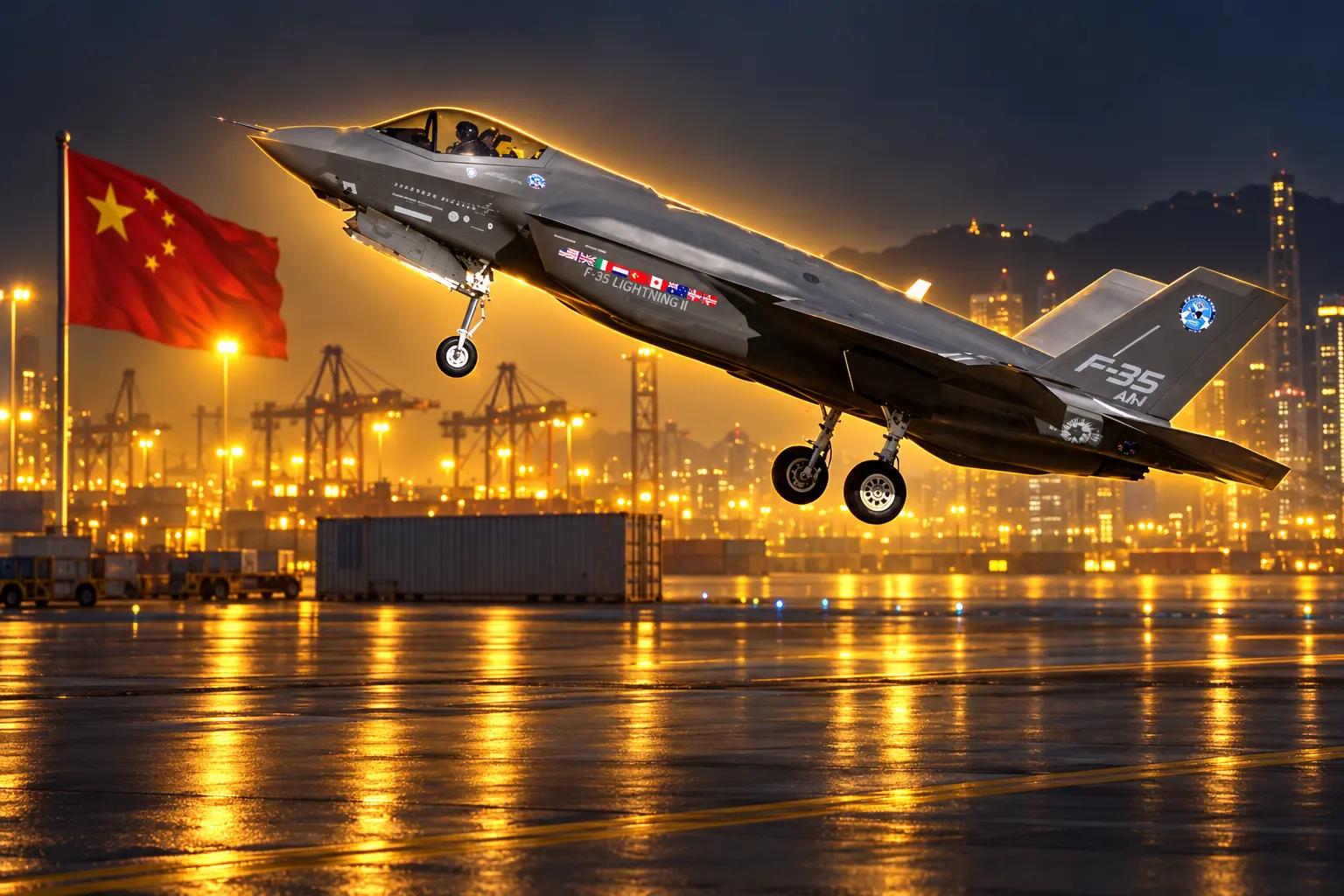
Chinese authorities are holding a cockpit canopy and a weapons-bay door from an Australian F-35A after a late-May 2026 shipment to the United States was sent through Hong Kong.
People briefed on the incident said a UPS employee missed an arms-export warning, then chose the faster hub. The F-35 Joint Program Office is still trying to get the hardware back.
A Late Shipment Took the Hong Kong Shortcut
The parts came off a Royal Australian Air Force F-35A. Lockheed Martin had them packed for inspection in the United States, and for repair or disposal if they could not go back on a jet.
UPS took the consignment in late May 2026. The planned path ran from Australia to San Francisco through South Korea and Taiwan, both US defence partners.
The box reached South Korea. Then the routing changed. It went to Hong Kong, a special administrative region of China. People briefed on the matter said Chinese authorities later took possession and have not given the parts back.
Australia operates 72 F-35A fighters and does airframe, engine, and component work for the type. Lockheed Martin, not Canberra, runs the global supply chain that moves those spares. Defence Minister Richard Marles said Australia is reviewing what happened at its end and is confident about how it has engaged the program.
THE MAY-TO-OCTOBER TRAIL
- Late May 2026: UPS ships an unserviceable F-35 canopy and weapons-bay door from Australia toward San Francisco.
- South Korea stop: The consignment arrives as planned, then is retimed through Hong Kong to make up a late departure.
- Hong Kong: Chinese authorities take the two parts and, in accounts through early October, do not return them.
- September 18, 2026: The diversion becomes public; the Joint Program Office confirms a shipment issue and a recovery effort.
- September 22, 2026: Marles tells reporters in Adelaide that Australia is helping Washington and Lockheed Martin.
- September 29, 2026: Pentagon officials brief House Foreign Affairs and Armed Services staff behind closed doors.
- October 7, 2026: People briefed on the case describe a missed DSV warning email at UPS.
USTRANSCOM has said it did not run this job. The box moved as ordinary air cargo, which is why a commercial hub was even on the menu.
An Unread Email, Two IT Systems
The last failure was small. DSV A/S, the Danish freight forwarder working for Lockheed Martin, emailed UPS that the shipment sat under the International Traffic in Arms Regulations. The message said the parts must not transit certain countries.
A person briefed on the case said the UPS employee who retimed the job never acted on that mail. The warning may have landed on a different IT system from the one that employee used.
The consignment had left Australia late. Hong Kong was the catch-up hop. UPS and DSV declined to discuss those details.
ITAR exists to keep US munitions out of unapproved hands. A commercial sorter making up time is not a cleared courier. That is the hole the email was meant to cover, and it is the hole the box fell through.
Export control on a fifth-generation fighter is supposed to live in licences, denied-party lists, and routing locks, not in whoever happens to open a mailbox. Once the warning missed the person with the routing screen, Hong Kong became a normal waypoint again.
What the Canopy and Bay Door Carry
The two pieces are a cockpit canopy and a weapons-bay door, both described as coated with radar-absorbing material. They were unserviceable. They are still physical samples of the F-35’s low-observable skin, which is why the detour landed in Chinese government custody rather than in a repair shop.
THE TWO PARTS IN CHINESE HANDS
| Part | Job on the jet | What a lab can study |
|---|---|---|
| Cockpit canopy | Stretched acrylic bubble over the cockpit | Transparent radar-absorbent coating on the outer surface |
| Weapons-bay door | Cover for an internal weapons bay | Radar-absorbing coating used on the stealth airframe |
US Air Force maintainers have been blunt about the canopy. The F-35A canopy is a stretched acrylic bubble, and it carries a thin layer of transparent radar absorbent material on the outside. Hill Air Force Base crews have replaced canopies when that layer degraded, peeled, or separated, because the peel opened a radar vulnerability. A swap takes nearly 100 man-hours.
Stealth is not one coating. Air Combat Command describes it as the jet’s lines and contours, its composite skin, and the radar-absorbent material that coats the whole aircraft. A door and a canopy do not hand over that system. They do hand over two coated surfaces a lab can measure, including how the film sits on acrylic and on a bay door.
There is no public evidence that the parts have been cut up or copied. Possession is the fact on the table. Exploitation is the fear that possession makes possible.
Canberra Calls the Hardware Unserviceable
Marles spent September 22 lowering the temperature. He said Australia was examining its end of the chain, then put the rest on Washington and Lockheed Martin, “the contractor that is responsible for managing the global supply chain.”
My understanding is that there is a sense of comfort, and we’re not talking about sensitive equipment here or sensitive parts.
Richard Marles, Deputy Prime Minister and Minister for Defence, doorstop in Adelaide, September 22, 2026
Asked again whether any sensitive parts were involved, he said the question was best directed to the United States and Lockheed, but that his understanding remained that officials are not talking about sensitive parts here.
A Lockheed Martin spokesperson said the components are unserviceable and deemed low risk for exploitation. The Joint Program Office said it was aware of a shipment issue of unserviceable F-35 Lightning II components and was working with US authorities and industry partners to retrieve them, investigate the incident, and place safeguards to avoid a future occurrence.
Those lines can sit together. Unserviceable is a maintenance status. Low risk is a judgment about software, sensors, and classified files that were not in the crate. Neither sentence is a chain of custody, and neither puts the coated hardware back in US hands.
Pat Conroy, Australia’s defence industry minister, told reporters in Hobart on September 23 he would not discuss specifics while investigations ran, principally in America. He said he had been aware of the matter well before it became public.
One Million Spares Already off the Books
The Hong Kong box is one loss. The program’s spare-parts system has been leaking for years, which is why a single reroute reads less like a freak accident than like a hole that was already on paper.
The Government Accountability Office reported on May 23, 2023, that the Joint Program Office does not enter global spares held at non-prime facilities into an accountable property system of record. Prime contractors keep those books. The parts sit at over 50 domestic and international sites. The Pentagon owns the pool. The contractors manage it. Offices still have not agreed whether the spares count as government-furnished property, which is the label that would force them into the system DOD uses to track losses.
WHAT THE 2023 AUDIT ALREADY SHOWED
- Program cost: DOD expects to spend more than $1.7 trillion over the life of the F-35.
- Identified losses: GAO found losses of over 1 million spare parts totaling over $85 million since May 2018, of which less than 2 percent had been reviewed by the Joint Program Office.
- Unreported stock: The same prime contractor had not reported over 900,000 spare parts valued at over $66 million as of October 2022, including 34 actuator doors costing over $3.2 million that were lost in the fourth quarter of 2019.
- Waiting on orders: Over 19,000 spare parts in the pool had been waiting for disposal instructions for anywhere from a few months up to 5 years.
DOD agreed with four recommendations, including putting the pool on contract as accountable property and writing a process for reporting losses and disposing of unserviceable stock. One prime contractor, listed as Vendor 1, rejected a bilateral GFP modification on March 23, 2023. DOD’s estimated completion date for getting GFP clauses onto the next contract was June 2024. GAO followed up in August 2026 and again in September 2026. All four recommendations were still Open.
A program that does not keep its own live record of the pool is asking a courier inbox to do the last mile of export control. The May 2026 box did not invent that arrangement. It used it.
Why the Courier Could Use a Port the Pentagon Cannot
In August 2026, US Transportation Command told the Department of War shipping community that export-controlled cargo transiting PRC or SAR ports is not authorized. Hong Kong and Macao sit inside that rule. Sensitive and classified cargo may not transit those ports. Transshipment is barred. Carriers must still follow export-control law even when a commercial timetable is burning.
WHAT MILITARY CARGO CANNOT DO THERE
- ITAR and EAR freight: Sustainment cargo on a government bill of lading may transit the PRC or its SARs only if it is not export-controlled.
- Sensitive loads: Ammunition, sensitive, and classified cargo may not transit PRC or SAR ports at all.
- No split in the port: Cargo that does transit is not allowed to transship or transload at those ports.
- Flag check: PRC, Hong Kong, or Macao-flagged vessels need advance approval before carrying that sponsored cargo.
That rule binds military cargo. This box moved as a commercial UPS job. The catch-up hub was available because the carrier still treats Hong Kong as a normal Asian waypoint, and because the person with the routing screen never saw the mail that said otherwise.
US munitions rules have treated Hong Kong as China for years. The same instinct now sits over who may receive America’s next fighter. The F-35 pool is supposed to be the tightly held present. It still rides the commercial network that delivers everything else on a clock.
The State Department’s Directorate of Defense Trade Controls opened a compliance probe. House staff heard the Pentagon’s version on September 29. As of the early October accounts, the canopy and the door had not come back.
Until they do, the F-35’s global pool has a documented path from an allied hangar to a Chinese government warehouse, and it did not require a hack. It required a late pickup and a hub that was faster.

Cook Hands Democrats the House as Crypto’s Bill Stays Dead

Wicker’s Broken Bed Was the Short Story’s Punch Line

Nvidia’s $500 Billion Financing Plan Draws a $180 Sell

Maserati Bets the Grecale V6 Can Fill Porsche’s Gap

EV Cable Theft Follows the Old Railway Copper Playbook

Aramco Crash Kills 14 Two Days After Oil Restart

Salah Captained Egypt to Their First World Cup Win

Zelda’s 40th Switch 2 Ships Without a Zelda Game

Apple Labor Day Deals Hide June’s Memory Price Hike

Palworld 1.0.4 Adds Palpedia Search After the 1.0 Launch
-
 BUSINESS4 months ago
Aramco Crash Kills 14 Two Days After Oil Restart
-
 NEWS5 months ago
Salah Captained Egypt to Their First World Cup Win
-
 GAMING2 months ago
Zelda’s 40th Switch 2 Ships Without a Zelda Game
-
 NEWS2 months ago
Apple Labor Day Deals Hide June’s Memory Price Hike
-

 NEWS4 months ago
El Niño Puts Israel’s Needed Winter Rain on a Flood Clock
-
 GAMING2 months ago
Palworld 1.0.4 Adds Palpedia Search After the 1.0 Launch
-

 BUSINESS8 months ago
BAE’s 60-Year Saudi Franchise Now Runs Through Taif
-

 BUSINESS8 months ago
Egypt Bets EGP 638 Billion Can Open Sinai to Investors