
BUSINESS
BNP Paribas Moves Its Regional Hub From Bahrain to Riyadh
BNP Paribas took a Riyadh RHQ licence on 25 August 2026, ending Bahrain’s role as its Gulf hub in return for Saudi contracts and a 30-year tax holiday.

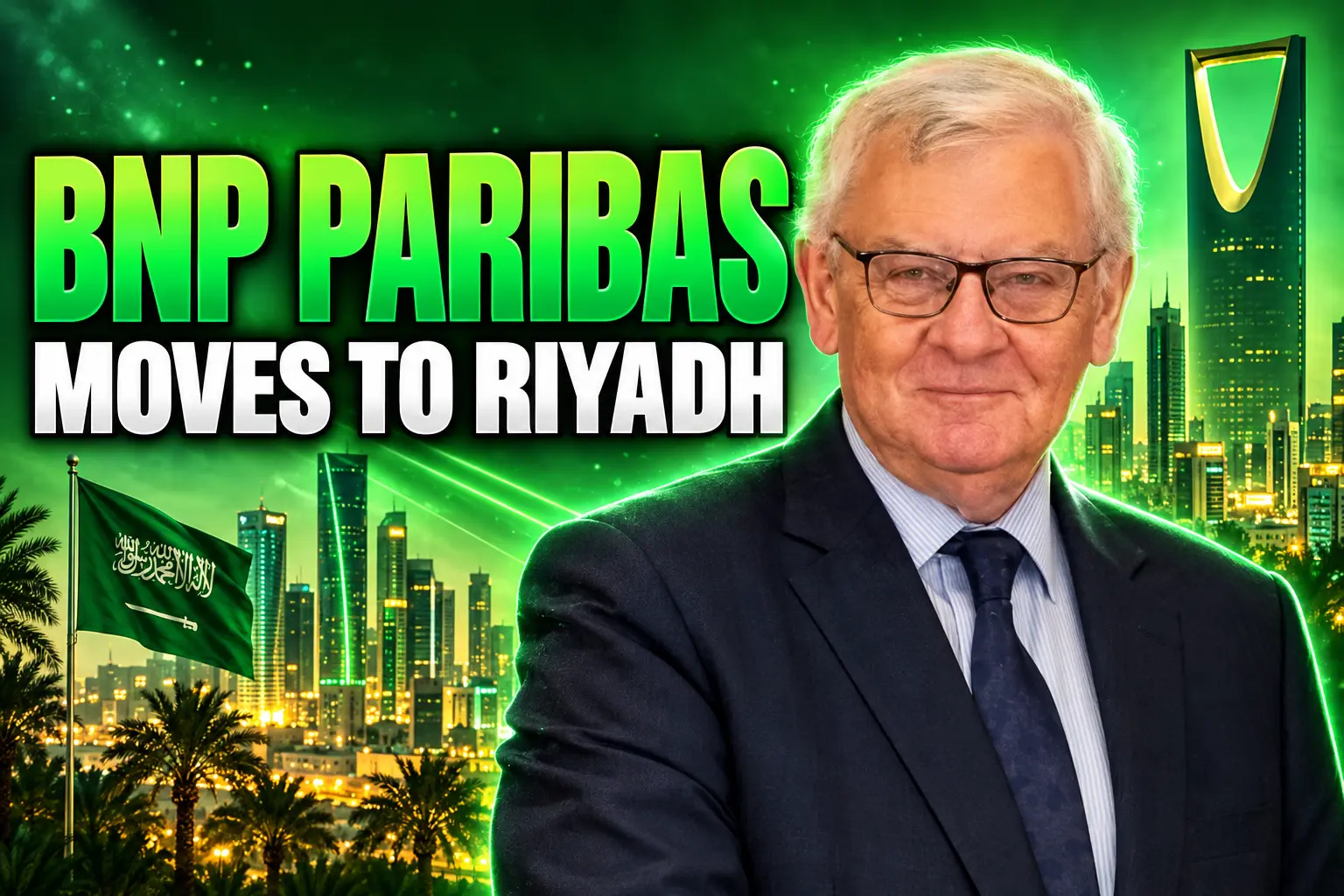
BNP Paribas received a Saudi regional headquarters licence on 25 August 2026, locking its Gulf command into Riyadh. Investment Minister Fahad bin Abduljalil Al-Saif handed the papers to Chairman Jean Lemierre at a meeting in Paris.
The French bank’s previous regional hub sat in Bahrain, where it had operated for more than 50 years. The new certificate is the price of staying eligible for Saudi state work, and it leaves Manama with a local office rather than the regional title.
Paris Handed BNP Paribas a Riyadh Licence
The Ministry of Investment said Al-Saif and Lemierre discussed deeper work in finance and support for the group’s expansion in Saudi Arabia and the wider region. At that meeting the group received investment registration for a regional headquarters in the Kingdom.
The ministry presented the filing as the latest global bank to join the Regional Headquarters Program, launched in 2021. More than 750 companies have now joined, well ahead of the original target of 500 companies by 2030. The announcement did not give an investment value, a staff plan, or an opening date.
HE Fahad Al-Saif, Minister of Investment, met with @BNPParibas Chairman Jean Lemierre in #Paris to oversee opportunities to strengthen cooperation and investment in finance. The Group’s investment registration for its Regional Headquarters in the Kingdom was handed over,… pic.twitter.com/g8toLl1jE9
— وزارة الاستثمار (@MISA) August 24, 2026
BNP Paribas is not a newcomer that needed a first licence to enter the market. It already runs a commercial bank branch under the Saudi Central Bank and BNP Paribas Investment Company under the Capital Market Authority, and it has been active in the Kingdom for almost two decades. In February 2025 it completed the relocation of its Saudi offices to KAFD, the King Abdullah Financial District in Riyadh.
We are pleased to announce the relocation of our headquarters to Riyadh’s premier business and lifestyle destination, KAFD. This move enhances our services and operational capabilities. The new offices represent our commitment to providing exceptional commercial banking services. Notably, BNP Paribas has been the leading international bank in the Kingdom for almost two decades.
Reema Alasmari, Head of Territory for Saudi Arabia, BNP Paribas, KAFD announcement, 3 February 2025
Ammar Pharaon, chief executive of the investment company, said the KAFD move was meant to put the bank closer to Saudi businesses. Lemierre attended the office opening. The August licence is the legal title that sits on top of that physical shift: regional management, strategic direction, and corporate functions now have to live in the Kingdom if the bank wants the public-sector book.
Bahrain’s 50-Year Hub Did Not Survive the Contract Rule
For a long stretch Manama was the bank’s Middle East and Africa head office, a holdover from the years when Bahrain sold itself as the Gulf’s banking city and Saudi Arabia kept foreign lenders on a tighter leash. That structure cracked in 2024, when Riyadh, Dubai, and Abu Dhabi were all courting the same regional titles.
On 16 October 2024, people familiar with the matter said BNP Paribas would drop Manama as its MEA head office and have local Gulf offices report to Paris, a way of avoiding the look of picking one Gulf capital. Staff were told Bahrain headcount would fall by early 2025. The bank’s annual financial report showed 261 people in Bahrain at the end of 2023, covering corporate and institutional banking, investment solutions, and Islamic banking.
BNP Paribas which has been operating in Bahrain for over 50 years, will maintain its significant presence in the country and pursue its local business development.
BNP Paribas statement, October 2024
Reporting into Paris was a pause, not a settlement. Once Saudi entities stopped awarding work to groups whose regional headquarters sat abroad, a European bank that wanted sovereign, PIF-linked, and ministry mandates had to put the brass plate in Riyadh. The 25 August registration is that brass plate. Goldman Sachs, JPMorgan, and Morgan Stanley already held the same class of licence; the French bank is completing a filing, not opening a new market.
HOW THE HUB LEFT MANAMA
- 2021: Saudi Arabia launches the Regional Headquarters Program to pull multinational management into Riyadh.
- 1 January 2024: Government entities generally stop contracting foreign groups whose regional headquarters sit outside the Kingdom.
- 16 October 2024: BNP Paribas scraps the Manama MEA head office and routes Gulf offices to Paris, with Bahrain jobs set to fall by early 2025.
- 3 February 2025: The bank and KAFD announce that the Saudi branch and investment company are moving into the financial district.
- 8 July 2026: Deutsche Bank receives its own Riyadh RHQ licence, its third Saudi legal entity.
- 25 August 2026: Al-Saif hands BNP Paribas its RHQ registration in Paris.
The sequence is a managed unwind, not a surprise exit. Bahrain kept a branch franchise the bank still describes as significant. It lost the regional reporting line that used to sit there, and it cannot match a 30-year Saudi tax holiday or the threat of being locked out of state contracts.
What the RHQ Package Contains
The licence is a separate headquarters entity, not a second banking licence. Trading stays with the SAMA branch and the CMA company. The RHQ is supposed to direct and support the group’s regional operations from Riyadh, and it has to show substance or the tax deal and the procurement pass both fail.
Invest Saudi’s programme rules require a minimum of 15 full-time employees, including three top executives such as a chief executive, chief financial officer, or vice president, within one year of the licence. Two hundred and fifty work visas are allocated from day one. The RHQ entity also gets a 10-year holiday from Saudization quotas.
RHQ INCENTIVES AND SUBSTANCE RULES
| Item | Term |
|---|---|
| Corporate income tax on eligible RHQ income | 0% for 30 years from licence date, renewable |
| Withholding tax on qualifying payments | 0% for 30 years (dividends, certain related-party and service payments) |
| Saudization (Nitaqat) relief | 10-year exemption for RHQ staff |
| Work visas | 250 allocated from day one |
| Minimum headcount | 15 full-time staff, including 3 executives, within one year |
The tax relief applies to qualifying headquarters work, not to every riyal the group earns in Saudi Arabia. Commercial income in the branch and the investment company still sits under ordinary tax and zakat rules. That is why large banks can justify a 15-person management shell: the prize is tender access and a clean intra-group tax line, while the existing licences keep doing the revenue work.
Deutsche Bank Got Its Licence in July
BNP Paribas is late relative to several peers and still early enough to matter for French-Saudi deal flow. Deutsche Bank said on 8 July 2026 that MISA had granted it an RHQ licence, making the German lender’s RHQ its third legal entity in Saudi Arabia after a Riyadh branch opened in 2006 and Deutsche Securities Saudi Arabia in 2007.
Jamal Al Kishi, Deutsche Bank’s chief executive for the Middle East and Africa, said Saudi Arabia and the Middle East are a key growth market and that the licence was a step toward the bank’s regional expansion targets. The statement is the template other houses now use: the RHQ is framed as a platform for regional management, not as a new product factory.
BANKS WITH A RIYADH RHQ FOOTPRINT
| Bank | RHQ status | Saudi operating base |
|---|---|---|
| BNP Paribas | Registration 25 August 2026 | SAMA branch and CMA investment company; KAFD offices from 2025; prior MEA hub in Bahrain |
| Deutsche Bank | Licence 8 July 2026 | Third legal entity; Riyadh branch 2006; Deutsche Securities Saudi Arabia 2007 |
| Goldman Sachs, JPMorgan, Morgan Stanley | Licences already granted | Named by the ministry and by the banks as RHQ holders in Riyadh |
The French bank still runs offices in the UAE, Qatar, Kuwait, and Bahrain. Those cities keep coverage and local books. They no longer hold the regional headquarters the Saudi programme recognises. For a universal bank that wants ministry, sovereign, and giga-project work, that distinction is the whole filing.
Saudi Banking Assets Are Already Near the 2030 Goal
The Financial Sector Development Program, launched in 2018, set a 2030 goal of total banking assets of SAR 4,553 billion (about $1.21 trillion). The programme’s 2024 annual report, issued with the Saudi Central Bank, put sector assets at SAR 4,494 billion by the end of 2024, SAR 59 billion short of that 2030 mark, or 98.7% of the target with four years still on the clock.
Riyadh is not short of bank balance sheets. It has been short of the people who sit on those books and decide where the next loan, bond, or advisory mandate is run from. The RHQ rule was written to close that gap: if the contracts and the capital are in the Kingdom, the regional management desk has to be there too.
THE TALLY BEHIND THE LICENCE
- RHQ licences: More than 750 companies as of 25 August 2026, against a 2030 target of 500.
- Bank assets, end 2024: SAR 4,494 billion, per the Financial Sector Development Program annual report.
- 2030 asset goal: SAR 4,553 billion, set by the Ministry of Finance under the same programme.
- Gap to target: SAR 59 billion, or 1.3% of the 2030 figure.
That arithmetic is why a 15-person headquarters in KAFD is treated as a strategic event. The sector already cleared the size test. The fight among Gulf cities is over where the title, the visas, and the intra-group charges sit.
Manama Keeps a Local Office After the Shift
Bahrain’s loss is the reporting line and the regional jobs that used to travel with it. The island still has a BNP Paribas office, a 50-year franchise, and a statement from 2024 that local business development would continue. What it does not have is a matching 30-year tax holiday or a rule that says ministries must buy from firms headquartered in Manama.
The bank tried, for two years, to sit above the Riyadh-Dubai-Abu Dhabi contest by reporting the Gulf into Paris. The contract bar made that posture expensive. Once Deutsche Bank and the Wall Street houses had filed, staying out looked less like neutrality and more like a blocked bid list.
WHAT WE KNOW
- The certificate: MISA recorded BNP Paribas’s RHQ registration on 25 August 2026 in Paris.
- The prior hub: The bank confirmed its previous regional headquarters was in Bahrain and said in 2024 it would keep a significant local presence there.
- The Saudi base: A SAMA branch and a CMA investment company already sit in KAFD.
WHAT IS UNCONFIRMED
- Money and headcount: No investment value or RHQ staff number has been published.
- Opening day: No date has been given for the headquarters entity to be fully staffed.
- Bahrain cuts: The 2024 plan to reduce Manama jobs by early 2025 was never given a public figure, and no 2026 headcount has been released.
Until those numbers appear, the only completed fact is the title. Riyadh has the regional headquarters licence. Manama has a branch. For a bank that spent half a century using Bahrain as its Gulf hub, that split is the whole story.
Frequently Asked Questions
What Tax Incentives Come With a Saudi RHQ Licence?
Qualified regional headquarters get 0% corporate income tax on eligible RHQ income and 0% withholding tax on qualifying payments for 30 years from the licence date, a term that can be renewed. The relief does not cover VAT, which remains 15%, and it does not wipe out zakat. Income from commercial work that falls outside approved headquarters activities is taxed under ordinary Saudi rules, so the holiday is tied to the RHQ entity, not to the whole group.
How Many Staff Does a Saudi Regional Headquarters Need?
Programme rules require 15 full-time employees on the RHQ payroll within one year, and three of them must be senior executives such as a chief executive, chief financial officer, executive director, or vice president. The same package issues 250 work visas from day one, grants a 10-year Saudization holiday, and waives professional accreditation for RHQ staff except in medicine and engineering. Spouses may work, and the residency age for male dependents is extended to 25.
Is BNP Paribas Closing Its Office in Bahrain?
No public statement says the Bahrain office is closing. In October 2024 the bank said it would maintain a significant presence and keep developing local business after dropping Manama as the Middle East and Africa head office. That Bahrain unit has offered corporate and institutional banking, investment solutions, and Islamic banking. The RHQ in Riyadh is a separate management entity and, under programme rules, is not itself meant to carry out direct revenue-generating commercial activity.
When Did the Regional Headquarters Program Start?
The programme was launched in 2021 as a joint effort of the Ministry of Investment and the Royal Commission for Riyadh City, under Vision 2030. A qualifying group must have at least two subsidiaries or branches outside both its home country and Saudi Arabia. From 1 January 2024, Saudi government entities have generally been barred from contracting groups that lack a Kingdom-based RHQ, which is why banks already licensed in Riyadh still file for the extra title.

Cook Hands Democrats the House as Crypto’s Bill Stays Dead

Wicker’s Broken Bed Was the Short Story’s Punch Line

Nvidia’s $500 Billion Financing Plan Draws a $180 Sell

Maserati Bets the Grecale V6 Can Fill Porsche’s Gap

EV Cable Theft Follows the Old Railway Copper Playbook

Aramco Crash Kills 14 Two Days After Oil Restart

Salah Captained Egypt to Their First World Cup Win

Zelda’s 40th Switch 2 Ships Without a Zelda Game

Apple Labor Day Deals Hide June’s Memory Price Hike

Palworld 1.0.4 Adds Palpedia Search After the 1.0 Launch
-
 BUSINESS4 months ago
Aramco Crash Kills 14 Two Days After Oil Restart
-
 NEWS5 months ago
Salah Captained Egypt to Their First World Cup Win
-
 GAMING2 months ago
Zelda’s 40th Switch 2 Ships Without a Zelda Game
-
 NEWS2 months ago
Apple Labor Day Deals Hide June’s Memory Price Hike
-

 NEWS4 months ago
El Niño Puts Israel’s Needed Winter Rain on a Flood Clock
-
 GAMING2 months ago
Palworld 1.0.4 Adds Palpedia Search After the 1.0 Launch
-

 BUSINESS8 months ago
BAE’s 60-Year Saudi Franchise Now Runs Through Taif
-

 BUSINESS8 months ago
Egypt Bets EGP 638 Billion Can Open Sinai to Investors