
NEWS
China’s Four-Country Aid Pledge Narrowed After Cargo Moved
China pledged emergency humanitarian aid to Iran, Jordan, Lebanon and Iraq with no figure, then published cargo lines for Iran and Lebanon.

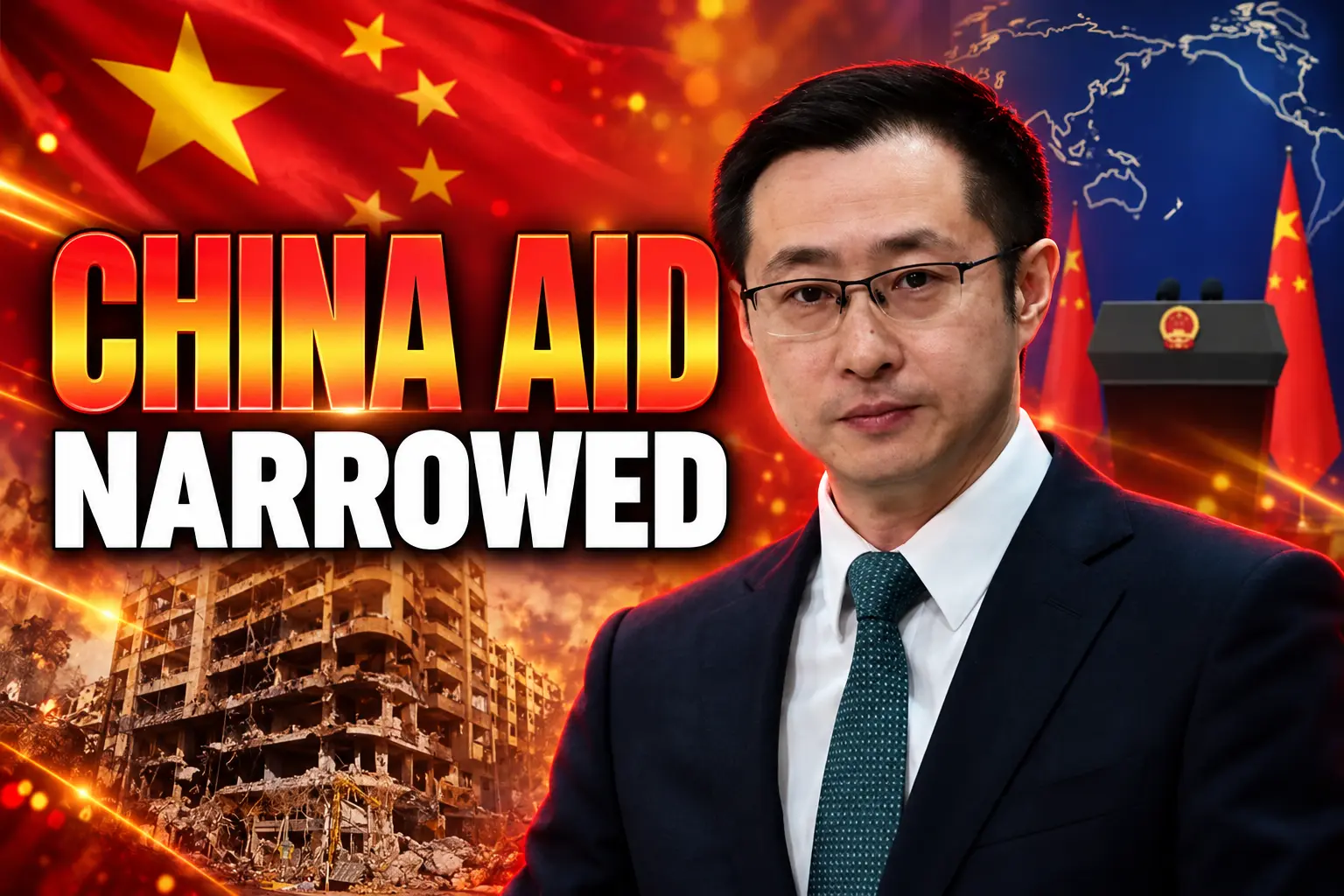
On March 17, 2026, China said it would send emergency humanitarian assistance to Iran, Jordan, Lebanon and Iraq, and gave no figure. Foreign Ministry spokesperson Lin Jian made the promise in Beijing in the third week of a war that began on February 28.
The cargo China later put on the record went to Iran and Lebanon. Jordan and Iraq stayed in the original sentence. The UN refugee agency’s Iran file, months on, was still mostly unpaid.
China’s First Public Pledge Named Four Capitals
A CGTN reporter asked whether Beijing would help after UNHCR called the Middle East crisis a major emergency. The question said the affected regions already hosted 25 million people as refugees, that civilians were being killed in Iran, that nearly 800,000 people were displaced in Lebanon, and that Jordan and Iraq were feeling the fighting too.
Lin answered with a four-country list and no tonnage, no cash line, and no delivery date. He said China would emergency humanitarian assistance to four countries in the hope of easing the hardship on the ground, and that Beijing would keep pushing for a ceasefire so the crisis did not spread.
The ongoing conflict inflicted an excruciating humanitarian disaster on people and countries in the region, including Iran. China deeply sympathizes with people in relevant countries and our hearts go out to them. China has announced the decision to provide emergency humanitarian assistance to Iran, Jordan, Lebanon and Iraq.
Lin Jian, Foreign Ministry spokesperson, regular press conference, March 17, 2026
He posted the same decision on his official account that afternoon, again without a price.
China has announced the decision to provide emergency humanitarian assistance to Iran, Jordan, Lebanon and Iraq. We hope this will help ease the difficult humanitarian situation facing the people there.
China will continue striving for a ceasefire, an early return of peace and… pic.twitter.com/UC9aTYmZvb
— Lin Jian 林剑 (@SpoxCHN_LinJian) March 17, 2026
The rest of that briefing was not about blankets. Reporters asked whether U.S. President Donald Trump would delay a visit to Beijing, and whether the trip was tied to the Strait of Hormuz. Lin said the two sides were still talking about the visit, including the dates, and that he had nothing to add.
The aid line was the first public Chinese relief decision for all four capitals at once. It was also an empty box. Anyone trying to score the pledge against UNHCR’s caseload had no denominator to use.
The 24 Million Were Already Displaced
The number that framed the question was not a count of people newly driven out after February 28. UNHCR’s Middle East emergency page says that even before the escalation, the affected countries already held more than 24 million already displaced people and returnees, plus the communities hosting them. That is the pre-war baseline, not a fresh war total.
The new fighting still moved a lot of people. UNHCR said 1 million people had been displaced in Lebanon since March 2, 2026. Government data cited by the agency put the Iranian shift at 600,000 to 1 million households that had temporarily left their homes. Over 200,000 people crossed from Lebanon into Syria, including 180,000 Syrians and 20,000 Lebanese, in the April update of that page.
THE CASELOAD BEHIND THE PLEDGE
- Pre-war baseline: UNHCR says more than 24 million people across the affected countries were already displaced or returnees before February 28.
- Briefing figure: The question put to Lin used 25 million people already hosted as refugees, a different wording from UNHCR’s own page.
- Lebanon: The question cited nearly 800,000 displaced; UNHCR later put displacement since March 2 at 1 million.
- Iran: UNHCR cited government data that 600,000 to 1 million households had temporarily left their homes.
By late September, UNHCR Lebanon said at least 340,000 people were still displaced. The March list had been sold as an answer to a regional emergency. The underlying file was older, larger, and still open.
Iran Got Cash for Minab, Then 58 Tonnes
Four days before the four-country announcement, China did publish a number, and it was for one school. On March 13, Lin said the Red Cross Society of China would give the Iranian Red Crescent $200,000 for bereaved parents of students from Shajarah Tayyebeh primary school in Hormozgan province. He condemned attacks on civilians and non-military targets and said China was ready to keep helping Iran.
That grant was not the four-country package. It was a special fund for families after the February 28 strike on the Minab school, the first day of the U.S. and Israeli assault on Iran.
The first large in-kind delivery that China described in public went to Tehran a month later. On April 17, Ambassador Cong Peiwu handed over emergency aid at Iranian Red Crescent headquarters with society president Pirhossein Kolivand. Cong said the load was 58 tonnes and that it was entirely medicine.
This aid package, totaling 58 tonnes, consists entirely of medicines. The recent war launched by the United States and Israel has caused a major humanitarian disaster for Iran, and medicine is in urgent need.
Cong Peiwu, Chinese ambassador to Iran, handover in Tehran, April 17, 2026
Cong called China and Iran good friends and partners. Kolivand thanked Beijing for the medicine and for support to the Iranian government. The ceremony was a bilateral channel through the Red Crescent, not a UN appeal, and it named Iran alone.
CHINA’S PUBLISHED AID LINES
| Date | Channel | Where | What was published |
|---|---|---|---|
| March 13, 2026 | Red Cross Society of China | Iran | $200,000 for families of the Minab school dead |
| March 17, 2026 | Foreign Ministry pledge | Iran, Jordan, Lebanon, Iraq | Decision announced, no figure |
| April 17, 2026 | Embassy and Iranian Red Crescent | Iran | 58 tonnes of medicines |
| May 5, 2026 | Beirut Port, Higher Relief Committee | Lebanon | 650 tons of Chinese food and relief goods in two shipments |
| June 17, 2026 | Lin Jian statement | Iran and Lebanon | Further aid promised, no figure |
Jordan and Iraq do not appear in that cargo column. The March sentence had four names. The rows that carry weight have two.
What Landed at Beirut Port in May
Lebanon was the other place where Chinese goods showed up on a dock with officials attached. On May 5, the Higher Relief Committee said two shipments had arrived at Beirut Port with 650 tons of Chinese humanitarian, food, and relief aid. Social Affairs Minister Haneen Al-Sayed and Chinese Ambassador Chen Chuandong stood with committee secretary-general Brigadier General Bassam Naboulsi and port chief Marwan Al-Naffi.
Al-Sayed thanked the Chinese government and people and said the goods would move through the committee and her ministry to those most in need. Naboulsi called the donation a sign of support in a hard period. Chen went further on volume. He said the relief materials had come in two shipments from China and Egypt and totaled more than one thousand tons of tents, blankets, mattresses, food, and medical supplies. That combined China-and-Egypt figure is larger than the 650 tons of Chinese goods the minister and the committee put on the two ships at the ceremony.
Chen also said China stood with Lebanon as a partner and friend and backed the country’s sovereignty, security, and unity. The political language matched Cong’s Tehran talk: friendship first, then the pallets. The March list had treated Lebanon as one of four. The port treated it as a destination with a ceremony, a minister, and a tonnage.
For families already on the move, a dock full of tents and food is not a press line. It is also not a four-country operation. The Lebanese file kept growing after the ships tied up. UNHCR’s late-September count of at least 340,000 people still displaced sat beside a Chinese delivery that had been measured in hundreds of tons in May.
The Two Names Without a Cargo Line
Jordan and Iraq were in Lin’s sentence because the war did not stop at Iran’s borders. They were not in the handover photos that followed. No Chinese tonnage, cash line, or port ceremony for either country turned up in the official notices that accompanied the Iran and Lebanon deliveries. When Lin spoke again in June, he dropped both names.
The four capitals were not under the same kind of fire, which is why a single unpriced pledge was always a diplomatic map more than a logistics plan.
HOW THE FOUR SAT IN THE WAR
- Iran: Direct target of U.S. and Israeli strikes from February 28, including the Minab school attack that drew the $200,000 grant.
- Lebanon: Pulled in from March 2, with UNHCR putting displacement from that date at 1 million people and Chinese goods arriving at Beirut Port in May.
- Jordan: Named on March 17 as affected by the wider fighting; China did not later publish a Jordan cargo row.
- Iraq: Named the same day as a neighbour under pressure; China did not later publish an Iraq cargo row.
A four-name pledge lets Beijing talk to Tehran and to Arab governments that were absorbing spillover at the same time. The partner-maintenance reading is the simpler one once the crates are counted. China already called Iran a friend. Lebanon got a dockside speech about a shared destiny. Jordan and Iraq got the original sentence.
That pattern is why the March announcement travelled so well as a story about China sending water while others sent fire, and why the later record looks narrower. Applause attached to the four-country line. The oil-and-aid reading attached to the follow-up that named only Iran and Lebanon. Both readings are looking at the same sequence: a wide list, then cargo along existing ties.
UNHCR’s Iran File Is 18 Percent Funded
The UN system that supplied the emergency label did not fill up after China’s pledge. A UNHCR snapshot of its own operations at the end of August 2026 put Iran at $140 million required and 18 percent funded. Lebanon stood at $472 million and 24 percent funded. Iraq, which never received a published Chinese tonnage in this sequence, was at $61 million and 42 percent funded.
UNHCR OPERATION FUNDING, END OF AUGUST 2026
| Operation | Required | Funded |
|---|---|---|
| Iran | $140 million | 18 percent |
| Lebanon | $472 million | 24 percent |
| Iraq | $61 million | 42 percent |
Those percents are UNHCR’s own appeal lines, not a scorecard of Chinese bilateral gifts. The 58 tonnes of medicine and the 650 tons at Beirut Port do not appear inside them. They do show what was still missing in the UN file for the two countries that actually received Chinese cargo, months after Lin’s four-country answer.
On June 17, Lin said China was deeply saddened by the humanitarian disaster from the U.S.-Israel-Iran conflict and its spillover. He said China had provided emergency aid to Iran and other countries in March. Then he announced further assistance to Iran and Lebanon to help people recover, rebuild, and improve livelihoods. He gave no figure. He did not name Jordan or Iraq.
The March list had four capitals and no price. The April and May cargo went to Tehran and Beirut. The June sequel named those two again. UNHCR Lebanon, in late September, still counted at least 340,000 people who had not gone home.

Ninja Theory Staff Face Redundancy After Two Xbox Sales Collapse

Amazon Sells the MacBook Air at Its Pre-Hike Price

U.S. Slows Jet Parts to Squeeze China’s Flying Fleets

PEGI Pulled the GTA 6 Age Rating After Cocaine Details

Northwestern’s Smaller Ryan Field Gave Penn State Nowhere to Hide

Aramco Crash Kills 14 Two Days After Oil Restart

Salah Captained Egypt to Their First World Cup Win

Apple Labor Day Deals Hide June’s Memory Price Hike

Palworld 1.0.4 Adds Palpedia Search After the 1.0 Launch

Zelda’s 40th Switch 2 Ships Without a Zelda Game
-
 BUSINESS3 months ago
Aramco Crash Kills 14 Two Days After Oil Restart
-
 NEWS4 months ago
Salah Captained Egypt to Their First World Cup Win
-
 NEWS1 month ago
Apple Labor Day Deals Hide June’s Memory Price Hike
-
 GAMING4 weeks ago
Palworld 1.0.4 Adds Palpedia Search After the 1.0 Launch
-
 GAMING4 weeks ago
Zelda’s 40th Switch 2 Ships Without a Zelda Game
-

 NEWS3 months ago
El Niño Puts Israel’s Needed Winter Rain on a Flood Clock
-

 BUSINESS2 months ago
Egypt Seeks Two Extra El-Dabaa Reactors Before First Power
-

 ENTERTAINMENT3 months ago
A Thousand and One Drops Off Riyadh’s October Calendar