
NEWS
Pashinyan Sits Through a Gaza Summit He Does Not Sign
Nikol Pashinyan went to the Sharm el-Sheikh peace summit as a guest, not a signatory, after Trump called him Ilham Aliyev’s compatriot.

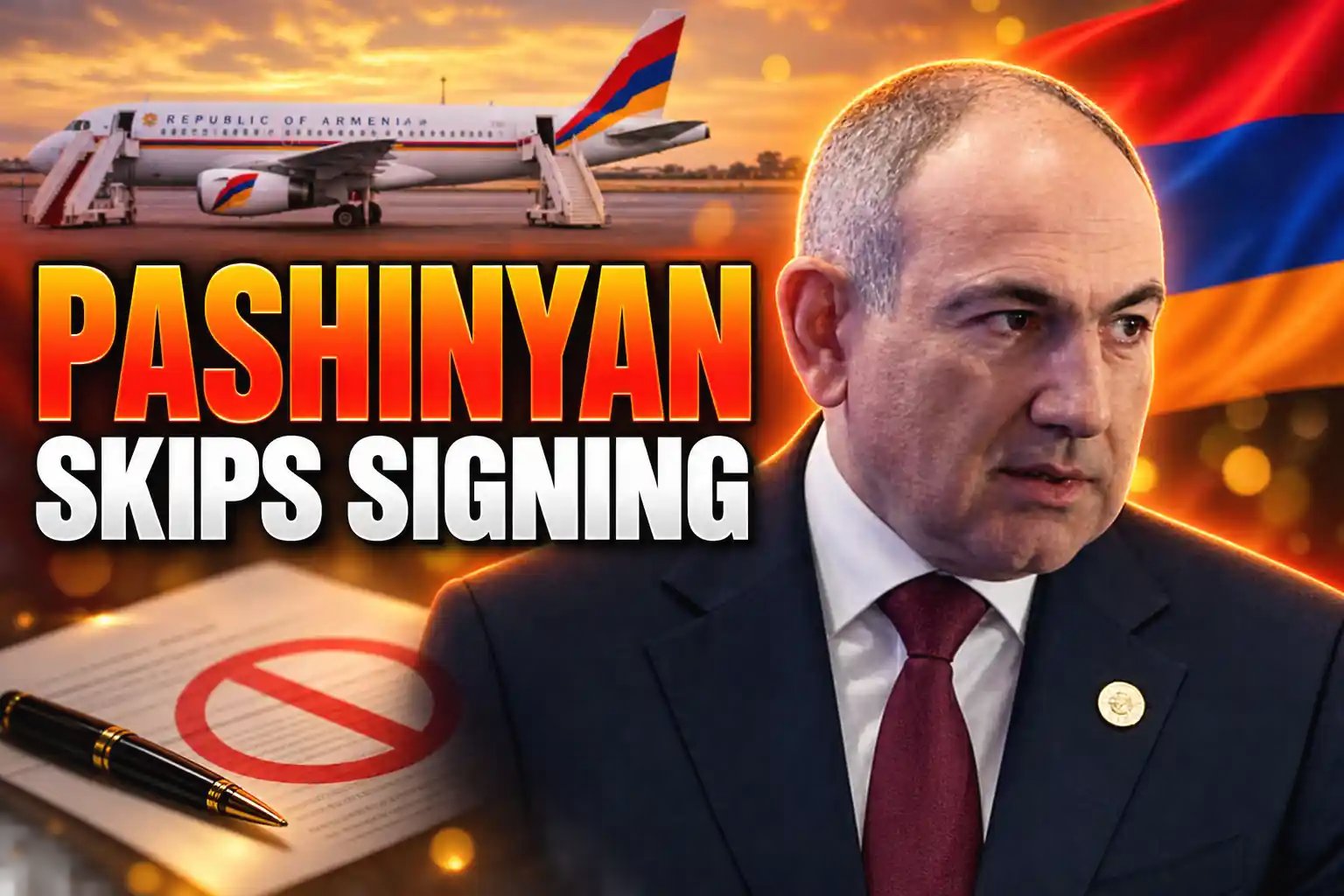
Armenian Prime Minister Nikol Pashinyan sat in Sharm el-Sheikh on October 13, 2025, as a guest at a Middle East peace summit he did not sign. He came at the invitation of U.S. President Donald Trump and Egyptian President Abdel Fattah El-Sisi. Trump spent part of the session hunting for him in the row, then introducing him as Azerbaijani President Ilham Aliyev’s “compatriot.”
Egypt’s presidency said the sitting was meant to back a Gaza deal sealed four days earlier. Armenia was on the guest list because Washington had already put Pashinyan and Aliyev on a stage of Trump’s own, and he wanted that pair in the picture again.
A Family Photo, Then Four Pens
Yerevan’s account of the day is short. El-Sisi welcomed the hall. Trump greeted the heads of government. The leaders posed for a family photo. Then four men signed a paper to end the war in Gaza, and the American and Egyptian presidents spoke. The Armenian office named no speech, no clause, and no task for its own prime minister.
The White House posted the declaration signed by four leaders under the title The Trump Declaration for Enduring Peace and Prosperity. The undersigned are Trump, El-Sisi, Qatar’s emir Tamim bin Hamad Al-Thani, and Turkey’s president Recep Tayyip Erdoğan. Egypt said those were the mediating governments standing behind the October 9 agreement, not the parties to the fighting.
The text says the parties welcome “the truly historic commitment and implementation by all parties to the Trump Peace Agreement, ending more than two years of profound suffering and loss.” It also binds the four to settle future disputes “through diplomatic engagement and negotiation rather than through force or protracted conflict.” Pashinyan’s name is not on it.
That gap is what the trip was. A small state got the camera. The pens stayed with the mediators.
Trump Looks for Aliyev’s Compatriot
Footage from the opening minutes shows Trump turning toward Aliyev, calling out Azerbaijan, and asking where his compatriot was. Aliyev pointed at Pashinyan, a few seats away. Trump then asked if the two were still getting along.
They fought for 32 years and in one hour we settled it. And they like each other.
Donald Trump, U.S. president, Sharm el-Sheikh peace summit
He also called Aliyev a “very strong ruler” who was “doing a great job,” and said he had “just solved the war for him.” In a later pass he called Armenia and Azerbaijan “a little war that we stopped,” said they had fought “like 31 years or some crazy number,” and described the two men hugging in the Oval Office after “one hour.”
The numbers are his. They are not a chronology. What the hall heard was a salesman checking that the product still smiled.
When the session ended, Pashinyan walked up to the podium while Trump thanked the room. “I’m the prime minister of Armenia. You remember me?” he said, then began “And now you…” Trump turned to U.N. Secretary-General António Guterres and Indonesian President Prabowo Subianto. Opponents in Yerevan circulated the clip as a joke. The joke writes itself. A guest who has to state his own title is not a co-author of the day.
The Washington File in a Gaza Room
The reason both Caucasus leaders were worth a Red Sea flight sits in Washington, not in Gaza. On August 8, 2025, Trump hosted Aliyev and Pashinyan at the White House. The two men signed a Joint Declaration. Their foreign ministers initialed a draft “Agreement on Establishment of Peace and Inter-State Relations.” Initialed, not signed, and not ratified.
The Joint Declaration says Armenia will work with the United States and “mutually determined third parties” on a framework for the Trump Route for International Peace and Prosperity, or TRIPP, “in the territory of the Republic of Armenia.” The route is the old fight over a land link from Azerbaijan to Nakhchivan, recast with an American name. The U.S. also Washington meeting documents the U.S. published as a packet of side deals.
THE CAUCASUS FILE BEFORE SHARM
- August 8, 2025: Aliyev and Pashinyan sign a Joint Declaration in Washington, and the two foreign ministers initial a draft peace agreement.
- October 2, 2025: The two leaders meet again in Copenhagen on the sidelines of the European Political Community and talk through TRIPP and the Washington text.
- October 9, 2025: Egypt, the United States, Qatar, and Turkey mediate an agreement to end the war in Gaza.
- October 13, 2025: Both Caucasus leaders sit in Sharm el-Sheikh while four mediators sign a Gaza declaration; Trump points at them as proof of a war he says he already closed.
- August 10, 2026: Washington, Yerevan, and Baku issue a one-year joint statement on the August 8 file, still treating that declaration as the roadmap.
The Gaza sitting did not add a line to the Armenia-Azerbaijan text. It put the two men under lights so Trump could tell a larger audience that a “little war” had already been handled in an hour.
WHAT AUGUST 8 PUT ON PAPER
- Joint Declaration: Aliyev and Pashinyan sign a Washington statement that records the initialing of a peace agreement and the need to keep going toward signature and ratification.
- TRIPP clause: Armenia agrees to work with the United States on a transit framework on its own territory, the route that would give Azerbaijan a link to Nakhchivan.
- U.S.-Azerbaijan memo: A working group is set up to write a charter on strategic partnership.
- U.S.-Armenia memos: Separate papers cover a Crossroads of Peace capacity-building partnership, an AI and semiconductor partnership, and an energy security partnership.
That is a lot of paper and still not a signed peace treaty. Sharm did not fix the gap. It advertised it.
Who Sat in Egypt, and Who Stayed Home?
The Egyptian presidency listed heads of state and government from the 27 other countries Egypt named, with Trump and El-Sisi in the chair. Armenia and Azerbaijan sit in that list beside France, the United Kingdom, Italy, Greece, Norway, Turkey, Qatar, Saudi Arabia, the UAE, Pakistan, India, and others. Also in the hall: Guterres, the secretary-general of the League of Arab States, the president of the European Council, the president of FIFA, and a former British prime minister.
WHO SIGNED AND WHO WATCHED
| Role | Person | On the day |
|---|---|---|
| Co-chair and signatory | Donald Trump | Signs the Gaza declaration; points at Aliyev and Pashinyan |
| Co-chair and signatory | Abdel Fattah El-Sisi | Hosts and signs |
| Signatory | Tamim bin Hamad Al-Thani | Signs as emir of Qatar |
| Signatory | Recep Tayyip Erdoğan | Signs as president of Turkey |
| Guest | Nikol Pashinyan | Family photo, sideline talks, does not sign |
| Guest | Ilham Aliyev | Family photo; praised from the stage |
| Absent | Benjamin Netanyahu | Stays away, citing Simchat Torah |
| Absent | Hamas | Sends no delegation |
Palestinian President Mahmoud Abbas was in the building. Israel’s prime minister was not. The fighting parties to the Gaza war were, in that sense, a missing pair, while a Caucasus pair that had not been at war in Gaza took two seats. The invite list makes more sense as a Trump reunion than as a Gaza drafting session.
Pashinyan Joins Aliyev and Sharif on the Sidelines
The Armenian office later put out photographs of brief talks. Pashinyan is shown with Abbas, Greek Prime Minister Kyriakos Mitsotakis, Norwegian Prime Minister Jonas Gahr Støre, Oman’s foreign minister, Guterres, and the FIFA president. Those are the standard hallway minutes of a large summit. None of them put Armenia on the Gaza page.
The encounter that matched the American script was with Aliyev. The two men spoke on the sidelines. Details of that talk were not released. Pakistani Prime Minister Shehbaz Sharif was already with Aliyev when Pashinyan came over for a handshake; Sharif appeared to wave him into the circle. Hungarian Prime Minister Viktor Orbán later spoke with both men. Armenia’s foreign minister Ararat Mirzoyan and Azerbaijan’s Hikmet Hajiyev and Jeyhun Bayramov also had short exchanges in Egypt.
Sameh El Hefny, Egypt’s civil aviation minister, had met Pashinyan at Sharm el-Sheikh International Airport. That is the level of ceremony a guest gets. The signing table was elsewhere.
A later doctored still swapped Pashinyan for Netanyahu in the Sharif handshake and tried to invent an Israeli-Pakistani meeting that never happened. The fake only worked because the man who was actually in the shot was easy to erase from a Gaza story. He had been standing there as someone else’s exhibit.
TRIPP Moves After the Sharm Stage
The Caucasus file did not freeze in that hall. On August 10, 2026, the United States, Armenia, and Azerbaijan put out a one-year statement on the Washington sitting. They said Aliyev and Pashinyan had jointly nominated Trump for the Nobel Peace Prize. They said the OSCE Minsk Group and related structures had been dissolved at the two countries’ request. They said both had joined the Board of Peace, the American-led body tied to the Gaza track, which is the one later link between the Sharm invitation and a Gaza job.
On August 1, 2026, Pashinyan wrote that Armenia, as a founding member of that board, welcomed progress on a 20-point Gaza plan and credited Trump, Egypt, Qatar, and Turkey. The guest pass of October 2025 had become a seat. That is the afterlife of the trip, and it still does not rewrite the night. He was not asked to sign in Sharm. He was asked to be seen.
THE FILE A YEAR LATER
- Transit volume: Azerbaijan lifted transit limits, and close to 60,000 tons of goods moved to and from Armenia through Azerbaijan in that year.
- Oil products: Azerbaijan supplied 20,000 tons of oil products to Armenia.
- U.S. fund: Washington granted $201 million to the Trans-Caspian Enterprise Fund for private investment along the Middle Corridor.
- TRIPP works: A U.S.-Armenia deal set up a TRIPP Development Company; engineering surveys were underway in Armenia, and Azerbaijan had nearly finished a highway and railroad on its side to meet the route.
The one-year statement still talks about implementing the August 8 Joint Declaration. It does not announce a signed, ratified peace treaty. Sharm had already shown what that unfinished file was worth to Trump: a visual, on a bigger stage, of two men who “like each other now.”
Pashinyan got the family photo, the airport greeting, and a line in a presidential riff. The four pens went to the mediators. The corridor still carries Trump’s name, and the treaty that was only initialed in Washington was not completed in Egypt either.
Frequently Asked Questions
Who Signed the Trump Declaration in Sharm El-Sheikh?
Donald Trump, Abdel Fattah El-Sisi, Tamim bin Hamad Al-Thani, and Recep Tayyip Erdoğan signed it. Their text also commits those four to “dismantle extremism and radicalization in all its forms” and treats the Gaza arrangements as part of a wider claim about Israel’s “friendly and mutually beneficial relationship” with neighbors, even though Israel’s prime minister did not sign.
Did Armenia Sign Any Gaza Document in Egypt?
No. Egypt described the signing as a joint document by the mediating countries’ leaders in support of the October 9 agreement, and Armenia was not one of those mediators. Yerevan’s readout records the family photo, the other men’s signatures, and the two speeches, then stops.
What Is the Trump Route for International Peace and Prosperity?
TRIPP is a multimodal transit project the August 8 Joint Declaration places on Armenian territory, meant to connect Azerbaijan with Nakhchivan while remaining under Armenian jurisdiction in the Washington wording. The later U.S.-Armenia work on a TRIPP Development Company, and Azerbaijan’s highway and rail build-out on its own side, are the construction follow-through, not a product of the Sharm signing.
Did Israel and Hamas Take Part in the Summit?
Netanyahu did not attend, citing the Jewish holiday of Simchat Torah, and Hamas sent no delegation. Abbas was in the hall and spoke briefly with Pashinyan, so the Palestinian Authority had a presence the Israeli government and Hamas did not.

Ninja Theory Staff Face Redundancy After Two Xbox Sales Collapse

Amazon Sells the MacBook Air at Its Pre-Hike Price

U.S. Slows Jet Parts to Squeeze China’s Flying Fleets

PEGI Pulled the GTA 6 Age Rating After Cocaine Details

Northwestern’s Smaller Ryan Field Gave Penn State Nowhere to Hide

Aramco Crash Kills 14 Two Days After Oil Restart

Salah Captained Egypt to Their First World Cup Win

Apple Labor Day Deals Hide June’s Memory Price Hike

Palworld 1.0.4 Adds Palpedia Search After the 1.0 Launch

Zelda’s 40th Switch 2 Ships Without a Zelda Game
-
 BUSINESS3 months ago
Aramco Crash Kills 14 Two Days After Oil Restart
-
 NEWS4 months ago
Salah Captained Egypt to Their First World Cup Win
-
 NEWS1 month ago
Apple Labor Day Deals Hide June’s Memory Price Hike
-
 GAMING4 weeks ago
Palworld 1.0.4 Adds Palpedia Search After the 1.0 Launch
-
 GAMING4 weeks ago
Zelda’s 40th Switch 2 Ships Without a Zelda Game
-

 NEWS3 months ago
El Niño Puts Israel’s Needed Winter Rain on a Flood Clock
-

 BUSINESS8 months ago
Egypt Bets EGP 638 Billion Can Open Sinai to Investors
-

 ENTERTAINMENT4 weeks ago
King Charles Letter Keeps Harry and Meghan as Private Citizens