
SCIENCE
Which Middle East and North Africa Countries Are Nuclear Capable?
The UAE and Iran already generate nuclear electricity. Egypt and Turkey are still building, and every other nuclear capable claim is a plan.

If you are trying to work out which Middle East and North Africa countries are nuclear capable, start with the power grid. The United Arab Emirates and Iran already make nuclear electricity, while Egypt and Turkey are building their first power plants and have none in operation. Saudi Arabia, Jordan, Algeria, and the other names in regional lists are at studies, cancelled projects, or a licensed site with no contract.
On this page, nuclear capable means a country already puts nuclear electricity on the grid, or has poured first concrete for a power reactor. A research reactor, a signed memorandum, or a ministerial announcement does not meet that test. Turkey sits in many European energy lists and in many Middle East news lists, and the Akkuyu site is on the Mediterranean coast in Mersin, so the country is included here.
What Does Nuclear Capable Mean for Electricity?
Three labels, from the World Nuclear Association country list updated on 28 October 2026, show how far a new nuclear power programme has gone. Under construction means first concrete for the reactor has been poured. Planned means approvals, funding, or a firm commitment are in place, with operation mostly expected within 15 years, and proposed means a specific programme or site exists while the timing stays uncertain.
A further group covers provisional plans, where commitment is still pending or has been deferred. No country in the Middle East or North Africa is in the planned group. The UAE and Iran already operate power reactors, so they sit outside the newcomer labels. Egypt and Turkey are under construction, Saudi Arabia is proposed, and Algeria, Iraq, Jordan, Morocco, Sudan, and Tunisia are provisional.
Libya, Syria, and Yemen appear on the regional interest list without a slot in those groups. This page does not rank nuclear weapons. A power reactor can run in a country with no weapons programme, and a weapons estimate is not a power plant you can read off a grid.
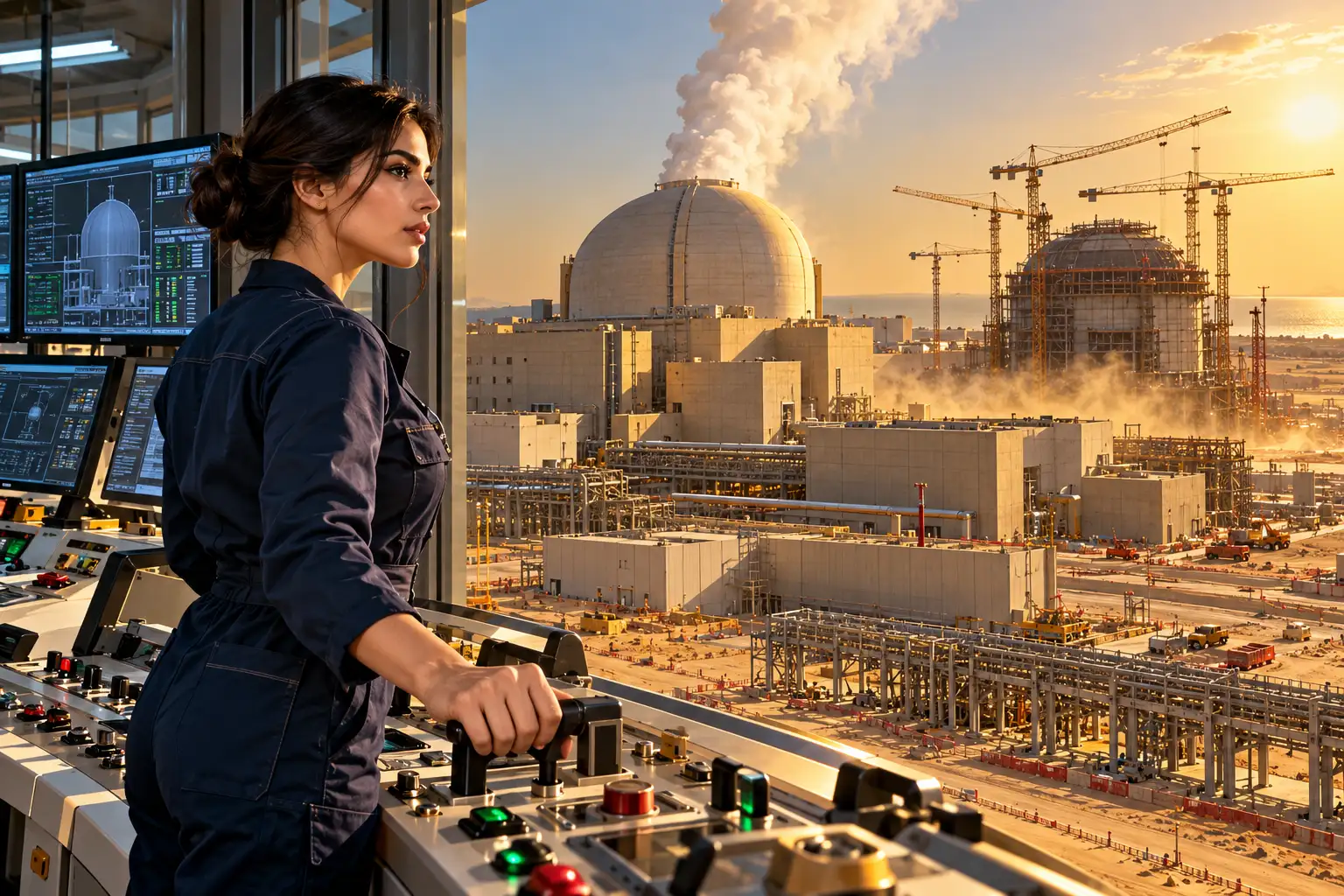
Nuclear Power Status by Country
Net capacity in the table is in megawatts electric, from tallies updated in October 2026. The share column is the portion of electricity that came from nuclear reactors in 2025, in the 2025 nuclear generation figures.
| Country | Stage | Operable reactors | Operating net capacity (MWe) | Reactors under construction | Construction net capacity (MWe) | Nuclear share of electricity in 2025 |
|---|---|---|---|---|---|---|
| United Arab Emirates | Operating | 4 | 5,348 | 0 | 0 | 22.0% |
| Iran | Operating, and building | 1 | 915 | 1 | 974 | 1.3% |
| Egypt | Under construction | 0 | 0 | 4 | 4,400 | None |
| Turkey | Under construction | 0 | 0 | 4 | 4,456 | None |
Saudi Arabia’s proposal is two reactors of about 2,800 MWe gross combined, with no unit under construction. Every other country in the region is absent from both capacity columns. If your country is missing from the table, it is not generating nuclear electricity and it is not pouring concrete for a power reactor.
Which Countries Generate Nuclear Electricity Today?
Only the two operating rows send nuclear electricity to customers. Calling Barakah the first nuclear plant in the Middle East leaves out Bushehr, which reached the Iranian grid in September 2011. Barakah’s first unit reached the UAE grid in August 2020.
The Barakah Plant in the UAE
Barakah stands in the Al Dhafra region of Abu Dhabi, on the Arabian Gulf. Korea Electric Power Corporation supplied four APR-1400 reactors, and Emirates Nuclear Energy Company operates the station with KEPCO. Each unit is rated at 1,337 MWe net, which adds up to the 5,348 MWe in the table.
Commercial operation months are recorded in the UAE country nuclear power profile, beside the grid dates from the reactor database.
- Barakah 1 was connected on 19 August 2020 and entered commercial operation in April 2021.
- Barakah 2 was connected on 14 September 2021 and entered commercial operation in March 2022.
- Barakah 3 was connected on 8 October 2022 and entered commercial operation in February 2023.
- Barakah 4 was connected on 23 March 2024 and entered commercial operation in September 2024.
The July 2023 update of the UAE Energy Strategy 2050 aims for nuclear to provide 6% of total energy supply by 2050. That 6% is a share of all energy, not of the electricity share in the table. No later reactor project at Barakah has been approved, though in November 2024 the nuclear company and ADNOC agreed to study small modular reactors and spare heat from the plant for oil and gas work.
The Bushehr Plant in Iran
Bushehr 1 is a Russian VVER-1000 pressurized water reactor, and its load factor in 2025 was 64%. The single unit is the whole of Iran’s nuclear electricity.
Bushehr 2, a second reactor of the same family, has been under construction since 27 September 2019. The Atomic Energy Organization of Iran said in September 2024 that this unit would start in 2029. The October 2026 outlook says site work was disrupted during the 2026 conflict and has been reported as restarted, while the public reactor tally still counts one Iranian unit under construction.
Where Are Power Reactors Under Construction?
Egypt and Turkey are each building four large Russian reactors, and neither country has an operable power reactor. Iran’s extra unit is an addition to a plant that already runs. South Africa is the only African country that already generates nuclear electricity, so El Dabaa would make Egypt the second on the continent.
Four Reactors at El Dabaa in Egypt
El Dabaa lies on the Mediterranean coast, and the Nuclear Power Plants Authority is the owner and operator. The four units are VVER-1200 reactors, with Russia supplying construction, fuel for the life of the plant, and storage for used fuel. Once they run, the station is expected to supply about 10% of Egypt’s electricity, and it is also meant to feed a desalination plant beside the site.
First concrete is the test behind the under-construction label, and each El Dabaa unit has passed it.
- 20 July 2022: El Dabaa 1, net capacity 1,100 MWe.
- 19 November 2022: El Dabaa 2, net capacity 1,100 MWe.
- 3 May 2023: El Dabaa 3, net capacity 1,100 MWe.
- 23 January 2024: El Dabaa 4, net capacity 1,100 MWe.
The four units are expected to start up in sequence from the end of 2028 through 2030. In August 2026 the electricity ministry held preliminary talks with Rosatom about two further reactors at the same site, and no decision or timeline was announced. Fuel supply, used-fuel storage, and the build contract are set out in the El Dabaa nuclear power plans.
The project owner has published a short video of the four-unit layout and the Rosatom contracts.
Four Reactors at Akkuyu in Turkey
Akkuyu is in Mersin province, and it is a build-own-operate project, so the company that builds the four VVER-1200 units also owns and runs them. Construction of unit 1 began in April 2018. The four units are scheduled to start in sequence over 2026 to 2028, and the first is due to begin operation by the end of 2026.
AKKUYU’S FIRST CHAIN REACTION
On 16 October 2026 Rosatom’s director general, Alexei Likhachev, said the aim was a first chain reaction in the second half of December 2026. Fuel loading and that first reaction come before any connection to the grid, so a December startup headline would not yet mean Turkish nuclear electricity.
Commissioning permits for units 1 and 2 were granted in November 2023 and March 2026. The national profile still expects all four units to be in operation by the end of 2028, and it still records no nuclear share of electricity. Those permit dates sit in the Turkey country nuclear power profile.
Which Countries Still Have Plans, Not Plants?
The countries below are the ones most often described as nuclear capable after a ministerial announcement or a signed memorandum. None of them has an operating power reactor, and none has poured first concrete for one, in the October 2026 classification.
PLANS WITHOUT A POWER REACTOR
- Saudi Arabia: A site licence for Duwaiheen was granted in March 2023 for two proposed reactors of about 1.4 GWe each, and the tender opened in 2022 still had no vendor in October 2026.
- Jordan: A two-unit large reactor deal was cancelled in June 2018, and the country has since studied small modular reactors with several vendors.
- Algeria: No power reactor is under construction, and a December 2025 joint statement with the IAEA puts small reactors for electricity and desalination ahead of a large plant.
- Morocco: Morocco remains in the provisional group, has hosted an IAEA infrastructure review, and has no power reactor under construction.
- Tunisia: Tunisia is provisional as well, with cooperation agreements on file and no construction start.
- Iraq: A June 2021 announcement sketched eight reactors and about 11 GWe, and no power reactor has been started.
- Israel: Israel has no civil nuclear power plant, and in December 2025 the energy minister said the government was seriously examining building one.
- Bahrain: Bahrain paused a nuclear effort in 2011, signed peaceful-use memorandums with the United States in July 2025 and with France in October 2026, and has no plant under construction.
- Kuwait: Kuwait named four large reactors in 2010 and then stopped the programme, a decision it confirmed in 2016.
- Qatar: Qatar has no domestic nuclear power plan.
- Oman: Oman set aside a domestic plant after judging that nuclear did not fit a grid built around peak demand.
- Syria: Older power-reactor proposals did not proceed, and in June 2025 the president expressed interest in exploring nuclear energy.
- Yemen: Draft plans for a reactor have been halted by civil war.
- Libya: Libya appears on the regional interest list and not among countries constructing, planning, or proposing a power reactor.
- Sudan: Sudan is provisional, has hosted an infrastructure review, and has no power reactor under construction.
Saudi Arabia’s older target of 17 GWe by 2032 was abandoned two years after it was set in 2013, which is why a licensed site is not a fleet. A July 2026 cooperation agreement with the United States still needs Congressional review before American companies can export reactor technology under it.
THE GRID SIZE CHECK
A power reactor is a poor fit when one unit is much larger than about one-tenth of the grid, because the country must replace that unit whenever it stops for fuel or repairs.
Jordan’s generating fleet is about 5,200 MWe, so a standard large reactor would be a much bigger slice than that guide. Cost pushed the same way: the large Russian plant was dropped, and later work has stayed on feasibility studies for small reactors, including an IAEA expert look at those studies in October 2023.
How Do the IAEA Milestone Steps Work?
The IAEA Milestones Approach is the checklist a newcomer is measured against, and the clock is long. The path from first consideration to operation is described as about 10 to 15 years, and only if the country keeps spending money and political attention.
- Phase 1: The country studies nuclear power and reaches a knowledgeable commitment, called milestone 1, and sets up a programme office. A widely used summary puts this phase at about 1 to 3 years.
- Phase 2: The country prepares a project, stands up a regulator, and becomes ready to invite bids or negotiate a contract, which is milestone 2. The summary span is about 3 to 7 years.
- Phase 3: The regulator is working and the plant is built through to operation, which is milestone 3. The summary span is about 7 to 10 years.
The approach covers 19 infrastructure issues, including the grid, the owner, the regulator, waste, staffing, and safeguards. Infrastructure review missions have visited Jordan, Egypt, Morocco, Saudi Arabia, Sudan, Turkey, and the UAE, among other countries. A finished review means a government asked for an outside look at its preparations. The country still needs a contract, concrete, and a grid connection before it belongs in the operating table.
Saudi Arabia shows the gap in practice. It has a site licence and a bid process, and it does not have a contract or first concrete, so it stays proposed. Egypt and Turkey are in the construction phase because the concrete is already in the ground. The UAE has finished its four-unit build and is an operating country.
Frequently Asked Questions
When Does Egypt Start Repaying the El Dabaa Loan?
Egypt’s Russian state export loan is $25 billion and covers 85% of the cost of the four units, with repayments set to start once the reactors are commissioned. Rosatom is also contracted to supply fuel for the life of the plant and to provide containers for used fuel stored at the site.
Why Did Jordan Cancel Its Large Reactor Plan?
Jordan dropped the project for two large Russian units in June 2018 after the national atomic energy commission said the price was too high, because the vendor wanted to raise the money with commercial loans. The two units were expected to supply about half of Jordan’s electricity and to support exports to neighbouring grids. Small modular reactors have been the planning focus since that cancellation.
Does a Research Reactor Make a Country Nuclear Capable?
A research reactor does not make a country nuclear capable for electricity, because it does not feed the public grid. Egypt has research reactors at Inshas and still has no nuclear power station in operation, and Algeria has operated research reactors for decades with the same result. Power capability begins only when a reactor is built to sell electricity.
Where Do Turkey’s Later Nuclear Plants Stand?
Sinop and a site in Thrace are the named locations for later reactors, and neither has a chosen vendor or a chosen reactor design. Akkuyu is separate from those sites because the builder owns and operates it under the Russian project. Any national capacity goal beyond Akkuyu waits on contracts that have not been signed.
What Did the IAEA Say After the May 2026 Barakah Event?
The mission found that Emirati authorities and the plant responded properly, followed their emergency procedures, sent the required notifications, and kept the affected unit in a safe condition. The review leaves the station in service as an operating plant. It does not add a reactor, and it does not move any other country in the region into the construction column.
The sort that lasts is the one in the table. An operating reactor means the country already supplies nuclear electricity, first concrete means a plant is being built, and a licence, a memorandum, or a review mission means the country is still preparing. Those three marks are the check the next time a headline calls a country nuclear capable.
Disclaimer: This article is an educational guide to public information on civilian nuclear power programmes in the Middle East and North Africa. It is not engineering, regulatory, legal, or investment advice, and it does not assess weapons programmes. Check the plant owner, the national nuclear regulator, or the International Atomic Energy Agency before you rely on a project status for a decision. Figures, licences, and construction schedules reflect the sources reviewed for this page and can change when a reactor is delayed, licensed, or connected to the grid.

Cook Hands Democrats the House as Crypto’s Bill Stays Dead

Wicker’s Broken Bed Was the Short Story’s Punch Line

Nvidia’s $500 Billion Financing Plan Draws a $180 Sell

Maserati Bets the Grecale V6 Can Fill Porsche’s Gap

EV Cable Theft Follows the Old Railway Copper Playbook

Aramco Crash Kills 14 Two Days After Oil Restart

Salah Captained Egypt to Their First World Cup Win

Zelda’s 40th Switch 2 Ships Without a Zelda Game

Apple Labor Day Deals Hide June’s Memory Price Hike

El Niño Puts Israel’s Needed Winter Rain on a Flood Clock
-
 BUSINESS4 months ago
Aramco Crash Kills 14 Two Days After Oil Restart
-
 NEWS5 months ago
Salah Captained Egypt to Their First World Cup Win
-
 GAMING2 months ago
Zelda’s 40th Switch 2 Ships Without a Zelda Game
-
 NEWS2 months ago
Apple Labor Day Deals Hide June’s Memory Price Hike
-
 NEWS4 months ago
El Niño Puts Israel’s Needed Winter Rain on a Flood Clock
-

 GAMING2 months ago
Palworld 1.0.4 Adds Palpedia Search After the 1.0 Launch
-

 BUSINESS9 months ago
BAE’s 60-Year Saudi Franchise Now Runs Through Taif
-

 NEWS4 months ago
Saudi Visa Routes Split Nigerian Travelers Into Two Speeds