
ENTERTAINMENT
Aydhab’s Lost Red Sea Port Surfaces Through Reservoir Find
Egyptian archaeologists uncovered medieval water reservoirs, residential foundations, and watchtowers at Aydhab, a Red Sea port in Egypt’s Halayeb region.

Egyptian archaeologists have uncovered a system of medieval water reservoirs, residential foundations, and watchtowers at Aydhab, a once-prominent Red Sea port in Egypt’s Halayeb region. The find, announced by Egypt’s Ministry of Tourism and Antiquities on May 28, 2026, gives a rare surviving look at the infrastructure that kept one of the medieval Islamic world’s busiest harbours running. The shards pulled from the site confirm Aydhab’s place in a trade network that stretched from the Mediterranean to the Indian Ocean.
Aydhab sat on the route that carried Egyptian and North African pilgrims to the holy lands, and it served as a maritime hub linking Egypt to India, Yemen, and the East African coast. The excavation was carried out by an Egyptian mission from the Supreme Council of Antiquities, led on site by Professor Mohamed Abu El-Wafa. A 2008 paper on the port’s history sits in the same scholarly literature the new find is now extending. The ministry framed the discovery as a sign of how developed ancient Egyptian ports had become. The find, the ministry says, fits a push to expand archaeological research in border and remote regions.
The Reservoir and Its Smaller Kin
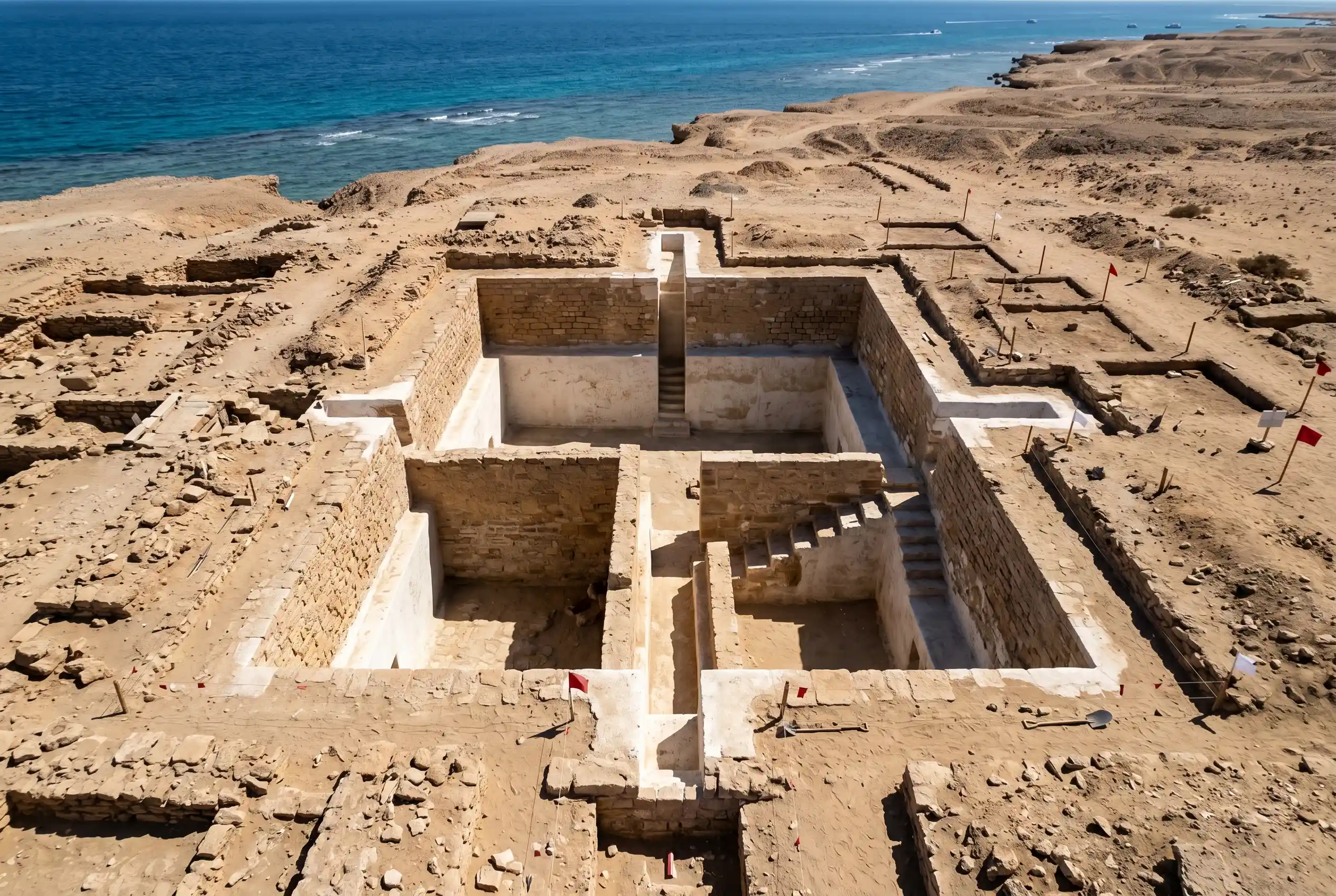
The standout find is a central water reservoir at Aydhab. The structure, built of sandstone and local coral, was designed to harvest and hold water in one of the driest stretches of the Egyptian Red Sea coast. Dr. Diaa Zahran, head of the Islamic, Coptic, and Jewish Antiquities Sector, said the lime mortar lining was the difference between a working cistern and a leaking one.
The numbers underline the scale. A cistern of the size found at Aydhab is the kind of investment a working port could not afford to skip on a coast that rarely sees rain.
Several smaller cisterns were uncovered on the southern side of the site, all built to the same basic standard. The Egyptian mission said the cluster of water-storage installations reflected a port that had been carefully designed to hold water in a stretch of coast that rarely sees rain. The main reservoir sat beside a set of smaller cisterns, all sealed with the same lime mortar lining. The port had reserve water capacity in case one of the basins needed maintenance. Pilgrims waited at the wharf for ships and for favourable winds to carry them across the Red Sea.
- Main reservoir length: 15.10 m
- Main reservoir width: 3.15 m
- Main reservoir height: nearly 3 m
What the Surrounding Structures Add
Survey work around the central reservoir turned up a wider settlement footprint. Archaeologists identified the foundations of residential buildings, the remains of watchtowers, and a set of service facilities, all clustered close to the water-storage network. The mission described the spread as a fully integrated port designed to accommodate the merchants and pilgrims who passed through the harbour over many centuries.
For Zahran, the structures point to a comprehensive system for managing the port and meeting the needs of visitors. Minister of Tourism and Antiquities Sherif Fathy framed the find in national terms, calling the installations evidence of an advanced infrastructure that supported trade and pilgrimage at a moment when Egypt sat at the centre of long-distance commerce. The cisterns, Fathy said, supplied water to ships, traders, travellers, and pilgrims using the port. He pointed out that the discovery reinforces Egypt’s long-standing position as a key crossroads of civilization and commerce. Fathy’s framing tied the find to a network linking Africa, the Arabian Peninsula, and beyond.
The residential foundations sit close enough to the cisterns that the water system runs into the residential area. The two share the same construction standard.
The watchtowers sit alongside the cisterns and the residential foundations. Pilgrims and merchants moving gold and luxury goods across the Red Sea needed protection, and a settlement that had permanent buildings had a reason to keep watch over the harbour approach. The Beja peoples, who occupied the inland desert routes around Aydhab before the Fatimid period, controlled the overland connections the port depended on. The mission described the cisterns, residences, and watchtowers together as the layout of a fully integrated port.
A Trade Network Written in Pottery and Porcelain
The shards recovered at Aydhab give a clearer picture of when the port was at its busiest and how far its trade networks reached. Excavators found pottery fragments dating to the Fatimid period, some decorated with a green glaze, alongside pieces of imported Chinese porcelain. The mission said the finds reflect the prosperity of trade at Aydhab and the extent of its maritime connections across the Indian Ocean.
- India, named among the trade regions tied to the port
- Yemen, listed as a regular commercial link
- East Africa, connected through the wider Red Sea and Indian Ocean trade
The Fatimid period covered A.D. 969 to 1171, a span that overlapped the height of Aydhab’s role as a Red Sea hub. An analysis of Aydhab’s wider commercial world frames the Chinese porcelain as the most evocative find, with each fragment a marker of an object that had crossed the South China Sea, the Indian Ocean, and the Red Sea before reaching Halayeb. The piece frames the port as a working node in a trade that ran from East Africa to Cairo and beyond. A shard from a Chinese kiln, recovered in this stretch of Egyptian desert, sits as evidence of a journey measured in thousands of kilometres.
How the Port Kept Pilgrims Alive
The single clearest use the cisterns served was keeping pilgrims alive on the long Red Sea crossing. Hisham El-Leithy, secretary-general of Egypt’s Supreme Council of Antiquities, said Aydhab had been a major transit point for pilgrims from Egypt and North Africa heading to the holy lands, as well as a trading centre connected to routes reaching India, Yemen, and East Africa. UNESCO’s tentative list of the Egyptian Hajj Road tracks the network of overland and maritime routes that linked Egypt to Mecca and Medina, of which Aydhab was a working node. The pilgrimage season would have turned the harbour into a staging ground for ships, camels, water sellers, and money changers. The cisterns sat at the same harbour where pilgrims gathered for the Red Sea crossing.
These installations reflect a sophisticated infrastructure that supported both trade and the movement of pilgrims.
The quote is from Sherif Fathy, Egypt’s Minister of Tourism and Antiquities, in the ministry’s announcement. Fathy’s ministry framed the find as evidence of how developed ancient Egyptian ports had become, with infrastructure built specifically to support a flow of people and goods. The Fatimid-era roots of Cairo’s lantern market sit in the same period, a reminder of how thoroughly Fatimid Egypt tied domestic life to trade with the wider Islamic world.
Pilgrims at the time had a narrow window to make the crossing safely. The cisterns and the smaller reservoir system together gave the port a way to keep water flowing through periods of cleaning or repair. Pilgrims waited at the port for ships to carry them across the Red Sea. The find shows Aydhab’s role in the medieval Hajj.
Egypt’s Border-Region Archaeological Push
Fathy used the announcement to flag a broader push. He said the ministry has begun to take a larger interest in the excavations and study of border regions and more remote areas, sites he called of great historical and cultural importance. The Halayeb region, where Aydhab sits, lies in the southeastern corner of Egypt’s Red Sea coast, on the border with Sudan.
The find is also a chance to test how medieval water infrastructure survived in Egypt’s most arid corners. The final stage of Cairo’s Mamluk aqueduct surfaced near the Citadel in a separate project, filling a gap in a different piece of medieval Egyptian water engineering. Aydhab’s cisterns, on the coast rather than the Nile, were built to a different standard and a different budget, with sandstone and coral where Cairo used cut stone. The Aydhab find is from the Fatimid period, and the Mamluk aqueduct is from the Mamluk period. Fathy said the two finds both fall within the ministry’s focus on border-region sites.
The cisterns, watchtowers, and residential foundations together form a working portrait of a medieval port. The mission’s full findings have not yet been published.
The find lands as Egypt’s tourism ministry tries to push visitors and researchers toward the country’s lesser-known sites, away from the Nile Valley mainstays. Aydhab sits in the Halayeb region, on the Egypt-Sudan border, an area the ministry flagged for expanded archaeological work. Fathy described Aydhab as a key crossroads between Africa, Arabia, and beyond.
Frequently Asked Questions
What is Aydhab?
Aydhab is a medieval Red Sea port in Egypt’s Halayeb region, on the country’s southeastern coast near the Sudanese border. Egyptian authorities describe it as one of the most prominent Egyptian ports during the Middle Ages, a hub for pilgrims moving between Egypt and the holy lands and for traders reaching India, Yemen, and East Africa.
When was Aydhab a major port?
The finds so far, including Fatimid-period pottery dated to A.D. 969 to 1171, imported Chinese porcelain, and the structural remains of an integrated port, place Aydhab’s peak activity in the Islamic-era Middle Ages. The site had largely faded from the commercial map by the 15th century, though the precise timeline of decline is still being pieced together by archaeologists.
What did the archaeologists find at Aydhab?
The Egyptian mission uncovered a main reservoir measuring 15.10 metres long, 3.15 metres wide, and nearly 3 metres high, built of sandstone and local coral and lined with white lime mortar. Several smaller cisterns sit on the southern side of the site. Around the reservoir cluster, the team also identified foundations of residential buildings, watchtowers, and service facilities, plus Fatimid-period pottery and imported Chinese porcelain.
Who led the excavation?
The excavation is being run by an Egyptian archaeological mission from the Supreme Council of Antiquities, with Professor Mohamed Abu El-Wafa leading on site. The official spokespersons for the find are Dr. Diaa Zahran, head of the Islamic, Coptic, and Jewish Antiquities Sector; Dr. Hisham El-Leithy, secretary-general of the council; and Minister of Tourism and Antiquities Sherif Fathy.
Why does the discovery matter?
The reservoirs and the surrounding infrastructure give a direct look at how a remote Red Sea port kept pilgrims, traders, and sailors supplied with water in one of the harshest coastal environments in the region. The Chinese porcelain and Fatimid pottery also confirm the port’s place in a trade network that stretched from the Mediterranean to the Indian Ocean.

Palworld 1.0.4 Adds Palpedia Search After the 1.0 Launch

Hersheypark Docks Tidal Force After 32 Years of Splashes

Trump’s Bombardier Threat Lands First on Kansas Shops

Nick Bosa Will Play the Rams on a Repaired Knee

Foremost Farms Will End 40-Pound Blocks in Marshfield

Apple Labor Day Deals Hide June’s Memory Price Hike

Russia Hits Kyiv After Witkoff and Kushner Talks
Trump’s Bombardier Threat Lands First on Kansas Shops

Hawaii Reran Its Iniki Playbook as Lowell Missed Kauai

King Charles Letter Keeps Harry and Meghan as Private Citizens
-
 NEWS2 weeks ago
Apple Labor Day Deals Hide June’s Memory Price Hike
-
 NEWS7 days ago
Russia Hits Kyiv After Witkoff and Kushner Talks
-
 BUSINESS6 days ago
Trump’s Bombardier Threat Lands First on Kansas Shops
-
 NEWS7 days ago
Hawaii Reran Its Iniki Playbook as Lowell Missed Kauai
-
 ENTERTAINMENT7 days ago
King Charles Letter Keeps Harry and Meghan as Private Citizens
-
 BUSINESS7 days ago
Foremost Farms Will End 40-Pound Blocks in Marshfield
-
 GAMING6 days ago
Palworld 1.0.4 Adds Palpedia Search After the 1.0 Launch
-

 TECHNOLOGY3 years ago
How to Stop Tiny Task from Slowing Down Your Computer