
GAMING
GTA VI Holds 30 fps After the PS5 Pro GPU Upgrade
Rockstar locked GTA VI at 30 fps on PS5 Pro, using the extra GPU for ray-traced shadows because the CPU is only 10 percent faster.

Grand Theft Auto VI launched on November 19 at 30 fps on every current console, including the PS5 Pro. Rockstar technology production director Marc Chambers said the Pro’s central processor is not powerful enough to run the game’s complex simulation at higher frame rates.
The extra graphics chip in Sony’s $899.99 console is being spent on ray-traced shadows and sharper images, not a 60 fps mode. Head of development Rob Nelson said a performance option would have forced “too much” compromise to ship.
Extra GPU Power Bought Shadows and Sharper Images
Rockstar’s November 10 Newswire said Grand Theft Auto VI was built from the ground up for this console generation, targeting 30 frames per second while pushing PlayStation 5 and Xbox Series X|S to their limits to hold the density of Leonida. That post already named the Pro extras: improved clarity through PlayStation Spectral Super Resolution (PSSR) and ray-traced shadows that exist only on PS5 Pro.
Chambers later spelled out the split. The base presentation uses ray-traced reflections and global illumination on every console. On PS5 Pro, that stack gains ray-traced shadows and PSSR. “The PS5 Pro features an upgraded graphics processor and upscaling technology that we leverage to increase the game’s visual fidelity,” he said. “While the PS5 Pro’s central processor is slightly better than the PS5 base console, it is not powerful enough to run the game’s complex simulation at higher frame rates.”
Nelson, Rockstar’s co-studio head and head of development, put the rejected performance mode in plainer words. “Too much, too much,” he said. “It wouldn’t have been acceptable to anybody. The simple answer is, when you ask the technical team, they’re, like, ‘Have you seen it?’ There’s too many compromises that would’ve had to have been made to do that, is the short answer.”
The world doing that work is packed with vehicles, characters, and foliage that reacts, and the sim behind those systems is what holds the frame rate. Dropping the Pro’s extra shadows would trim the GPU bill. It would not give the processor twice as much time to finish traffic, crowds, and physics.
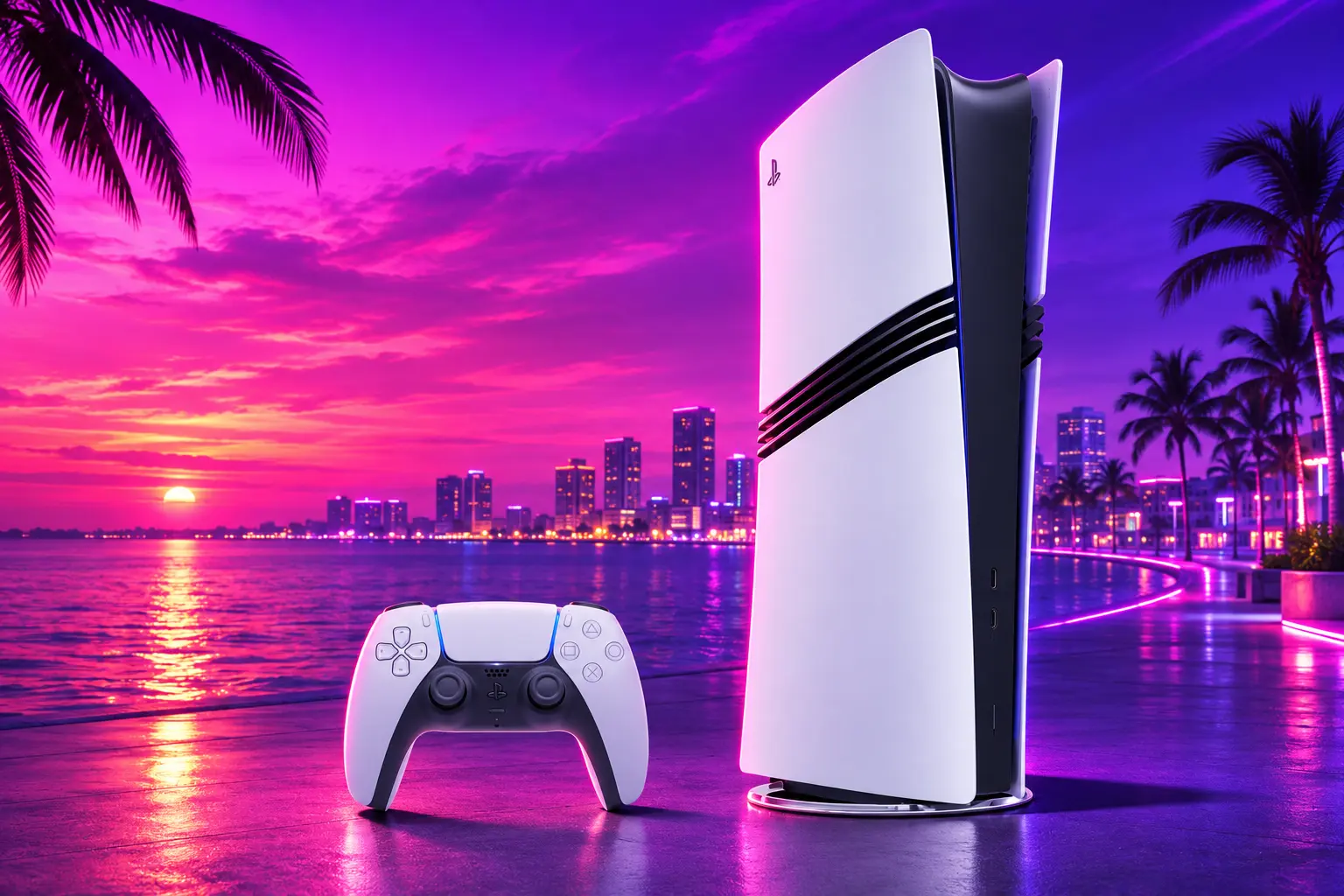
Sony Still Sells the Pro as a 60 fps Machine
That choice collides with how Sony still describes the hardware. The official PS5 Pro page tells buyers the world’s game makers can enhance titles with advanced ray tracing, sharper 4K images, and high frame rate play, and that compatible games can 60fps or up to 120fps with ray tracing plus AI-enhanced 4K using PSSR, all at once. A separate line promises higher and more consistent frame rates on 60Hz and 120Hz displays.
Other big PS5 Pro patches have used the extra GPU the way that pitch implies. Guerrilla’s Horizon Forbidden West note on the same page says visual quality that matches or beats Quality mode on the regular PS5, now at 60 fps. Insomniac’s Spider-Man titles advertise a Performance Pro mode that keeps Fidelity-mode ray tracing at 60 fps. GTA VI went the other way. It kept the 30 fps cap and spent the Pro’s GPU on shadows and reconstruction.
The louder complaint after launch is not that 30 fps looks broken in stills. It is that the extra money in the Pro was spent on a graphics upgrade, and Leonida is a CPU problem. Console players already in the state are arguing about feel. People waiting on PC are treating Chambers’s line as a reason to sit out this hardware generation.
Why 40 fps Still Breaks the Simulation Budget
Both PlayStation 5 models use the same eight-core, 16-thread Zen 2 design. Sony’s high CPU frequency mode lets the Pro run those cores at 3.85 GHz instead of the 3.5 GHz cap on the base machine, which is a 10 percent clock bump. Sony’s own 2024 pitch for the GPU side was about 45 percent faster rendering, plus much stronger ray tracing and PSSR. GTA VI is the title that shows what that split costs when the heavy work is simulation, not fill rate.
THE FRAME TIME MATH
- 30 fps: About ~33 milliseconds per frame, the window Chambers said is only just enough to finish the required work.
- 40 fps: About 25 milliseconds, which tech analyst Richard Leadbetter said would still need a huge amount of optimization or cutbacks.
- 60 fps: About 16.7 milliseconds, which he called not viable on this hardware.
Chambers went further on why the 30 fps line exists at all.
GTA 6 pushes the current-generation console hardware to its absolute limits. The complexity of simulating and rendering the environments and inhabitants in a world the scale of Leonida, while maintaining the density, visual fidelity, and player agency we envisaged, places extraordinary demands on the hardware. Bringing all of these systems together and completing the required work for every frame is only just possible within a ~33ms frame budget.
Marc Chambers, technology production director, Rockstar Games
Leadbetter’s warning on a 40 fps compromise was that in a world where almost anything can happen because the systems interact, chasing a tighter frame time is asking for trouble. A 60 fps mode would ask the same Zen 2 chip to finish the same traffic, crowds, and physics in half the time. The Pro’s fatter GPU does not do that job.
1440p on Three Machines, 720p on the Fourth
Tech analyst John Linneman, who spent more than 50 hours in the PS5 Pro build, called it the best way to play the game by far. He described a near-flawless 30 fps update with perfect frame pacing and cutscenes that stay consistent, unlike older Rockstar titles. In normal play he did not see a dip. A grenade-launcher stress test, with several cars blown up at once, sent the Pro to 24 fps as a worst case, then it recovered.
The base PS5 is less tidy. Linneman said it struggles to hold 30 fps more often than expected, with small dips through ordinary traversal that he noticed and that slightly pull you out of the experience. The same explosion test produced sustained drops that stayed below 30 fps until he left the area. Both PlayStation machines render internally at 1440p (2560×1440). PSSR on Pro reconstructs an image he said convincingly passes for native 4K, while the base PS5 looks like a spatially upscaled 1440p picture.
HOW GTA VI RUNS ON EACH CONSOLE
| Console | Internal resolution | Upscaler | Frame rate | Lighting extras |
|---|---|---|---|---|
| PS5 Pro | 1440p | PSSR to near 4K | Near-locked 30 fps; 24 fps in a grenade stress test | Ray-traced shadows, plus RT reflections and global illumination |
| PS5 | 1440p | Spatial upscale to 4K | Mostly 30 fps, with dips in heavy action | RT reflections and global illumination |
| Xbox Series X | 1440p | Spatial / TAA upscale to 4K | 30 fps target | RT reflections and global illumination |
| Xbox Series S | 720p | AMD FSR 4.1 to 1080p | 30 fps target | RT reflections and global illumination |
Series S is the first Xbox game called out as using FSR 4.1 this way, reconstructing from 720p to 1080p. It still carries the shared lighting stack. The least powerful machine in the family has to close the same simulation, which is why a Pro-only 60 fps path was never a free lunch sitting unused in the GPU.
Pre-Loads Hit 212 GB With No Disc in the Box
The shipped game is huge, digital in practice, and still missing a PC date. Sensor Tower estimated 17.07 million digital pre-orders by November 16, worth more than $1.6 billion, with about 75 percent on PlayStation. Rockstar has not published its own figure.
FROM PRE-LOAD TO LAUNCH
- November 3, 2026: Rockstar says digital pre-loading needs up to 212 GB depending on your device and sets the November 10 start.
- November 10, 2026: Pre-loads open at midnight local time on PS5 and at 12 a.m. GMT on Xbox Series X|S, and Rockstar confirms the 30 fps target plus Pro-only PSSR and ray-traced shadows.
- November 12, 2026: Code-in-box copies reach retailers; the box holds a download code, not a playable disc, so the same install still applies.
- November 19, 2026: The game unlocks on PS5, PS5 Pro, and Xbox Series X|S, 13 years after Grand Theft Auto V, with no PC release date attached.
Those GTA VI pre-loads that broke UK records were the first public stress test of a 212 GB drop. A 512 GB Series S has much less usable space than a 2 TB Pro, so the same file is a much larger share of the drive on Microsoft’s cheaper box.
WHAT ELSE ROCKSTAR CONFIRMED WITH THE PRE-LOAD
- DualSense: High-fidelity haptic feedback is built across the PS5 game and can be adjusted in accessibility settings.
- Audio and loads: Spatial audio uses Tempest 3D Audio, and Rockstar says load times are improved on PS5.
- Cloud play: Xbox Cloud Gaming on Series X|S and Xbox One uses Series S graphics settings, with streaming quality tied to the connection.
- Remote Play: Full support on PlayStation and Xbox.
Rockstar has not committed to a later performance mode on these consoles. It has also not named a PC date, which is the remaining path to a higher frame rate that does not have to share a Zen 2 budget with Series S.
Rockstar Cut a Frame of Delay Instead of Frames
The studio did spend engineering time on how 30 fps feels in the hands. David Hynd, Rockstar’s vice president of technology, said the team removed one full frame of delay against past titles.
The input controller is sampled as late as possible during the game update. As a consequence, the game is updated with the most recent input data and we minimise the time between pressing a button and seeing the results on screen.
David Hynd, vice president of technology, Rockstar Games
Hynd said the mechanics work also stripped as much dead space as possible from the start of animations and interrupted them as early as was practical. That is the trade they shipped: a locked 30 fps with less waiting between a button press and the result on screen, rather than a second mode that thins out Leonida.
During the November 19 launch, major US retailers listed the PS5 Pro as sold out at the $899.99 recommended price. The extra GPU is doing the work Rockstar assigned it, ray-traced shadows and a PSSR image, on the same 30 fps ceiling as the rest of the generation. Chambers left no path around that ceiling on this CPU.

Jennifer Lopez and Mahershala Ali Describe a Pipeline They Cannot Buy

Lightsail Scatter Turns to Drag Far Above Starshot

Tallulah Willis Deletes a Bruce Willis Photo She Called Intimate

S&P 500 Futures Rebound Into a Holiday-Shortened Week

GTA VI’s Record Launch Still Needs the Same Fragile Grid

Aramco Crash Kills 14 Two Days After Oil Restart

Salah Captained Egypt to Their First World Cup Win

Zelda’s 40th Switch 2 Ships Without a Zelda Game

Apple Labor Day Deals Hide June’s Memory Price Hike

El Niño Puts Israel’s Needed Winter Rain on a Flood Clock
-
 BUSINESS5 months ago
Aramco Crash Kills 14 Two Days After Oil Restart
-
 NEWS6 months ago
Salah Captained Egypt to Their First World Cup Win
-
 GAMING3 months ago
Zelda’s 40th Switch 2 Ships Without a Zelda Game
-
 NEWS3 months ago
Apple Labor Day Deals Hide June’s Memory Price Hike
-
 NEWS5 months ago
El Niño Puts Israel’s Needed Winter Rain on a Flood Clock
-

 GAMING3 months ago
Palworld 1.0.4 Adds Palpedia Search After the 1.0 Launch
-

 NEWS4 months ago
Saudi Visa Routes Split Nigerian Travelers Into Two Speeds
-

 BUSINESS9 months ago
BAE’s 60-Year Saudi Franchise Now Runs Through Taif