
ENTERTAINMENT
Tallulah Willis Deletes a Bruce Willis Photo She Called Intimate
Tallulah Willis deleted a porch-swing photo of Bruce Willis after calling it too intimate, reversing a 2025 defense of showing him.

Tallulah Willis deleted a photo of her father, Bruce Willis, on Nov. 22, one day after she posted the pair holding hands on a porch swing. He is 71 and living with frontotemporal dementia. She wrote that the picture, taken while they watched Frankie Valli sing, was possibly too intimate to show.
Seventeen months earlier, the same daughter had answered a critic who said she had no permission to post him at all. She said the family uses discretion, and she posted anyway because she knows what he means to everyone.
They Were Watching Frankie Valli When Someone Clicked
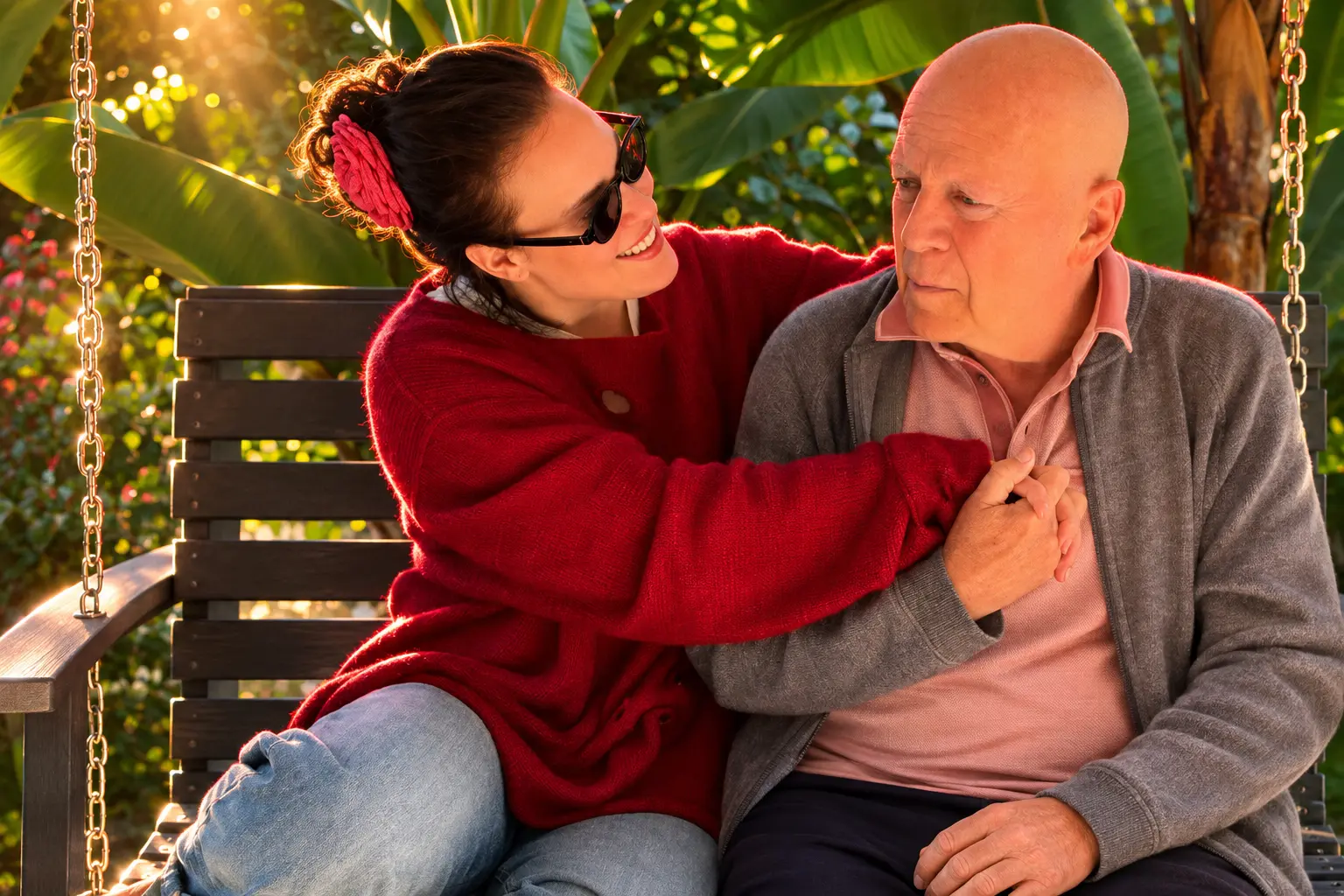
The Nov. 21 picture went up on her Instagram, @buuski, with two emojis and no essay. Tallulah, 32, sat on an outdoor porch swing in greenery, in a red sweater and sunglasses, her fingers laced with his. Bruce wore a grey cardigan over a salmon shirt. She was beaming. He looked off to the side.
Someone else took the frame while they watched a Frankie Valli clip. She later said it had been a beautiful visit and that the sweetness of the moment outran any thought about who else would see it. By the next morning the post was gone. In its place she put a throwback of Bruce with her as an infant, a block of text over the old print, and the caption “I can do better.”
Hi, I posted a photo of my dad yesterday because we were having a BEAUTIFUL visit. I had someone take a super sweet photo of a shared moment between us watching a video of Frankie Valli singing. I was very excited by the sweetness of the moment that I didn’t think farther ahead that this was possibly too intimate a photo to show. I can acknowledge that and vow to do better. I know you all love him. I love him. My family loves him. And he’s still always the absolute hero we know him to be.
Tallulah Willis, Instagram, Nov. 22, 2026
She did not name a troll, a sibling, or a doctor. She named the gap between a private afternoon and a public feed. The apology is the rare thing in this story that is on the record in her own words.
Seventeen Months Ago She Told a Critic to Look
On June 22, 2025, Tallulah posted pictures from a Sunday at her grandmother’s house: sitting on the floor holding Bruce’s hand, an embrace, her now-husband Justin Acee in the mix. The caption was “Sunday funday at Grams ! Grateful.” A follower told her not to expose a vulnerable man, and said she did not have his permission.
She answered in the comments. “Hi. I hear that. As a family we use our discretion when posting. Today was a great day filled with smiles.” Then the line that now sits next to the deletion: “I made the judgment call to show that to the world, because I know what he means to everyone.”
The two posts are not different species of picture. Both are a daughter holding her father. Both went to the same account. The change is the call she made after the shutter clicked.
THREE FAMILY PHOTOS, THREE DIFFERENT CALLS
| Date | What went up | What she said after |
|---|---|---|
| June 22, 2025 | Holding hands at her grandmother’s | “I made the judgment call to show that to the world” |
| Aug. 8, 2026 | Bruce with an arm around the bride, Acee holding his other hand | “A tender moment with my dad and Justin at the start of wedding weekend” |
| Nov. 21, 2026 | Porch swing, holding hands, Frankie Valli on a phone | Deleted; “possibly too intimate a photo to show” |
The middle row is the tell. She has not treated every recent picture of him as a mistake. She treated this one as a line she wished she had seen in time.
Her August Wedding Photos of Bruce Never Came Down
Bruce appeared at Tallulah’s Aug. 8 wedding to Acee. She posted several frames from the weekend, including a black-and-white shot of the newlyweds with him. He is smiling, one arm around her as she leans in, his new son-in-law holding the other hand. That picture stayed up. The porch swing did not.
The difference is hard to police from the outside. A wedding is a ritual the family chose to stage with guests. A weekday visit with a video playing is the sort of hour that used to belong to the house. Once it is on Instagram, the hour belongs to whoever screenshots it, and to whoever writes “too intimate” or “so sweet” underneath.
Bruce shares Tallulah, Rumer, 38, and Scout, 35, with Demi Moore, his wife of 13 years until they separated in 2000. He shares Mabel, 14, and Evelyn, 12, with Emma Heming Willis, whom he married in 2009. Five daughters, two households, one famous patient, and no shared rulebook that is visible from the comments.
Emma Heming Willis Put His Name on a Research Fund
Emma has been the public face of the illness in a way Tallulah has not. In March 2026 she launched the Emma & Bruce Willis Fund for Dementia Research and Caregiver Support at the Association for Frontotemporal Degeneration’s Hope Rising Benefit in New York. On Oct. 1, during World FTD Awareness Week, she posted a rare photo of him and wrote that he is the driving force behind her advocacy. “I will not let his diagnosis be in vain,” she said. She added that she knows how proud he would be to know he is helping families living with FTD, other dementias, and their care partners be seen and heard.
Seen and heard is the campaign. A porch-swing picture of the man as he is now is also the campaign, until a daughter decides it is a trespass.
In September, Emma described the family’s days as a constant state of grief. “FTD is a devastating illness that steals things from you very slowly,” she said. She also said the family pours its heart into supporting him and respects the way each person chooses to express that love. That sentence leaves room for Tallulah to post, and room for Tallulah to take a post down, without either choice being a betrayal of the others.
Emma has said Bruce lives in a nearby home with round-the-clock care, an arrangement meant to give him a quieter house while Mabel and Evelyn keep a more ordinary one. In May she said her husband is supported and loved, and that they are doing the best they can under the circumstances. The Association for Frontotemporal Degeneration still calls FTD the most common dementia for people under 60, which is why a star of his age still startles people who think dementia only arrives with memory loss in much older parents.
THE FAMILY’S PUBLIC FTD RECORD
- March 2022: The family says Bruce has aphasia and is stepping away from acting.
- February 2023: The family says the diagnosis is frontotemporal dementia. He is 67 in the AFTD note on the announcement.
- June 22, 2025: Tallulah posts the grandmother’s-house pictures and defends them.
- March 2026: Emma puts both names on a research and caregiver fund at AFTD’s New York benefit.
- Aug. 8, 2026: Bruce is in the wedding pictures. Those stay up.
- Oct. 1, 2026: Emma posts him again for World FTD Awareness Week and ties the image to the work.
- Nov. 21, 2026: Tallulah posts the porch swing. On Nov. 22 she takes it down.
The record is not a hide-him plan. It is a family trying to keep him in view without turning the worst hours into content. The swing photo landed on the wrong side of that line, in her view, after it had already been seen.
What Frontotemporal Dementia Does to Consent
FTD is not a memory disease first. It damages the frontal and temporal lobes, so the early changes are often in personality, behavior, language, and movement. Federal health pages say 60 percent of people with FTD are 45 to 64 years old. There is no cure and no approved way to slow it. The Association for Frontotemporal Degeneration puts estimated 50,000 to 60,000 U.S. cases on the books and says experts think the true number is higher because the disease is so often missed.
FTD, IN THE FIGURES THE FAMILY IS FUNDRAISING AGAINST
- Time to a name: It takes 3.6 years, on average, to get an accurate diagnosis after symptoms start, because FTD is so often read as depression, Alzheimer’s, Parkinson’s, or a psychiatric illness.
- Money: A 2017 study co-written and funded by AFTD put the economic hit at about $120,000 a year, more than twice the estimated cost for families living with Alzheimer’s.
- How long: People diagnosed with FTD face a life expectancy of 7 to 13 years. About 20 percent of cases are tied to a known gene.
- Care: High levels of help, including 24-hour care, may be needed as the disease moves. Bruce already has that team in a separate house.
Aphasia, the first public word the family used in 2022, can be a symptom of FTD rather than a separate ending. Primary progressive aphasia is the language form. Behavioral variant FTD is the most common form and hits judgment, personality, and social sense. Either way, the person who used to clear a photo for a magazine cover may no longer be the person who can clear a photo for Instagram.
That is the part a two-emoji caption cannot carry. A visit can be sweet and still be a medical fact the patient did not agree to publish.
Followers Wanted the Picture Left Up
The comments under the apology did not demand a takedown. One person wrote that the journey is between Tallulah, her father, and her family, and that how she chooses to share it is nobody else’s business. Another wished the culture would stop hiding the hard parts of aging and illness, and said there is dignity in those moments too. A third said they had no idea why the picture would have been a problem, and that they had thought, simply, “aw, sweet.”
The louder objection after the deletion is that she owed nobody an apology for holding her father’s hand. Taking the picture down did more to advertise the visit than the original post did. People went looking for the frame. A few posted it again. The apology became a second distribution system for the hour she had decided was too close to share.
A smaller objection cuts the other way, and it is the one that tracks with her own second thoughts. A man who spent decades playing invulnerable parts may not have wanted strangers studying him in a cardigan on a swing, watching an old singer on a phone. Fans like updates. They are not the ones who will sit with him when the camera is off. The family already knows that split, which is why Emma talks about respect for different ways of showing love, and why Tallulah now says she can do better.
Bruce Willis Has No Vote on the Next Post
Family-shot dementia clips travel farther than most relatives expect. A 2023 study of TikTok’s 100 most-popular #dementia videos found that relatives posted 65 percent of videos, and that those clips drew 5.31 million shares. The tally measures reach. It does not measure permission.
Capacity is specific to a decision. A diagnosis does not, by itself, hand the phone to the nearest adult child. The Alzheimer’s Association’s legal-planning guidance says people retain control of their decisions while they have legal capacity, and that a power of attorney cannot override those choices just because an agent disagrees. Filming and posting are two different asks. Someone might accept a picture in a family album and reject the same picture in a feed that never forgets.
A FIVE-POINT CHECK BEFORE A DEMENTIA PHOTO GOES UP
- The image: Can the person understand what the picture shows and why it was taken?
- The audience: Can they grasp that strangers may watch, copy, and comment?
- The pressure: Are they choosing freely, without fear of losing care or affection if they say no?
- The limits: Can they say which details, scenes, or audiences are acceptable?
- The recap: Did anyone replay the finished frame with them before it went public?
If those answers are unclear, the less exposing option is the one that protects him. Share the caregiver’s day. Keep the face in the group chat. Write that it was a beautiful visit, which is what Tallulah did the second time, over a baby picture he cannot be said to have posed for last week.
She still called him the absolute hero they know him to be. The swing photo tried to show that in the present tense. Then she decided the present tense was the problem. The next picture, if there is one, will be another judgment call made for a man who can no longer make it on a public account in his own name.
Disclaimer: This article is news reporting and analysis of a public family statement and of published facts about frontotemporal dementia. It is for information only and is not medical, legal, or caregiving advice, and it is not a judgment on any family’s choices about photos or care. Readers who are making decisions about a relative’s health, capacity, or privacy should consult a qualified physician, neurologist, or elder-law attorney before acting. Figures, diagnoses, and the status of social posts reflect the sources available on Nov. 22, 2026, and may change as the family or clinicians release new information.

Jennifer Lopez and Mahershala Ali Describe a Pipeline They Cannot Buy

Lightsail Scatter Turns to Drag Far Above Starshot

Tallulah Willis Deletes a Bruce Willis Photo She Called Intimate

S&P 500 Futures Rebound Into a Holiday-Shortened Week

GTA VI’s Record Launch Still Needs the Same Fragile Grid

Aramco Crash Kills 14 Two Days After Oil Restart

Salah Captained Egypt to Their First World Cup Win

Zelda’s 40th Switch 2 Ships Without a Zelda Game

Apple Labor Day Deals Hide June’s Memory Price Hike

El Niño Puts Israel’s Needed Winter Rain on a Flood Clock
-
 BUSINESS5 months ago
Aramco Crash Kills 14 Two Days After Oil Restart
-
 NEWS6 months ago
Salah Captained Egypt to Their First World Cup Win
-
 GAMING3 months ago
Zelda’s 40th Switch 2 Ships Without a Zelda Game
-
 NEWS3 months ago
Apple Labor Day Deals Hide June’s Memory Price Hike
-
 NEWS5 months ago
El Niño Puts Israel’s Needed Winter Rain on a Flood Clock
-

 GAMING3 months ago
Palworld 1.0.4 Adds Palpedia Search After the 1.0 Launch
-

 NEWS4 months ago
Saudi Visa Routes Split Nigerian Travelers Into Two Speeds
-

 BUSINESS9 months ago
BAE’s 60-Year Saudi Franchise Now Runs Through Taif