
ENTERTAINMENT
You Can See Everything Hits $102 Million Holmes Cannot Watch
You Can See Everything has taken $102 million worldwide and one million Letterboxd logs while Elizabeth Holmes sits in a Texas prison.

You Can See Everything has taken $102.47 million worldwide, and it is the first documentary one million Letterboxd members have logged as watched. A24 opened the 174-minute film in North America on Oct. 16. Six weekends later the domestic cume is $93.47 million.
Elizabeth Holmes has been in federal prison in Bryan, Texas, since May 30, 2023. She invited the cameras in. She is not in the rooms where the receipts are being counted.
$102 Million, and 91 Percent of It Is American
Box Office Mojo puts overseas play at $9 million, or 8.8 percent of the global total, which means 91 percent of the money is still American. That split will move as Sony Pictures and A24 keep opening territories, but it already tells you what kind of hit this is. Michael Moore’s Fahrenheit 9/11, the record this film is chasing, did almost half its business abroad.
The Numbers lists a $7 million production budget. Worldwide receipts are now 14.6 times that figure. A24 made the movie in secret and, according to co-director Lance Oppenheim, gave Nathan Fielder a clause that let them throw the footage away if nothing was there.
The domestic climb did not look like a normal documentary opening. It looked like a comedy people told their friends to sit through.
THE SIX WEEKENDS IN NORTH AMERICA
| Weekend | Rank | Weekend gross | Theaters | Running total |
|---|---|---|---|---|
| Oct. 16, 2026 | 2 | $15.6 million | 855 | $15.6 million |
| Oct. 23, 2026 | 2 | $18.7 million | 2,655 | $44.4 million |
| Oct. 30, 2026 | 1 | $11.4 million | 3,243 | $64.7 million |
| Nov. 6, 2026 | 5 | $8.4 million | 2,473 | $79.4 million |
| Nov. 13, 2026 | 5 | $5.4 million | 1,845 | $88.9 million |
| Nov. 20, 2026 | 6 | $2.5 million | 1,252 | $93.47 million |
The second weekend rose 20 percent, from $15.6 million to $18.7 million, while the theater count jumped from 855 to 2,655. Documentaries almost never do that. In its third weekend the film reached No. 1 in North America, the first documentary to take that spot so late in a run, and it peaked at 3,243 theaters.
The $15.6 million debut from 855 theaters averaged $18,247 per screen, the second-biggest domestic launch for a non-music documentary after Fahrenheit 9/11. Borat, in 2006, remains the comparison people reach for when a movie this contained prints that much money. You Can See Everything is also the second-highest-grossing domestic non-music documentary, with Fahrenheit 9/11’s $119.2 million still ahead.
Holmes Invited the Crew In With 34 Days Left
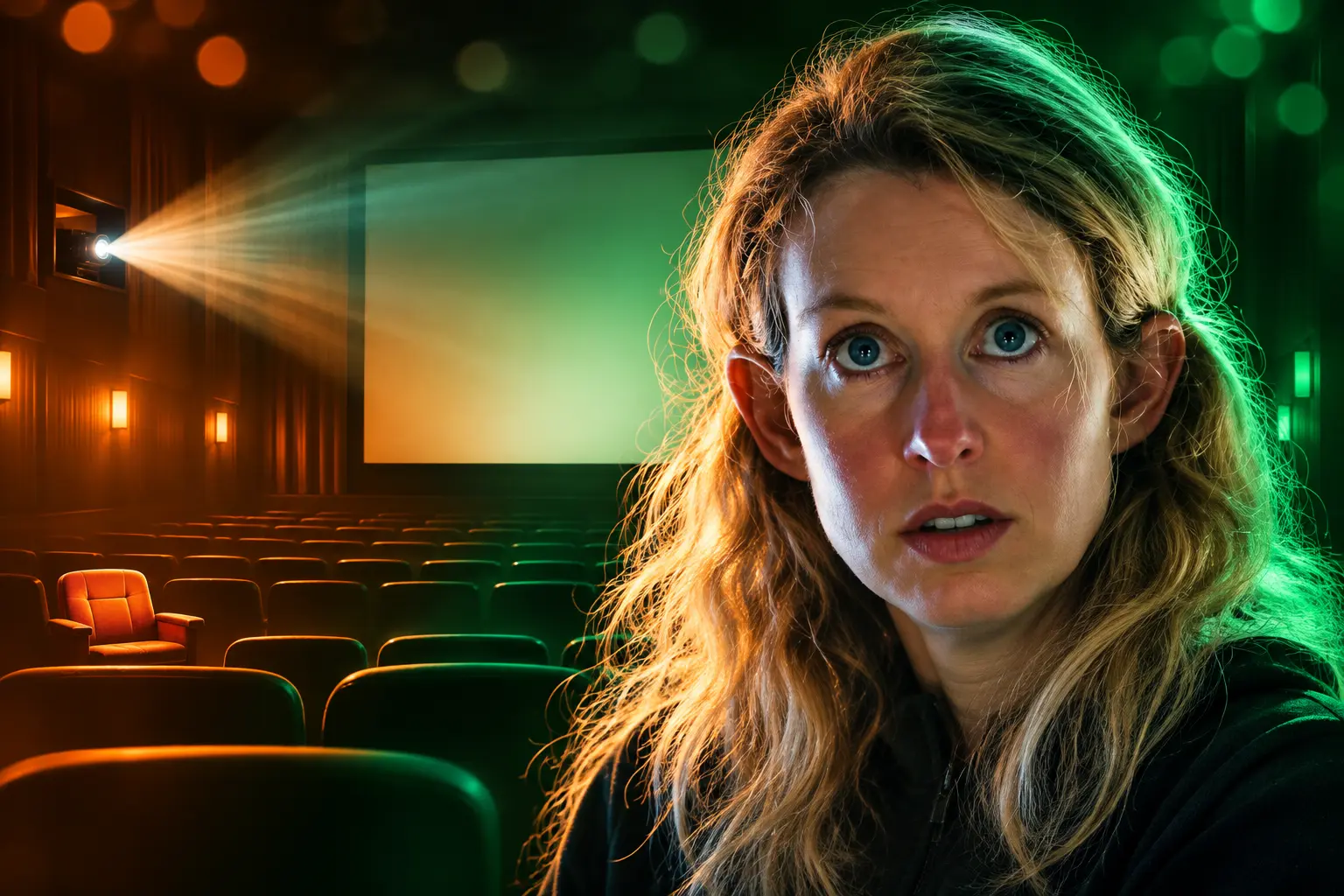
A24’s own page is blunt about the setup. Thirty-four days before prison, Holmes invites a skeptical film crew to document her every move. What begins as an intimate portrait, the copy says, becomes a three-year journey. Fielder and Oppenheim shot in a rented beach house in Del Mar, California, that Holmes shared with her partner, Billy Evans, and their two children.
The project started, they said at the New York Film Festival, after a magician in Los Angeles asked for a celebrity name and someone shouted Holmes. Oppenheim had heard she wanted someone to film her life and had already called A24. Fielder went to meet her because she had barely spoken in public for years, even though he thought the Theranos story was already told.
We don’t know what the story is. But we want to see what happens.
Nathan Fielder, co-director, New York Film Festival
A24 said that was fine, and that they could pull the plug. They began with one camera, then three, shooting 16 hours a day with two small crews and no more than four people in the house at once. Oppenheim said a wide lens covered the whole house so they would not miss a turn in the room. Fielder moved from behind the camera onto it, because the interesting thing was his own face when Holmes gave a circular answer about whether she knew the blood tests did not work.
After each day the two directors would argue about what they had just watched. That disagreement, they said, was the film. Fielder still does not claim to know why Holmes and Evans said yes. Maybe, he said, they thought that inviting someone who seemed like a friend would mean no one would take it seriously.
FROM THE MAGIC SHOW TO OPENING NIGHT
- 2023: Fielder and Oppenheim hear Holmes wants a film, meet her, and move a crew into the Del Mar house for the last 34 days before prison.
- May 30, 2023: Holmes reports to Federal Prison Camp Bryan in Texas to begin a 135-month sentence, later cut to 123 months in March 2026.
- Sept. 6, 2026: The finished film premieres as Telluride’s secret screening, then plays the New York Film Festival on Sept. 30.
- Oct. 16, 2026: A24 opens it in 855 North American theaters. Letterboxd logs a 4.7 debut average that same night.
Cinematographer David Bolen, speaking later at Camerimage, described the house as a tense place where he exchanged pleasantries with Holmes and Evans and otherwise tried to disappear. “I really tried to stay out of the situation as much as possible,” he said, adding that when the office scenes tightened he stayed quiet, stayed polite, and got the cameras out. The Motion Picture Association rated the film R for language and some graphic nudity. Editor Adam Locke-Norton cut it from hundreds of hours of tape down to 174 minutes.
The Partner on the Interview Circuit
Holmes is the face on the poster. Evans is the person who can still sit for interviews. Fielder has said A24 agreed to a profit-sharing arrangement Evans negotiated, and the movie itself watches Fielder try to work out whether Holmes knows. On camera, shortly before she left for Texas, she told him she had no economic interest in the film. In a later prison visit restaged for the movie, she said she does not have the option to care about money because restitution takes every dollar.
A federal judge in San Jose sentenced her on Nov. 18, 2022, to 135 months and ordered $452 million in restitution, jointly with former Theranos president Ramesh “Sunny” Balwani, after a jury convicted her on one conspiracy count and three wire-fraud counts tied to investors. She was acquitted on the patient counts. The term came down to 123 months in March 2026 after a guidelines change. Deadline’s festival notes now describe it as a 10-year sentence. Evans has called the original term insane and said their daughter took her first steps in a prison visiting room.
In his first long television interview this month, Evans said he still loves the film and would do it again with a better sense of what he was walking into. He also said a shower scene that shows him nude was filmed with cameras he knew were running, but not with consent to show his whole body, and that his children’s teachers have now seen it. A24’s response was flat: everything that was filmed was filmed with their consent. He has not spoken to Fielder since he watched the cut. He is not suing.
That is the hidden ledger under the $102.47 million. Holmes opened the door so the last month of her freedom would be visible on her terms. Evans, still outside, is the one answering for the cut, the nudity, the kids, and a new business the movie follows after the Del Mar month ends. She is in Bryan. He is on the couch.
Fahrenheit 9/11 Still Owns the Worldwide Record
Moore’s 2004 film remains the non-concert documentary to beat, and the gap is not close once you leave North America. It opened to $23.9 million from 868 theaters, cost about $6 million, and finished at $119.2 million domestic and $222.4 million worldwide. March of the Penguins, from 2005, is next globally at $127 million, with $77 million of that in the United States.
THE NON-CONCERT DOCUMENTARIES AHEAD OF IT
| Film | Domestic | Worldwide |
|---|---|---|
| Fahrenheit 9/11 (2004) | $119.2 million | $222.4 million |
| March of the Penguins (2005) | $77 million | $127 million |
| You Can See Everything (2026) | $93.47 million | $102.47 million |
On U.S. screens, Fielder and Oppenheim have already passed the concert-adjacent titles that used to clog the documentary chart, and they have a realistic shot at Moore’s domestic number if they hold screens into awards season. They will not catch $222.4 million without a foreign run Moore got in a different century. Fahrenheit 9/11 was an election-year argument people bought as politics. This one is a 174-minute access puzzle that a young comedy audience is treating like a midnight movie.
That is why the remaining dates matter more than another week of domestic decline. The American money is largely in. The record this film can still break lives in rooms that have not opened yet.
Letterboxd’s First Documentary Million
On Oct. 16, Letterboxd posted that You Can See Everything had debuted at 4.7 and was the highest-rated feature on the app. That number was never going to hold. The same platform will three-star The Godfather to be contrary and five-star a new sacred object before Monday. By the time the film crossed 1 million member watches, the average had settled at a 4.61 average Letterboxd rating.
That 4.61 still makes it the highest-rated 2026 feature on the app, the second-highest-rated documentary there after Stop Making Sense, and the second-highest-rated film of any kind to enter the One Million Watched Club, behind 12 Angry Men at 4.63. It is the 19th 2026 title in that club and the first documentary. Letterboxd said so itself on Nov. 21.
You Can See Everything has joined the One Million Watched Club on Letterboxd 👀
This is the first documentary to join the club. View the full list: https://t.co/uHtF6Uu9rA pic.twitter.com/fw1tN7DYVT
— Letterboxd (@letterboxd) November 21, 2026
The logging is the cultural half of the box office. A million people did not just buy tickets. They performed having seen it, in public, on the app that now does the work reviews used to do for a movie like this. Critic Angie Han called it “smart, funny and full of surprises.” It holds a 97 critics score on Rotten Tomatoes. Saturday Night Live has already put Druski in the turtleneck. The three hours keep getting treated as a riddle people exit still unable to score.
Why Young Buyers Are Filling 596 U.K. Screens
The United Kingdom opened the weekend of Nov. 20 to $3.2 million from 596 cinemas, A24’s second-largest debut there after Backrooms at $5.7 million, and the widest non-concert documentary opening the territory has logged. About 70 percent of that audience was under 35, the same skew A24 saw in the United States. Australia and New Zealand, which started a week earlier, are the top foreign markets so far at $3.8 million. Poland has done $1.47 million. Turkey, where the film opened Oct. 30, has sold more tickets than any other international documentary in that country.
The staggered map is the other joke inside the title. For a month after the U.S. opening, a lot of the world could not see the movie at all, and the delay did what scarcity always does for a Fielder project: it made the people who had seen it louder. Sony is carrying Germany, Austria, Scandinavia, the Middle East, Latin America and several other territories. A24 is keeping the U.K. and Australia in-house.
STILL AHEAD ON THE MAP
- Nov. 25 and 26: Mexico, Brazil and Argentina open, the first big Latin American dates of the Sony deal.
- Dec. 3 and 4: Germany, Austria and Hong Kong join, which is where the foreign cume has to start looking like a record chase.
- Dec. 25 and Dec. 30: Spain and then France, two markets that can still move a documentary in awards season.
- March 12: Japan, last among the announced territories, long after the Oscars have already voted.
If those dates behave like London, the 8.8 percent international share will look like a timing artifact. If they behave like a normal documentary, Fahrenheit 9/11’s worldwide number stays untouched and this remains what it already is: an American youth event that happens to be nonfiction.
No Documentary Has Ever Been Nominated for Best Picture
That fact is doing as much work as the gross. Fielder and Oppenheim have a live argument for the first nonfiction Best Picture slot in 99 ceremonies, and a harder one inside the documentary branch, which still prefers films that pretend the director is not in the room. Fielder is in the room. Amanda Seyfried, who won an Emmy playing Holmes in The Dropout, is in the second half, reenacting material the crew could not hold once prison and time ate the original access. Christopher Abbott plays Evans in those passages. The movie keeps insisting that watching is not the same as knowing.
Holmes asked a comedy director into her house so that, for 34 days, you could see everything. A million people have now checked a box that says they did. The receipts are $102.47 million and climbing on screens she cannot enter. Evans is still talking. The cameras, Bolen said, tried to stay polite. The title did the rest.

Jennifer Lopez and Mahershala Ali Describe a Pipeline They Cannot Buy

Lightsail Scatter Turns to Drag Far Above Starshot

Tallulah Willis Deletes a Bruce Willis Photo She Called Intimate

S&P 500 Futures Rebound Into a Holiday-Shortened Week

GTA VI’s Record Launch Still Needs the Same Fragile Grid

Aramco Crash Kills 14 Two Days After Oil Restart

Salah Captained Egypt to Their First World Cup Win

Zelda’s 40th Switch 2 Ships Without a Zelda Game

Apple Labor Day Deals Hide June’s Memory Price Hike

El Niño Puts Israel’s Needed Winter Rain on a Flood Clock
-
 BUSINESS5 months ago
Aramco Crash Kills 14 Two Days After Oil Restart
-
 NEWS6 months ago
Salah Captained Egypt to Their First World Cup Win
-
 GAMING3 months ago
Zelda’s 40th Switch 2 Ships Without a Zelda Game
-
 NEWS3 months ago
Apple Labor Day Deals Hide June’s Memory Price Hike
-
 NEWS5 months ago
El Niño Puts Israel’s Needed Winter Rain on a Flood Clock
-

 GAMING3 months ago
Palworld 1.0.4 Adds Palpedia Search After the 1.0 Launch
-

 NEWS4 months ago
Saudi Visa Routes Split Nigerian Travelers Into Two Speeds
-

 BUSINESS9 months ago
BAE’s 60-Year Saudi Franchise Now Runs Through Taif