
AUTO
BMW’s Convertible Mule Is Stress-Testing the Electric M3
A BMW M4 convertible mule spotted in Germany is stress-testing the electric M3’s four-motor drivetrain in a body with no roof.

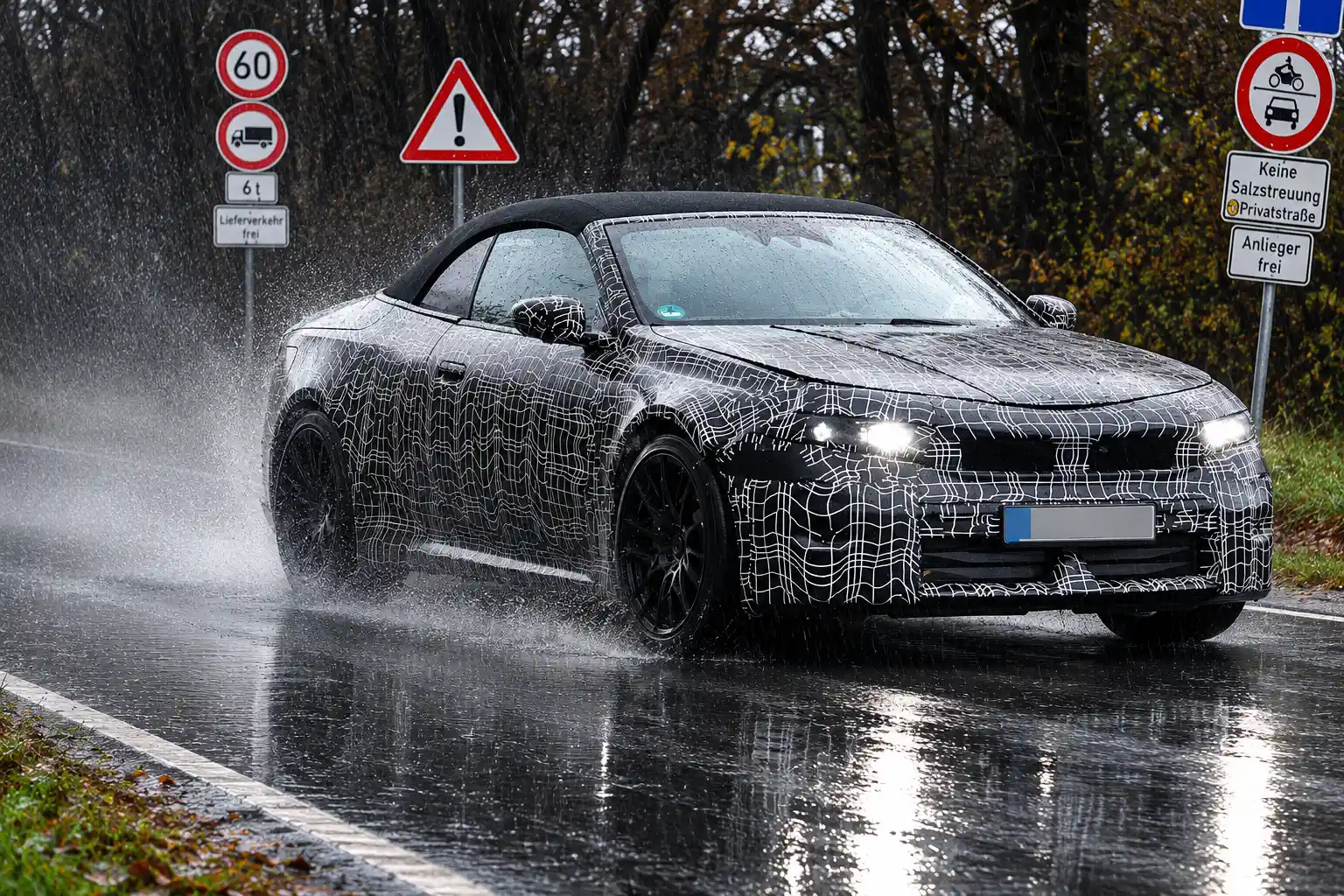
Photographers caught a camouflaged BMW two-door with a fabric roof and no tailpipes in German rain on November 17, 2026. The car is being treated as a BMW M4 convertible, and it showed up a day after journalists drove BMW’s first electric M3.
The timing is the tell. BMW is already running the four-motor sedan hardware in public, and this mule is how that drivetrain meets a body with no roof to keep it stiff.
A Soft Top, No Pipes, and Wheel-Filling Brakes
The prototype was still buried in wrap, with temporary lamps and a riveted panel over the hood, but the silhouette is a two-door drop-top on a wide track. The rear has no exhaust outlets. BMW returned its 4 Series convertibles to a fabric roof in 2021, and this test car uses the same kind of soft top rather than the old folding hardtop.
Cooling flaps sit in the front bumper. A small lip spoiler sits on the trunk edge. The wheels are very wide, and the drilled rotors fill almost the whole inside of the rim, with blue calipers behind them. Those are not styling extras on a quiet commuter mule.
WHAT THE CAMOUFLAGE DID NOT HIDE
- The roof: A fabric top, up in the rain, in the same family BMW has used on 4 Series convertibles since 2021.
- The tail: A blank rear valance with no tailpipes, the cleanest EV tell on the car.
- The track: Flared front fenders and a wider rear stance than earlier i4 convertible mules.
- The brakes: Huge drilled discs and blue calipers that occupy almost the full wheel.
- The nose: Neue Klasse lighting graphics and a hood panel that matches the vent seen on electric M3 prototypes.
Flush handles appear on some frames, older i4-style handles on others, which is one reason the badge fight started before the wrap even came off. The car was an early mule either way, running public roads in weather that would soak a cabin if the top seals were the point of the day. They were not. The chassis and the brakes were.
Is This an M4 or an i4 M60?
It is not settled. Wide fenders, a covered hood vent, and those brakes are the case for a full electric M4 convertible, coded ZA3 in BMW’s internal list. Older door handles, temporary lamps, and a 2028 slot for a regular i4 convertible, coded NA3, are the case for a hot i4 M60 drop-top instead of a full M car.
BMW has not named the mule. It has not confirmed an electric M4 convertible at all. The regular i4 Convertible is being talked about for production in July 2028, and a true M drop-top, if it is on the plan, is being placed later still, even in 2029 in some of those reconstructions. Those dates are not factory dates. They are the calendar people use when they map codes onto plant slots.
WHERE THE SPY SHOTS SPLIT
- The wide-body read: Fat fenders, a hood-vent cover like the electric M3, and wheel-filling brakes point to a full M4 cabrio, not a warmed-over i4.
- The code read: i4-style handles, early lights, and the NA3 production window point to an i4 M60, with the iX3 M60’s 603 hp dual-motor setup as the likely power analog.
- What nobody has: A factory confirmation of the badge, the motor count, or an on-sale year for either car.
The split does not empty the photos of meaning. Even the milder reading still puts a high-power Neue Klasse two-door on an open body. The stronger reading puts the sedan’s four motors in that same body. Either car has to keep a floor pack, a folding roof, and a stiff shell in one package, which is the job the sedan does not have to do.
838 Horsepower Before Anyone Chops the Roof
On November 16, 2026, BMW let the press drive camouflaged electric M3 prototypes at its Miramas proving ground in southern France. The sedan, coded ZA0, is the first full M car on Neue Klasse, and BMW’s preliminary figures put it at 838 hp (625 kW) and 1,200 Nm from four motors. Plant Munich is due to build it in 2027, without an iM3 badge. A gasoline M3, coded G84, is due to follow in 2028.
Two “sport drive units” hold the motors, one unit per axle, two motors side by side in each housing, each motor with its own single-speed gearbox. There is no mechanical differential. Software meters each wheel. The rear unit is the muscle: about 751 hp (560 kW) and 1,000 Nm. The front is about 644 hp (480 kW) and 540 Nm. Those axle peaks do not add into a 1,395 hp headline, because the pack cannot feed both at once. BMW’s system figure is the 838 hp number, and it already calls the layout rear-drive biased, with a decoupling unit that can drop the front axle in Comfort.
THE ELECTRIC M3 HARDWARE BMW HAS ALREADY SHOWN
| Item | Power | Torque |
|---|---|---|
| Front axle | 644 hp (480 kW) | 540 Nm |
| Rear axle | 751 hp (560 kW) | 1,000 Nm |
| System (BMW preliminary) | 838 hp (625 kW) | 1,200 Nm |
The pack is an M-spec Gen6 unit of about 100 kWh, with every cell row cooled on both sides, double the cooling of the regular i3 sedan. Preliminary charging is 420 kW DC, about 350 km in 10 minutes, with a targeted 650 km WLTP and about 300 miles EPA. Peak regeneration is 540 kW when the friction brakes and the motors work together. A Track preset preconditions the pack and holds output for stints of two, eight, or 15 minutes. Andreas Bentenrieder, BMW M’s high-voltage battery expert, said of that mode, “There’s no degradation.”
An M-specific version of the Heart of Joy control unit runs the lot at a one-millisecond tick, and Philipp Brunn, who leads the electric M3 project, said the Neue Klasse control stack is 10 times faster than the electronics in today’s M cars. Simulated shifts, paddles, and an M soundtrack are part of the same brief, a first for BMW. That soundtrack is already the part of the sedan people want to argue with, and a convertible would play it with the roof down, which is a poor place to hide a speaker.
The unique concept lets us achieve performance levels you’ve never seen in a BMW M production car as of now.
Philipp Brunn, head of the BMW M Neue Klasse project, to reporters
Brunn also said M could not wait for the base electric 3 Series to freeze and then raise a hand. BMW’s January briefing on the BMW M eDrive four-motor system put one motor at each wheel on every electric Neue Klasse M car from 2027, with the front axle able to disconnect for a rear-drive mode. If this mule is a full M4, that is the hardware in the rain. If it is an M60, the sedan still shows what a true M cabrio would have to carry later.
Why a Convertible Fights a Floor Battery
The sedan uses the battery housing as a shear plate bolted to both axle carriers, so the pack, the floor, and the dampers act as one stiff unit. Brunn’s case was blunt: if the body flexes, the dampers cannot do their job. Extra aluminum plates tie the pack to the front and rear axle carriers. Welded struts carry shock-tower loads into the A-pillars. Four weld-on pickup points go onto M3 bodies only, so a regular i3 does not haul around M bracing it does not need.
A convertible deletes the roof that finishes that torsion box. The scuttle has to stay still with the top down, while a folding roof mechanism still has to stack in the rear deck, on top of a rear drive unit that already houses two motors, two gearboxes, and an inverter. The current gas M4 Competition xDrive Convertible already pays for that hardware in mass. BMW’s U.S. curb figure is 4,306 pounds, against 3,979 pounds for the coupe, a 327-pound penalty before anyone adds a 100 kWh pack.
That is why the mule matters more than another set of camo shots. BMW can prove four-motor torque vectoring on a sedan with a fixed roof. It cannot prove the same pack-as-chassis idea in a drop-top until a car like this one is running, twisting, and braking on a wet road with the roof latches taking load they will not take on the M3. Huge rotors make sense in that light. The motors can modulate ABS faster than hydraulics, Brunn said, but you still need friction brakes when regeneration falls off, and a heavy open car is a long way from a light coupe when the discs are the last word.
BMW Still Sells a 523-Horsepower Soft Top
The electric mule does not retire the car in showrooms now. The current M4 Competition xDrive Convertible uses a 3.0-liter twin-turbo inline-six rated at 523 horsepower (530 PS, 390 kW) at 6,250 rpm and 479 lb-ft (650 Nm) from 2,750 rpm. BMW’s 0-60 mph claim is 3.6 seconds. Top speed is 155 mph, or 174 mph with the M Driver’s Package. The U.S. base price on the last published Competition xDrive Convertible sheet was $97,175.
That six-cylinder is the emotional leftover in this story. When the electric M3’s soundtrack clip circulated, the sharpest pushback was not about badges. It was about fake noise, and about stuffing a B58 back into the hole where a cross-plane idle used to live. BMW has already answered part of that in hardware terms: the next gas M3 is still coming in 2028, on an updated version of the current cluster architecture, with a revised S58. The same split is expected for M4 coupe and convertible, even though combustion mules for those cars have not been seen yet.
So the open M car on sale today is still a 523-horsepower soft top that weighs 4,306 pounds and hits 60 mph in 3.6 seconds on paper. The electric two-door, if it is an M4, has to beat that without a roof and with a floor full of cells. If it is an M60, it has to beat a regular i4 cabrio, not an M4, and the 838 hp sedan remains the high bar sitting one body style away.
The Folgore’s 761-Horsepower Benchmark
The sports-car convertible class has thinned out, and the electric side of it is thinner still. Maserati already sells the four-seat GranCabrio Folgore, which is the open EV this mule would actually have to live next to. The factory figures are 761 horsepower and 1,350 Nm from three motors on an 800-volt pack, with 610 kW available in MaxBoost. Official 0-100 km/h is 2.8 seconds. Homologated weight is 2,340 kg (5,159 lb). The nominal pack is 92.5 kWh, with 270 kW DC and an 18-minute 20-to-80 percent claim.
OPEN TOPS AND THE SEDAN THAT LENDS THE DRIVE
| Car | Power | Torque | Sprint | Weight |
|---|---|---|---|---|
| M4 Competition xDrive Convertible (current) | 523 hp | 479 lb-ft (650 Nm) | 3.6 s 0-60 (BMW) | 4,306 lb |
| Electric M3 sedan (preliminary) | 838 hp (625 kW) | 1,200 Nm | Not published | Not published |
| GranCabrio Folgore | 761 hp (560 kW) | 1,350 Nm | 2.8 s 0-100 | 2,340 kg (5,159 lb) |
The Italian car is already in the two-and-a-third-tonne club, which is the mass a battery cabrio tends to land at once the roof mechanism is in. BMW has not published a weight for the electric M3, let alone for a drop-top that would add the 327-pound class of penalty the gas cars already show. Power is the easy column. The Folgore’s 761 hp sits under the M3’s 838 hp preliminary figure and well above the current M4 cabrio’s 523 hp. The hard column is the one BMW still has not filled in for any open Neue Klasse car: kilos, scuttle shake, and how much of that 540 kW regen still works when the body is twisting.
Munich Builds the Sedan in 2027
The convertible mule is early. The sedan is not. BMW has been showing the four-motor idea in public for most of this year, and the drop-top only joined that trail once the press had already driven the four-door.
HOW THE ELECTRIC M FAMILY SHOWED UP
- January 14, 2026: BMW M details four-motor eDrive, Heart of Joy software, and a performance pack for Neue Klasse M cars from 2027.
- June 12, 2026: The M Concept Neue Klasse appears at the Le Mans 24 Hours as the closest public look at the electric M3.
- November 16, 2026: Journalists drive camouflaged electric M3 prototypes at Miramas.
- November 17, 2026: A fabric-roof EV two-door mule runs in German rain with no tailpipes and outsize brakes.
- 2027: Plant Munich is due to start electric M3 production; a gasoline M3 is due in 2028.
Munich will build the electric M3 in 2027 and a gasoline M3 in 2028, a split that echoes how BMW already runs five powertrains off one X5 line in South Carolina. The i4 Convertible’s July 2028 production talk, and a 2029 guess for a full M drop-top, still sit outside that factory calendar. They are scheduling folklore until BMW prints a date.
The mule that went past the cameras on November 17 still had its roof up. The hardware that would have to hold that body together is already running, with a roof, at Miramas, and the open car is now doing the part of the program the sedan cannot finish for it.

One UI 9.5 Beta Puts the Galaxy S26 on Last Year’s Clock

DBS Puts a 24/7 USDC Window Inside the Bank

European Startups Head for $81 Billion as First Checks Shrink

US Stocks Lost $1.3 Trillion Before Nvidia’s Beat

Home Depot Bets on Finance Chief Richard McPhail as CEO

Aramco Crash Kills 14 Two Days After Oil Restart

Salah Captained Egypt to Their First World Cup Win

Zelda’s 40th Switch 2 Ships Without a Zelda Game

Apple Labor Day Deals Hide June’s Memory Price Hike

El Niño Puts Israel’s Needed Winter Rain on a Flood Clock
-
 BUSINESS5 months ago
Aramco Crash Kills 14 Two Days After Oil Restart
-
 NEWS6 months ago
Salah Captained Egypt to Their First World Cup Win
-
 GAMING2 months ago
Zelda’s 40th Switch 2 Ships Without a Zelda Game
-
 NEWS3 months ago
Apple Labor Day Deals Hide June’s Memory Price Hike
-
 NEWS4 months ago
El Niño Puts Israel’s Needed Winter Rain on a Flood Clock
-

 GAMING2 months ago
Palworld 1.0.4 Adds Palpedia Search After the 1.0 Launch
-

 NEWS4 months ago
Saudi Visa Routes Split Nigerian Travelers Into Two Speeds
-

 BUSINESS9 months ago
BAE’s 60-Year Saudi Franchise Now Runs Through Taif