
AUTO
The Can-Am Pulse Got Cheaper and Still Cannot Leave Town
Can-Am cut the Pulse to $10,999, but J1772 charging and an 80 mph cap still keep the electric naked in town.

The 2026 Can-Am Pulse starts at $10,999 after a $3,000 cut, and it still cannot use the fast chargers cars now plug into. Can-Am sells it as a naked street bike with a Rotax E-Power motor, an 8.9 kWh pack, and an 80 mph lid. Travis Langness, a tester who lived with a company loaner for months in Los Angeles, found the cheap miles and the city punch, then ran out of both range and J1772 posts once the freeway started.
The sticker now sits next to LiveWire’s cheapest S2. The plug and the speed cap still belong to a city brief.
A $3,000 Cut Still Leaves the Pulse Above Gas Nakeds
Can-Am launched the Pulse at $13,999, then dropped the 2026 bike by $3,000. The U.S. configurator now starts at $10,999 in Bright White. Carbon Black is $11,499. The Pulse ’73, a heritage pack with Sterling Silver paint, a LinQ windshield, and a cover, is $12,999. Freight and destination are extra; Can-Am’s own payment tool lists $400 in transport and prep.
Unused 2025 Pulses and Origins still on dealer floors carry a $6,000 rebate, which is the louder price signal. BRP had to cut the new bike and pay people to take last year’s leftover. That is not the posture of a sold-out launch.
THE 2026 PULSE AT A GLANCE
- Sticker: $10,999 for Bright White, before freight.
- Pack: 8.9 kWh lithium-ion, liquid-cooled with the motor, inverter, and onboard charger.
- Punch: 47 hp peak, 27 hp continuous, 53 lb-ft from 0 to 4,600 rpm, 3.8 seconds to 60 mph.
- Lid: 80 mph, on a 390 lb curb weight bike with a 30.86 in seat.
Gas nakeds in the same shopping tab still cost less before you plug anything in. Yamaha lists MT-07 prices starting at $8,599, $2,400 under the Pulse, with a $675 destination charge. Honda’s CB750 Hornet E-Clutch base MSRP of $7,999 plus $600 destination lands at $8,599 out the door before tax. Kawasaki’s 2026 Z650 S ABS is $7,699, $3,300 under the Pulse. All three are more powerful in the way riders mean when they talk about a highway pass.
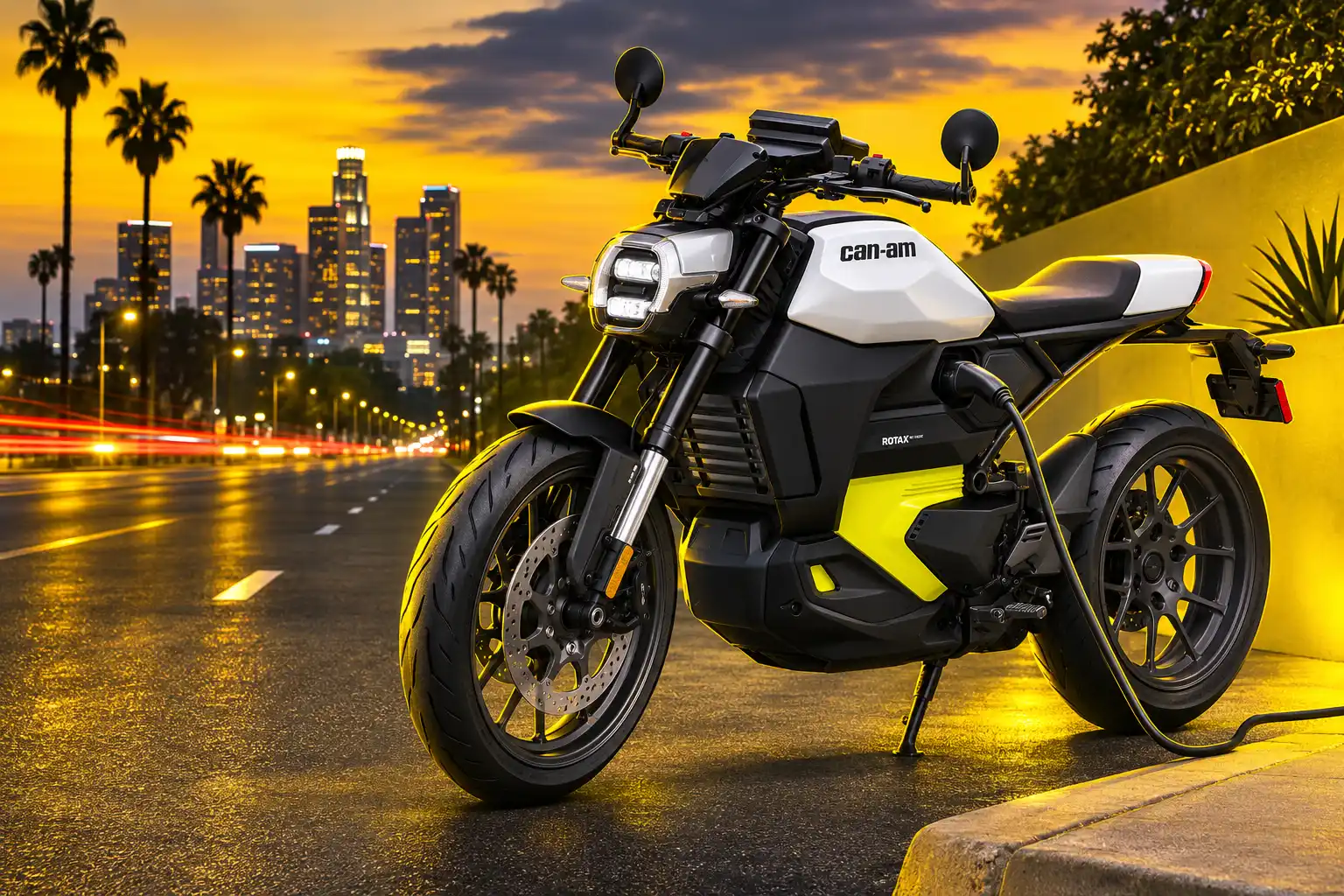
Cheap Miles and a Silent Chain in Traffic
Where the Pulse earns the money is the first two blocks. There is no clutch and no gearbox, only a direct drive and an oil-bath chain in a sealed case, so you thumb it on and twist. Langness said it felt much quicker than the gas mid-sizers from 0 to 30 mph, the way a small EV car does off a light. Can-Am’s 3.8-second 0 to 60 mph claim is enough to clear a pack of SUVs. Reverse exists for parking; he never used it because the bike is light enough to walk.
The chassis is narrow, 390 lb at the curb, with a 55.6 in wheelbase and Dunlop Sportmax GPR-300 rubber in 110/70 front and 150/60 rear. Turn-in is fast. Lane-splitting in Los Angeles is the job it was drawn for. Four modes (Normal, ECO, Rain, Sport+) sit behind a 10.25-inch touchscreen with Apple CarPlay, and the screen stayed readable in hard sun. A glove box up front takes a phone and a USB cable. LinQ points accept a tank bag, a 36 L top case, or 22 L saddlebags if you want to carry a bulky adapter.
Running cost is the clean win. Langness paid $1.29 for 40 miles at one public post and about $2.00 for about 50 miles at another. A 50 mpg gas bike covering those same 50 miles at the $4.03 national average he used would burn about one gallon, roughly double the electricity bill. Quiet drivetrain noise is part of the same deal: you hear traffic instead of a twin, and you disappear in a crowd until someone notices there is no exhaust.
Today, we are reclaiming our two-wheel heritage by bringing new excitement to the electric motorcycle industry. 50 years ago, Can-Am celebrated many victories with its Track ’n Trail motorcycles, and we are bringing that pedigree back with a focus on modern electric power, connectivity and thrill.
José Boisjoli, President and CEO of BRP
Regen is the odd new skill. Passive regen feeds a little back when you roll off. Active regen needs a forward twist on the throttle, which is a fight if your fingers are already on the lever. Langness stopped mixing them and used one or the other. The physical front brake is a single 320 mm disc with a J.Juan two-piston caliper, and he found little bite on a hard grab. Honda’s Hornet uses dual 296 mm discs. For a 390 lb bike that is otherwise happy in town, the lever is the weak hand.
Power Falls Off Once California Freeways Start
Can-Am publishes three range numbers, all on a full charge. City riding is listed at 100 miles. The WMTC combined cycle is 80 miles. Hold a steady 50 mph and the claim falls to 55 miles. Langness’s months on the bike came in closer to 60 miles of usable range on mixed roads, which is already a short leash between plugs.
Fifty mph is not how a California freeway works. Limits are 65 or 70, and at 70 the Pulse’s range dropped to 30 to 40 miles. Over 60 mph the motor flattens. Merging is possible; staying with impatient truck traffic is a drain on both speed and battery. An 80 mph limiter is the hard stop, and he noted a single-cylinder scooter he had just ridden north of that on the same kind of road.
OFFICIAL RANGE VERSUS A MONTHS-LONG LOAN
| Condition | Can-Am figure | Loaner result |
|---|---|---|
| City | 100 miles | Not isolated as a separate test |
| Combined (WMTC) | 80 miles | About 60 miles mixed |
| Steady 50 mph | 55 miles | Not realistic on his freeways |
| About 70 mph | Not published | 30 to 40 miles |
The tank fairing is too narrow to brace with your knees the way a typical naked lets you, so his legs slid forward on stops. The seat is padded and upright, fine for short hops, thin for a large rider. KYB’s 41 mm fork and the SACHS rear shock, both with 5.5 in of travel, take small hits. Big pavement breaks buck the bike hard enough that he stood up. Comfort is a city setting, not a weekend loop.
Why the J1772 Port Is a Problem in 2026
Short range only works if the next post is close and the right shape. The Pulse uses a Type 1 J1772 connector on the spec sheet and a 6.6 kW onboard charger. Level 2 takes 50 minutes from 20% to 80% and 1 hour 30 minutes from empty to full. There is no DC fast-charge hardware.
Los Angeles public sites have been moving to NACS and CCS, the plugs cars want for a 20-minute stop. A J1772 adapter for those cabinets is bulky, and the Pulse has no side cases unless you buy them. Langness found a leftover J1772 at a gas station and another on a light post, both easy, both about an hour. That density is what turns a 60-mile battery into a town bike.
WHAT THE PLUG ACTUALLY ALLOWS
- Home overnight: Level 1 on 120 V is the slow path, quoted at 3 hours 10 minutes from 20% to 80%.
- Public Level 2: 6.6 kW AC, 50 minutes for the 20% to 80% window Can-Am advertises.
- DC fast charge: None. A NACS or CCS post does nothing without an adapter, and an adapter still feeds AC through the same 6.6 kW box.
- Can-Am’s line: The company said it would follow the market on NACS and offer adapters if needed. Adapters do not add a DC bus.
The cheaper electric class has the same hole. LiveWire’s S2 platform is Level 1 and Level 2 only; its own charging guide says the S2 is not compatible with DC fast charge. Zero is aiming a 2027 CCS (Europe) and NACS (North America) module at 20% to 80% in under 30 minutes, with a retrofit for some older bikes. The Pulse’s $3,000 cut did not buy a ticket onto that map. It bought a smaller battery that has to live on the posts cars are leaving behind.
LiveWire and Zero Are Fighting the Same Price War
On November 10, 2026, LiveWire published S2 Del Mar now $11,999, with the Mulholland at the same money and the Alpinista at $12,999. The Pulse undercuts that street S2 by $1,000. It also gives up pack size (8.9 kWh against the S2’s 10.5 kWh) and the extra speed the Harley-derived platform carries. Zero’s SR/F remains a different shelf at $19,995, with a 17.3 kWh pack, 176 miles of claimed city range, 124 mph, 111 hp, and 140 lb-ft.
THE STREET PRICE FIGHT
| Bike | Base MSRP | Energy | Claimed city range | Top speed | Public plug |
|---|---|---|---|---|---|
| Can-Am Pulse | $10,999 | 8.9 kWh | 100 miles | 80 mph | J1772 Level 2 |
| Yamaha MT-07 | $8,599 | 689 cc gas | n/a | n/a | n/a |
| Honda CB750 Hornet | $7,999 | 755 cc gas | n/a | n/a | n/a |
| LiveWire S2 Del Mar | $11,999 | 10.5 kWh | n/a in LiveWire’s price note | n/a in that note | Level 2 only |
| Zero SR/F | $19,995 | 17.3 kWh | 176 miles | 124 mph | Level 2 AC now, DC promised for 2027 |
The Pulse is the light, cheap EV in that grid, and it is still a few thousand above the gas bikes that will do a 70 mph merge without hunting a post. Origin, the dual-sport twin, shares the same Rotax pack and 80 mph cap, with 90 miles of claimed city range, taller suspension, and a higher seat. If the Pulse feels small, that is the platform talking, not a trim.
Can-Am Named a Trim for 1973
BRP announced the Pulse and Origin on August 20, 2024, with pre-orders in the U.S., Canada, and much of Europe, production in the fourth quarter of 2024, and deliveries in early 2025. Boisjoli cast it as a return, not a side project. Can-Am’s two-wheel line had been gone since the 1980s, while the brand kept selling Spyders, ATVs, and Ski-Doos. Rotax, the in-house engine shop, supplied the E-Power unit; the same 8.9 kWh chemistry is shared with the Origin and with Can-Am’s electric Outlander. The bikes are built to be twist-and-go for new riders as much as for people coming off a 900 cc naked.
CAN-AM’S ROAD BACK TO TWO WHEELS
- 1973: Can-Am’s first motorcycles, the era the ’73 trim is named for.
- 1980s: Two-wheel production ends; the brand moves to other powersports.
- August 20, 2024: BRP opens Pulse and Origin pre-orders and says it wants to lead electric motorcycles.
- Late 2024: Production starts, with global deliveries in early 2025.
- August 28, 2025: Can-Am cuts 2026 Pulse and Origin MSRPs by $3,000.
- 2026: Bright White Pulse at $10,999; leftover 2025 units offered with a $6,000 rebate.
Warranty is 2 years on the vehicle and 5 years or 31,068 miles on the battery. ABS and traction control are standard. There is no cruise control. For errands, a commute that stays under 60 miles, and a garage with a 240 V box, the math on electrons is friendly and the bike is easy to ride. For a canyon day that becomes a freeway, or a charger map that has already gone NACS, the $3,000 cut does not move the limiter or the inlet.
A leftover 2025 Pulse is $6,000 cheaper than the 2026 on the configurator, and it still needs the same J1772 post. That is the deal Can-Am is actually selling.
Frequently Asked Questions
How long does Level 1 charging take on a Can-Am Pulse?
On a 120 V household outlet, Can-Am quotes 3 hours 10 minutes from 20% to 80% and 5 hours 15 minutes from empty to full. That is the overnight-at-home path. The faster 50-minute window is Level 2 at 240 V through the same 6.6 kW onboard unit.
What extra coverage can you buy beyond the factory Pulse warranty?
Dealers can sell BRP’s B.E.S.T. extension for 12, 24, or 36 months on the vehicle. That add-on still excludes the battery, which stays on its own 5-year / 31,068-mile (50,000 km) terms, whichever comes first.
Does the Can-Am Pulse support Tesla NACS or DC fast charging?
No. The U.S. bike is J1772 AC only. Can-Am said it would follow the market on NACS and offer adapters if needed, which would still feed the 6.6 kW onboard charger rather than a DC fast-charge bus.
What does the Pulse ’73 add over the base bike?
The $12,999 ’73 pack is a paint and trim tribute to Can-Am’s 1973 start: Sterling Silver coloration, exclusive badges, signature LED lights, a LinQ windshield, and a vehicle cover. Motor, 8.9 kWh pack, 80 mph cap, and charge times match the $10,999 Pulse.
Can you carry a passenger on the Can-Am Pulse?
A second seat is an accessory in the U.S., not standard on the base model, and some European configs include a passenger seat as standard. Maximum vehicle load is 333 lb, which has to cover rider, passenger, and whatever you strap to the LinQ points.

Jennifer Lopez and Mahershala Ali Describe a Pipeline They Cannot Buy

Lightsail Scatter Turns to Drag Far Above Starshot

Tallulah Willis Deletes a Bruce Willis Photo She Called Intimate

S&P 500 Futures Rebound Into a Holiday-Shortened Week

GTA VI’s Record Launch Still Needs the Same Fragile Grid

Aramco Crash Kills 14 Two Days After Oil Restart

Salah Captained Egypt to Their First World Cup Win

Zelda’s 40th Switch 2 Ships Without a Zelda Game

Apple Labor Day Deals Hide June’s Memory Price Hike

El Niño Puts Israel’s Needed Winter Rain on a Flood Clock
-
 BUSINESS5 months ago
Aramco Crash Kills 14 Two Days After Oil Restart
-
 NEWS6 months ago
Salah Captained Egypt to Their First World Cup Win
-
 GAMING3 months ago
Zelda’s 40th Switch 2 Ships Without a Zelda Game
-
 NEWS3 months ago
Apple Labor Day Deals Hide June’s Memory Price Hike
-
 NEWS5 months ago
El Niño Puts Israel’s Needed Winter Rain on a Flood Clock
-

 GAMING3 months ago
Palworld 1.0.4 Adds Palpedia Search After the 1.0 Launch
-

 NEWS4 months ago
Saudi Visa Routes Split Nigerian Travelers Into Two Speeds
-

 BUSINESS9 months ago
BAE’s 60-Year Saudi Franchise Now Runs Through Taif