
AUTO
Mercedes Sends the Baby G-Class to Hungary
Spy shots show a smaller G-Class mule, but Mercedes has already given exclusive production to Kecskemét, not Graz, after the electric G stumbled.

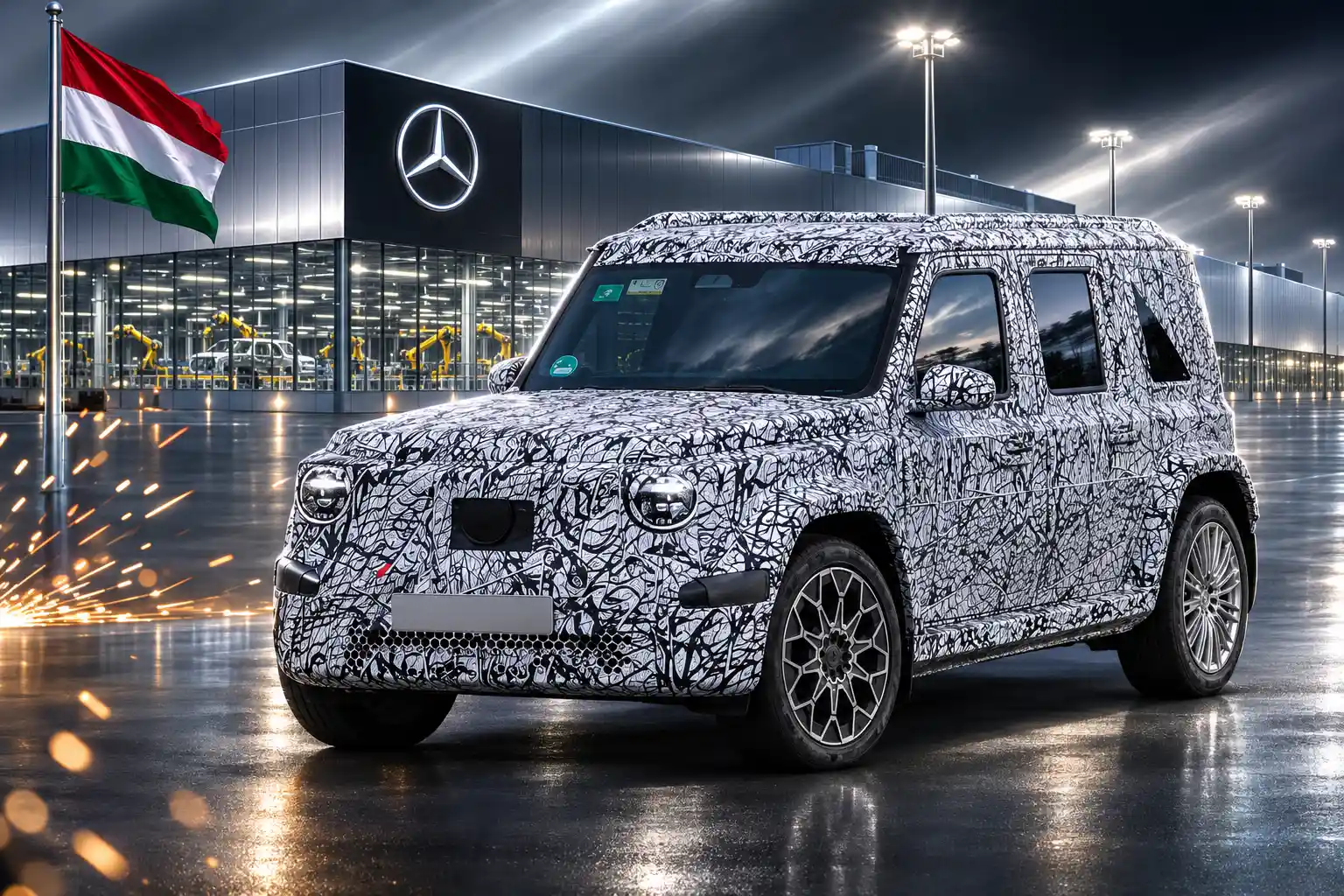
A square, camouflage-wrapped Mercedes mule was photographed on November 18, 2026, with a three-pointed star on the nose and G-Class cladding on the flanks. It is the smaller G-Class Stuttgart has talked about since 2023. The cute box is not the decision that will set what the badge is worth. That decision already went to Hungary.
Mercedes-Benz Group has said the compact G-Class will be manufactured exclusively in Kecskemét, the Hungarian plant it has just doubled, not at Magna Steyr in Graz, where every full-size G-Class has been built since 1979. German compact plants were in the conversation. They did not get the job.
The Camouflage Mule Looks Like a G-Class in a Wash
The November mule is a four-door SUV with a flat roof, short overhangs, fat fender flares, and a spare-wheel bump on the tailgate. Photographers caught a big Mercedes badge up front, sporty Pirelli P-Zero tires on snowflake-pattern wheels, and what looks like an exhaust outlet. That last detail matches the company’s retreat from an electric-only brief.
Earlier test cars wore a “little g” wrap. Design chief Gorden Wagener, speaking while the project was being shown in Munich in 2025, said the small one would get a sharper front and younger light graphics, then drew a hard line. “It’s a touch more modern than the big one, but it’s a G,” he said. “Must not change it.”
WHAT THE MULE SHOWS
- Body: Four doors, squared roof, short overhangs, and the upright greenhouse of the Graz truck, shrunk.
- Cladding: Heavy wheel-arch flares and lower-body armor, closer to a Bronco Sport than to a GLA.
- Wheels: Snowflake-pattern rims on Pirelli P-Zero tires, a hint Mercedes will dress this one like a fashion SUV, not a farm tool.
- Power: An exhaust hint on the latest mule, which fits the hybrid plan Mercedes confirmed in May 2026.
German specialist accounts put the finished car at about 4.5 meters, in GLA territory, not G-Wagon territory. Mercedes has not published a length, a weight, or a name. Baby G, Little G, Mini G, and a lowercase g-Class have all been used in briefings. None is a window sticker.
Kecskemét Won the G Badge, Rastatt Did Not
On July 13, 2026, Mercedes opened the expanded Kecskemét works with Hungarian Prime Minister Péter Magyar in the hall. The company put about €1 billion ($1.14 billion) into the site under its 2022 to 2026 plan, grew the footprint from 200 to 440 hectares, and described a 400,000-unit hub that becomes its largest plant in Europe. An investor deck put factor costs about 70 percent below Germany.
Production board member Michael Schiebe said the small G-Class would come to Kecskemét. The company’s own plant note went further and made Hungary the only site. The same factory already builds the A-Class, the electric GLB, and the electric C-Class. More than 5,000 people work there. Graz still has the slow, expensive G. Hungary gets the one meant to sell.
THE THREE PLANTS AROUND THE G BADGE
| Plant | What it builds | The stake |
|---|---|---|
| Magna Steyr, Graz | Full-size G-Class since 1979 | Keeps the six-figure original |
| Mercedes, Kecskemét | Compact G, GLB, A-Class, electric C-Class | Exclusive compact G after a €1 billion expansion |
| Mercedes, Rastatt | New GLA on the MMA compact architecture | The German compact plant that did not receive the G badge |
Mercedes has a public target to cut production costs 10 percent between 2024 and 2027. Moving a fashion SUV with G-Class margins onto a best-cost line is how that target gets hit without touching Graz. In Germany the compact G was already being read as a factory story, not a lifestyle story, because Hungary already builds Mercedes, Audi, and BMW cars for a fraction of Baden-Württemberg wages. Rastatt still has the new GLA. It does not have the badge people photograph.
Record G-Class Sales Still Belong to Graz
The reason Hungary wants that badge is sitting in Austria. Mercedes-Benz Group posted 49,700 G-Class deliveries in 2025, up 23 percent, and called it the model’s best year. Group car sales were down. The square truck was not.
German price lists still open the G-Class near 125,000 euros. The AMG G 63, the version that does the real work in the mix, commonly transacts around 200,000 euros. Mercedes marked the 600,000th G-Class in 2025 and has said about 80 percent of all G-Classes ever built remain on the road. That is a halo with a waiting list, not a volume problem.
The electric G 580 with EQ Technology is the weak plank in that story. Mercedes said the electric version helped the 2025 record and brought in new buyers. In November 2025 it also doubled the German discount on that model to 10 percent. A six-figure electric off-roader that needs a discount is exactly the kind of product a cheaper compact G is meant to flank, or to replace in the brochure.
Källenius still reserves one stunt for Graz. He has said the original can descend the Schöckl, the G-Class test mountain near the plant, at 60 to 70 km/h, and that only one car in the world can do that. The compact G is not being asked to. It is being asked to look as if it could.
Why the Baby G Is No Longer Electric-Only
When Källenius floated a smaller G-Class at the IAA in Munich in September 2023, the working idea was a compact electric off-roader. That brief did not survive contact with dealers, with the G 580’s slow start, or with the cost of building a fashion object in Germany.
Markus Schäfer, then Mercedes’ technology chief, told interviewers in 2025 that the Mini G had to be authentic and could not sit on an existing platform. “The G is very special, authentic car. And the Mini G also has to be authentic,” he said. “So I cannot take just an existing platform, I have to create my own modules.” He talked about unique body parts, even unique door handles, and about suspension and wheel size as a new development. In a later briefing he said the car would not use a ladder chassis like the Graz truck.
Plant-side accounts have still tied the hardware to the MMA compact architecture already in Kecskemét for the CLA and GLB. Mercedes has not published a platform name. The honest description is a unique body on compact-car bones, built in the cheap plant, sold with a G face.
HOW THE LITTLE G GOT HERE
- September 2023: Källenius presents a smaller G-Class at the IAA in Munich as a new member of the family.
- 2025, Munich: Schäfer and Wagener describe unique modules and a G look that must not change; camouflage mules begin to appear.
- May 2026: Mercedes confirms a combustion version as well as an electric one, ending the EV-only plan.
- July 13, 2026: The Kecskemét expansion opens, and Mercedes names Hungary as the exclusive plant for the compact G.
- October 2026: Källenius says the car is coming in less than 24 months; AMG’s Stefan Weckbach says it will not hunt the Graz buyer.
- November 18, 2026: A four-door mule with G cladding, Pirelli P-Zeros, and an exhaust hint is photographed on public roads.
The combustion candidate is the 1.5-liter turbo four-cylinder already used in the new CLA, rated there at 190 horsepower and 300 Nm, paired with a hybrid module in the gearbox. Mercedes has not said it will use that engine unchanged, or at all. The electric brief circulating with the mule still points to one motor per axle. Either way, this is a compact-car powertrain under a Graz costume, which is the whole product.
AMG Drew a Line Around the Real G Customer
Stefan Weckbach, who runs Mercedes-AMG and also oversees the G-Class and Maybach, spent October 17, 2026, at the company’s 140 Festival in Stuttgart trying to stop the obvious reading: that Hungary is a discount G-Wagon. He wants a different showroom, a different buyer, and a firewall around Graz residuals.
We will make sure that the little G-Class will target a different segment. It will be significantly different from the big brother or mother or father. It won’t target the real G customer.
Stefan Weckbach, Mercedes-AMG CEO, 140 Festival, Stuttgart
Källenius, in the same autumn, sounded hungrier. He said everybody loves the G-Class, and that when the smaller brother was announced “my phone was on fire with messages.” He then gave the only official clock Mercedes has offered: the baby G is coming “sooner than you think,” in “less than 24 months from now,” which from that October 2026 interview lands before October 2028.
Those two lines can both be true only if the compact G brings in people who were never going to spend 125,000 euros. The risk sits in the other queue. If the Hungary car looks enough like a G-Class, costs enough like a GLB, and wears the same three-pointed star, some of those 49,700 Graz buyers will simply buy the cheaper photograph. Weckbach is paid to say they will not. The mule is being styled to make that promise hard to keep.
The 1.5-liter problem is the same promise in mechanical form. Mercedes can spend an hour on DNA, adventure, and unique door handles. If the compact G arrives with the CLA’s four-cylinder, the press conference still has to say the number out loud. That is the product AMG is trying to keep away from the G 63 buyer, and it is also the product Kecskemét can actually build at volume.
A Smaller Defender Is Already on the Clock
JLR is running the same play from the other side of the fence. Company boss PB Balaji said the smaller, all-electric Defender will go with the Range Rover GT when Solihull turns the line over, and that JLR will put the electric baby Defender into production at the end of 2027. Mercedes now has a public window that can slip past that. The two cars will still meet in the same U.S. showrooms, aimed at people who like a Bronco or a Wrangler and want a luxury badge on the hood.
Mercedes already sells a boxy compact with G cues. It is called the GLB, and it will share a Hungarian roof with the compact G. The new car has to be more than a GLB with a worse drag coefficient, or Weckbach’s “different segment” line collapses into a trim walk. Schäfer’s unique modules and Wagener’s locked silhouette are the argument that it is more. The plant assignment is the argument that it still has to be cheap enough to print.
WHAT WE KNOW
- The plant: Mercedes has named Kecskemét as the only factory for the compact G-Class.
- The clock: Källenius put the car less than 24 months out as of October 2026.
- The drivetrains: Electric and combustion are both in the plan after an EV-only start.
- The look: A four-door box with G cladding, a star, and a spare-wheel tail, now seen in winter and road camo.
WHAT IS UNCONFIRMED
- The name: No final badge, and the lowercase g-Class talk remains a briefing nickname.
- The price: Mercedes has not issued an MSRP; German lists for the Graz G still start near 125,000 euros.
- The engine: The CLA 1.5-liter turbo is the hybrid candidate, not a signed specification.
- AMG: Sport wheels on the mule are not an AMG program, and Weckbach has not announced one.
Källenius still has to deliver a car that looks like the mule and costs like Hungary. Weckbach still has to keep it out of the Graz buyer’s garage. The photographs from November 18, 2026, show the costume is ready. The plant that will stamp it is already open.

Jennifer Lopez and Mahershala Ali Describe a Pipeline They Cannot Buy

Lightsail Scatter Turns to Drag Far Above Starshot

Tallulah Willis Deletes a Bruce Willis Photo She Called Intimate

S&P 500 Futures Rebound Into a Holiday-Shortened Week

GTA VI’s Record Launch Still Needs the Same Fragile Grid

Aramco Crash Kills 14 Two Days After Oil Restart

Salah Captained Egypt to Their First World Cup Win

Zelda’s 40th Switch 2 Ships Without a Zelda Game

Apple Labor Day Deals Hide June’s Memory Price Hike

El Niño Puts Israel’s Needed Winter Rain on a Flood Clock
-
 BUSINESS5 months ago
Aramco Crash Kills 14 Two Days After Oil Restart
-
 NEWS6 months ago
Salah Captained Egypt to Their First World Cup Win
-
 GAMING3 months ago
Zelda’s 40th Switch 2 Ships Without a Zelda Game
-
 NEWS3 months ago
Apple Labor Day Deals Hide June’s Memory Price Hike
-
 NEWS5 months ago
El Niño Puts Israel’s Needed Winter Rain on a Flood Clock
-

 GAMING3 months ago
Palworld 1.0.4 Adds Palpedia Search After the 1.0 Launch
-

 NEWS4 months ago
Saudi Visa Routes Split Nigerian Travelers Into Two Speeds
-

 BUSINESS9 months ago
BAE’s 60-Year Saudi Franchise Now Runs Through Taif