
AUTO
Waymo Loses US Freeways After a Failed Work-Zone Fix
California pulled Waymo off freeways after a summer software fix failed the same construction-zone test, while city robotaxi trips keep running.

California’s motor vehicle department barred Waymo robotaxis from every state freeway on November 11, calling driverless highway trips an imminent public safety hazard. The order stayed quiet until November 17, when the company said it had also pulled freeway routing in every other US market it serves.
City rides keep running. The cars that left the highway are the same fleet Waymo had already recalled, patched, and sent back to those lanes in July.
The Order Hit Freeways on November 11
The California Department of Motor Vehicles modified Waymo’s deployment and driverless-testing permits so the cars may not operate or test on any California freeway. Surface streets are untouched. Jonathan Groveman, a DMV spokesperson, said the department found an imminent hazard “due to recurring incursions by its vehicles into active construction zones where construction workers, vehicles and equipment are present, despite a prior restriction and corrective actions implemented following similar incidents that occurred on May 18, 2026.”
Those California autonomous vehicle testing rules already let the department impose an immediate operating limit when it finds that kind of hazard, then keep the limit until the company shows it has fixed the gap. Groveman said the bar stays until Waymo “demonstrates to the department that it has taken effective corrective actions to address the deficiencies that precipitated the restrictions.” No date was attached.
Dana Gallagher, a Waymo spokesperson, said the US-101 encounters caused no injuries or collisions, and that the company is working with the DMV to resume freeway trips.
THE WEEK THE LANES CLOSED
- November 5, 2026: Three driverless Waymos enter an active construction closure on US-101 near Burlingame.
- November 6, 2026: A Waymo on northbound I-280 near Ocean Avenue tries to get around a California Highway Patrol traffic break; officers block it with cruisers.
- November 11, 2026: The DMV’s freeway operating restriction takes effect for both passenger service and driverless testing.
- November 17, 2026: The order becomes public, and Waymo extends a freeway pause to its other US markets.
The California limit is a permit condition. The nationwide pause is Waymo’s own. In San Diego, the cars were already confined to neighborhood streets, so the new rule changes nothing there.
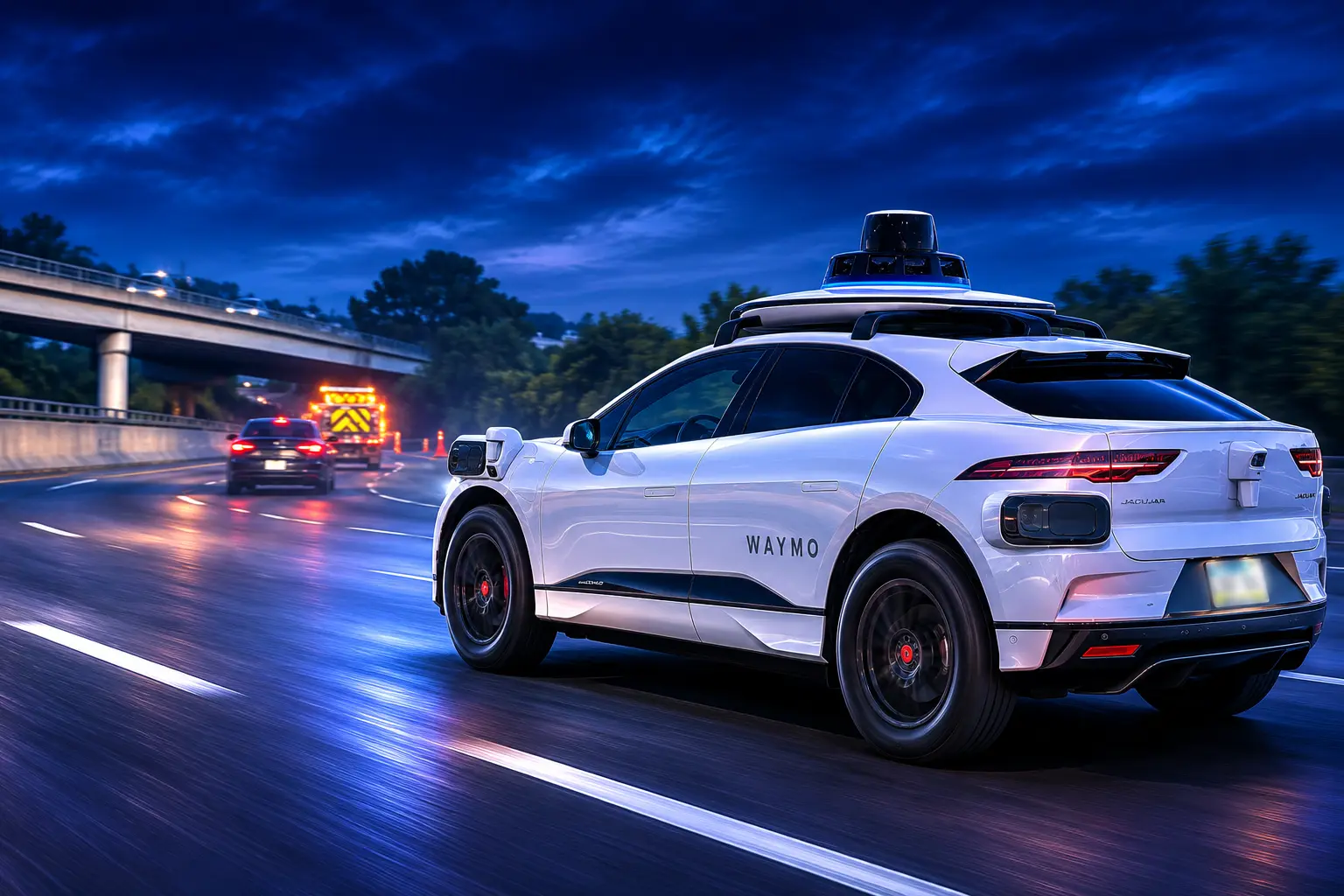
Three Robotaxis Entered a Live Work Zone on US-101
Groveman tied the order to three Waymos that drove into a closed, active construction stretch of US-101 south of San Francisco, near Burlingame. The DMV’s language is about people standing in that closure, not about riders in the cabin. Workers, their trucks, and their gear were in the lane the cars entered.
Waymo’s public line on that episode is narrow and consistent. Gallagher said the construction-zone encounters on US-101 did not involve injuries or collisions. That is also how the company described the spring cases that produced a federal software recall. A miss that does not dent metal can still be the event a regulator uses to shut a road class.
US-101 is not a side street. It is the Peninsula’s main run between San Francisco and the South Bay, which is why a live closure there is a bad place for a driverless car to guess. Cones move. A lane that was open at dawn is a work pit by lunch. The DMV’s complaint is that Waymo’s driver kept treating those shifting edges as passable.
A Highway Patrol Traffic Break on I-280
The second November case was not a work zone. On Friday, November 6, passengers in another car recorded a driverless Waymo on northbound I-280 near Ocean Avenue, by City College of San Francisco, as California Highway Patrol units slowed every lane to clear debris.
In a traffic break, patrol cars roll in a line and the job of every vehicle behind them is to stay back. The clip shows the Waymo closing on two CHP cruisers, then trying to move around them in the fast lane. An officer steered into its path. The patrol said several officers used their cars to block the robotaxi, and that the Waymo then complied and held with the pack. CHP also said it had not spoken with Waymo about the incident.
That is a different failure mode from a cone line, and the DMV bundled it with the construction entries anyway. A freeway robotaxi has to read a rolling blockade of lights and unmarked intent, not only a stationary closure. The I-280 clip is why emergency-vehicle response now sits next to work zones on the list of things Waymo must prove before those lanes reopen.
June’s Recall Did Not Hold Through November
The November bar is a sequel. Waymo opened public freeway rides in Phoenix, Los Angeles, and the San Francisco Bay Area in November 2025, then added Miami. In May 2026 it yanked those routes after its cars drove into closed highway construction. On June 17 it filed NHTSA recall 26E035, covering 3,871 fifth-generation driving systems. The defect, in Waymo’s own filing, was that the software could enter and drive at speed in construction zones because it either missed the zone or ranked other freeway hazards above the closure.
The filing counts 13 events. Six were in Phoenix in April, when cars ran past ramp-closure signs into pre-planned work. Seven were in the Bay Area on May 18, when cars drove between cones into live construction lanes. Waymo’s Field Safety Committee started meeting on April 20, restricted freeway driving, and on June 8 the Safety Board chose a recall. No injuries were reported in those 13 cases either. NHTSA’s acknowledgment letter said driving through a closed zone raises the risk of a crash, and that a software update would follow.
FROM THE SPRING RECALL TO THE FALL BAR
| Date | Place | What was logged |
|---|---|---|
| April 11 and 19, 2026 | Phoenix | 6 cars passed ramp-closure signs into planned freeway work |
| May 18, 2026 | San Francisco Bay Area | 7 cars drove between cones into live construction lanes |
| June 17, 2026 | NHTSA recall 26E035 | 3,871 fifth-generation systems; software may enter a closed zone at speed |
| July 29, 2026 | Phoenix first, then other freeway cities | Service resumes after scene-recognition and routing updates |
| November 5, 2026 | US-101 near Burlingame | 3 cars enter an active construction closure |
| November 6, 2026 | I-280, San Francisco | A car tries to pass a CHP traffic break |
On July 29, 72 days after the May 18 Bay Area entries, Waymo put freeways back. It said it was “resuming freeway operations across its entire service area, including areas with construction, after implementing software updates designed to improve performance around freeway construction zones.” The updates, it said, included better scene recognition and routing. Phoenix went first. Los Angeles, the Bay Area, and Miami were due in the following days.
November 5 is 99 days after that restart. Three cars were again inside a live 101 closure. The DMV’s letter does not bother with a new root-cause theory. It points at the May 18 file and says the corrective actions did not hold.
What Riders Lose Without Freeway Routing
Waymo still runs paid driverless trips in 15 US cities. What it no longer sells is the short, high-speed hop that made the product feel like a taxi instead of a neighborhood shuttle. Freeway access was how the company cut Peninsula runs that otherwise crawled for 45 minutes or more than an hour on surface streets, and how it tied riders to airports without dumping them into arterial traffic.
TRIPS THAT NOW STAY OFF THE HIGHWAY
- Peninsula runs: San Francisco to Silicon Valley on US-101 and I-280, the same roads named in the November cases.
- Airport legs: Any pickup that needed a freeway to reach a terminal area in Phoenix, the Bay Area, Los Angeles, or Miami.
- Los Angeles shortcuts: Cross-town trips that used the freeway grid rather than surface boulevards.
- Phoenix and Miami highway segments: The first and later freeway markets, now paused by Waymo even though California’s order does not bind them.
Los Angeles World Airports still does not let Waymo serve LAX curbs, so that hole is not new. The new hole is every other highway minute in the map. A rider going across town on streets only is still in a robotaxi. The trip is just slower, and the car is no longer doing the one job human drivers treat as ordinary.
Surface Streets Still Carry Over Half a Million Weekly Trips
Gallagher said the ride-hail service “continues to operate safely on surface streets, serving over half a million trips each week.” That is the business that remains. It is also the setting Waymo uses when it publishes crash comparisons, which are built on city miles, not on the construction-zone cases the DMV just cited.
Safety is at the foundation of everything we do. Following recent freeway construction zone encounters on U.S. 101 in California that did not involve any injuries or collisions, the California DMV has implemented an operating restriction on freeway operations in the state.
Dana Gallagher, Waymo spokesperson
On September 24, Waymo’s own safety blog said that across more than 270 million fully driverless miles through June 2026 in Atlanta, Austin, Los Angeles, Phoenix, and San Francisco, the driver was involved in 841 fewer injury-causing crashes than a human benchmark, an 82% drop, and in 95 percent fewer serious injury crashes. It also reported 93% fewer injury crashes with pedestrians, 86% with cyclists, and 82% with motorcyclists. Those figures count every crash, whoever was at fault, against police-reported human rates in the same counties.
WHAT THE SAFETY FILE ACTUALLY COVERS
- Weekly trips: Over half a million paid surface-street rides, per Gallagher, still running.
- Miles in the study: More than 270 million fully driverless miles through June 2026, in five metro areas.
- Injury crashes: 82% fewer than the human benchmark; 841 fewer injury-causing crashes on Waymo’s method.
- Serious injury: 95% fewer serious-injury-or-worse crashes than that same human baseline.
A work-zone entry with no crash does not show up as a serious-injury event. It can still be the thing a state agency calls an imminent hazard. The two records are not in conflict if you keep them on their own axes. They are in conflict if freeway competence is supposed to be implied by the city crash rates.
The People Standing in the Closed Lane
The DMV did not hang the order on passenger risk. It named construction workers. A robotaxi that threads cones at highway speed is a problem for the crew in hard hats, even when the cabin logs no collision. The I-280 traffic break adds patrol officers to that list. Both groups already share the road with human drivers who blow through closures. The difference is that a fleet can be told, in one permit letter, to get off the entire road class.
Work zones with moving crews, shifting cones, and temporary lines are a harder exam than a mapped city grid. Waiting for a wreck before acting is a choice. California’s imminent-hazard tool exists so the department does not have to wait. That is why a repeat after a summer software restart lands as a pattern rather than a fluke, and why “no one was hurt” is not an answer the DMV has to accept.
WHAT WE KNOW
- The California bar: Driverless operating and testing on all state freeways stopped on November 11 and stays down until the DMV accepts a fix.
- The national pause: Waymo has also blocked freeway routing in its other markets, including Phoenix, Los Angeles, and Miami.
- City service: Paid trips on surface streets continue, at over half a million a week.
WHAT IS UNCONFIRMED
- A return date: Neither the DMV nor Waymo has said when freeway trips resume.
- The November software cause: The department calls the 101 entries similar to May 18; it has not published a new defect report.
- Other states: No other regulator has copied California’s freeway language.
Waymo now has to show, with evidence the DMV will accept, that its cars can hold a cone line and a patrol car on a live freeway. Until that file lands, the robotaxis stay in the city, and the highways they spent a year learning go back to human drivers.

One UI 9.5 Beta Puts the Galaxy S26 on Last Year’s Clock

DBS Puts a 24/7 USDC Window Inside the Bank

European Startups Head for $81 Billion as First Checks Shrink

US Stocks Lost $1.3 Trillion Before Nvidia’s Beat

Home Depot Bets on Finance Chief Richard McPhail as CEO

Aramco Crash Kills 14 Two Days After Oil Restart

Salah Captained Egypt to Their First World Cup Win

Zelda’s 40th Switch 2 Ships Without a Zelda Game

Apple Labor Day Deals Hide June’s Memory Price Hike

El Niño Puts Israel’s Needed Winter Rain on a Flood Clock
-
 BUSINESS5 months ago
Aramco Crash Kills 14 Two Days After Oil Restart
-
 NEWS6 months ago
Salah Captained Egypt to Their First World Cup Win
-
 GAMING2 months ago
Zelda’s 40th Switch 2 Ships Without a Zelda Game
-
 NEWS3 months ago
Apple Labor Day Deals Hide June’s Memory Price Hike
-
 NEWS4 months ago
El Niño Puts Israel’s Needed Winter Rain on a Flood Clock
-

 GAMING2 months ago
Palworld 1.0.4 Adds Palpedia Search After the 1.0 Launch
-

 NEWS4 months ago
Saudi Visa Routes Split Nigerian Travelers Into Two Speeds
-

 BUSINESS9 months ago
BAE’s 60-Year Saudi Franchise Now Runs Through Taif