
NEWS
Asteroid 2026 QQ8 Joins a Short Line of Mini-Moons
Asteroid 2026 QQ8 is a one-meter capture bound since April, the latest in a known mini-moon class, and it leaves Earth’s pull in December.

Asteroid 2026 QQ8 has been looping around Earth since late April as a temporary capture, a one meter rock the Minor Planet Center classed as bound on October 29, 2026. Hungarian astronomer Krisztián Sárneczky logged the first frames in August, months after the object had already slipped inside Earth’s Hill sphere.
Headlines treated that confirmation as a second moon. The circular describes a temporarily captured object, the same class that produced 2006 RH120, 2020 CD3 and the 2024 flyby 2024 PT5, and that a 2012 dynamical model said should be present at meter scale almost all the time.
Earth Caught the Rock in April and Noticed in August
Orbit reconstructions put the capture in late April 2026, when 2026 QQ8 crossed the Hill sphere, the region where Earth’s gravity can hold a small body against the Sun. A close approach on May 1 helped lock the loop. Sárneczky, working August plates from the GINOP-KHK station at Piszkéstető Observatory, did not see the object until it had already been circling for about four months.
The first astrometric line in the discovery circular is August 19 at 22:07 UTC, magnitude 20.3, from a 0.60-meter Schmidt. The IAU Minor Planet Center issued MPEC 2026-U95 on October 29 at 16:50 UTC and said orbit integrations show the object is temporarily bound to the Earth. Nine stations contributed positions through October 9. The stay is due to end in December, after which the rock resumes a Sun-centered path in 2027.
HOW THE CAPTURE CAME TO LIGHT
- Late April 2026: Enters Earth’s Hill sphere and becomes gravitationally bound.
- May 1, 2026: Makes an early close approach as the capture takes hold.
- August 19, 2026: Sárneczky records the first positions at Piszkéstető, magnitude 20.3.
- October 9, 2026: Maunakea follow-up reaches magnitude 24.77.
- October 29, 2026: The Minor Planet Center issues MPEC 2026-U95 as a temporarily captured object.
- December 2026: The bound episode ends and the rock returns to a solar orbit.
That lag between capture and discovery is normal for meter-class objects. They are faint, fast, and easy to file with rocket bodies until the arc is long enough to test both the orbit and the mass-to-area ratio.
A One-Meter Loop That Stays Beyond the Moon
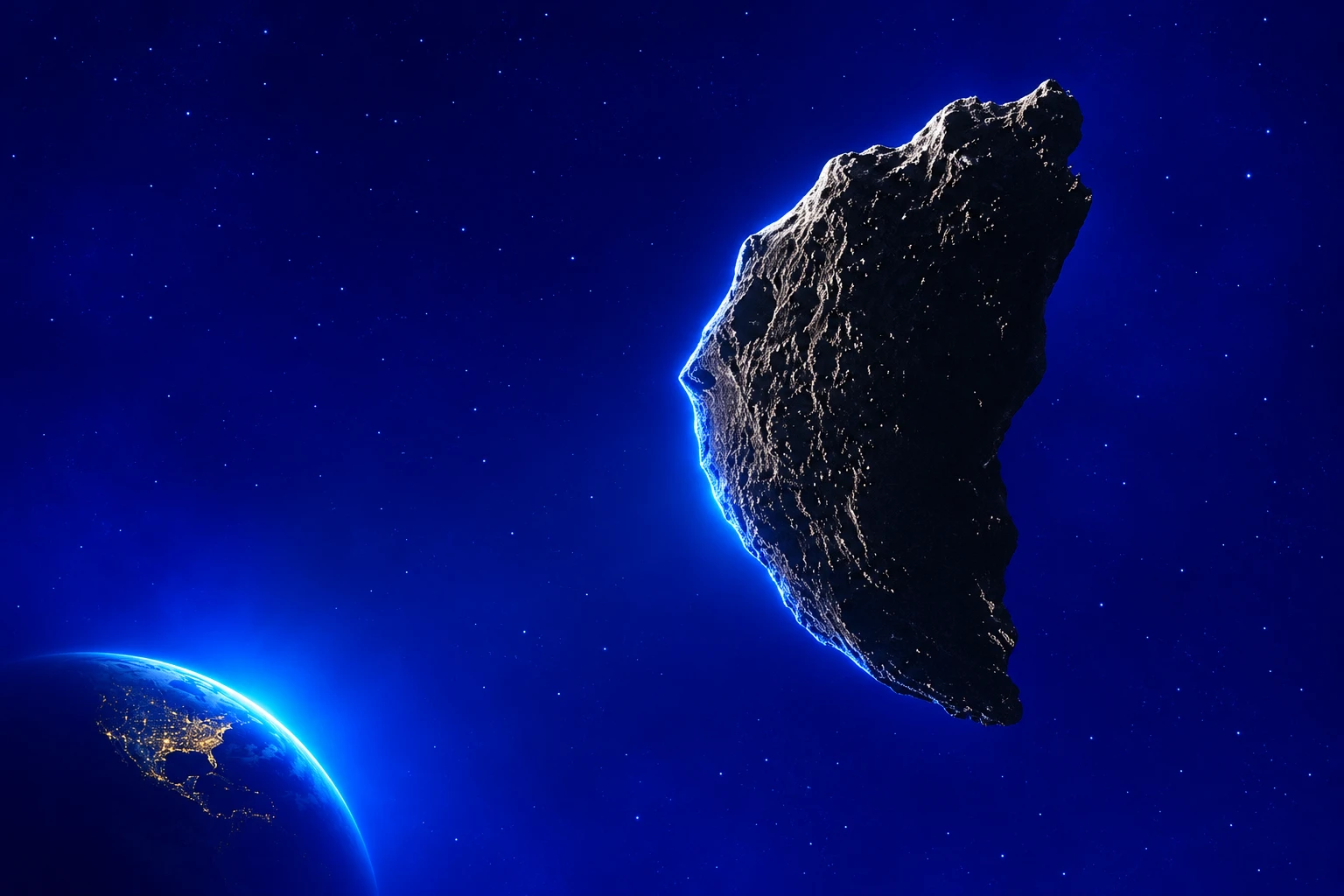
The circular lists an Earth minimum orbit intersection distance of 0.0038 AU, about 1.5 times the average Earth-Moon distance, so 2026 QQ8 never undercuts the real Moon’s path. Absolute magnitude H = 31.34 matches a rock about one meter across. The heliocentric orbit is Earth-like: semimajor axis 0.9886780 AU, eccentricity 0.0261776, inclination 0.52827 degrees, period 0.98 years.
THE ROCK IN NUMBERS
- Absolute magnitude: H = 31.34, which for typical stony albedos corresponds to a body about one meter wide.
- Earth MOID: 0.0038 AU, far enough that the object poses no impact hazard during this visit.
- Area-to-mass ratio: (7.94 +/- 3.41) x 10^-4 m^2/kg in a fit that includes solar radiation pressure.
- Heliocentric period: 0.98 years, so it keeps nearly the same year as Earth when it is not bound.
The geocentric track is a kidney-shaped loop, not a tidy circle. Tony Dunn’s integrations, used widely after the announcement, show the rock doing a strange pass around Earth before the Sun peels it away. Close approaches of this object recur about every 10 years. It came near in 1965 without being captured and is due again in 2058, again without crossing the Hill sphere on the current solution.
Even on a collision course, a one-meter stone would burn into a brief meteor. The December 13 Earth pass is listed near 1,352,000 kilometers, well outside the Moon’s orbit, as the bound chapter closes.
Why Did Astronomers Call 2026 QQ8 Space Junk?
A one-meter object on a loopy Earth-bound track is exactly how spent upper stages and old probes show up in survey data. Before the October circular, even specialists would not call the call. Orbit simulator Tony Dunn, posting on September 3 under the temporary label Sar2901, asked whether the object was a mini-moon or space junk and wrote that the astronomy community was divided, with November photometry still needed.
The fitted area-to-mass ratio is about 11 times the 7.02 x 10^-5 m^2/kg derived for 2024 PT5, a rocky minimoon with a measured density near 3.9 g/cm^3. High area-to-mass is what radiation pressure does to hollow hardware, which is why the junk file opened first. The circular still found no match to a catalogued artificial object and asked for more data.
Orbit integrations indicate that this object is temporarily bound to the Earth. The orbital solution includes solar radiation pressure; the fitted effective area-to-mass ratio is (7.94 +/- 3.41) x 10^-4 m^2/kg, with the quoted uncertainty at 1 sigma. No link to a known artificial object has been found. Further observations and dynamical studies are strongly encouraged.
Minor Planet Center, MPEC 2026-U95, October 29, 2026
That confusion is itself a pattern. 2020 SO, once sold as a mini-moon, was a Centaur stage. In 2025, 2025 US6 sat in the asteroid file until identifications pointed at China’s DRO-B probe and the Minor Planet Center removed it. Follow-up on 2026 QQ8 used the 4.3-meter Lowell Discovery Telescope, with Nick Moskovitz and S. Hemmelgarn observing and Marco Micheli measuring, plus David J. Tholen on Maunakea. Spectral and astrometric work from those nights is what let the Center treat the object as a natural inner-solar-system rock.
Two Earlier Rocks and a 56-Day Flyby
Astronomer László Kiss, posting after the Hungarian find, said only two previous temporarily captured bodies were known to complete a full circuit of Earth, 2006 RH120 and 2020 CD3, and that 2026 QQ8 would be the third if the present integration holds. The 2024 visitor was a different animal. Carlos and Raúl de la Fuente Marcos showed that 2024 PT5 was a 56.6-day captured flyby in 2024, bound from September 29 to November 25 without finishing a revolution around the Earth-Moon barycenter.
NASA’s Jet Propulsion Laboratory was blunt about that one, saying 2024 PT5 was not quite a mini-moon because it would never be captured by Earth’s gravity and would only linger nearby. The 2026 circular uses stronger language for QQ8: temporarily bound. Kiss’s full-circuit claim is still a dynamical inference, which is why the Center asked for more observations rather than numbering a satellite.
CONFIRMED MINI-MOON VISITS
| Object | Bound window | Size | Capture type |
|---|---|---|---|
| 2006 RH120 | July 2006 to July 2007 | A few meters | Temporarily captured orbiter |
| 2020 CD3 | September 2017 to May 2020 | About 1 to 2 meters | Temporarily captured orbiter |
| 2024 PT5 | September 29 to November 25, 2024 (56.6 days) | 5.4 +/- 1.2 meters | Temporarily captured flyby |
| 2026 QQ8 | Late April 2026 through December 2026 | About 1 meter | Temporarily bound (full loop still being tested) |
Shorter flybys sit on the same list. 1991 VG visited in the early 1990s. 2022 NX1 was captured in 1981 and again in 2022 and may return around 2051. Quasi-satellites such as 2025 PN7 are a separate file: they share Earth’s year around the Sun without ever being gravitationally bound, which is why they can be sold as second moons for decades and still fail a simple test. If the Sun vanished, a bound mini-moon would keep looping Earth; a quasi-satellite would not.
The Frames Came From a Hungarian Schmidt
Sárneczky has a long record of fast-moving discoveries from Piszkéstető, in the Mátra Mountains northeast of Budapest. The 0.60-meter Schmidt that caught 2026 QQ8 is a survey instrument, not a giant, which is the point. Meter-class captives are found by people who already comb the same fields for near-Earth asteroids, then by larger telescopes that pin down the arc.
WHO MEASURED THE ARC
- Piszkéstető Schmidt: K. Sárneczky, 0.60-meter, discovery night of August 19, magnitude 20.3.
- Lowell Discovery Telescope: 4.3-meter, Moskovitz and Hemmelgarn, with Micheli among the measurers, including faint September recoveries at magnitude 23.8 to 23.9.
- Maunakea 88-inch: D. J. Tholen on the University of Hawaii 88-inch telescope, October 9, magnitude 24.77, the last line on the discovery circular.
Višnjan, Schiaparelli, Tenerife Las Cumbres nodes and the Wide-field Mufara Telescope at Isnello filled nights in between. By late October the object had faded to about magnitude 25.3, far below amateur reach. Kiss noted that objects this faint and fast remain hard to catch even when they are nearby, and that the Vera C. Rubin Observatory is the facility likely to turn similar captures from rarities into a queue.
Some of those future captives could be cheap rendezvous targets, because they arrive already slow relative to Earth. That is a mission-design argument, not a plan for 2026 QQ8, which is too small and too brief for anything but telescopes.
A 2012 Model Already Counted Meter-Class Guests
Mikael Granvik, Jeremie Vaubaillon and Robert Jedicke ran the first steady-state census of Earth’s irregular natural satellites in Icarus in 2012. Their result still reads like a caption for this week’s circular: at any given time there should be at least one 1-meter captured satellite orbiting Earth. The average temporarily captured orbiter, defined as an object that completes at least one revolution about Earth in a co-rotating frame, lasts 286 +/- 18 days and completes 2.88 +/- 0.82 revolutions. About 0.1 percent of meteors were once captives. Capture is possible year-round and slightly more common near January and July.
WHAT THE 2012 CENSUS FOUND
- Standing population: At least one natural Earth satellite about 1 meter across should be present at any time.
- Typical orbiter: 286 +/- 18 days bound, 2.88 +/- 0.82 revolutions before the Sun takes it back.
- Impact share: Roughly 0.1 percent of meteors were previously Earth-bound.
A 2017 follow-up by Grigori Fedorets, Granvik and Jedicke split the population into orbiters and flybys and trimmed the constant guest to about 80 centimeters for the combined set. Kilometer-scale captures still look like once-in-10-million-year events. 2026 QQ8, at about one meter and a bound window from late April through December, sits on the orbiter side of that forecast if Kiss’s full-loop reading survives the next few weeks of tracking.
Surveys, not Earth’s gravity, changed. Automated sky patrols now recover objects that would have passed in the 1990s as anonymous meteors or unclaimed trails. Each recovery restarts the same headline, which is why 2024 PT5, 2025 PN7 and 2026 QQ8 can look like a sudden fashion when they are three different dynamical jobs.
Back on a Solar Orbit by December
The bound episode is already in its last weeks. Current integrations keep 2026 QQ8 as Earth’s guest through December, with a distant Earth pass on December 13, then release it onto the 0.98-year solar orbit it had before April. The 2058 encounter is not expected to recapture it. Temporary capture depends on geometry and relative speed, not on coming somewhat close.
Further astrometry will decide whether this visit counts with 2006 RH120 and 2020 CD3 as a full orbiter or with 2024 PT5 as a long, loopy flyby. Either way the rock is a laboratory for three-body chaos that did not require a probe, and it will be gone before the year is.

One UI 9.5 Beta Puts the Galaxy S26 on Last Year’s Clock

DBS Puts a 24/7 USDC Window Inside the Bank

European Startups Head for $81 Billion as First Checks Shrink

US Stocks Lost $1.3 Trillion Before Nvidia’s Beat

Home Depot Bets on Finance Chief Richard McPhail as CEO

Aramco Crash Kills 14 Two Days After Oil Restart

Salah Captained Egypt to Their First World Cup Win

Zelda’s 40th Switch 2 Ships Without a Zelda Game

Apple Labor Day Deals Hide June’s Memory Price Hike

El Niño Puts Israel’s Needed Winter Rain on a Flood Clock
-
 BUSINESS5 months ago
Aramco Crash Kills 14 Two Days After Oil Restart
-
 NEWS6 months ago
Salah Captained Egypt to Their First World Cup Win
-
 GAMING2 months ago
Zelda’s 40th Switch 2 Ships Without a Zelda Game
-
 NEWS3 months ago
Apple Labor Day Deals Hide June’s Memory Price Hike
-
 NEWS4 months ago
El Niño Puts Israel’s Needed Winter Rain on a Flood Clock
-

 GAMING2 months ago
Palworld 1.0.4 Adds Palpedia Search After the 1.0 Launch
-

 NEWS4 months ago
Saudi Visa Routes Split Nigerian Travelers Into Two Speeds
-

 BUSINESS9 months ago
BAE’s 60-Year Saudi Franchise Now Runs Through Taif