
NEWS
Lightsail Scatter Turns to Drag Far Above Starshot
A Harbin preprint finds lightsail scatter becomes drag at 0.75c, well above Breakthrough Starshot’s 0.2c target, and already treated as a steering tool.

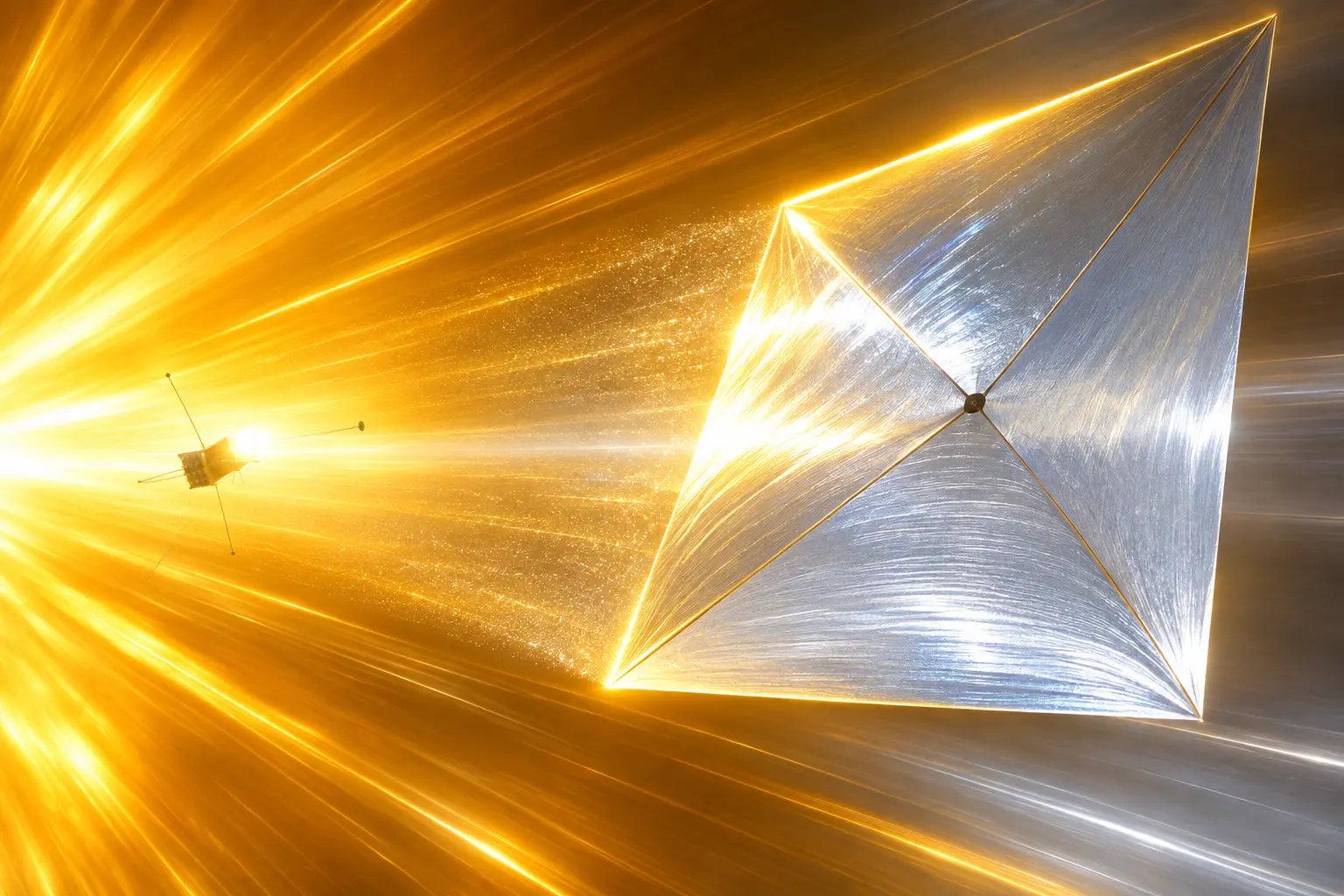
A Harbin Institute of Technology preprint finds that diffuse scatter from a laser-driven lightsail flips from thrust to drag at 0.75 times the speed of light. Chao Shen and Jiaze Li posted the work to arXiv on June 2, 2026, and the net laser force still points forward. The sign change belongs to a speed no funded probe is built to reach.
The round fraction is easy to headline. The piece that already sits inside real designs is the redshift that starts as soon as the sail moves.
Harbin Researchers Split the Light Into Three Forces
Shen and Li list the School of Science at the HIT Shenzhen campus and the State Key Laboratory of Space Environment Interaction with Matter in Harbin. Their nine-page relativistic lightsail analysis runs to four figures and treats a sail in flat spacetime, with gravity, dust, and extra electromagnetic forces left out. They take the momentum that photons hand to a reflecting sheet and split it into incident light, specular reflection, and diffuse scattering.
The study reveals the existence of a critical velocity for thrust from diffuse scattering; beyond this point, it transforms into drag, although the net radiative force continues to accelerate the spacecraft.
Chao Shen and Jiaze Li, Relativistic Lightsail Propulsion Dynamics, arXiv
Incident light supplies the strongest shove in their breakdown, specular reflection comes next, and diffuse scatter is the weakest. All three weaken as speed rises because the incoming beam redshifts. For a perfect mirror, their motion equation reduces to the directed-energy trajectory that Neeraj Kulkarni, Philip Lubin, and Qicheng Zhang published in 2018 for NASA’s Starlight program.
Lightsails have already left the blackboard. JAXA’s IKAROS and The Planetary Society’s LightSail 2 are the on-orbit cases the Harbin paper cites as proof that photon pressure can steer a real craft. Those flights used sunlight. The interstellar bet replaces the Sun with a ground laser aimed at a gram-scale probe.
Diffuse Scatter Flips Sign at 0.75c
The new result is a critical speed for that weakest term. Below 0.75c, which is β = 3/4 in their equations, diffuse scatter still adds a little forward force. Above that mark, relativistic aberration bunches the scattered light forward in the ground frame, so the recoil points backward.
THREE WAYS PHOTONS PUSH THE SAIL
| Contribution | Role at low speed | Role at 0.75c |
|---|---|---|
| Incident light | Strongest forward thrust | Still strongest, weaker from redshift |
| Specular reflection | Second-strongest thrust | Still thrust, weaker from redshift |
| Diffuse scattering | Weakest forward thrust | Drag from forward-beamed scatter |
They stress that the net radiative force still accelerates the craft. The laser does not become a brake. Part of the interaction does. In their numerical solution, most of the speed gain comes in the first stretch of the burn, and within five characteristic acceleration times the velocity has already reached 0.75c. After that, extra illumination buys less and less speed, even while the beam stays on.
The flip is a property of how scattered rays line up with velocity, not of how many watts the array dumps into the sail. Turning the laser up would not move the 0.75c mark. It would only get a craft there sooner, and with more heat to dump.
Each Extra Increment of Speed Buys Less Thrust
The Doppler piece is older than this preprint. As the sail recedes from the source, incoming light shifts to lower frequency, so each photon delivers less momentum. Shen and Li find that drop in all three terms, and they find that heating from absorbed light falls too, because the arriving frequency drops. When reflectivity is less than perfect, some of the beam becomes heat rather than thrust. As speed approaches light speed, their curves for different reflectivities converge, and the force itself becomes extremely small.
Kulkarni’s group had already built that fade into a laser trajectory. In that 2018 solution, a 1 gram craft pushed by a 100 gigawatt beam from a 10 kilometer director can reach about 0.2c in a few minutes, and diffraction plus redshift limit how much more speed the same beam can buy. Photon recycling, they noted, helps more at low speed than at relativistic cruise.
The Harbin split does not invent that tax. It shows the weakest slice of the force can change sign while the rest is still pushing. Anyone sizing a 0.2c flyby already had to design a sail that still reflects after the beam has reddened. Anyone chasing 0.75c has to design the scatter itself, because that term no longer helps.
Starshot’s 0.2c Probes Never Meet That Drag
Breakthrough Starshot remains the public name for the laser-sail idea the Harbin paper is aimed at. The initiative’s page still describes a ground beamer pushing ultra-light nanocraft at up to 100 million miles an hour, with a flyby of Alpha Centauri in just over 20 years and a chance to beam back images of Proxima b. The physics papers that sized a 100 gigawatt array used a 0.2c cruise. Either figure is far below 0.75c.
SPEEDS ON THE PAGE AND IN THE PAPERS
| Source | Speed | What it describes |
|---|---|---|
| Breakthrough Starshot public page | 100 million miles an hour | Nanocraft flyby of Alpha Centauri in just over 20 years |
| Kulkarni, Lubin and Zhang, 2018 | about 0.2c | 1 gram craft, 100 gigawatt beam, a few minutes of illumination |
| Shen and Li, 2026 | 0.75c | Diffuse term flips to drag; net force still forward |
Pete Worden, executive director of Breakthrough Initiatives, has said the program was put on hold and that portions would move to others. The public page still lists hard engineering problems and a launch goal within a generation. The scatter flip is not why the project went quiet. Beam cost, sail heating, pointing through air, and dust were already on that list, and they bite at 0.2c.
A 0.2c probe never reaches the aberration regime where diffuse scatter turns around. It does pay the redshift tax the whole way up, which is why sail materials are being asked to stay reflective across a widening band as the craft speeds away from the laser.
A 2024 Study Treated Relativistic Scatter as a Steering Tool
Two years before the Harbin preprint, a Sydney-led group treated a related relativistic optical force as something to use, not dodge. Jadon Y. Lin, C. Martijn de Sterke, Michael S. Wheatland, Alex Y. Song, and Boris T. Kuhlmey argued that a generalization of the Poynting-Robertson effect can passively damp motion across the beam during the boost phase.
We show that this purely optical effect can be enhanced by two orders of magnitude compared to plane mirror sails by judicious design of the scattering response.
Jadon Y. Lin, C. Martijn de Sterke and colleagues, All-optical damping forces enhanced by metasurfaces, arXiv
A flat mirror is a poor damper in that picture. A metasurface that sets how light leaves the sail can raise the sideways damping by two orders of magnitude. That is the same family of scatter the Harbin equations watch as it flips from a weak push to a weak drag along the beam.
Metamaterials and photonic crystals are already on the materials list for laser sails because a real film has to stay light, stay cool, and stay pointed. Controlling scatter is how some groups hope to keep a sail on the beam without extra thrusters. At 0.75c, that control stops being optional for the forward force budget. It is also how a designer might keep the diffuse term from working against the craft, or accept the drag and size the laser around it.
The first public reads of the Harbin preprint, which appeared in June, already noted that the sail keeps accelerating. The later explainers treated 0.75c as a wall. It is a sign change in the weakest term, and it is not a wall.
The Sails That Have Flown
Every sail that has left a lab has been a sunlight craft, not a laser starship. The Harbin paper leans on those flights as the reason lightsails are no longer only a concept, then jumps many orders of speed to the relativistic case.
SAILS THAT LEFT THE GROUND
- May 21, 2010: JAXA launches IKAROS, about 310 kilograms, and unfurls a 14 meter square membrane on the way toward Venus, the first interplanetary solar sail.
- 2015: The Planetary Society’s LightSail 1 tests in-orbit deployment of a CubeSat sail.
- June 25, 2019: LightSail 2 launches; its sail deploys on July 23, 2019, and sunlight is used to change orbital altitude until reentry on November 16-17, 2022.
- April 23, 2024: NASA launches the Advanced Composite Solar Sail System; the sail deploys on August 28, 2024, and the mission is listed as completed.
ACS3 packed an about 80 square meter kite into a 12-unit CubeSat and stretched it to about nine meters on a side, 30 feet, on composite booms. One boom appeared bent after deploy. The primary goal, getting the sail out, was met. IKAROS proved photon thrust and attitude tricks with LCD panels on a cruise toward Venus. LightSail 2 showed a small satellite can use sunlight to fight orbital decay.
Those speeds are orbital or interplanetary. They are a tiny fraction of 0.2c, let alone 0.75c. They say nothing about a gigawatt-class beam, a redshift that runs away with velocity, or scatter that changes sign. NASA’s NEA Scout, which the Harbin paper flags as a solar-sail asteroid attempt, never fully deployed after communications trouble. There is still no laser-driven sail on an interstellar trajectory to test the equations against.
Dust and Heat Stay Outside the Model
Shen and Li are explicit about what they left out. The paper is radiation dynamics on an idealized sheet. Other failure modes that would hit a real 0.2c or 0.75c probe are off the page.
WHAT THE EQUATIONS DO NOT COVER
- Interstellar gas and dust: A thin sail at a large fraction of light speed can be punctured or eroded by grains the model never tracks.
- Laser heating: Absorbed energy can damage or melt the film; their heating-rate term falls with redshift, but they do not build a thermal-failure model.
- Pointing and shape: A real sail can billow, twist, or walk off the beam, which is the stability problem the 2024 metasurface paper tried to damp with scatter.
- Gravity and curved spacetime: The motion is solved in flat spacetime, a simplification they flag rather than a full interstellar metric.
Future films are being asked to be light, highly reflective, and able to set how they scatter. Photonic crystals and other structured surfaces are on that list because a single shiny sheet is a poor answer once wavelength, heat, and beam-riding all move together. Shen and Li do not offer a material that cancels the 0.75c drag. They show how a force that helps at low speed can reverse, and they leave the engineering to the groups already chasing scatter on purpose.
No complete laser-driven sail exists at the speeds in these equations. The Harbin paper is a set of those equations, solved on the page, for a craft that has not been built.

Jennifer Lopez and Mahershala Ali Describe a Pipeline They Cannot Buy

Lightsail Scatter Turns to Drag Far Above Starshot

Tallulah Willis Deletes a Bruce Willis Photo She Called Intimate

S&P 500 Futures Rebound Into a Holiday-Shortened Week

GTA VI’s Record Launch Still Needs the Same Fragile Grid

Aramco Crash Kills 14 Two Days After Oil Restart

Salah Captained Egypt to Their First World Cup Win

Zelda’s 40th Switch 2 Ships Without a Zelda Game

Apple Labor Day Deals Hide June’s Memory Price Hike

El Niño Puts Israel’s Needed Winter Rain on a Flood Clock
-
 BUSINESS5 months ago
Aramco Crash Kills 14 Two Days After Oil Restart
-
 NEWS6 months ago
Salah Captained Egypt to Their First World Cup Win
-
 GAMING3 months ago
Zelda’s 40th Switch 2 Ships Without a Zelda Game
-
 NEWS3 months ago
Apple Labor Day Deals Hide June’s Memory Price Hike
-
 NEWS5 months ago
El Niño Puts Israel’s Needed Winter Rain on a Flood Clock
-

 GAMING3 months ago
Palworld 1.0.4 Adds Palpedia Search After the 1.0 Launch
-

 NEWS4 months ago
Saudi Visa Routes Split Nigerian Travelers Into Two Speeds
-

 BUSINESS9 months ago
BAE’s 60-Year Saudi Franchise Now Runs Through Taif