
BUSINESS
Founders Ask von der Leyen to Withdraw the EU Inc Plan
Startup groups asked von der Leyen to withdraw EU Inc after Council cuts, the same week Isomorphic Labs closed a $5 billion round.

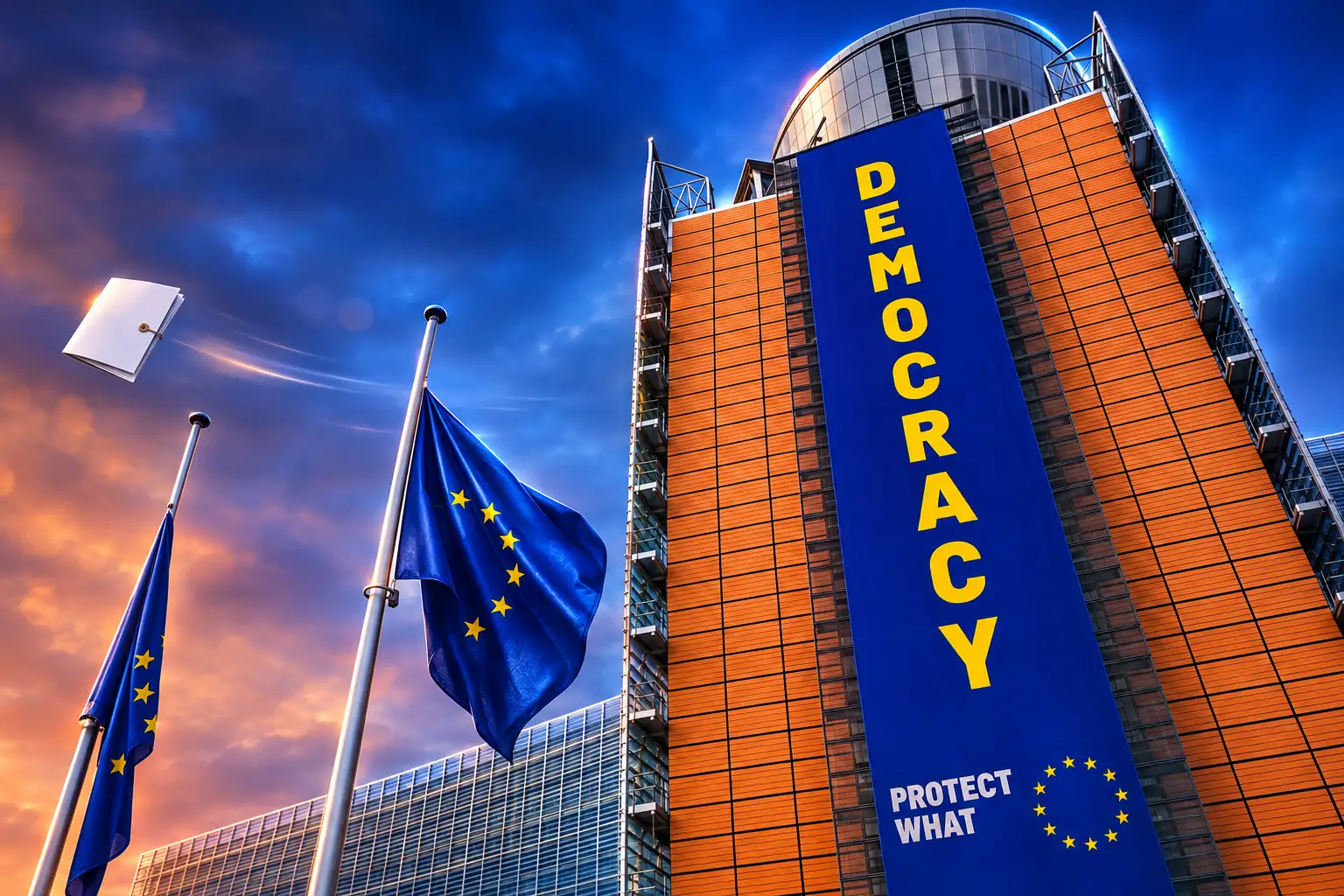
EU-INC and Startups for Europe asked Ursula von der Leyen on 19 November 2026 to withdraw the EU Inc proposal and table it again. Member states had, in an October mandate, stripped the parts that would have made the form a single European standard. The ask went public at Slush in Helsinki, hours after London’s Isomorphic Labs closed $5 billion and Paris’s Genesis AI raised $500 million.
The groups still want the Commission’s original text. They say the Council version is one founders will skip for Delaware.
Campaigners Asked Brussels to Withdraw EU Inc
Andreas Klinger, the Austrian investor who has driven the EU-INC campaign, and Hannah Wundsam, chief executive of AustrianStartups, put the plea to Commissioners Henna Virkkunen and Ekaterina Zaharieva at a Slush roundtable on the Thursday morning. A joint letter had already gone to von der Leyen in the days before the conference. The official campaign account posted the same ask the next morning.
Late to our own "take one step back to take two steps forward" party on X, but we are officially now asking the European Commission and President Ursula von der Leyen to 𝘄𝗶𝘁𝗵𝗱𝗿𝗮𝘄 𝗮𝗻𝗱 𝗿𝗲-𝘁𝗮𝗯𝗹𝗲 𝘁𝗵𝗲 𝗘𝗨 𝗜𝗻𝗰 𝗽𝗿𝗼𝗽𝗼𝘀𝗮𝗹.https://t.co/cI4R0Mi1DF pic.twitter.com/BggmdSJRp5
— EU–INC (@euinc_petition) November 20, 2026
Klinger was careful about the target. The campaign is not walking away from a pan-European company form. It is walking away from this draft, which it says would be a public failure if it became law.
We are its biggest supporters. If it would now go into the final step, we end up with a massive PR fiasco.
Andreas Klinger, co-founder of EU-INC, on X, 20 November 2026
Wundsam, who sits on the board of Startups for Europe, said the Commission text from March was not everything the campaign had wanted, but it worked. Founders could pick a seat, operate across the Union, grant cross-border stock options and incorporate online. Ann Mettler, a board member of the European Innovation Council, and three law professors had already called for a withdrawal in the days before Slush.
The campaign site lists 26,000+ founders, investors and operators across 27 countries. Its own legal review, done with Dentons, still backs five non-negotiables still under threat: free choice of seat, one central registry, no size cap on the form itself, a common stock-option scheme, and local labour and tax rules that follow real work, not the registered address.
What the October Mandate Took Out
The Commission tabled EU Inc in 2026 as an optional European company form, a so-called 28th regime meant to sit beside the 27 national ones. The impact assessment attached to that draft expects about 308,000 EU Inc companies over ten years. Von der Leyen has called continental scale the Union’s greatest asset in a world of giants. The Council, meeting under the Irish presidency, adopted its negotiating mandate on 19 October 2026. The European Parliament’s Legal Affairs committee failed its own vote the same day, on employee rights, so Parliament still has no position and trilogue cannot start.
A Council note can still boast a two-day filing. That headline is true and incomplete. The fast track is 48 hours and €100 at most. A slower standard track, with extra anti-money-laundering checks, sits beside it. The pieces that would have made the form worth picking over a US company were the ones that moved.
WHAT SURVIVED AND WHAT DID NOT
| Piece of the form | Commission draft | Council mandate |
|---|---|---|
| Registration | Digital filing, 48-hour aim | 48 hours and €100 on a fast track; slower track with extra checks |
| Central registry | One EU register | Cut; 27 national registers remain |
| Stock options | Common EU plan with deferred tax | Capped at 750 employees or €150 million turnover |
| Insolvency | Simplified rules | Removed |
| Choice of seat | Founders pick the country | Weakened; national authorities can challenge the choice |
Tax, payroll and labour law were never in the regulation. They follow where people actually work. The campaign accepts that. What it will not accept is a product that still needs 27 logins and 27 winding-up codes. Without the central register, the form is an Irish EU Inc, a German EU Inc and a French EU Inc sharing a name. Klinger’s line is that business as usual in Brussels broke several fundamentals, and that the Commission should get everyone back on the same text before the final bargain begins.
$5 Billion for a London Lab That EU Inc Would Not Cover
Isomorphic Labs, the Alphabet-backed drug design company Sir Demis Hassabis founded out of Google DeepMind in 2021, announced $5 billion Series C financing on 17 November 2026 from London. Greenoaks and Sequoia Capital co-led an oversubscribed round. Andreessen Horowitz joined, Alphabet put in more, and every existing backer came back: Thrive Capital, MGX, GV, CapitalG, Temasek and the UK Sovereign AI Fund.
The company did not state a valuation. The round follows a $2.1 billion Series B in May 2026 and $600 million in March 2025, taking disclosed outside funding to $7.7 billion across three rounds. Hassabis said the new money would push the first therapeutic programs toward clinical trials. President Max Jaderberg said the IsoDDE design engine is turning model output into molecular profiles with a shot at becoming medicines. The firm has offices in Cambridge, Massachusetts and Lausanne as well as London, and it reported positive preclinical results in oncology and immunology, with no drug yet in human trials.
EU Inc would not have touched this cheque. Isomorphic is a UK company. Sequoia, Greenoaks and Andreessen Horowitz are US firms. The UK Sovereign AI Fund is British industrial policy. The week’s largest round is a reminder of how capital already moves when the science is scarce and the buyers are global. It is a poor advertisement for a Union company form, because the Union company form would not have been on the term sheet.
Genesis, Plural and the Cheques That Still Cross Borders
The better test sits in Paris. Genesis AI, a French robotics company founded in 2024 by Zhou Xian and former Mistral researcher Théophile Gervet, raised $500 million on 17 November 2026 at a $3.5 billion valuation. Premji Invest, Khosla Ventures and Eclipse co-led. Nvidia, Bpifrance, Xavier Niel and Eric Schmidt participated. Genesis still incorporates as a French company. If EU Inc had existed as a single standard, this is the kind of firm that was supposed to use it.
Plural, the founder-run firm led by Wise co-founder Taavet Hinrikus and Skype veteran Sten Tamkivi, posted €1 billion in new capital ($1.1 billion) on 14 November 2026. The firm said the raise was almost four times its first fund in 2022 and double its second in 2024. Partners Khaled Helioui and Carina Namih said about two-thirds goes into a third early-stage fund and the rest into a new follow-on vehicle. The official note names Helsing, Proxima Fusion, OLIX and The Exploration Company as the kind of defence, energy, space and AI infrastructure bets the new money is for.
MONEY THAT CLOSED AROUND SLUSH
| Name | Base | Amount | Date |
|---|---|---|---|
| Plural Fund 3 | London, Tallinn, Paris | €1 billion (fund) | 14 November 2026 |
| Isomorphic Labs | London | $5 billion Series C | 17 November 2026 |
| Genesis AI | Paris | $500 million Series A at $3.5 billion | 17 November 2026 |
Helioui said in the fund note that someone building a fusion reactor or a space company from Europe used to be treated as too risky, and that those founders are now among the most sought-after in the world. “We’re convinced these frontier founders are capable of building Europe’s first trillion-dollar company, and we want to be backing them from day one,” he said. Those companies will still hire, issue options and wind down under national codes until a usable EU Inc exists. A larger European fund does not replace a missing company form. It just writes bigger cheques into the same 27 filing systems.
Atomico’s 12th State of European Tech report, out on 18 November, put the year in a wider frame. European startup investment set to reach $81 billion in 2026, up 62 percent from $50 billion in 2025, and second only to $94 billion in 2021. About 40,000 people founded a tech company in Europe this year, up 36 percent. The tech base is valued at $4.4 trillion, up 18 percent, with more than 450 companies above $1 billion and 53 above $10 billion. Thirteen rounds of at least $1 billion in the first nine months took 37 percent of the cash. Tom Wehmeier, Atomico’s head of intelligence, said the capital, talent and demand are all here, “but they’re locked or misallocated.” He added, “Our founders are flying into the wind.”
Stock Options Stop at 750 Staff
The size cap is the detail that will decide whether anyone uses the form after year five. The 750-employee and €150 million turnover ceiling applies to the European stock-option plan, not to the right to be an EU Inc. A company can keep the wrapper and lose the one tool that lets it hire past a German or French tax treatment of options. That is exactly when options start to matter, because that is when a scale-up is competing with US firms for the same people.
Delaware remains the off-the-shelf alternative. It is available this quarter. It has one insolvency code, one filing office and option plans that do not fall off a cliff at 750 staff. EU Inc, even on the Commission’s own clock, cannot produce a company before late 2028. A founder choosing now is not comparing two live products. They are comparing a working US form with a European draft that its own sponsors want sent back.
THE DELAWARE TEST
- One register: Delaware is a single filing office; the Council text keeps 27 national registers and no central EU login.
- Options at scale: The shared European plan stops at 750 employees or €150 million in turnover, then national tax rules return.
- Insolvency: The simplified winding-up chapter is gone, so exit still depends on which country holds the file.
- Seat: Founders’ free choice of country is weakened, and national authorities have more room to challenge it.
- Time: A Delaware company can exist this month; an EU Inc cannot exist before late 2028 at the earliest.
Conversion of an existing company is open only after two years of activity or two approved financial years, per the Council compromise. Early teams that wanted to switch into the new form would wait. Labour law stays with the country where staff sit, which the campaign itself treats as settled. The fight is not about dodging German employment rules. It is about whether a Sofia or Lisbon company can issue the same option grant as a Paris one without a second legal team.
The Same Stage Handed Virkkunen a €100 Billion Plea
On the same Slush floor, more than 35 European founders and executives, representing over €100 billion in company value and 115,000 jobs, handed Virkkunen a joint declaration. The signatories included Daniel Ek of Prima Materia, John Elkann of Exor and Robert Gentz of Zalando. They asked for three shifts: unlock European institutional capital, complete the single market through EU Inc, and cut rules on smaller firms while enforcing competition law on the largest platforms.
We share one conviction: Europe can lead the next era of technology, and we want to make it happen.
Joint declaration of European tech leaders, Slush, 19 November 2026
The letter and the withdrawal ask sat in the same hall and pulled in opposite directions on tactics, not on the destination. The 35-plus leaders still want EU Inc built. The campaign that coined the name now says this text will not be used. European pension funds, in Atomico’s figures, put 0.006 percent of assets into venture, against 0.028 percent in the United States, which is the capital gap the declaration wants closed. A company form that founders do not pick will not keep that capital at home even if the pensions move.
Slush itself ran on 18 and 19 November at Helsinki’s Messukeskus. Noora Saksa, the conference chief executive, has set a public aim that two of the world’s ten most valuable tech companies should be European by 2050. ASML, Europe’s most valuable firm, still sits well outside that band. The political argument in the hall was familiar: keep talent, keep the company seat, stop treating a 27-country market as 27 products. The new fact is that the original campaign has now joined the people telling Brussels to stop.
No EU Inc Company Before Late 2028
Even a clean re-table would not put a company on the register this decade’s middle years. The status tracker that follows the file, last updated 13 November, is blunt. Until Parliament adopts a position, trilogue cannot start. Political agreement is estimated in 2027. The Council text then waits 21 months after entry into force. The first companies in late 2028 are the optimistic end of that math; 2029 is in the same estimate.
THE PATH TO AN EU INC
- 2026: The Commission tables an optional European company form, with an impact assessment of about 308,000 companies over ten years.
- 5 October 2026: Parliament’s Legal Affairs committee postpones its vote.
- 19 October 2026: The committee vote fails on employee rights, and the Council adopts its mandate the same month.
- 19 November 2026: EU-INC and Startups for Europe ask von der Leyen to withdraw the text and table the original again, at Slush.
- Next, undated: JURI agrees a report, the plenary votes, trilogue begins, then a 21-month wait before the first filing.
Employee participation is the lock in Parliament. Trade unions want board-level rights written in. Founders want those rights to follow where people work, not where the holding company sits. Until that fight produces a text, there is nothing for the Council and Commission to bargain over. Withdrawing and re-tabling would reset the Council mandate as well as the Parliament file. Leaving the draft in trilogue, the campaign says, would lock in cuts that three-way bargaining rarely puts back.
WHAT WE KNOW
- The ask: EU-INC and Startups for Europe have written to von der Leyen to withdraw and re-table the original proposal.
- The Council text: 48-hour, €100 filing survived; the central register, simplified insolvency and uncapped stock-option plan did not.
- Parliament: JURI has no agreed report, so trilogue has not started.
WHAT IS UNCONFIRMED
- The Commission: There is no public decision from von der Leyen on whether she will pull the file.
- The calendar: No date is set for a fresh JURI vote, a plenary position, or the start of trilogue.
- Use: No founder can yet say whether a final EU Inc, if it arrives in late 2028, will beat Delaware on options and winding-up.
The money that closed in mid-November will be in the bank long before anyone can file as an EU Inc. Hassabis can run trials from London. Zhou can build robots in France under French law. Hinrikus can write early cheques into Helsing and Proxima Fusion. The 40,000 people who started companies in Europe this year are the ones the form was for, and they are still incorporating the old way.

Jennifer Lopez and Mahershala Ali Describe a Pipeline They Cannot Buy

Lightsail Scatter Turns to Drag Far Above Starshot

Tallulah Willis Deletes a Bruce Willis Photo She Called Intimate

S&P 500 Futures Rebound Into a Holiday-Shortened Week

GTA VI’s Record Launch Still Needs the Same Fragile Grid

Aramco Crash Kills 14 Two Days After Oil Restart

Salah Captained Egypt to Their First World Cup Win

Zelda’s 40th Switch 2 Ships Without a Zelda Game

Apple Labor Day Deals Hide June’s Memory Price Hike

El Niño Puts Israel’s Needed Winter Rain on a Flood Clock
-
 BUSINESS5 months ago
Aramco Crash Kills 14 Two Days After Oil Restart
-
 NEWS6 months ago
Salah Captained Egypt to Their First World Cup Win
-
 GAMING3 months ago
Zelda’s 40th Switch 2 Ships Without a Zelda Game
-
 NEWS3 months ago
Apple Labor Day Deals Hide June’s Memory Price Hike
-
 NEWS5 months ago
El Niño Puts Israel’s Needed Winter Rain on a Flood Clock
-

 GAMING3 months ago
Palworld 1.0.4 Adds Palpedia Search After the 1.0 Launch
-

 NEWS4 months ago
Saudi Visa Routes Split Nigerian Travelers Into Two Speeds
-

 BUSINESS9 months ago
BAE’s 60-Year Saudi Franchise Now Runs Through Taif