
NEWS
QFI Adds Ukrainian Repair After 10,000 German-Made Linzas
QFI will spend more than €10 million on Ukrainian training and repair as its German plant finishes 10,000 Linza drones and scales fivefold.

Quantum Frontline Industries is putting more than €10 million into Ukrainian training and repair as its German plant finishes a 10,000-drone Linza run. The money, announced in Berlin on 19 November 2026, is for operator training, a dedicated support line and local maintenance on Frontline Robotics designs built in Germany.
The joint venture of Quantum Systems and Frontline Robotics has also booked a larger 2027 order from the National Guard of Ukraine and says it will raise production capacity fivefold next year. Matthias Lehna, vice president at Quantum Systems and managing director of QFI, said the shops that keep the machines flying in Ukraine have to grow with the German line.
More Than €10 Million Follows the First 10,000 Drones
The 19 November statement is the next stage of a partnership formed in December 2025. QFI started making Frontline’s Linza 3.0 multi-purpose drone in Germany in February 2026. The first contract, for 10,000 Linza systems for Ukraine, is nearing completion.
Lehna called the new spend a further step to strengthen Ukraine’s defence-industrial base and to build long-term capacity around Ukrainian-developed unmanned systems. “As our co-production scales in Germany, the infrastructure that supports these systems in Ukraine needs to grow alongside it,” he said.
The partners will send more than €10 million to Ukraine for that work. They have not said how much each firm will put in. The sum sits beside a factory plan, not inside it: fivefold capacity is a 2027 production target in Germany, while the euros are for people and benches on the Ukrainian side of the border.
That split is the whole point of the week’s news. A plant that can finish 10,000 airframes in a year still hands those airframes to units that have to fly them under jamming, crash them, strip them and send them back out. Frontline already promised a 12-month warranty and repairs no matter the cause of damage. The new money is how that promise is supposed to hold when the next lot is larger than the first.
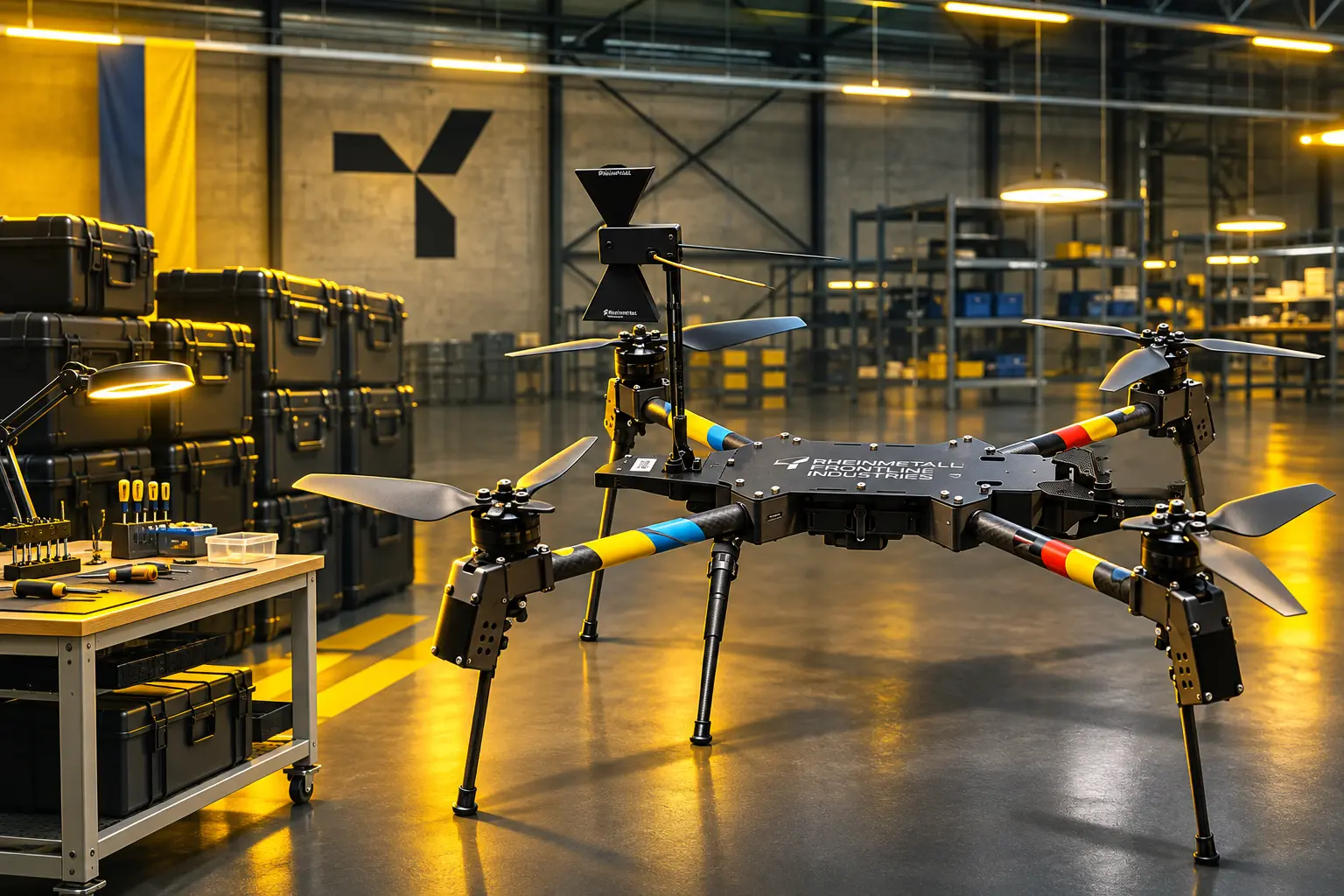
The Factory Had to Leave the Range of Russian Missiles
QFI was presented on 15 December 2025 in Berlin and Kyiv as the first German-Ukrainian defence-industrial joint venture, under Ukraine’s Build with Ukraine initiative. Quantum Systems supplies the plant and the production operation. Frontline supplies licensed designs, training and full lifecycle support to NATO standards. 100% of systems produced in Germany go to Ukraine’s Defence Forces, in volumes set by the Ukrainian Ministry of Defence.
Sven Kruck, co-CEO of Quantum Systems, said Ukrainians had changed the drone war and that the two firms would now change the industrial war together. Yevhen Tretiak, CEO of Frontline Robotics, said the line would send thousands of drones to the Defence Forces. The partners also said the plant would open jobs in Germany for Ukrainians. They have not published a headcount or a formal site name, citing security.
Mykyta Rozhkov, Frontline’s chief business development officer, put the geography in plainer terms when the venture launched. Safe factory ground inside Ukraine is hard to hold in wartime, and a German partner was how Frontline could raise serial output without parking the line under fire.
In wartime, finding safe locations for manufacturing inside Ukraine is difficult. Partnering with Quantum Systems allows us to expand our production capacity and strengthen the Defense Forces even further.
Mykyta Rozhkov, Chief BD Officer, Frontline Robotics, 15 December 2025 launch statement
At launch, Alexander Kamyshin described the structure as a German Model project: Ukrainian design, German production, and the German government buying from the joint venture and donating the drones to Ukraine. QFI has not repeated that funding path for the 2027 National Guard contract. The October signing was with the Guard’s commander, which leaves open whether Kyiv, Berlin or both will pay for the larger lot.
The industrial logic does not depend on that invoice. Design authority stays with the company that iterates from units at the front. The airframes leave a plant that Russian missiles do not reach. And the repair work, if the 19 November programme is built out, returns to Ukraine with the operators.
What Linza 3.0 and Zoom Are Built to Do
Linza 3.0 is the first type QFI put on the German line. Frontline, founded in 2023, already had the earlier Linza in the field as a small multi-use logistic and strike quadcopter. The 3.0 airframe is 12 inches across. It carries up to 4 kg for one or two munitions, flies a tactical radius of up to 15 km, and stays up for up to 60 minutes. The previous version was rated at 2 kg and 10 km, so payload is double and range is half again as long.
The useful change is how it holds station when GPS is junk. Frontline fitted an in-house visual-inertial navigation module that maps a loiter route, steadies a hover over a target at up to 200 metres, and firms up the landing. Dual-band frequency-hopping control and an encrypted one-way video link are meant to keep a crew in the picture under electronic warfare. Day birds use a gyro-stabilised 1280×720 camera with 6x digital zoom. Night birds swap in a 640×512 thermal imager at 30 Hz. Cruise is 12 to 15 metres a second.
Zoom is the scout that joins Linza on the 2027 National Guard paper. It uses the same 12-inch class of airframe and the same hopping radio, but the camera is the point: 10x optical zoom and hybrid x90 on the day set, with the same thermal option. Frontline rates payload at 3 kg and range at up to 15 km, or 12 km with that 3 kg aboard, at a cruise of 50 to 60 km/h. The complex has NATO stock numbers for Zoom, which is how a Ukrainian design gets written into allied logistics lists.
LINZA 3.0 AND ZOOM, SIDE BY SIDE
| Attribute | Linza 3.0 | Zoom |
|---|---|---|
| Role | Strike and logistics | Reconnaissance |
| Frame | 12-inch | 12-inch |
| Payload | Up to 4 kg | Up to 3 kg |
| Tactical range | Up to 15 km | Up to 15 km; 12 km with 3 kg |
| Endurance | Up to 60 minutes | Not stated on the product sheet |
| Day camera | 1280×720, 6x digital zoom | 1280×720, 10x optical, hybrid x90 |
| Night option | 640×512 thermal, 30 Hz | 640×512 thermal, 30 Hz |
A Linza kit is sold as a ready box: the quadcopter, a universal drop system, batteries, a ground station, an 8 m mast, a 50 m extension reel, an 11-inch Android tablet, a Radiomaster tx16s handset and a field spare pack. That is a lot of ground kit per airframe, and it is one reason a factory in Bavaria does not finish the job when the crate lands in Ukraine.
From Zero to 35 Airframes a Day
On 13 February 2026, President Volodymyr Zelenskyy took delivery of the first German-made Linza 3.0, with German Defence Minister Boris Pistorius on hand during the Munich security meetings. Serial crates started moving on 1 April 2026. By May, Lehna said on a Militarnyi podcast that the German shop was at 35 Linza 3.0 drones a day, after an export licence in mid-February.
Frontline said in February that Linza 3.0 was already with more than 60 Ukrainian units, and that the 3.0 changes came from that use. Those units are the feedback loop Kosolapkin still cites. They are also the people who will absorb the next 10,000, then whatever the Guard buys for 2027.
THE FIRST YEAR ON THE GERMAN LINE
- 15 December 2025: Quantum Systems and Frontline Robotics announce Quantum Frontline Industries in Berlin and Kyiv.
- February 2026: The German line starts on Linza 3.0 after an export licence in mid-February.
- 13 February 2026: Zelenskyy receives the first German-made Linza 3.0, with Pistorius present.
- 1 April 2026: The first serial batch leaves for Ukraine.
- May 2026: Daily output reaches 35 Linza 3.0 drones, Lehna says.
- 5 October 2026: The National Guard signs a larger 2027 order for Linza and Zoom.
- 19 November 2026: The partners commit more than €10 million to training, a support line and local maintenance in Ukraine, with the 10,000-drone contract nearing completion.
Thirty-five a day is a rate, not a census of what has already arrived. QFI has only said the 10,000-drone contract remains on track to finish in 2026. If that holds, a venture that did not exist in November 2025 will have run a five-figure tactical drone programme in Germany in a single calendar year.
National Guard Commander Signs the Larger 2027 Order
The follow-on paper was signed in Ukraine on 5 October 2026. Lehna signed for QFI. Pavlo Kosolapkin, Frontline’s chief technology officer and co-founder, signed with him. Major General Oleksandr Pivnenko, commander of the National Guard of Ukraine, signed for the buyer. The contract covers Linza multi-purpose drones and Zoom reconnaissance drones for delivery in 2027. QFI said it exceeds the 2026 volume and did not publish a unit count or a price.
The buyer shift matters. The first 10,000 were framed as Defence Forces supply, in volumes the Ministry of Defence sets. The larger 2027 lot is a National Guard contract. That spreads German-made Ukrainian types beyond the first user set, and it is why Zoom, which the German line has not been publicly described as building in 2026, now sits on the same order as Linza.
Having a Ukrainian-developed alternative to widely used foreign systems is of strategic importance to Ukraine. Expanding production in Germany gives us access to additional, urgently needed capacity while keeping Ukrainian technology and operational experience at the core.
Maj. Gen. Oleksandr Pivnenko, Commander, National Guard of Ukraine, 5 October 2026 QFI statement
Kosolapkin called a follow-on order one of the strongest validations a defence technology can receive. He said Linza and Zoom keep changing on feedback from Ukrainian units, and that the contract lets Frontline scale systems already shaped by that use while pushing development, localisation and supply-chain resilience. Lehna said the past year showed QFI could build production quickly and that the follow-on was proof the model works.
WHAT WE KNOW
- The 2027 buyer: The National Guard of Ukraine, signed by Pivnenko on 5 October 2026.
- The types: Linza multi-purpose drones and Zoom reconnaissance drones, both Frontline designs.
- The factory plan: QFI says it will raise German production capacity fivefold in 2027.
WHAT IS UNCONFIRMED
- Unit count: QFI says the 2027 volume exceeds 2026 and has not released a number.
- Price: No contract value has been published for either year.
- Who pays: The launch model was described as a German government purchase and donation; the Guard signing does not, by itself, prove that path still holds.
Fivefold is a capacity claim, not a confirmed order of five times 10,000. Anyone multiplying through to 50,000 airframes is doing arithmetic QFI has not put on paper. What the firm has put on paper is a larger Guard contract plus a plant expansion large enough, in its own telling, to need a new support programme in Ukraine.
Training and Repair Must Match German Output
Rozhkov has also said that flying one of these drones still takes about 2.5 people, and that more autonomy might one day let one operator run as many as ten. Even the current 10,000-drone run, at 2.5 people each, is a 25,000-person problem if every airframe is in service at once, which it will not be. Attrition, training pipelines and repair queues cut that load. They also create the queue the €10 million is meant to shorten.
A fivefold plant does not fivefold the number of crews overnight. It fivefolds the number of airframes that can show up in a year if the order book fills. That is why Lehna’s November line about support growing alongside German co-production is the load-bearing sentence, not a courtesy. The bottleneck after a successful first year is no longer whether a German line can assemble a 12-inch quadcopter. It is whether Ukrainian units can train on it, fix it and keep a radio and a mast set in the field.
THE UKRAINE SUPPORT PACKAGE
- Operator training: Crews for Linza and, in 2027, Zoom, paid for under the more than €10 million commitment.
- Dedicated support line: A standing channel for units as more German-built systems enter service.
- Local maintenance: Repair in Ukraine for Frontline designs produced in Germany, on top of the 12-month warranty and no-fault repair policy already on the product sheet.
Frontline’s original bargain was that it would keep lifecycle support even while Quantum Systems ran the factory. The November programme makes that bargain cash and headcount. It also quietly concedes the limit of the German Model: you can move the moulds and the jigs out of missile range, and you still need a Ukrainian shop floor for the part of the system that breaks.
QFI has not published the 2027 unit count. It has said the Guard order is larger than 2026, that output capacity will rise fivefold, and that more than €10 million will go to the people in Ukraine who will fly and fix those machines.

Jennifer Lopez and Mahershala Ali Describe a Pipeline They Cannot Buy

Lightsail Scatter Turns to Drag Far Above Starshot

Tallulah Willis Deletes a Bruce Willis Photo She Called Intimate

S&P 500 Futures Rebound Into a Holiday-Shortened Week

GTA VI’s Record Launch Still Needs the Same Fragile Grid

Aramco Crash Kills 14 Two Days After Oil Restart

Salah Captained Egypt to Their First World Cup Win

Zelda’s 40th Switch 2 Ships Without a Zelda Game

Apple Labor Day Deals Hide June’s Memory Price Hike

El Niño Puts Israel’s Needed Winter Rain on a Flood Clock
-
 BUSINESS5 months ago
Aramco Crash Kills 14 Two Days After Oil Restart
-
 NEWS6 months ago
Salah Captained Egypt to Their First World Cup Win
-
 GAMING3 months ago
Zelda’s 40th Switch 2 Ships Without a Zelda Game
-
 NEWS3 months ago
Apple Labor Day Deals Hide June’s Memory Price Hike
-
 NEWS5 months ago
El Niño Puts Israel’s Needed Winter Rain on a Flood Clock
-

 GAMING3 months ago
Palworld 1.0.4 Adds Palpedia Search After the 1.0 Launch
-

 NEWS4 months ago
Saudi Visa Routes Split Nigerian Travelers Into Two Speeds
-

 BUSINESS9 months ago
BAE’s 60-Year Saudi Franchise Now Runs Through Taif