
BUSINESS
Egypt’s Energy Cut Shifts the Bill From Fuel to Power
Egypt’s 20 percent energy cut hides a 78.9 percent fuel collapse and a larger electricity cheque, while pump prices remain at March levels.

Egypt cut combined energy subsidies to EGP 120 billion (USD 2.28 billion) for 2026/27, a 20 percent drop that lands almost entirely on fuel. Finance Minister Ahmed Kouchouk set the line out on 11 April 2026, before the fiscal year opened on 1 July.
The electricity cheque inside that total is larger than a year earlier. Fuel support is the line that was drained, and by 2 October 2026 pump prices were still the March rates that the budget had treated as a stepping stone, not a floor.
The Headline Cut Lands Almost Entirely on Fuel
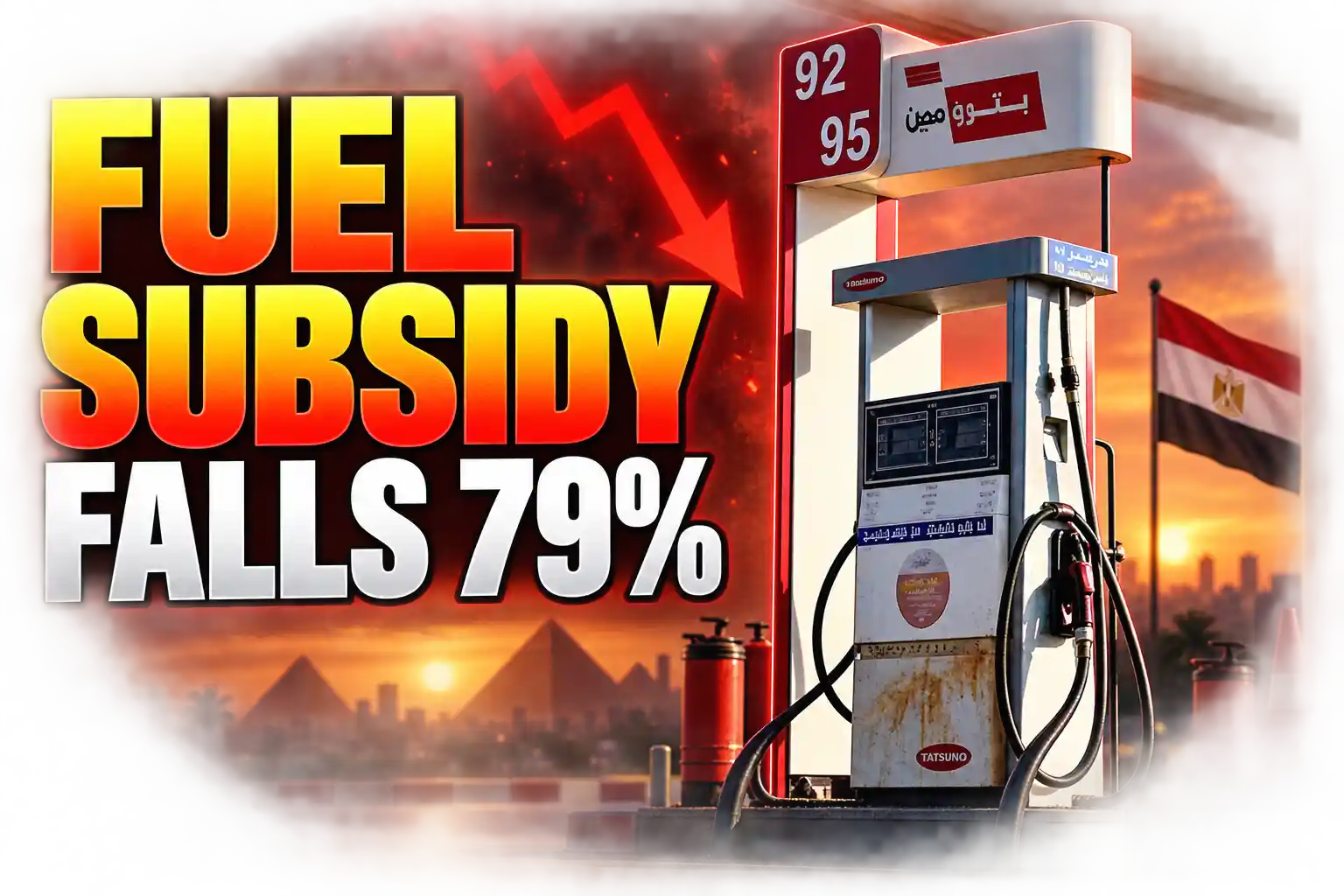
The Ministry of Finance financial statement for the draft 2026/27 budget does not spread the pain evenly across energy. Petroleum-product support falls from EGP 75.033 billion in 2025/26 to EGP 15.840 billion, a reduction of EGP 59.193 billion, or 78.9 percent. Electricity support moves the other way, from EGP 75 billion to EGP 104.160 billion.
WHERE THE EGP 120 BILLION GOES
| Line | FY2025/26 | FY2026/27 | Change |
|---|---|---|---|
| Petroleum products | EGP 75.033 billion | EGP 15.840 billion | -EGP 59.193 billion (-78.9%) |
| Electricity | EGP 75 billion | EGP 104.160 billion | +EGP 29.160 billion (39%, ministry) |
| Combined energy | about EGP 150 billion | EGP 120 billion | about -20% |
The petroleum line, the statement says, is what the treasury pays when fuel is sold below the cost of producing or importing it, plus support for butane cylinders and for mazut used by bakeries. A further EGP 25 billion is booked as petroleum taxes the treasury itself bears. Electricity support is the gap between the cost of generating power and the prices charged to users, after a jump in generation costs.
Kouchouk told the 11 April press conference the package was meant to keep supply stable while pushing the mix toward cleaner sources.
The new allocations are designed to support stable energy supplies while encouraging a shift toward more sustainable sources, including renewable energy.
Ahmed Kouchouk, Minister of Finance, 11 April 2026 press conference
He also said the state still hedges about 50 percent of its annual petroleum-product needs and is studying a wider hedge, and that the sums would back efficiency work, renewables, grid upgrades, and strategic projects including the El-Dabaa plant.
Electricity Support Rises Even as the Total Falls
The same press conference put a 39 percent rise in electricity support on the record, with extra money for transmission and distribution. That is the opposite of the fuel treatment, and it is why a 20 percent cut in the combined energy total can coexist with a fatter power subsidy.
The 2025/26 energy envelope had already been halved from the year before, then split about evenly between fuel and power at EGP 75.033 billion and EGP 75 billion. This budget keeps the combined total heading down and then reloads the electricity side. Drivers and diesel users lose most of the remaining untargeted fuel aid. The grid keeps a larger cheque, because the state is still covering the gap between what power costs to make and what most homes pay.
Mahmoud Esmat, the electricity and renewable energy minister, told editors on 28 September 2026 that changes in how plants run had cut fuel use for generation to less than 170 grams per kilowatt and had saved the equivalent of EGP 70 billion in fuel costs over two years. He put grid losses at 17.6 percent and said more than 35,000 MW had been added, with sector investment near EGP 5 trillion. Those efficiency claims are the government’s answer to why the electricity line is growing even while it talks about rationalising energy spending.
The Budget Priced Oil at $75 a Barrel
The fuel collapse in the tables only works on paper if domestic prices stay close to cost, or if crude is cheap. The budget was built on the first bet, and the second was already wrong on the day Kouchouk spoke.
THE ASSUMPTIONS INSIDE THE FUEL LINE
- Oil price: The draft uses $75 a barrel; Brent was hovering around $95 on 11 April 2026.
- Exchange rate: The draft uses EGP 47 per dollar; the dollar was trading around EGP 53 that day.
- Hedge: About 50 percent of annual petroleum-product needs are hedged, Kouchouk said, with a wider hedge under study.
- Inflation: The budget is built on inflation easing to about 9.3 percent, with a primary surplus of 5 percent of GDP and an overall deficit of 4.9 percent.
He said the oil assumption was the cautious reading of Middle East risk. The market on conference day was already $20 above the line that sets the EGP 15.840 billion fuel envelope. By 1 October 2026 Brent had moved above $98 a barrel after earlier prints above $105, so the gap did not close once the fiscal year began.
Kouchouk also set public revenues at EGP 4 trillion, up 30 percent, and spending at EGP 5.1 trillion, up 13.2 percent. Debt is supposed to fall to 78 percent of GDP by June 2027, with external debt down $1 billion to $2 billion a year. Those targets sit next to a fuel subsidy that is priced as if the pump and the oil market will do most of the work the treasury is no longer doing.
Pump Prices Have Sat Still Since March
The Automatic Pricing Committee for Petroleum Products raised gasoline and diesel on 10 March 2026 by 14 to 17 percent, after a regional oil spike. Prime Minister Mostafa Madbouly said on 5 July 2026 that quarterly automatic pricing would return in the July-September quarter, after the state absorbed costs when oil ran up to $125 a barrel earlier in the year. The IMF’s July review treated that return as part of the path to cost recovery.
The committee then did not meet. On 24 September 2026 the Ministry of Petroleum and Mineral Resources said circulating new prices were false, that the committee had not convened, and that no new fuel decision had been issued. Figures the ministry listed on 2 October 2026 were unchanged from March.
PUMP PRICES LISTED ON 2 OCTOBER 2026
| Product | Price |
|---|---|
| 95-octane gasoline | EGP 24.00 per liter |
| 92-octane gasoline | EGP 22.25 per liter |
| 80-octane gasoline | EGP 20.75 per liter |
| Diesel | EGP 20.50 per liter |
| Household LPG cylinder (12.5 kg) | EGP 275 |
| Commercial LPG cylinder (25 kg) | EGP 550 |
| Vehicle natural gas | EGP 13 per cubic meter |
A weekly tracker that draws on the petroleum ministry still had EGP 24.00 per liter for 95-octane on 28 September 2026, unchanged from a month earlier and from three months earlier, and 26.3 percent above the EGP 19.00 print a year before. Diesel sat at EGP 20.50. The March move is still the last official one, which means the 78.9 percent cut in the fuel line has not yet shown up as a fresh hike at the pump inside this fiscal year.
WHAT WE KNOW
- The last official hike: Gasoline, diesel, vehicle gas and butane moved on 10 March 2026, and those rates were still posted on 2 October 2026.
- The committee: Madbouly said quarterly reviews would resume in the July-September quarter; the petroleum ministry said on 24 September 2026 that the committee had not met.
- The budget math: The EGP 15.840 billion fuel line assumes much less untargeted support than the EGP 75.033 billion it replaces.
WHAT IS UNCONFIRMED
- The next meeting date: No session of the automatic pricing committee had been announced by 2 October 2026.
- The size of any later move: How far domestic prices still sit from full cost recovery has not been published as a fresh official schedule for this quarter.
That freeze is the practical joke inside the reform. The IMF program wants no open-ended fuel subsidy and no indefinite price freeze, and Cairo restored the committee on paper in July. Three months into the fiscal year the pumps still read March, while Brent is well above the $75 budget case. Motorists already paid the 14 to 17 percent March increase. They have not yet paid the increase the 2026/27 fuel envelope implies if oil stays rich and the pound stays weaker than EGP 47.
What Low-Use Households Still Receive
Power tariffs did move in April 2026, but the household map was narrow. The Ministry of Electricity and Renewable Energy left six of seven home brackets where they had sat since 1 September 2024 and raised only the top band, above 1,000 kWh a month, from 223 piastres to 258 piastres per kWh, a 15.7 percent increase. Commercial tariffs rose by about 20 percent in the same round. The lowest home slices stayed at 68, 78, 95, 155, 195 and 210 piastres.
Kouchouk called the wider 2026/27 budget a shield for poorer households and put subsidies and social protection at EGP 832.3 billion, up 12 percent. That is the intended swap: less untargeted fuel aid, more named cash and food support, while the cheapest power brackets stay cheap.
THE SOCIAL OFFSET IN THE SAME BUDGET
- Food supply: EGP 175.3 billion, up 10 percent, described as reaching more than 60 million people.
- Cash and care: EGP 55.3 billion for Takaful and Karama, social security, child pensions and rural women programs, covering more than 4.7 million families.
- Housing: EGP 13 billion for low- and middle-income support through utilities, interest help and cash.
- Wages: EGP 821 billion for public-sector pay, sitting beside the subsidy block rather than inside it.
The first home electricity slices still ask the state to carry most of the bill, which is why the electricity line can rise 39 percent while Kouchouk talks about targeting. Diesel is the awkward residue. It is still politically sensitive for transport and farms, and it is still EGP 20.50 a liter, the March price, inside a fuel budget that has almost been withdrawn.
December 15 Closes the Fund Program
Energy subsidy reform is a core term of Egypt’s $8 billion Extended Fund Facility with the IMF, the 46-month arrangement extended through 15 December 2026. The Fund completed the seventh EFF review and the second Resilience and Sustainability Facility review on 30 July 2026, allowing about $1.8 billion to be drawn, of which about $1.5 billion is EFF and about $272 million is RSF, and taking combined purchases to about $7.3 billion.
The announced resumption of the automatic fuel pricing mechanism is important to reduce untargeted energy subsidies and advance toward energy cost recovery.
IMF Executive Board, press release on the seventh review, 30 July 2026
Julie Kozack, the IMF communications director, said on 1 October 2026 that the eighth and final EFF review and the third RSF review are expected in the fourth quarter of 2026, with about $2.3 billion tied to those approvals. She said the actual mission dates were not yet set. The Board’s July text also flagged fiscal risks at state firms, including EGPC, and treated the resumption of the automatic fuel pricing mechanism as unfinished business rather than a completed act.
FROM THE APRIL CUT TO THE LAST REVIEW
- March 10, 2026: Raises gasoline and diesel 14 to 17 percent after the oil spike.
- April 11, 2026: Kouchouk presents the 2026/27 budget with EGP 120 billion for energy, $75 oil, and the 78.9 percent fuel cut.
- July 1, 2026: The fiscal year begins on the new envelope.
- July 5, 2026: Madbouly says quarterly automatic fuel pricing returns this quarter.
- July 30, 2026: The IMF completes the seventh review and disburses about $1.8 billion.
- September 24, 2026: The petroleum ministry says the pricing committee has not met and denies new pump prices.
- December 15, 2026: The EFF arrangement is due to end after the eighth review in the fourth quarter.
The remaining Fund money is the leverage. A fuel subsidy that has already been written down to EGP 15.840 billion leaves little room if the committee stays idle and crude stays firm. A later pump move would complete the budget arithmetic and the IMF clause at the same time. It would also land on households that have already absorbed March fuel and April’s top-band power increase.
The Grid Gets the Money the Pumps Lost
Esmat’s September briefing is the other half of the reallocation. He said the ministry is working with petroleum officials so plants can run on the fuel mix that is actually available, and that it has scenarios to avoid a return to load shedding if regional shocks hit supply. He put El-Dabaa at 4,800 MW, about 38,000 GWh a year, and a saving of nearly 8 billion cubic metres of gas. That is the long asset the electricity subsidy is being asked to protect while fuel aid is withdrawn.
We changed the operating patterns of generation plants and applied quality and economic operation standards, succeeding in reducing fuel consumption for electricity generation to less than 170 grams per kilowatt.
Mahmoud Esmat, Minister of Electricity and Renewable Energy, 28 September 2026
The winners of the 2026/27 energy envelope are the power system and the households that still sit in the cheap brackets. The losers are untargeted fuel users, EGPC’s residual subsidy claim, and any industrial plant whose gas and power costs have already been pushed up this year. The irony is mechanical: Cairo cut “energy subsidies” by 20 percent, then raised the electricity share of that smaller pot, then left the pumps on March prices into October while the IMF’s last review comes due.
Kozack’s about $2.3 billion in the fourth quarter is the next cash test. The EGP 15.840 billion fuel line is the next price test. As of 2 October 2026 those two tests were still open, and the pumps still read EGP 24, EGP 22.25, EGP 20.75 and EGP 20.50.

Christa Pike Survived the Execution Tennessee Would Not Pause

Musk’s Oligarch Charge Hits a Queue of Three

Circle Puts USDC and EURC Into SAP Pay Workflows

Ring’s First Smart Lock Skips Home Wi-Fi for Sidewalk

GTA 6 Puts Cash Back on the Story Path

Salah Captained Egypt to Their First World Cup Win

Aramco Crash Kills 14 Two Days After Oil Restart

Apple Labor Day Deals Hide June’s Memory Price Hike

Zelda’s 40th Switch 2 Ships Without a Zelda Game

Palworld 1.0.4 Adds Palpedia Search After the 1.0 Launch
-
 NEWS5 months ago
Salah Captained Egypt to Their First World Cup Win
-
 BUSINESS4 months ago
Aramco Crash Kills 14 Two Days After Oil Restart
-
 NEWS2 months ago
Apple Labor Day Deals Hide June’s Memory Price Hike
-
 GAMING1 month ago
Zelda’s 40th Switch 2 Ships Without a Zelda Game
-
 GAMING1 month ago
Palworld 1.0.4 Adds Palpedia Search After the 1.0 Launch
-

 NEWS3 months ago
El Niño Puts Israel’s Needed Winter Rain on a Flood Clock
-

 ENTERTAINMENT1 month ago
King Charles Letter Keeps Harry and Meghan as Private Citizens
-

 ENTERTAINMENT4 months ago
A Thousand and One Drops Off Riyadh’s October Calendar