
BUSINESS
New Hope Breaks Ground on a $30 Million Egypt Feed Mill
New Hope’s $100 million Egypt feed pledge is now a $30 million mill in 10th of Ramadan, with 2025 sales already at 800,000 tons.

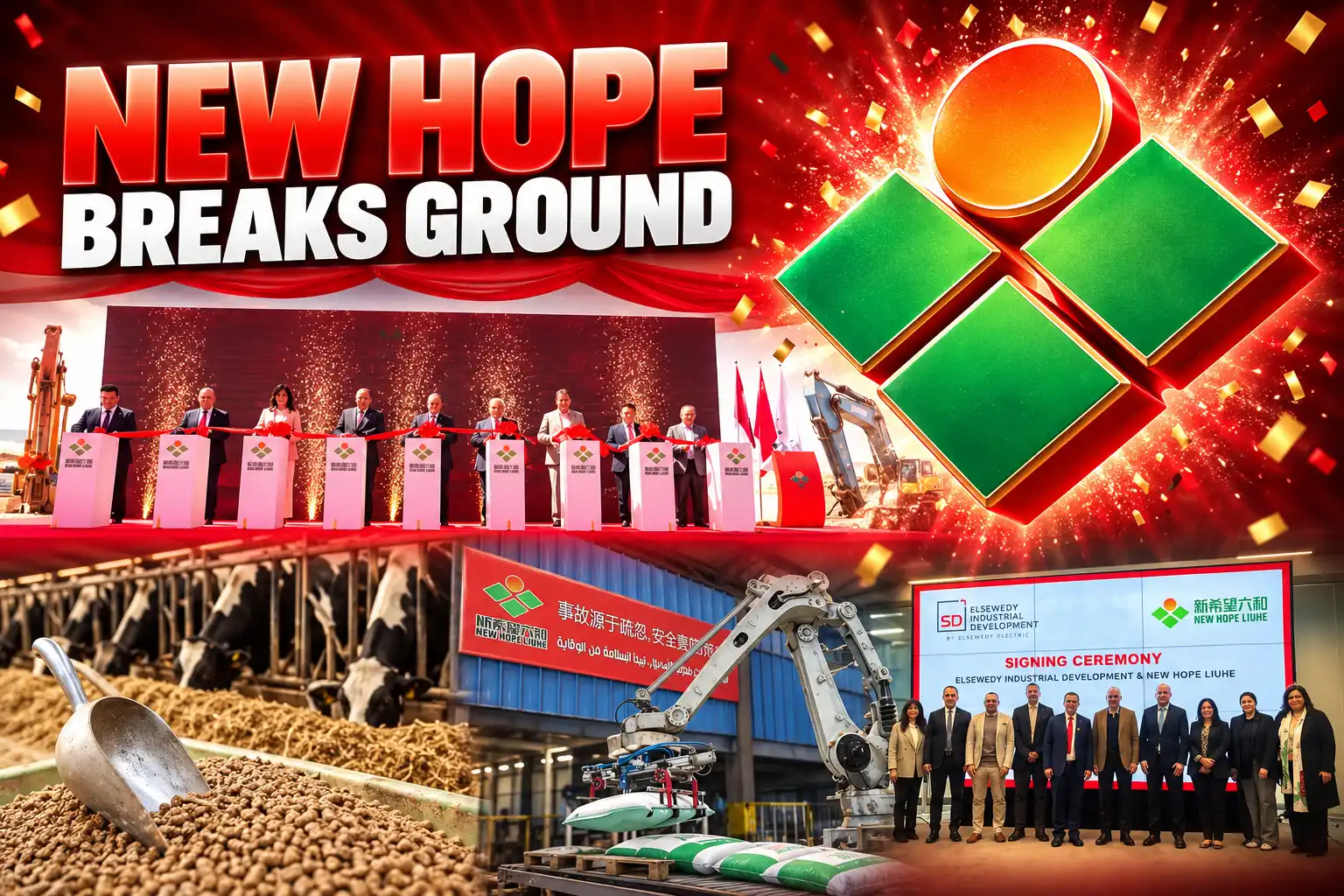
Chinese agribusiness New Hope Liuhe laid a foundation stone on September 24, 2026, for a $30 million animal feed mill in 10th of Ramadan City. The plant is the first large cheque from a $100 million Egypt plan the company aired in Cairo 21 months earlier.
Chairwoman Liu Chang put that ceiling on the table in December 2024 talks with minister Manal Awad, Egypt’s then minister of local development. What Egypt is pouring now is a single mill, not a $100 million complex, and the corn it will grind still has to be imported.
The Extra $30 Million Is a Mill in 10th of Ramadan
The 2024 meeting in the Administrative Capital was billed as a $100 million push into feed plants and fish farms. Liu Chang said Egypt was a priority market. Awad said the money would deepen Egypt-China trade. The working fact underneath the headline was narrower: New Hope already made feed in Egypt, and it wanted more capacity.
Ceremony coverage put the new mill at $30 million, about EGP 1.5 billion, under a unit called New Hope Future Agritech Egypt. Sharqia Governor Hazem El-Ashmouny attended, as did Mostafa El-Sayyad, the deputy agriculture minister, standing in for Agriculture Minister Alaa Farouk. Shao Wen, New Hope’s regional director for the Middle East, has been the company’s public face on the file since the 2024 room.
That $30 million increment is the part of the old ceiling that now has a plot, a name, and a stone. The rest of the $100 million figure was a planned stock, not a wire that landed in one transfer.
FROM THE CAIRO MEETING TO THE FOUNDATION STONE
- December 4, 2024: Liu Chang meets Awad and says New Hope wants to take its Egypt commitment to $100 million and its output toward 1 million tons a year.
- December 18, 2025: Investment manager Wu Qian Feng describes a new mill pitch of $35 million, 80,000 square meters east of Cairo, 500,000 tons a year, eight lines, and 16 months to start after land is in hand.
- March 12, 2026: Elsewedy Industrial Development signs land at Industria Asher in 10th of Ramadan City with Shao Wen and Elsewedy Electric chief Ahmed Elsewedy.
- September 24, 2026: New Hope Future Agritech Egypt lays the foundation stone on that plot.
The mill that got land is smaller than Wu’s December 2025 pitch. The site is 34,000 square meters, not 80,000. Nameplate is 400,000 tons a year, not 500,000. The cheque is $30 million, not $35 million. The bet was resized when the industrial park deal closed.
Sales Already Hit 800,000 Tons Before the New Mill
New Hope was not arriving. It opened its first poultry-feed plant in Sadat City, Menoufia, in 2011, and has been in Egypt for 15 years. Elsewedy’s March statement, which repeats New Hope’s own figures, put existing spending at EGP 2.7 billion across four feed plants and a chick-hatching company. Sales in Egypt reached about 800,000 tons in 2025.
In the 2024 meeting the company said it was producing 650,000 tons a year, which it called 10 percent of Egypt’s feed output, with Egyptians holding 94 percent of the jobs. The 2025 sales figure sits above that 2024 production number, so the volume bet was already moving before anyone poured a foundation in Sharqia. Shao Wen said at the 2026 ceremony that the group already provided more than 2,000 direct jobs in Egypt.
NEW HOPE EGYPT AT A GLANCE
| Item | Existing operations | New 10th of Ramadan mill |
|---|---|---|
| Volume | About 800,000 tons sold in 2025 | 400,000 tons a year planned |
| Money | EGP 2.7 billion already in | $30 million (about EGP 1.5 billion) |
| Jobs | More than 2,000 direct | About 500 direct; close to 10,000 indirect |
| Footprint | Four feed plants plus a hatchery | 34,000 square meters at Industria Asher |
If the 650,000 tons from 2024 still describes nameplate at the old plants, adding 400,000 tons would push the group past the 1 million-ton target Liu Chang named in Cairo. That math only holds once the new lines run. They have not.
Parent company New Hope Liuhe, listed in Shenzhen as 000876, told investors in its 2025 annual report that Egypt is a core overseas feed market and that group overseas feed sales of 6.38 million tons rose 21 percent that year. Total feed sales were 29.74 million tons. Egypt is one slice of that map, beside Indonesia and Vietnam, and the 10th of Ramadan mill is how the slice gets thicker.
What the 400,000-Ton Plant Will Produce
Elsewedy Industrial Development said the new factory is designed for 400,000 tons of poultry and aquaculture feed a year and will be New Hope’s fifth plant in Egypt. About 50,000 tons is earmarked for export. The company said the project should create about 500 direct jobs and close to 10,000 indirect jobs across suppliers and services.
WHAT THE NEW MILL IS SET UP TO DO
- Poultry pellets: Broiler and layer rations for a country that produced 1.6 billion commercial broilers and 320 million rural birds in the 2025/26 marketing year, covering 97 percent of domestic broiler demand.
- Fish feed: Rations for farms that already supply about 80 percent of Egypt’s fish, with national output near 1.6 million metric tons.
- Export slice: About 50,000 tons a year, which New Hope wants to ship from a park that sits on the Cairo-Suez industrial belt.
Chinese project notes on the groundbreaking also listed ruminant feed beside poultry and aqua. Elsewedy’s English statement does not. The safe description is the one on the land deal: poultry and aquaculture feed, 400,000 tons, 34,000 square meters.
Shao Wen said the agreement could open the door to more investment. Ahmed Elsewedy said New Hope’s expansion shows foreign manufacturers still trust Egypt to host plants, and that his firm sells a working industrial park, not only dirt. Industria Asher is inside the Elsewedy complex in 10th of Ramadan City, which puts the mill on paved roads, power, and customs routes that a greenfield desert plot would not have had in 2011, when New Hope built in Sadat.
The Grain Ships That Feed the New Mill
A new mill does not grow corn. FAS Cairo, in a September 28, 2026 grain update, put Egypt’s 12.5 million metric tons of corn imports in marketing year 2026/27, in line with its revised figure for the year before. Domestic corn output is estimated at 7 million metric tons, up from 6.7 million. Consumption is estimated at 19.5 million metric tons. Yellow corn grown at home covers less than 40 percent of feed demand.
The same note says poultry, dairy, and aquaculture remain the main pull on corn. In 2025/26 Egypt produced 16 billion table eggs, up from 14 billion a year before 2023, when broiler output sat near 1.4 billion birds. Aquaculture feed demand is 1.4 million to 1.5 million metric tons a year now, and FAS Cairo cites a path above 2.0 million metric tons by 2032. Those fish rations still lean on yellow corn at 20 to 25 percent of the mix, with wheat bran, rice bran, and oils around it.
EGYPT’S MAIN CORN SUPPLIERS, MY 2025/26 (OCT-JUL)
| Origin | Volume |
|---|---|
| Brazil | 6.18 million metric tons |
| Argentina | 3.95 million metric tons |
| Ukraine | 0.86 million metric tons |
Every extra pellet line in 10th of Ramadan is a claim on that import slate. Brazil already supplies the bulk. Argentina is second. Ukraine is a distant third, and FAS Cairo says more U.S. and South American corn will have to fill gaps if Black Sea loadings stay messy. New Hope’s own overseas mills buy corn from the United States, Brazil, Argentina, and Ukraine, and soybean meal from the United States, Brazil, and Argentina, according to the International Finance Corporation’s project file. The Egypt mill will eat from the same trade.
A $150 Million Loan Spread Across Five Countries
The 10th of Ramadan plant also sits inside a wider New Hope Singapore funding file. IFC disclosed in April 2026 a proposed $150 million loan to New Hope Singapore Pte Ltd to expand feed capacity in Vietnam, Egypt, Bangladesh, Cambodia, and Nepal. The project cost is put at $214 million, with the balance from internal cash. New mills are to be built only in Vietnam and Egypt, both inside industrial parks. Existing mills in all five countries would get new lines.
New Hope Singapore is the overseas arm of New Hope Liuhe. IFC’s file says it runs 48 facilities, including 39 operating feed mills, across 14 countries outside China, and 22 mills in the five target countries. Liu Yonghao and family control the parent. The file listed a board date of May 20, 2026. A development-finance tracker still had the loan as proposed as of September 14, 2026. It is not treated here as money already drawn.
A May 19, 2026 letter from advocacy groups told IFC that more feed mills would lock edible corn and soy into animal rations. IFC’s June 10 reply said New Hope works mainly in poultry and aquaculture, where feed conversion is tighter than in other livestock, and that the borrower would have to buy deforestation-free corn and soy. That fight is about the protein model, not about whether 10th of Ramadan gets a mill. Egypt’s government wants the mill because it wants cheaper chicken and fish on local lines.
Poultry Feed Fell From EGP 40,000 a Ton
Mill shells do not set the price of feed when the grain is late. In 2025, after the state moved grain buying toward the Future of Egypt agency, poultry producers said corn, soy, and wheat were slow to clear. Abdel Aziz El-Sayed, head of the poultry division at the Federation of Chambers of Commerce, said feed had run at EGP 40,000 a ton and that up to 40 percent of farms were at risk of shutting. By December 2025, Sameh El-Sayed, who heads the poultry division at the Giza chamber, said prices had dropped to EGP 19,000 to EGP 22,000 a ton once corn, soy, and wheat were entering without the earlier bottlenecks.
That swing is why a 400,000-ton plant can look like food security in a Sharqia tent and still leave farm-gate chicken hanging on the dollar price of Brazilian corn. When foreign exchange is tight, mills sit on inventory and farms cull flocks. When dollars are easier, as FAS Cairo says they were when it raised its 2025/26 corn-import estimate by about 23 percent, the same mills run harder. New Hope is betting the easier-dollar phase lasts long enough to fill a new line.
A later squeeze in April 2026, after fighting involving Iran disrupted regional freight, pushed corn toward EGP 16,000 a ton and soy toward EGP 36,000 a ton, according to producers who spoke then. The point for 10th of Ramadan is crude: pellet capacity is not the scarce input. Hard currency and cargos are.
Local Payroll, 55 Chicks, and a Hatchery in Alamein
Liu Chang’s 2024 pitch leaned on local staff and Chinese kit. Egyptians, she said, already held 94 percent of the jobs, and the partnership would teach feed technology.
We see Egypt as a strategic partner, and the government’s supportive policies have been instrumental in our success.
Liu Chang, Chairwoman, New Hope
The industrial map under that line is ordinary and specific. Feed plants have run in Sadat, Beni Suef, Hosh Issa in Beheira, and Gamasa in Dakahlia. Chick production sits in Alamein. New Hope Egypt Poultry Ltd. started in December 2020 and was still inside a 10-year livestock tax holiday in 2025, per the parent’s filing. Sister companies in Egypt paid a 22.5 percent income tax that year.
Beside the mills, New Hope Liuhe has been running a village poultry scheme with Egypt’s National Alliance for Civil Development Work and the Sonaa El-Kheir foundation. In Beheira it has given 55 chicks, feed, and medicine to 100 families across four villages, 25 households each, with company vets on household visits and a WhatsApp group for the cycle. The first phase, the company said, added about EGP 8,900 of income per participating family, with a survival rate above 95 percent. In late August 2026 that backyard program, not the Sharqia mill, was the Egypt story the company was still pushing in public. The mill is the capital bet. The chicks are the social license around it.
Awad told the 2024 meeting that the investments would build bridges of cooperation and help the local economy. The mill that followed is a $30 million plant on 34,000 square meters, with 400,000 tons on the drawing and about 500 jobs attached. It has not started production. Until those lines pellet corn Egypt does not grow, New Hope’s Egypt wager is a signed park plot, a foundation stone, and the 800,000 tons it already sold.

Christa Pike Survived the Execution Tennessee Would Not Pause

Musk’s Oligarch Charge Hits a Queue of Three

Circle Puts USDC and EURC Into SAP Pay Workflows

Ring’s First Smart Lock Skips Home Wi-Fi for Sidewalk

GTA 6 Puts Cash Back on the Story Path

Salah Captained Egypt to Their First World Cup Win

Aramco Crash Kills 14 Two Days After Oil Restart

Apple Labor Day Deals Hide June’s Memory Price Hike

Zelda’s 40th Switch 2 Ships Without a Zelda Game

Palworld 1.0.4 Adds Palpedia Search After the 1.0 Launch
-
 NEWS5 months ago
Salah Captained Egypt to Their First World Cup Win
-
 BUSINESS4 months ago
Aramco Crash Kills 14 Two Days After Oil Restart
-
 NEWS2 months ago
Apple Labor Day Deals Hide June’s Memory Price Hike
-
 GAMING1 month ago
Zelda’s 40th Switch 2 Ships Without a Zelda Game
-
 GAMING1 month ago
Palworld 1.0.4 Adds Palpedia Search After the 1.0 Launch
-

 NEWS3 months ago
El Niño Puts Israel’s Needed Winter Rain on a Flood Clock
-

 ENTERTAINMENT1 month ago
King Charles Letter Keeps Harry and Meghan as Private Citizens
-

 ENTERTAINMENT4 months ago
A Thousand and One Drops Off Riyadh’s October Calendar