
NEWS
Egypt’s Child Hemophilia Prevention Frees Wards but Stops at Adulthood
Egypt moved children with hemophilia onto scheduled prevention, cutting hospital days 95% and saving more than 800 million pounds.

Egypt raised preventive treatment for children with hemophilia from 20% to 80% in two years, and hospital days for those patients fell 95%. The health ministry reported that jump in April 2025. A later review put the annual bleed rate down 81.4% and cut the state’s disease bill by more than 800 million Egyptian pounds a year.
The drugs did not do that work alone. A 2023 order, 19 insurance centres, a national registry, and scheduled factor or a weekly shot built a system that empties pediatric beds. Most identified patients in Egypt are already adults, and the same system still treats adulthood as the edge of the plan.
A Ministerial Order in April 2023 Reset the Default
Dr. Mehan Abdullah Mohamed, a pediatric hematology consultant, told a ministry session at the World Population, Health and Human Development Conference (PHDC’25) that Egypt had been running at about 60 bleeds a year per patient, against a global average of 23.3. In April 2023 a ministerial order switched the default from on-demand clotting factor, given after a bleed, to preventive treatment for all, and the Health Insurance Organization spread the service across 19 centres, with a centre of excellence at Egypt Children’s Hospital.
Dr. Hossam Abdel Ghaffar, the ministry spokesman, said on 15 April 2025 that a national hemophilia registry had been launched, doctors and nurses had been trained, and families were describing a real change in how their children lived, including sport. He named four sites being built up as excellence centres.
THE FOUR EXCELLENCE SITES
- Egypt Children’s Hospital: The flagship centre of excellence under health insurance, and the site officials keep using as the model.
- Nile Hospital in Shubra: One of the four hospitals Abdel Ghaffar listed for upgraded infusion rooms and referral care.
- Zagazig Hospital: The Nile Delta site in that same excellence group.
- Assiut Hospital: The Upper Egypt site, meant to stop families travelling to Cairo for routine prevention.
Those four sit inside a wider map. The Egyptian Society of Hemophilia lists 21 affiliated treatment centres, a different count from the 19 insurance sites, because university hospitals and the society network are not the same payroll as health insurance. The Cabinet information centre put the child-coverage line on the record five days after Abdel Ghaffar spoke.
ازدادت نسبة تقديم العلاج الوقائي لمرضى الهيموفيليا 60%، فقد ارتفعت نسبة الأطفال الذين يتلقون العلاج الوقائي خلال عامين من 20% إلى 80%، كما تم تقليل عدد مرات النزيف بنسبة تزيد على 80%، وتقليل مضاعفات المفاصل، ومضاعفات نزيف المخ بنسبة تصل إلى 85%، بالإضافة إلى خفض أيام الحجز… pic.twitter.com/4kC73dL5te
— مركز المعلومات ودعم اتخاذ القرار (@EgyptCabinet) April 20, 2025
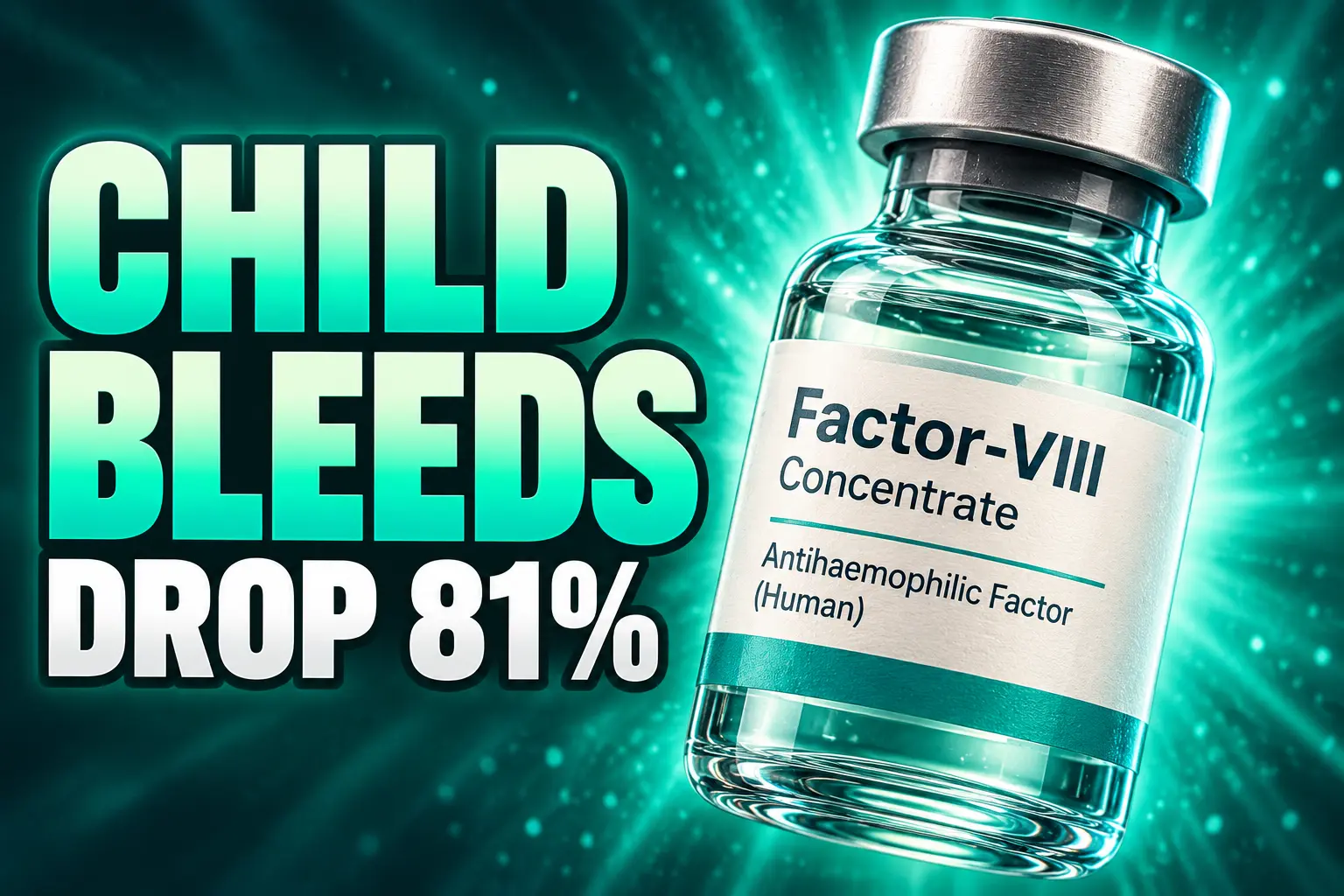
Hospital Days Fell 95 Percent After the Switch
PHDC’25 ran from 12 to 15 November 2025 in the New Administrative Capital, under the title “Success Stories in Managing Hemophilia.” Mohamed walked through the clinical change. Dr. Islam Anan, chief executive of Accsight, walked through the bill. Accsight had already modelled prophylaxis against on-demand care for Egyptian payers in 2022; the November figures are what the ministry was willing to read out after two years of the 2023 order.
WHAT THE MINISTRY AND ACCSIGHT READ OUT
| Measure | Result |
|---|---|
| Child preventive coverage | 20% to 80% in two years |
| Annual bleeding rate | Down 81.4% |
| Hospital stay days | Down 95% |
| Joint and brain complications | Down as much as 85% |
| Burden on the state budget | Down 45.4% |
| Burden before prevention | 2.2 billion EGP a year |
| Annual saving | More than 800 million EGP |
| Return on each pound | 1.91 EGP |
Anan said the old load was 2.2 billion pounds a year, and that the new approach saves more than 800 million pounds a year at a return of 1.91 pounds for each pound spent. He also said the protocol keeps 45% of those children from reaching working age with a disability. That 45% is a disability share, not the 45.4% budget cut in the same session.
On World Hemophilia Day in April 2024, Mohamed Al Sayed Dahy, then chairman of the Health Insurance Organization, told the ministry that insurance had been treating about 75% of Egypt’s hemophilia patients for 20 years, that school attendance among children on the protocol had reached 90%, and that home treatment was under study. The empty-bed number is the piece other specialties can feel. A hematology clinic that no longer holds a child for days is a ward that can take someone else.
Most Identified Patients Are Already Adults
The World Federation of Hemophilia’s 2024 Annual Global Survey tables put Egypt at 5,916 people with hemophilia A and 1,388 with hemophilia B, or 7,304 in all, up from 6,233 people with hemophilia in the 2020 survey cited in later Egyptian guidelines. Among hemophilia A, 5% were aged 0 to 4, 22% were 5 to 13, 11% were 14 to 18, 51% were 19 to 44, and 11% were 45 or older.
THE AGE MIX FOR HEMOPHILIA A
- Ages 0 to 18: 38%, about 2,248 people, the group the 80% child-coverage claim describes.
- Ages 19 to 44: 51%, about 3,017 people, already past the pediatric protocol.
- Ages 45 and older: 11%, about 651 people, many with joints already damaged under on-demand care.
- Adult share overall: 62%, about 3,668 people, larger than the child caseload the ministry is celebrated for.
Dr. Magda Rakha, chair of the Friends of Bleeding Patients Association, has put the wider bleeding-disorder register at 9,947 people, including von Willebrand disease and other factor deficiencies, among them about 66 patients from Palestine, Yemen, Nigeria, Syria, and Sudan. She has also said adults on state-expense treatment still receive 6,000 pounds every six months, a sum that does not cover a serious prophylaxis schedule. The 80% figure was never a census of every bleeder in the country. It is a child share inside a program that insurance can staff and buy for.
Emicizumab Changed How Prevention Is Given
Classic prevention is intravenous factor VIII or IX, often several times a week, which needs veins, trained hands, and a fridge. Emicizumab, a monoclonal antibody given under the skin, copies part of factor VIII’s job and can be dosed weekly or less often. Egyptian experts writing in Annals of Hematology in October 2025 called it the first, and still the only, licensed non-factor replacement for hemophilia A in Egypt. Minia University’s treatment centre began covering eligible patients in January 2020, after the product’s 2019 licence.
The updated Egyptian hemophilia A guidelines came from 14 clinicians at 10 institutes, including Ain Shams, Cairo, Mansoura, Alexandria, Zagazig, Benha, Menoufia, Shabrawishi Hospital, the National Health Insurance Organization, and the National Research Centre, using a Delphi rule of 80% agreement. The panel backed emicizumab for inhibitor-positive moderate and severe disease, for the months after a brain bleed, and for patients whose veins cannot take regular factor. That is how a coverage rate can jump without a matching jump in factor units: some of the 80% are not on factor at all.
Currently, more than 90% of all children below 18 years of age with severe hemophilia are on emicizumab or high dose prophylaxis, and the goal is to increase this to 100%.
World Federation of Hemophilia, PACT memorandum note, March 2024
That 90% is severe disease only, and it predates the ministry’s April 2025 line that 80% of children were on preventive treatment. The two numbers can both stand, because they do not count the same group. What they share is the product mix: a subcutaneous shot is easier to take home than a vein infusion, which is why the ministry also talked about cold-chain boxes and drop-off once the hospital had taught the family the first doses.
Plasma From Egyptian Donors Is the Supply Bet
Scheduled treatment is a purchase order that never sleeps. For years Egypt bought plasma medicines abroad, much of it tied to United States supply. In 2020 the government and Grifols signed a joint venture, Grifols Egypt for Plasma Derivatives, with a stated investment of 280 million euros. On 4 December 2025 Grifols said Egypt had reached clinical self-sufficiency in coagulation factors, immunoglobulins, and albumin, and called Egypt the sixth country in the world to do so.
Plasma self-sufficiency in Egypt marks a turning point for the country’s public health.
Tomás Dagá, Grifols board member and vice president of GEPD, company statement, 4 December 2025
Grifols said more than 1 million vials made from Egyptian plasma had already gone into national circulation, that it ran 16 donation centres with four more planned in 2026, and that the first phase of a processing plant in Egypt was due in 2026. It put its 2025 GDP contribution at 55 million euros and direct jobs at 1,200. Plasma-derived factor is not emicizumab, and it will not replace every recombinant unit or every humanitarian shipment. It does change the second-order risk: a protocol that needs weekly product is less exposed if some of that product is collected, tested, and released inside the country.
Two Decades of WFH Work Sat Under the Leap
The April 2023 order looks sudden only if the clock starts in 2023. The World Federation of Hemophilia dates its Egypt work to early 2000 and, in October 2023, signed a trilateral care and treatment pact in Cairo with the ministry and the Egyptian Society of Hemophilia, under the Path to Access to Care and Treatment program. Cesar Garrido signed for WFH, Dahy for insurance and the ministry, and Dr. Magdy El-Ekiaby, the society’s vice president, for the national member group.
THE RUN-UP TO UNIVERSAL CHILD PREVENTION
- Early 2000: WFH begins sustained work with Egyptian treaters, the society, and the state, through twinning, training, and later humanitarian product.
- 2015: Humanitarian factor shipments into Egypt, which WFH later tallied at 94.6 million international units through the following decade, including 25.6 million units in 2023.
- 2018: The Egyptian Society of Hemophilia publishes national hemophilia A guidelines, later refreshed in 2025.
- October 2023: The PACT memorandum is signed, after a Cairo workshop on pediatric prophylaxis led by WFH board member Dr. Cedric Hermans, and after 463 people with bleeding disorders were newly identified that year.
- April 2025: The ministry reports the child preventive share at 80% and begins talking about home delivery and family training as the next layer of the same system.
Dr. Ahmed Elekiaby, a physician at Shabrawishi Hospital in Giza, the WFH-accredited training centre that co-piloted in-country courses for nurses, physiotherapists, pediatric hematologists, and lab staff, credited those donations with pulling more government money into treatment. Identification almost doubled over the life of the partnership, which is why a 2024 caseload of 7,304 is not only new disease. It is old disease that finally has a name on a registry the purchaser can see.
Stopping at 18 Would Waste the Outlay
Anan closed the November session with a demand that prevention continue when patients turn 18, warning that cutting it wastes the first outlay and turns people the state has already paid to keep in school into dependents. The age tables explain why that warning is the rest of the story. About 2,248 people with hemophilia A are 18 or younger. About 3,668 are already past that line. A protocol that works in pediatric infusion rooms and then drops the same person onto a 6,000-pound state-expense coupon is a system that spends twice: once to protect joints, and again to live with the joints it stopped protecting.
Home boxes, a digital tracker, and plasma collected in Egyptian centres are how a rare-disease program starts to look like any other chronic-care line, closer to dialysis than to an emergency bay. They are also how the 1.91 return stays on the books. If the child share is the headline, the adult share is the invoice that comes due when those children keep their birthdays.
Frequently Asked Questions
What is prophylactic treatment for hemophilia?
Prophylaxis is clotting-factor concentrate or a non-factor drug such as emicizumab given on a calendar to stop bleeds before they start, rather than after a joint or muscle has already filled with blood. Factor VIII or IX is usually an intravenous infusion several times a week; emicizumab is a subcutaneous injection that, in the Egyptian panel’s dosing, uses 3.0 mg/kg weekly for four weeks and then 1.5 mg/kg weekly, or 3 mg/kg every two weeks, or 6 mg/kg every four weeks.
How many people in Egypt have hemophilia A and hemophilia B?
The 2024 World Federation of Hemophilia survey counted 5,916 people with hemophilia A and 1,388 with hemophilia B. Of the hemophilia A group, 3,909 had severe disease; of hemophilia B, 672 were severe. Those severe counts are the group for whom scheduled prevention is standard in high-resource protocols, and they are larger than the child caseload alone.
When was emicizumab licensed for use in Egypt?
Emicizumab was licensed in Egypt in 2019 for routine prevention of bleeds in hemophilia A with or without factor VIII inhibitors, and Minia University’s hemophilia treatment centre, the only specialised centre in Minya Governorate, began covering eligible patients in January 2020. The Egyptian Drug Authority’s blood-disorders formulary lists it as a subcutaneous antihemophilic monoclonal antibody in several vial sizes, including 30 mg/ml and 150 mg/ml.
What is the World Federation of Hemophilia’s factor VIII per capita target?
WFH has long used 1 international unit of factor VIII per capita of national population as the minimum for a country that wants survival-level care for its hemophilia population. Egypt’s 2024 survey line was 0.73 IU per capita including humanitarian product and 0.44 IU without it, on 84,708,750 IU total, of which 32,995,750 IU were humanitarian aid, a reminder that emicizumab and donations now sit beside purchased factor in the same ledger.
Which plasma-derived medicines does Egypt now produce at home?
Grifols Egypt for Plasma Derivatives says it has reached clinical self-sufficiency in three groups: immunoglobulins, albumin, and coagulation factors used for bleeding disorders, including factors VIII and IX. Donation centres have passed Plasma Protein Therapeutics Association and European inspections, and the company said Egyptian collections now meet internal demand for the medicines it supplies, after decades of almost total reliance on imported plasma.
Disclaimer: This article is news reporting and analysis of public statements, survey tables, and published guidelines on hemophilia care in Egypt. It is for information only and is not medical advice, a treatment recommendation, or a substitute for a clinic visit. Readers who have a bleeding disorder, or who care for someone who does, should consult a hematologist or hemophilia treatment centre before changing any medicine, infusion schedule, or home-care routine. Figures and program statuses are those given by the named officials, the World Federation of Hemophilia, Grifols, and the cited clinical papers, and they can change as registries, tenders, and licences are updated.

Christa Pike Survived the Execution Tennessee Would Not Pause

Musk’s Oligarch Charge Hits a Queue of Three

Circle Puts USDC and EURC Into SAP Pay Workflows

Ring’s First Smart Lock Skips Home Wi-Fi for Sidewalk

GTA 6 Puts Cash Back on the Story Path

Salah Captained Egypt to Their First World Cup Win

Aramco Crash Kills 14 Two Days After Oil Restart

Apple Labor Day Deals Hide June’s Memory Price Hike

Zelda’s 40th Switch 2 Ships Without a Zelda Game

Palworld 1.0.4 Adds Palpedia Search After the 1.0 Launch
-
 NEWS5 months ago
Salah Captained Egypt to Their First World Cup Win
-
 BUSINESS4 months ago
Aramco Crash Kills 14 Two Days After Oil Restart
-
 NEWS2 months ago
Apple Labor Day Deals Hide June’s Memory Price Hike
-
 GAMING1 month ago
Zelda’s 40th Switch 2 Ships Without a Zelda Game
-
 GAMING1 month ago
Palworld 1.0.4 Adds Palpedia Search After the 1.0 Launch
-

 NEWS3 months ago
El Niño Puts Israel’s Needed Winter Rain on a Flood Clock
-

 ENTERTAINMENT1 month ago
King Charles Letter Keeps Harry and Meghan as Private Citizens
-

 ENTERTAINMENT4 months ago
A Thousand and One Drops Off Riyadh’s October Calendar