
LIFESTYLE
Traditional Arabic Breakfast Restaurants in Riyadh: What to Order
Traditional Arabic breakfast restaurants in Riyadh cook Najdi, Hijazi, or Levantine plates. Choose the kitchen, then share foul, hot tamees, and a sweet closer.

You want a real morning meal in Riyadh, and a hotel buffet will not cook it. The plate is shared: hot bread, beans, eggs, and a sweet bowl once the savoury dishes are done. Traditional Arabic breakfast restaurants in the city are worth it when they cook one regional kitchen well.
Choose that kitchen before you choose the room you will sit in. A Najdi house, a Hijazi foul counter, and a Palestinian cafe are three different breakfasts. You will get the dishes, the rooms that still cook them, and a simple order for two.
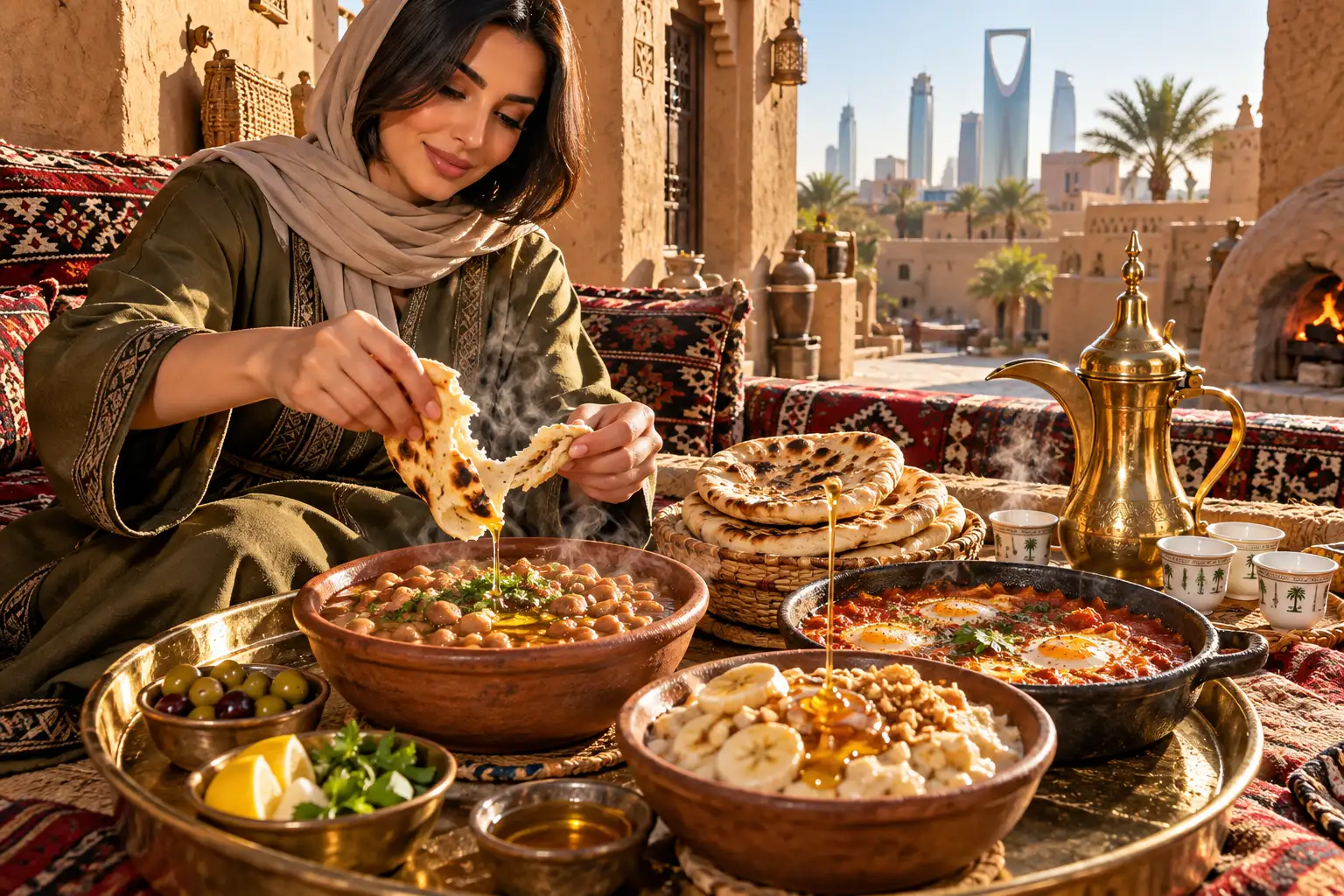
Foul, Tamees, Shakshouka, and Masoub
A morning table here is several shared dishes, not one plated entree with your name on it. You tear hot flatbread and move across the bowls, and coffee or sweet red tea with mint arrives before the food and again after the plates are cleared.
THE SHARED PLATE
- The beans: Foul is fava beans cooked soft, finished with olive oil, lemon, tomato, and chilli, with whole beans still visible in a good bowl.
- The eggs: Shakshouka is eggs in a cumin tomato sauce, sometimes with halloumi, sometimes left in the clay bowl so they keep cooking.
- The bread: Tamees comes off the tannour hot, and you tear it and use it as the spoon.
- The meat: Kebda is pan-seared liver with onion, pepper, cumin, and lemon, and it belongs to breakfast rather than to dinner.
- The sweet: Masoub or areeka waits until the savoury plates are underway, then closes the meal.
Breakfast write-ups describe the Saudi shakshouka pan as hotter than a Levantine one. When the menu says shakshouka bil fekhara, the clay dish is the point, because it holds heat on the table. If a server asks whether the liver should be harra, that word means spicy, and Hijazi kebda is the sharper, lemon-heavy version, served with diced tomato and green chilli.
Mutabbaq is the folded bread, pan-fried until the outside crackles, filled with minced meat, onion, egg, and herbs, or with banana, cream, and honey when you want it sweet. Masoub is the soft Hijazi pudding: overripe banana mashed with ground flatbread, cream, and honey, often with pistachio, almond, or a line of qishta. Areeka, also written areekah, is denser crumbled bread with ghee, honey, and sometimes dates.
Najdi, Hijazi, and Levantine Kitchens
Riyadh is a Najdi city, and the wheat-and-meat dishes belong to that table: jareesh, mugalgal, qursan, ghee, and dates. The foul counters locals actually queue for are often Hijazi, carried from Makkah and Jeddah, with more olive oil, mutabbaq, masoub, and lemon on the liver. A Palestinian room is a third breakfast, built on gallaya and fatteh rather than on jareesh.
| Kitchen | The plate you came for | Where it shows up |
|---|---|---|
| Najdi | Jareesh, mugalgal, qursan, ghee, dates, floor seating | Al Atherya Village, Najd Village, parts of Mirzam |
| Hijazi | Foul, mutabbaq, masoub, areeka, lemony kebda | Tameesa, Ban3mah, Hamsa wa Taghmeesa, Wahid Fol |
| Levantine | Gallaya, fatteh hummus, shakshouka, Turkish coffee | AlKofeia in Al Olaya |
| Southern | Foul galaba, kebda, homey Jizan plates | Mshagith in Qurtubah |
The Culinary Arts Commission adopted Jareesh as the national dish in 2023 for its place in heritage, its simple cooking, and how widely Saudis already eat it. In the central region it is coarsely ground wheat, not a fine mince, cooked until it resembles a thick porridge. It is a main meal, and a traditional breakfast for the wedding morning. You will not get it at every foul counter, so ask for it when wheat and meat are the reason you sat down.
Mugalgal is the other Najdi morning pan: diced beef, chicken, or lamb with onion, tomato, and green chilli, brought out while it still hisses. Qursan layers thin dried flatbread with meat broth and lamb. Those are the dishes a Najdi room is for. Foul can sit beside them, but it is not the whole point.
How to Match a Restaurant to the Plate
A generous sit-down breakfast for two, about four or five shared dishes plus bread, coffee, and tea, runs about SAR 100 to 180 (USD 27 to 48) in 2026 breakfast listings. A mutabbaq and tea from a simpler counter sits nearer SAR 15 to 25. Hotel buffets, often SAR 90 to 200, rarely cook the regional plates you came for, so skip them when foul and tamees are the goal.
Three Riyadh rooms in the MICHELIN Guide Saudi Arabia 2026 selection carry a Bib Gourmand for this cooking: Tameesa for Hijazi breakfast, Mirzam for regional plates near King Abdullah Financial District, and Najd Village for a Najdi feast built on the Sofra menu and fresh bread. The selection, announced in stages through December 15, 2025, covers 51 restaurants in Riyadh, Jeddah, and AlUla, with 11 Bib Gourmands in all.
Hours and prices below are tied to the listing date in the cell. They move, and a Friday board is the one most likely to differ from the weekday one.
| Place | Area | Order this | Hours on the listing |
|---|---|---|---|
| Al Atherya Village | King Abdullah Road, King Faisal, Riyadh 13215 | Chicken mugalgal, kebda, shakshouka, tamees | Maps listing: 5am to 1am daily. Guides through April 2026: 4am to 2am |
| Tameesa | King Abdul Aziz Branch Road, Al Yasmin, Riyadh 13326 | Foul, mutabbaq, moutabbal, tamees, areeka | March 2026 listing: 4am to 4pm. Michelin: early morning to mid-afternoon |
| Ban3mah | King Fahad Branch Road, Al Aqiq | Foul, motabaq, shakshouka, masoub | Morning service; dish prices from an October 23, 2025 visit |
| Hamsa wa Taghmeesa | Al Abbas Ibn Abdulmutalib, At Taawun, Riyadh 12476 | Smoked foul, Hijazi liver, bread platter | March 2026 listing: daily 5am to midnight |
| Harat | Northern Ring Branch Road, and Diriyah | Lamb mugalgal, halloumi eggs, lentil stew | Breakfast service 7am to noon |
| Mirzam | Takamul Plaza, Al Nakheel; also Al Wadi | Sharing dips, mugalgal, Hijazi kebda, Saudi foul | March 2026: Al Wadi 5am to 5pm; Takamul Sunday to Thursday 5am to 3pm, Friday and Saturday 5am to 5pm |
| Wahid Fol | An Nafal | Foul, masoub, mutabbaq, fatteh | June 2024 guide: daily 5am to 11:30pm |
| Taghmees | Al Olaya | Foul, lamb liver, stuffed falafel | June 2024 guide: Sunday to Thursday 6am to 4pm, closed Friday and Saturday |
| Maqsaf | Ar Rayyan and Al Mohammadiyyah | Shakshouka, falafel, masoub | June 2024 guide: Saturday to Thursday 3:45am to 1am, Friday closed |
| AlKofeia | Prince Muhammad Ibn Abd Al Aziz, Al Olaya, Riyadh 12241 | Gallaya, fatteh, shakshouka, Turkish coffee | March 2026: Monday to Saturday 5am to 1am, Sunday 5am to noon |
| F6or Faris | Turki Square, Prince Turki Al Awwal Road | Masoub, liver, Saudi platter, or zaatar French toast | June 2024 guide: daily 5am to 3:30pm |
| Bread and Nwashf | Al Sahafa | Foul al chief, tamees, goat liver | September 28, 2024 review: 6am to 2pm, then 4:30pm to 11pm |
Once the row matches the plate you want, the rooms below show how that meal feels, what a small order costs, and which hour is too late.
Al Atherya Village on King Abdullah Road
Al Atherya Village is the Najdi compound guides name when they mean floor seating rather than a counter. Low doors, palm-frond ceilings, and private majlis rooms are built to feel like a mud-brick village. Chicken and beef mugalgal made its name: diced meat off a hot griddle with onion, tomato, and green chilli. Add beef kebda, shakshouka, and tamees.
A public listing for the King Faisal district branch shows daily hours of 5am to 1am and the phone +966 50 240 8888. Guides dated through April 2026 still describe a kitchen that opens at 4am and runs until 2am. Those are two different boards for the same road, so call the day you go. Sit-down estimates for a full person run SAR 50 to 90. That is a different bill from a delivery bundle.
A delivery menu for that branch prices the popular breakfast box at SAR 85, with goat liver, mugalgal, chicken, marasee, lentils, fava beans, tawa chickpeas, and Adeni shakshuka. The same menu lists a shakshuka pan at SAR 12, traditional foul at SAR 13, and a small areeka with ghee and honey at SAR 18. Use the box when you want one spread for the middle of the table, and the per-person range when everyone is ordering a full sit-down round.
BOOK THE MAJLIS
- The room: Ask for a private majlis when four or more of you want the floor seating.
- The pan: Chicken mugalgal and kebda are the plates this kitchen is known for, with tamees beside them.
- The check: Confirm 4am or 5am by phone, because the published boards do not match.
Groups that only want a quick foul can spend the drive on a counter closer to home. Al Atherya pays off when you want the Najdi room and you have time to sit on the floor.
Tameesa, Ban3mah, and the Hijazi Line
Tameesa, on King Abdul Aziz Branch Road in Al Yasmin, is the Hijazi breakfast inspectors treated as more than a canteen. The plate they point to is foul, moutabbal, and mutabbaq, with plenty of tamees and tandoor bread, and areeka to close. A March 2026 listing also puts a branch at 7876 Prince Muhammad Ibn Abd Al Aziz in Al Olaya, Riyadh 12313, with daily hours of 4am to 4pm. Walk in during the morning. The room is bright, the kitchen is in sight, and the bread is meant to arrive while you are still sitting down.
Ban3mah, on King Fahad Branch Road in Al Aqiq, comes from a Makkah foul shop opened in 1952 in the Jaroul district under the name Foul Makkah. Three decades later the family took the same cooking to Jeddah, and the brand now has six branches. The idea they still state is food they would serve their own family. An October 23, 2025 visit priced a cheese motabaq at SAR 14, a meat motabaq at SAR 16, Ban3mah shakshouka at SAR 18, foul at SAR 15, and masoub with dates, cream, and honey at SAR 20 to 28.
Zayed Al Garmoshi is the other long Hijazi line, trading since 1953, with Riyadh among seven cities. The house list is foul, lentils, and qulaba finished with oil, ghee, or smoke, plus masoub and areeka, sweet and savoury mutabbaq, tamees in plain, wheat, zaatar, or cheddar versions, kebda, and meat or chicken mugalgal. Doors open after fajr until noon, then again after maghrib until midnight. A plan that only looks at lunch will miss both sittings.
Hamsa wa Taghmeesa, Harat, and Mirzam
Hamsa wa Taghmeesa, on Al Abbas Ibn Abdulmutalib in At Taawun, is the dip-and-scoop room. You tear bread into smoked foul, baked halloumi, lentil stew, eggplant, and three kinds of kebda, including Hijazi liver. A March 2026 listing gives daily hours of 5am to midnight and the phone 050 679 0666. A 2024 city guide had Friday split, with a morning close and an afternoon reopen, so check Friday before you promise the table. Weekend bookings matter here more than at a foul counter. Listings put a person at about SAR 70 to 120, with portions that are large for the price.
Harat, whose name means neighbourhoods, builds a 1980s Saudi street inside a modern room: neon shop signs, painted walls, and old radios. Breakfast runs 7am to noon, which is later than the dawn counters, at branches on Northern Ring Branch Road and in Diriyah. Order lamb mugalgal, egg and halloumi in clay, lentil stew, and the mixed breads. Expect about SAR 60 to 100 a person. The crowd is young and local, which helps if the village compound feels like a set.
Mirzam is the Bib Gourmand for a modern regional spread, with Sadu-style cushions, pottery, and plates meant for the middle of the table. A 2024 note on the Al Nakheel branch at Takamul Plaza points to six dips, beef and chicken mugalgal, Hijazi kebda, Saudi foul, and a foul jug. The March 2026 hours differ by branch: Al Wadi, on Wadi As Sarh, Riyadh 13313, runs 5am to 5pm daily, while Takamul Plaza, Riyadh 12383, runs 5am to 3pm Sunday to Thursday and 5am to 5pm on Friday and Saturday. Go here when you want several Saudi regions on one table, not a single house foul.
Early Foul Counters for a Quick Plate
These rooms matter when you are up before the destination restaurants fill, or when you want beans and liver without a majlis. People asking around the city for breakfast often name the dish first, excellent masoub or foul in a clay pot, and they disagree about whether Riyadh even has a masoub worth the drive. Use that as a warning, then judge the bowl in front of you.
THE EARLY COUNTERS
- Wahid Fol: The name means one foul. The An Nafal room also does masoub, mutabbaq, and fatteh, and a June 2024 guide lists daily hours from 5am to 11:30pm.
- Taghmees: In Al Olaya, a 2024 list priced lamb liver at SAR 22, foul at SAR 9, and a stuffed falafel plate at SAR 11, open Sunday to Thursday from 6am to 4pm and closed Friday and Saturday.
- Maqsaf: The canteen in Ar Rayyan and Al Mohammadiyyah does shakshouka and falafel sandwiches, then masoub, from 3:45am to 1am Saturday to Thursday in that 2024 guide, with Friday closed.
- Bofia: On Abi Bakr As Siddiq Road in Shorofat, Al Nada, the industrial room still cooks a neighbourhood list: shakshouka, kebda, and foul tawa, daily 5am to 3:30pm in the 2024 guide.
Those three Taghmees plates come to SAR 42, and the 2024 note said they could feed three people. Maqsaf’s 3:45am open is the useful one after a night landing, earlier than the 5am boards elsewhere. Al Afrah on Olaya Street is another dawn name locals still give for beans, with breakfast from about 5am until late morning, then a later sitting. Treat a single neighbourhood tip as a lead, and look at the bread when you arrive.
Levantine Cafes and Mixed Breakfast Menus
Use this group when the people at your table do not want the same cuisine. F6or Faris at Turki Square is the Saudi diner version: masoub, liver, a three-cheese dip, and a sharing platter on one side of the menu, zaatar French toast on the other. A June 2024 guide lists daily hours of 5am to 3:30pm and about SAR 45 to 80 a person. The shorthand in the name is futoor, breakfast, with Faris attached.
HLM in Al Yasmin twists the same staples. Liver arrives with béchamel, mozzarella, green pepper sauce, and tahini, mugalgal shows up in a taco, and mutabbaq is scrambled with lemon and crisp slices. There is a Saudi coffee station with local beans. The 2024 hours start at 5am on most days, with Tuesday and Wednesday closing at 5pm, Thursday and the weekend stretch running later, and Friday split across two windows.
Zalata, inside Huna Riyadh Park in Al Aqiq, is a tamees counter in a food hall. The classic platter lines up white foul, eggplant, shakshouka, cream cheese, salad, spicy green pepper, and tamees, and the counter also sells tamees tacos and hot pies. Saturday to Thursday it opens at 9am, and Friday at 12:30pm, so it is a late breakfast, not a fajr stop. Mshagith in Qurtubah brings southern Jizan cooking, including foul galaba, kebda, and omelettes, with an outdoor family terrace, listed in 2024 as daily from 6am to midnight.
AlKofeia, on Prince Muhammad Ibn Abd Al Aziz in Al Olaya, is the Palestinian table: gallaya, minced meat fried with tomato and olive oil, shakshouka, fatteh hummus with meat, and Turkish coffee. The March 2026 board is Monday to Saturday from 5am to 1am, Sunday from 5am to noon, phone 055 345 3888. A person runs about SAR 30 to 60, and the portions are large. Bread and Nwashf in Al Sahafa is the quieter Saudi room if you want tamees baked in front of you, foul al chief with onion and tomato, goat liver, falafel, and Saudi coffee and dates on the house. A September 28, 2024 review put the most expensive dish at SR 49 and the hours at 6am to 2pm, then 4:30pm to 11pm. The menu was Arabic-only then, with staff who could translate.
Najd Village, including a branch on Abi Bakr As Siddiq Road in the King Salman neighbourhood, is the Bib Gourmand for the big Najdi meal rather than for dawn foul. One listing shows a 6am open and another shows service from noon, with Friday later, so ask before you treat it as breakfast. The meal to book is the Sofra or the Village Trip: kabsa, jareesh, qursan, and bread, with coffee and dates. A full shared feast there is a different bill from the breakfast-for-two band above: listings put that lunch-style spread around SAR 100 to 180 a person. A published phone for the brand is +966 9200 33511.
An Order for Two People
Start from the October 23, 2025 Ban3mah prices if you want a Hijazi table you can add up before you sit. One foul, one shakshouka, one meat motabaq, one cheese motabaq, and one masoub cover two people who are sharing, with tea alongside.
A HIJAZI ORDER FOR TWO
- Foul, SAR 15: The bean bowl, mashed enough to scoop and still showing whole beans.
- Shakshouka, SAR 18: The egg pan for the same bread.
- Motabaq, SAR 16 and SAR 14: One meat and one cheese, so the folded bread is both savoury and rich.
- Masoub, SAR 20: The low end of the SAR 20 to 28 range, after the savoury plates.
That order is SAR 83 with masoub at SAR 20, or SAR 91 if the masoub is SAR 28. Add a pot of tea and you are still under the SAR 100 to 180 band for a destination sit-down. At Al Atherya, either share the SAR 85 breakfast box or budget SAR 50 to 90 each for mugalgal, kebda, shakshouka, and tamees. At Taghmees, the SAR 42 trio is the thrifty version of the same idea: beans, liver, and a falafel plate.
Skip a second meat pan if one of you does not eat liver. Cheese motabaq, foul, shakshouka, tamees, and masoub still read as a full Hijazi breakfast. Say no kebda when you order, because it is a default plate, not a special request.
Saudi Coffee, Bread, and the Right Hand
Gahwa on this table is lightly roasted coffee with cardamom, sometimes cloves or saffron, poured from a long-spouted dallah into small handleless cups. It is pale and bitter, nothing like an espresso shot. Red tea, shay ahmar, is the other constant: strong, very sweet, often with mint. You do not need both, but one of them should be on the table before you decide the meal is finished.
When you have had enough, hold the cup out and give it a small side-to-side shake. A still cup reads as a request for more. On formal occasions the pour follows how Saudi coffee is served officially: from the pot into small cups, guest or host first when one person is pouring, then the person to their right, with pitted dates. A breakfast house will not stage a reception, but the shake and the right-hand offer still read.
Scoop with your right hand. Etiquette guides still treat eating with the right hand only as the rule at a shared tray, even when a modern room also sets out forks. Wait until someone says bismillah, or until the most senior person starts. On the floor, keep the soles of your feet from pointing at the people beside you. Flatbread is the utensil for foul, so a fork is optional and a cold loaf is not.
Screened family seating is a normal request, not an extra. People looking for an east-Riyadh breakfast ask for partitions along with foul, hummus, falafel, and tea. Al Atherya can answer that with a majlis room. Mshagith has a family terrace. If you need a screen, say so when you pick the row, instead of hoping the hall will do.
Eid Morning and Ramadan Hours
The Eid breakfast in Riyadh Province is the morning spread on the first day of Eid al-Fitr, and it is Najdi: jareesh, qursan, and markook, shared by the family. It is not the foul-counter menu. Qassim’s Eid table adds rice with meat, jareesh, and qursan, plus markook, matazeez, and Saudi coffee. If you are in Riyadh on that morning, a Najdi house is the closer match, and a masoub shop will feel like the wrong region.
Fotoor on a sign is the ordinary word for breakfast. It shares a root with iftar, and outside Ramadan the two are not the same meal. A maqha fotoor is a breakfast house you can walk into on a normal day. In Ramadan the fast opens at iftar with dates and water, and suhur is the meal before dawn, so the dawn counters shift toward those two sittings. Plan a midday foul visit in the other months, and use the after-maghrib window, the one Garmoshi and similar houses already run, when you are in the city during the fast.
Frequently Asked Questions
What Does Fotoor Mean on a Riyadh Sign?
Fotoor is the ordinary Arabic word for breakfast, from the same root as iftar, the meal that breaks the Ramadan fast. A sign reading maqha fotoor means a breakfast house you can visit on a normal morning. In Ramadan those kitchens turn toward sunset iftar, which opens with dates and water, and toward suhur before dawn, so a midday breakfast visit fits the months outside the fast.
Do Riyadh Breakfast Kitchens Close on Friday?
Some stay open and some do not, and Friday is the day the boards diverge. A March 2026 listing has Hamsa wa Taghmeesa open daily from 5am to midnight, while a 2024 listing showed Maqsaf closed all day Friday and Taghmees closed Friday and Saturday. Treat Friday as a call-ahead morning, especially if you are going after prayer with a family.
Can You Build a Meat-Free Arabic Breakfast Plate?
Yes. Foul, hot tamees, shakshouka without meat, halloumi, olives, and masoub or areeka make a full shared table. Skip kebda, mugalgal, and gallaya, and say so when you order, because liver and diced meat are standard plates on the same menus. A cheese motabaq covers the folded bread if you do not want the meat filling.
When Should You Book a Private Majlis Room?
Book a private majlis at Al Atherya Village when your group wants the floor seating rather than a shared hall. Foul counters expect you to walk in, and Tameesa is built for the same. At Hamsa wa Taghmeesa the weekend crowd is the reason to book, and you are booking a busy hour, not a private house.
Which Bread Replaces Tamees if the Oven Is Between Batches?
Ask for whatever bread just left the tannour, even when the menu name is not tamees. Mutabbaq can be the piece you tear, and some rooms also bake sholek. Bread that has sat is a worse tool for foul than a different loaf that is still hot, because you are using it as the spoon.
The useful test at the door is the oven, not the cushions. Look for tamees that just left the heat, foul with whole beans still in it, and either a bowl of masoub or a mugalgal pan that is still hot. Those three things tell you the kitchen matches the plate you came for, whether the room is a majlis, a counter, or a neon street set.

Cook Hands Democrats the House as Crypto’s Bill Stays Dead

Wicker’s Broken Bed Was the Short Story’s Punch Line

Nvidia’s $500 Billion Financing Plan Draws a $180 Sell

Maserati Bets the Grecale V6 Can Fill Porsche’s Gap

EV Cable Theft Follows the Old Railway Copper Playbook

Aramco Crash Kills 14 Two Days After Oil Restart

Salah Captained Egypt to Their First World Cup Win

Zelda’s 40th Switch 2 Ships Without a Zelda Game

Apple Labor Day Deals Hide June’s Memory Price Hike

El Niño Puts Israel’s Needed Winter Rain on a Flood Clock
-
 BUSINESS5 months ago
Aramco Crash Kills 14 Two Days After Oil Restart
-
 NEWS5 months ago
Salah Captained Egypt to Their First World Cup Win
-
 GAMING2 months ago
Zelda’s 40th Switch 2 Ships Without a Zelda Game
-
 NEWS3 months ago
Apple Labor Day Deals Hide June’s Memory Price Hike
-
 NEWS4 months ago
El Niño Puts Israel’s Needed Winter Rain on a Flood Clock
-

 GAMING2 months ago
Palworld 1.0.4 Adds Palpedia Search After the 1.0 Launch
-

 BUSINESS9 months ago
BAE’s 60-Year Saudi Franchise Now Runs Through Taif
-

 NEWS4 months ago
Saudi Visa Routes Split Nigerian Travelers Into Two Speeds