
NEWS
OpenAI’s Hardware Shortcut Now Cuts Both Ways in Court
OpenAI pledged a hardware-secrets freeze after a San Jose judge said an injunction is highly likely, as both firms allege two-way file theft.

U.S. District Judge Edward J. Davila said on October 14 he is highly likely to bar OpenAI from using Apple hardware secrets while their gadget fight proceeds. OpenAI then pledged not to use the disputed material and to copy 14 employees’ devices, a deal the judge can enforce.
Hours earlier, OpenAI told the same San Jose court that an engineer who had gone back to Apple sent over a hundred of its own device files the other way. The talent shortcut now cuts in both directions.
A San Jose Judge Is Ready to Freeze the Hardware Shop
The case is Apple Inc. v. Liu et al., No. 5:26-cv-07078-EJD, in the Northern District of California. Apple filed the 41-page complaint on July 10, 2026, under the Defend Trade Secrets Act, and followed on August 4 with a motion for a preliminary injunction.
Davila has not signed that order. He said at the October 14 hearing that he is “highly likely” to grant one, which would stop OpenAI, io Products, Chang Liu, and Tang Yew Tan from using Apple’s unreleased device designs, component work, test methods, and supply-chain data while the suit runs.
He also called a sweep of every device and archive that might hold Apple secrets a “huge ask.” Apple’s lawyer, John M. Desmarais, narrowed the request on the spot.
They don’t have 400 bad apples, your Honor, they have a few bad apples and know who they are.
John M. Desmarais, counsel for Apple, October 14 hearing in San Jose
OpenAI still wants the complaint thrown out. It says Apple is dressing up ordinary hiring as theft and trying to scare staff who leave. The pledge on October 14 lets it avoid a written loss in the first real clash, while giving Apple most of the freeze it came for.
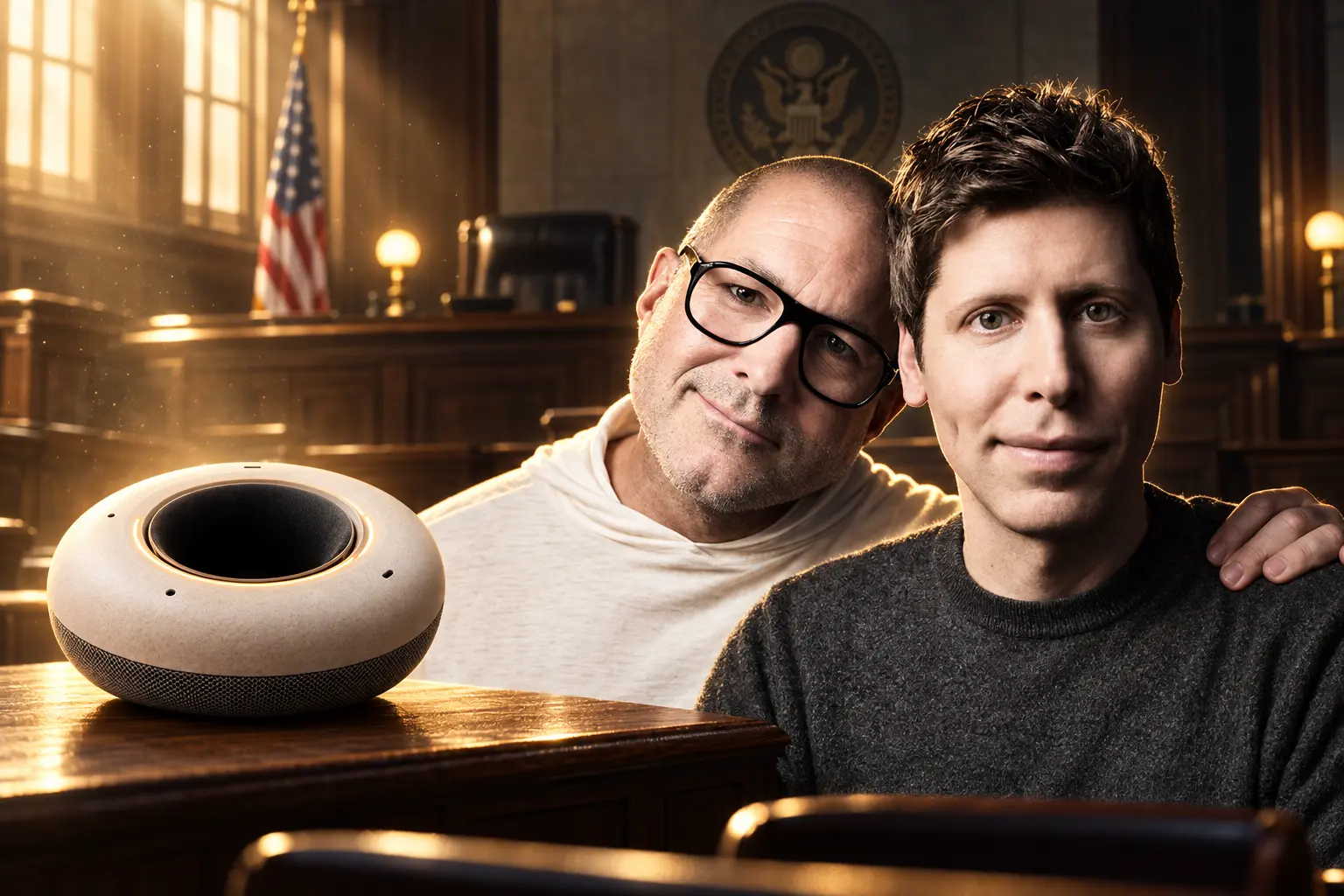
The $6.5 Billion Hire Built a Two-Way Pipe
The hardware shop on trial is not a side project. On July 9, 2025, OpenAI said the io Products team has officially merged into the company. Jony Ive and LoveFrom stayed independent and took design work across OpenAI. Ive is not a defendant.
Counsel on the deal recorded the price as approximately $6.5 billion in stock. Ive had founded io a year earlier with Scott Cannon, Evans Hankey, and Tang Tan, all Apple design veterans. Tan is now OpenAI’s chief hardware officer.
That buy packed decades of Apple device habit into an AI lab that had never shipped a consumer gadget. OpenAI is building a new family of AI-era devices, including a doughnut-shaped smart speaker expected to cost more than $300. A freeze before that speaker ships costs more than a fight after it is on shelves, which is why the company volunteered the pledge rather than wait for Davila’s pen.
The same pipe runs backward. People who leave Apple for io and OpenAI can return. Files travel with them unless someone stops the copy.
What Apple Says Liu and Tan Took
Apple’s complaint opens with a blunt line: this case is about former employees stealing its trade secrets for OpenAI. It says it has spent hundreds of billions of dollars and decades of work on iPhone, Apple Watch, and MacBook, and that the secrets behind that work are among the most valuable assets in American business.
APPLE’S CORE CLAIMS IN THE JULY 10 COMPLAINT
- Liu’s laptop: Chang Liu spent eight years as a senior system electrical engineer, left in January 2026, and failed to return an Apple-issued work laptop.
- The auth bug: While at OpenAI he used a rare login bug to reach Apple shared folders, then downloaded dozens of confidential hardware files on unreleased products, specs, and project data.
- The LOL note: Messages on a colleague’s Apple laptop show Liu writing “LOL” and “so funny” about the leftover access, then coaching that colleague, Yu-Ting “Alyssa” Peng, on how to copy files and “avoid trouble with the security team.”
- Tan’s 24 years: Tang Yew Tan, former vice president of product design for iPhone and Apple Watch, emailed himself supplier lists and industry summaries before he left, then used Apple project code names in OpenAI interviews.
- The February letter: Apple wrote OpenAI in February as the inquiry began. The complaint says OpenAI never replied.
Apple’s ask is not a royalty. It wants the court to stop the use of that material inside OpenAI’s devices before the secrets are mixed in so deep they cannot be pulled out.
OpenAI’s nascent hardware business now rests on the shakiest of foundations, rotten to its core by its illegal reliance on misappropriated trade secrets.
Apple Inc. complaint, filed July 10, 2026, Northern District of California
Liu Kept a Laptop and Found a Bug
Apple says it called Liu after he left to sign a confidentiality reminder, set an exit interview, and confirm he had returned his devices. He did not answer. He then used a colleague’s still-logged-in Apple laptop and, later, the authentication bug. Apple says it patched the bug once it found it, and that other people hit by the same flaw did not grab files.
OpenAI’s forensic expert, in later briefing, said a review of Liu’s Mac mini showed no sign he used a claimed secret file with any AI platform. Apple’s expert said Liu used an Apple trade secret file in March 2026. That fight is why Davila ordered the underlying disk images turned over early.
Tan Asked Candidates for Actual Parts
The complaint says Tan told candidates still on Apple’s payroll to bring “actual parts” to OpenAI for show-and-tell. One candidate said he “didn’t even know we could take those from the office.” OpenAI’s interview scripts, Apple says, asked for CAD files, prototypes, subsystem choices, and vendor names.
Tan also kept or obtained an internal Apple managers’ memo marked “Need to Know” on exit security, the filing says, and shared it with new hires so they could dodge Apple’s checks. He told them not to say they had taken OpenAI jobs, so they could stay at Apple as long as possible.
Files Left Singapore After Midnight on June 2
OpenAI flipped the story on October 14 in a four-page supplement, before the hearing. A forensic review tied to this lawsuit, it said, found that a former OpenAI employee who had joined from Apple, stayed six months, and gone back to Apple sent over a hundred highly confidential files on at least one unreleased OpenAI device to personal accounts.
Some of those files were sent just after midnight in Singapore on June 2, 2026, the former employee’s final day at OpenAI. Further, it is OpenAI’s understanding that the former employee made a presentation about OpenAI’s product plans to Apple’s senior leadership, including Apple’s vice president of operations in Asia.
Defendants’ supplement, Document 176, filed October 14, 2026
The files, OpenAI said, include detailed images of the unreleased device or devices, engineering and manufacturing data, supplier lists, project files, cosmetic-finish standards, and reports on coating and sealing hardware. It says it raised the matter with Apple and has not received assurances that Apple does not hold or use the material. It asked Davila for room to investigate and, if needed, file counterclaims. Those claims are not on file yet.
Apple said it has policies that bar new hires from using a prior employer’s secrets, that it has found no evidence for OpenAI’s account, and that it will work with OpenAI to clean anything that does show up on Apple systems. The unnamed employee is a different person from Liu, whose last Apple day was in January 2026.
TWO PILES OF FILES, TWO DIRECTIONS
| Point | Apple’s July 10 complaint | OpenAI’s October 14 supplement |
|---|---|---|
| Direction | Apple files to OpenAI | OpenAI files to Apple |
| Person named | Chang Liu and Tang Yew Tan | Unnamed employee who returned to Apple |
| Volume claimed | Dozens of hardware files, plus supplier mail | Over a hundred files on an unreleased device |
| Timing | After Liu’s January 2026 exit, and before Tan left | Just after midnight in Singapore on June 2, 2026 |
| What the court is asked | An early order stopping use of the secrets | Time to investigate and possible counterclaims |
The two rows are not a tie. Apple has a live injunction motion and a judge who said he is highly likely to grant it. OpenAI has a supplement and an unanswered ask. Both filings, though, rest on the same theory: a hardware engineer’s personal accounts are now a product plan.
OpenAI Pledges a Freeze to Avoid a Written Loss
Faced with Davila’s signal, OpenAI agreed at the hearing not to use the Apple secrets it is accused of holding, for as long as the case runs. It also agreed to collect full copies of devices from 14 employees who may have Apple material. The judge will be able to police that deal.
WHAT WE KNOW
- The pledge: OpenAI said it will not use the alleged Apple trade secrets while the fight continues.
- The 14 copies: It will image devices of 14 employees, a narrower set than Apple’s first forensic demand.
- The October 13 order: Davila had already required early production of disk images already collected, OpenAI interview scripts for Apple candidates, and LINE chats between Liu and Peng since January 1, 2026.
WHAT IS UNCONFIRMED
- A signed injunction: Davila has not issued the written order Apple filed on August 4.
- The reverse files: Apple says it has found no evidence that OpenAI’s June 2 files landed in Cupertino product work.
- Counterclaims: OpenAI reserved the right to sue back. It has not filed that case.
Practically, the accord gives Apple the freeze it wanted without the stain, for OpenAI, of a formal loss. It does not decide who stole what. It does decide that OpenAI’s hardware group must treat Apple-origin material as off limits while depositions run.
How OpenAI Turned Job Talks Into Parts Show-and-Tell
Apple’s complaint treats hiring as the collection method. It says OpenAI told Apple staff to bring “CAD/design artifacts” and “prototypes” to interviews, and to talk through “subsystem and component selection,” the tools used for system integration, and “vendor selection and communication.” Tan, it says, asked “What’s the plan[?]” for an unannounced Apple product, using an internal code name.
In another episode, an Apple employee was screenshotting and downloading files on a highly confidential project in the hours before an interview with Tan, the complaint says. Tan then asked about that same project in the room.
OpenAI’s answer is that this is how hardware interviews work, and that Apple is recasting job talk as espionage to lock in staff. That defense is harder to sell after OpenAI’s own June 2 account, which describes the same pattern in reverse: personal accounts, device photos, supplier data, a briefing for senior Apple operations staff in Asia.
The complaint also says io, after the merger, used confidential Apple information with a trusted Apple partner, including a metal-finishing method, while leading that partner to think Apple had signed off. Davila refused to fast-track OpenAI’s own files on metal finishes, power management, and battery behavior. Those stay on the ordinary discovery clock, so Apple does not get a peek at OpenAI’s independent engineering yet.
Forensic Copies, LINE Chats, and Early Depositions
The October 13 order, issued without a hearing, is the machinery under the October 14 pledge. Davila found good cause for a slimmed list because Apple’s injunction motion is pending and because chats about wiping Apple-owned electronics raised a real risk that logs could vanish.
THE COURT CLOCK SINCE THE IO CLOSE
- July 9, 2025: OpenAI closes the io Products merger. Ive and LoveFrom stay independent.
- January 2026: Liu leaves Apple for OpenAI and, Apple says, keeps a work laptop.
- February 2026: Apple writes OpenAI about leaked hardware secrets. The complaint says there was no reply.
- June 2, 2026: OpenAI says the unnamed returnee sends device files to personal accounts just after midnight in Singapore, then later briefs Apple leaders.
- July 10, 2026: Apple sues Liu, Tan, OpenAI Foundation, OpenAI Group PBC, and io Products LLC.
- August 4, 2026: Apple moves for a preliminary injunction and for early discovery.
- October 13, 2026: Davila grants limited early discovery and vacates the next day’s discovery hearing.
- October 14, 2026: OpenAI files the reverse-file supplement. At the hearing, Davila says an injunction is highly likely. OpenAI pledges a freeze and 14 device copies.
Defendants have 14 days to produce the ordered material, or five days for anything already collected. Apple may depose Liu, Tan, and Peng, plus corporate designees of OpenAI Foundation, OpenAI Group PBC, and io Products, within 30 days after those responses land. The depositions will test both stories: whether Liu’s leftover access fed OpenAI’s speaker, and whether a six-month tour through OpenAI fed Apple’s next home devices.
Davila left OpenAI’s metal, power, and battery research on the normal track. That split matters. Apple can see how OpenAI interviewed its people. It cannot yet read OpenAI’s own hardware notebooks. OpenAI, for its part, still has to prove its doughnut speaker was drawn from a clean page.
The first OpenAI device has not shipped. The injunction has not been signed. The files OpenAI says walked back to Apple have not been shown in a product. What the San Jose docket already shows is simpler. A $6.5 billion hire of Apple’s old hardware crew built a door that swings both ways, and both companies are now asking a federal judge to nail it shut.
Disclaimer: This article is news reporting and analysis of public court filings and a hearing in Apple Inc. v. Liu et al. It is for information only and is not legal advice, an opinion on the merits, or a prediction of how the court will rule. Readers who face a trade-secret, employment, or intellectual-property dispute should consult a licensed attorney in the relevant jurisdiction before acting on any filing or order discussed here. Figures, quotes, and case status reflect the complaint, the October 13 discovery order, the October 14 supplement, and hearing accounts as of those dates and may change as the docket moves.

Cook Hands Democrats the House as Crypto’s Bill Stays Dead

Wicker’s Broken Bed Was the Short Story’s Punch Line

Nvidia’s $500 Billion Financing Plan Draws a $180 Sell

Maserati Bets the Grecale V6 Can Fill Porsche’s Gap

EV Cable Theft Follows the Old Railway Copper Playbook

Aramco Crash Kills 14 Two Days After Oil Restart

Salah Captained Egypt to Their First World Cup Win

Zelda’s 40th Switch 2 Ships Without a Zelda Game

Apple Labor Day Deals Hide June’s Memory Price Hike

Palworld 1.0.4 Adds Palpedia Search After the 1.0 Launch
-
 BUSINESS4 months ago
Aramco Crash Kills 14 Two Days After Oil Restart
-
 NEWS5 months ago
Salah Captained Egypt to Their First World Cup Win
-
 GAMING2 months ago
Zelda’s 40th Switch 2 Ships Without a Zelda Game
-
 NEWS2 months ago
Apple Labor Day Deals Hide June’s Memory Price Hike
-

 NEWS4 months ago
El Niño Puts Israel’s Needed Winter Rain on a Flood Clock
-
 GAMING2 months ago
Palworld 1.0.4 Adds Palpedia Search After the 1.0 Launch
-

 BUSINESS8 months ago
BAE’s 60-Year Saudi Franchise Now Runs Through Taif
-

 BUSINESS8 months ago
Egypt Bets EGP 638 Billion Can Open Sinai to Investors