
NEWS
HyLight Puts €13 Million Into a Living Map of Europe’s Grid
HyLight’s €13 million Series A funds more hydrogen airship kilometres so labelled grid defects, not the envelope itself, become the product.

€13 million arrived on 12 October 2026 to take HyLight from four hydrogen airships flying daily to 15 by 2027. The French company says those four ships have already inspected 7,000 km this year, up from 400 km in 2025.
Rubio Impact Ventures led the Series A, with DRW and Teampact Ventures joining. Y Combinator and Ring Capital followed on. The round is about €14.5 million, and it takes total capital to about €16.7 million after a €3.7 million seed in April 2024. The money buys more kilometres of labelled grid, not a prettier balloon.
Four Airships Have Already Logged 7,000 km
HyLight posted the round itself: 45 people, four HyLighters in daily service, 7,000 km inspected, and a target of 15 ships in the air by 2027.
We raised €13M to put 15 HyLighters in the sky by 2027 🚀
Series A led by Rubio with @DRWTrading and @Teampact_
Our autonomous electric airships inspect power lines, pipelines and railways, from flight to insight.45 people. 4 HyLighters flying daily. 7,000 km inspected. pic.twitter.com/p0Hnsw8SDV
— HyLight (@hylight_aero) October 12, 2026
Martin Bocken, co-founder and chief executive, put the same shift in older language. “Most power lines are still inspected by helicopter, just as they were fifty years ago. Our HyLighters already do the same job, with greater precision and less risk. This funding takes us from four aircraft to a fleet.”
Thomas Laporte, co-founder and chief business officer, filled in the year-on-year jump. The company is scaling from 400 km inspected in 2025 to more than 7,000 km in 2026 already. Bocken separately said the ships covered almost 3,000 km in September alone, and that one mission has now stretched to 350 km.
THE FLEET ON 12 OCTOBER
- People: 45 staff, with 50 further hires planned in engineering, AI, data, operations, regulation and sales.
- Aircraft: four HyLighters flying daily, 15 to operate at once in 2027.
- Hours: more than 750 flight hours across France and other European countries.
- Kilometres: 7,000 km inspected in 2026, including almost 3,000 km in September.
Paid work already runs for Enedis, NaTran, Téréga, SNCF Réseau and VINCI. The company site also lists Suez. Bocken told an interviewer that every contract so far has been paid, and that helicopters, not other drones, are the rival he actually prices against.
The Product That Lands on a Maintenance Desk
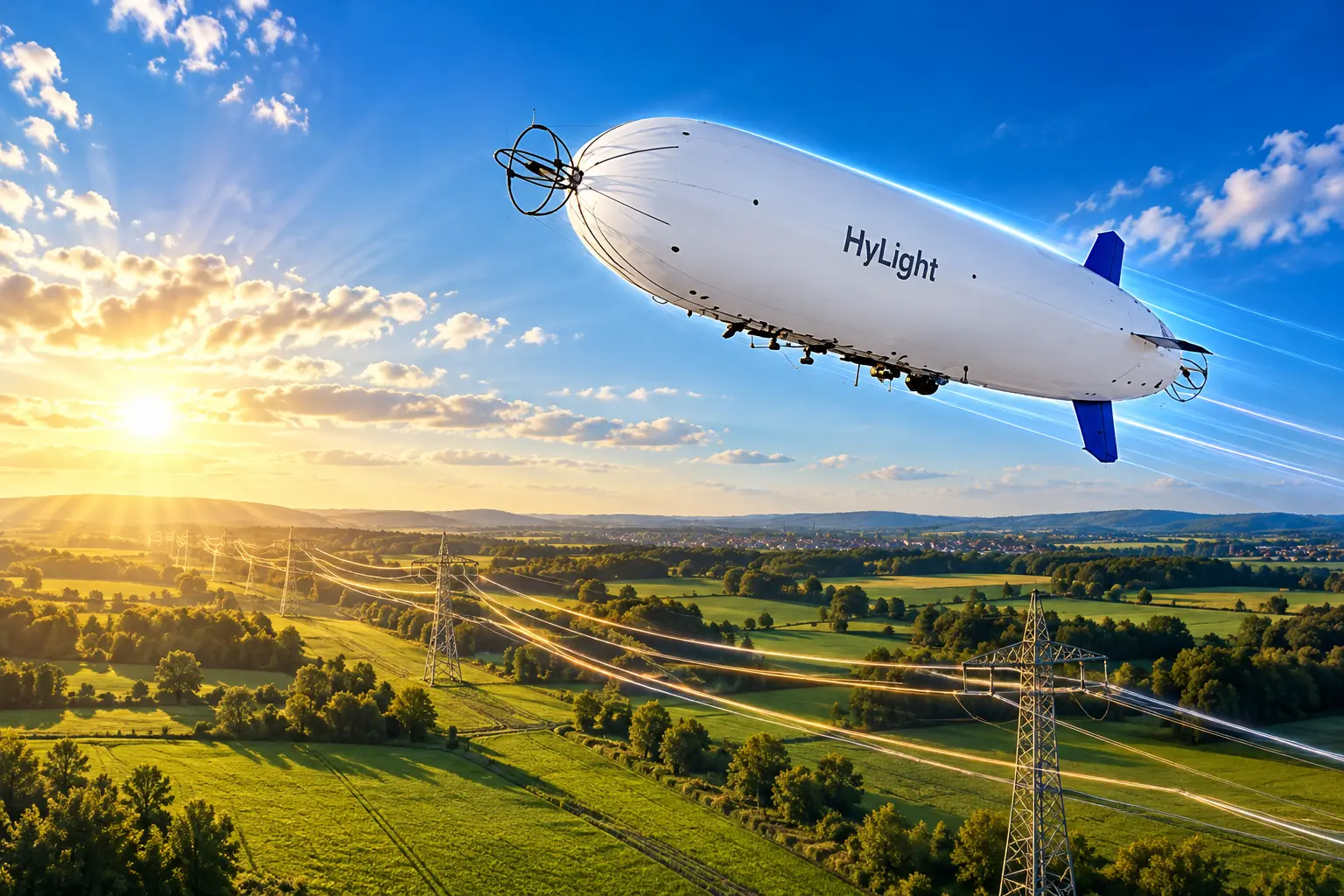
A HyLighter is 12 metres long. Lift comes from helium. A hydrogen fuel cell for long-endurance flights turns electric motors, with no direct emissions and very little noise, for up to ten hours. The ship can carry 10 kg of LiDAR, cameras and methane detectors. From 25 metres it images at 1 mm per pixel and writes LiDAR denser than 1,000 points per square metre.
What the HyLighter Carries at 25 Metres
Flights are run beyond visual line of sight from a control room in Paris, with radio, mobile and satellite links. France’s DGAC and EASA have authorised that work over rural, suburban and urban ground. The ships have crossed the Palace of Versailles and been shown on the Champs-Élysées, at VivaTech and at the Grand Palais.
That is not the file a line crew opens. HyLight keeps design, build, flying and analysis in one shop. Software then tags and geolocates more than 50 kinds of grid defects plus vegetation risk, so teams get a place, a type and a picture instead of thousands of raw frames. Bocken’s line is that more flying builds more history, and that history is how reactive repair becomes predicted repair.
DEFECTS ENEDIS ALREADY SAW IN TRIALS
- Metal: corrosion on network hardware.
- Debris: foreign objects sitting on the lines.
- Trees: vegetation growing into the corridor.
- Insulators: missing or damaged units.
- Structures: damaged supports and parts fitted the wrong way.
Those finds went into Enedis asset systems after regional trials in Nord-Pas-de-Calais, Picardie, Côte d’Azur, Sillon Rhodanien and Limousin. HyLight’s longer aim is a high-definition digital twin of the corridors it keeps flying, then a wider data layer for roads, cities, woods and farmland, with possible uses in insurance, farming and public land. For now it does not sell the aircraft or the software on their own.
Enedis Still Inspects More Than 100,000 km a Year
That is the blunt arithmetic behind the round. Enedis, the French distribution operator, carries out more than 100,000 km of overhead inspections every year for vegetation, faults and reliability. Helicopters still do most of that work. HyLight’s 7,000 km in 2026, across every customer, is a thin slice of one operator’s annual programme.
Enedis holds “entreprise à mission” status and wants a 30 percent cut in greenhouse gases by 2030. Helicopters remain effective, and they also bring carbon, noise and cost. After approvals in November 2025, the airship is cleared for long-range jobs comparable to a helicopter outside restricted airspace, and perhaps beyond that in quiet zones because it is quieter. The 2026 brief is to prove volume, zero accidents involving third parties or network assets, and a price that beats both helicopters and ordinary drones. Sébastien Courtin is the Enedis contact on the file.
HOW FAR EACH PLATFORM GOES
| Platform | Distance | Time aloft | People aboard | Direct CO2 |
|---|---|---|---|---|
| HyLighter | 350 km target per mission | Up to 10 hours | None (flown from Paris) | None |
| Ordinary drone | About 20 km per day (Bocken’s estimate) | Short hops | None, often in visual line of sight | Low |
| Inspection helicopter | Bulk of Enedis’s 100,000-plus km a year | Hourly sorties | Crew on board | Up to 1 tonne CO2e per hour |
HyLight puts worldwide linear infrastructure at more than 80 million km. Satellites lack the millimetre view. Ground sensors see only a point. Drones run out of range. The airship’s claim is the long, slow, low pass that those three cannot combine. The open question is whether utilities will book enough of those passes to keep 15 ships busy.
A Helicopter Cut a Live Cable on October 2
On 2 October 2026 a contractor helicopter working for Enedis was checking a high-voltage line at La Ricarde in La Pacaudière, in the Loire. The rotors severed a cable. The pilot put the machine down in a nearby field. Nobody on board was hurt. About 150 homes lost power and were restored after 20:00. Enedis opened an internal inquiry. The gendarmerie des transports aériens opened another.
Bocken’s reaction to that class of job is plain. “You look at that and think, why are we still using helicopters for this? It’s too risky. We want to change that, and we’re already doing it.”
A separate crash on 16 April 2026 at Saint-Julien-de-Concelles, near Nantes, was not an inspection flight. A 59-year-old pilot spraying shade paint on greenhouse tunnels hit a 20,000-volt line and came down on a plastic shelter. He walked away. The outage hit 800 homes and three market gardens. Five appliances and 17 firefighters attended. Low, slow work around live wires is the shared hazard, whether the job is paint or patrol.
Helmer Schukken, managing partner at Rubio Impact Ventures, also tied the round to ageing helicopter crews. Rubio manages €250 million across three funds and ties all of its carried interest to independently checked impact. Teampact Ventures, a €45 million vehicle, came in as well.
Methane Rules Now Demand Repeat Pipeline Surveys
Power lines are only one corridor. NaTran and Téréga already use the ships on gas networks. Y Combinator’s public brief for the company still lists methane leaks on pipelines beside vegetation and faults on wires and rail. Pipeline methane is a legal problem now, not a nice-to-have extra sensor.
Regulation (EU) 2024/1787, adopted on 13 June 2024, makes oil and gas operators run leak detection and repair surveys on a set timetable, fix leaks at once or justify a delay longer than five days, and file annual reports. The Commission opened a four-week consultation on 12 October 2026, the same day as HyLight’s round, on the reporting templates that sit under that law, with adoption due by the end of 2026.
A quiet, ten-hour platform that already carries a methane detector is a way to walk those kilometres without a helicopter. Public acceptance is the other gate. Bocken argues that a buoyant ship reads more like a hot-air balloon than a camera drone, which matters in Germany, a priority market, where low flying cameras meet a harder privacy argument. He also says some operators have had drones shot at by people who took them for foreign surveillance. The ships have flown villages that then posted photos. That is a softer landing than a rotor disk at 25 metres.
Brétigny Has to Turn Four Ships Into Fifteen
HyLight started in 2022 and sits on Air Base 217 in Brétigny-sur-Orge, south of Paris. Bocken, Josef Rokusek (chief technology officer) and Laporte are the three founders still in the business, with an average age of 27. They went through Y Combinator’s Summer 2023 batch with a brief for unmanned airships for long-range monitoring. A new factory is already running. More strategic parts are due to be pulled in-house. The 50 hires are meant to staff that line plus AI, flying, regulation and sales.
FROM PROTOTYPE TO SERIES A
- 2022: The company is founded and based at Air Base 217 in Brétigny-sur-Orge.
- Summer 2023: HyLight joins Y Combinator and begins paid work with a large European power-line operator.
- April 2024: A €3.7 million seed closes with Y Combinator and Ring Capital on the cap table.
- November 2025: Long-range inspection approvals land, with a scope comparable to helicopter jobs outside restricted airspace.
- September 2026: Almost 3,000 km are inspected in a single month; a 350 km mission is in the log.
- 12 October 2026: The €13 million Series A is announced, with 15 ships the 2027 target.
Germany and the Netherlands are the first export markets. Belgium is under review. Suppliers already sit in Italy, the United Kingdom, Germany and the Czech Republic. Bocken calls the firm French-built and European. He also says demand, not a slide deck, forced the raise: clients wanted more kilometres, faster.
The industrial risk is ordinary and harsh. Hardware, hiring, unit cost and flying have to move together. Bocken has said that building the aircraft was only the start. A 12-metre envelope that works in a demo is not 15 envelopes that work every week over live 20,000-volt lines, in German airspace, with a methane detector that a regulator will accept as an LDAR tool.
HyLight offers a clean and scalable alternative that does the same work reliably, even over densely populated areas, and has the potential to deliver unrivalled cost savings.
Helmer Schukken, managing partner, Rubio Impact Ventures, in the 12 October 2026 funding announcement
Cost savings only show up if the geolocated file changes a crew’s day. As the fleet grows, the hard part is whether a maintenance desk trusts those 50 defect classes enough to skip a helicopter pass, not whether the ship can stay up for ten hours. Enedis will still send helicopters over the bulk of its more than 100,000 km this year. Fifteen HyLighters in 2027 will not swallow that map. They will thicken the labelled strip HyLight already owns, and that strip is what the €13 million is for.

Cook Hands Democrats the House as Crypto’s Bill Stays Dead

Wicker’s Broken Bed Was the Short Story’s Punch Line

Nvidia’s $500 Billion Financing Plan Draws a $180 Sell

Maserati Bets the Grecale V6 Can Fill Porsche’s Gap

EV Cable Theft Follows the Old Railway Copper Playbook

Aramco Crash Kills 14 Two Days After Oil Restart

Salah Captained Egypt to Their First World Cup Win

Zelda’s 40th Switch 2 Ships Without a Zelda Game

Apple Labor Day Deals Hide June’s Memory Price Hike

Palworld 1.0.4 Adds Palpedia Search After the 1.0 Launch
-
 BUSINESS4 months ago
Aramco Crash Kills 14 Two Days After Oil Restart
-
 NEWS5 months ago
Salah Captained Egypt to Their First World Cup Win
-
 GAMING2 months ago
Zelda’s 40th Switch 2 Ships Without a Zelda Game
-
 NEWS2 months ago
Apple Labor Day Deals Hide June’s Memory Price Hike
-

 NEWS4 months ago
El Niño Puts Israel’s Needed Winter Rain on a Flood Clock
-
 GAMING2 months ago
Palworld 1.0.4 Adds Palpedia Search After the 1.0 Launch
-

 BUSINESS8 months ago
BAE’s 60-Year Saudi Franchise Now Runs Through Taif
-

 BUSINESS8 months ago
Egypt Bets EGP 638 Billion Can Open Sinai to Investors