
NEWS
Jordan’s Mobile CT Clinic Hinges on Who Operates It
Vannin finished a GE Maxima mobile CT clinic for Jordan, but Taleed, the local GE agent, must still turn the trailer into care.

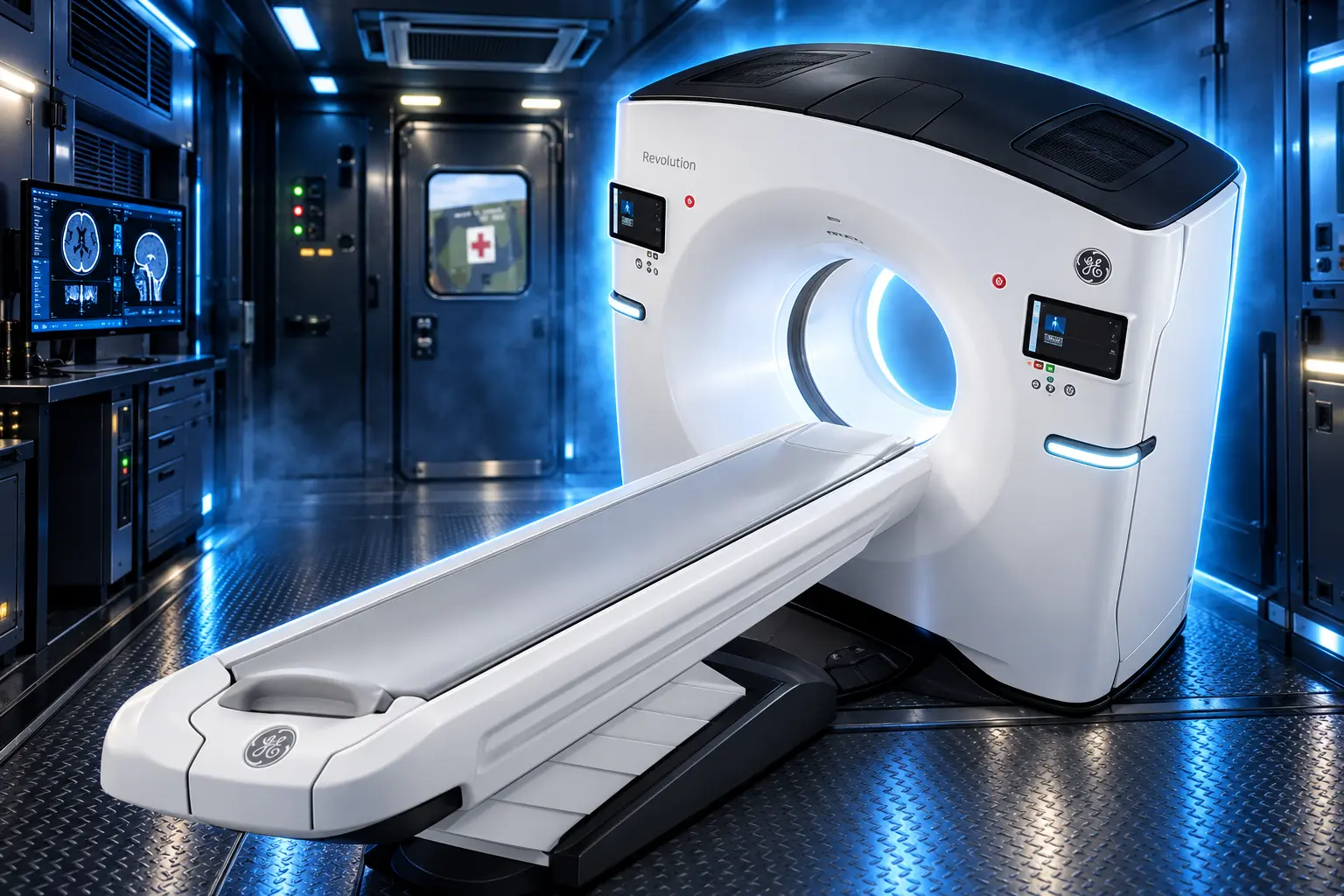
Vannin Healthcare has finished a mobile CT clinic for Jordan, built around a GE HealthCare Revolution Maxima scanner. The trailer was ordered so patients in remote areas would not have to travel as far for a scan. GE’s exclusive agent in Jordan is the party named to run it.
That agent, Taleed Medical Supplies, already sells the same scanner into private Amman hospitals. The factory job is done. Whether the clinic shortens a public waiting list depends on where Taleed parks it, who staffs it, and how it ties into the ministry’s imaging network.
A Climate-Controlled CT Trailer Leaves the Factory
The August 2025 completion of the unit put a Revolution Maxima on a trailer bound for Jordan, with GE’s local distributor assigned to operations, technical support, and clinical training on arrival. Vannin, which builds climate-controlled mobile clinic platforms from the Isle of Man and Florida, framed the job as a design win as much as a clinical one.
We have manufactured a beautiful unit. Most mobile clinics nowadays are very dull and boring but we are very happy with the outcome. Integrating the GE Revolution Maxima into a fully mobile environment required both technical expertise and precision engineering. We are proud to deliver a beautiful, robust, mobile solution equipped with world-class diagnostic technology, and we are confident it will make a measurable difference to patient care in Jordan.
Oliver van Veen, Chief Executive Officer, Vannin Healthcare
The release listed a self-contained medical bay, not a scanner bolted to a truck bed. Power, cooling, and shielding travel with the gantry, which matters in a country where summer heat and unstable site power would wreck a hospital-grade CT.
INSIDE THE JORDAN-BOUND TRAILER
- Climate and power: A climate-controlled trailer with its own power supply and HVAC, so the scanner is not tied to a hospital plant.
- Radiation shielding: Built-in shielding around the scan room, required before the unit can take patients outside a fixed radiology department.
- Staff workspace: An operator’s console laid out for workflow on a narrow floorplate.
- Patient access: A changing area and a wheelchair lift, so the visit does not start with a climb into the chassis.
- The scanner: A Revolution Maxima with Auto Positioning, TrueFidelity deep-learning reconstruction, ASiR-V dose software, and Smart MAR for metal artifact reduction.
Vannin Group, the parent, also sells Greencube, an electronic health record used at more than 300 clinical sites in 14 countries. The Jordan announcement did not say whether this trailer will feed those records, the national Hakeem system, or a private PACS. That choice belongs to whoever runs the route.
Taleed Is the Party That Has to Run It
The August 2025 text never named the distributor. Taleed Medical Supplies, an Amman firm founded in 2014, states that it is the exclusive distributor of GE HealthCare in Jordan. On its own pages it also claims Abbott Diagnostics. If that exclusive brief holds, Taleed is the company the release assigns to manage the clinic, train staff, and keep the tube running.
Taleed is not new to this gantry. On December 26, 2024, it announced a Revolution Maxima cardiac CT, listed as 64/128-slice with an AI camera for positioning, for Istiqlal Hospital. In June 2025, Ibn Al-Haytham Hospital said it had signed for a Revolution Maxima through Taleed, calling it the first in Jordan set up for advanced coronary CT. On January 3, 2026, Taleed announced another Maxima for Istishari Hospital.
Those are fixed installs in private Amman hospitals, not the trailer. They show what Taleed already does with this product: put it in capital-city radiology departments that can pay for cardiac CT. The mobile unit is a different commercial object. It is the same scanner, sold as access rather than as a hospital upgrade.
Engineer Youssef Shalabi, Taleed’s head of diagnostic imaging on the Istiqlal signing, is the kind of local technician the trailer will need on the road. A mobile CT fails first on service, not on paint. Tube heat, alignment after a highway hop, and a 3D camera that still sees straight after a rough lot are distributor problems. Vannin can ship a handsome box. Taleed has to keep it scanning.
Months-Long Queues Still Define Public Imaging
The clinic was pitched against noncommunicable disease, especially heart disease and cancer, and against long trips to major hospitals. Jordan’s own imaging numbers explain why a trailer was even interesting.
On August 30, 2025, Health Minister Ibrahim Badour said a plan starting September 1, 2025 would lift MRI output at five crowded government hospitals from 5,700 exams a month to about 13,000, more than 7,000 extra. The five sites were Al-Bashir, Al-Hussein New Salt, Zarqa Governmental, Princess Basma, and Karak Governmental. The tools were evening shifts, Saturday lists, and 6 a.m. starts, not new vans.
Mammography was in the same bind. On January 24, 2026, Badour said Al-Bashir alone was doing about 180 mammograms a month with a list of about 2,500 women and waits of up to 12 months. He said routine screens would move to Jamil Al-Tutunji Hospital and the Amman Comprehensive Health Center, with Al-Bashir keeping diagnostic work.
IMAGING PRESSURE POINTS IN JORDAN
| Service | The bottleneck | The official response |
|---|---|---|
| MRI at five government hospitals | 5,700 exams a month before the 2025 plan | Raise output to about 13,000 a month from September 1, 2025 |
| Mammograms at Al-Bashir | About 2,500 on the list, waits up to 12 months | Send routine screens to other Amman sites |
| Cancer cases, 2024 | 46.2% recorded in Amman, 6.7% in the South | Reaya treatment cover plus the National Cancer Control Strategy 2026-2030 |
| CT at Ma’an Public Hospital | A southern government hospital short of kit | Jordan Phosphate Mines Company donated a CT worth about JD600,000 in September 2026 |
The Jordan Cancer Registry’s 2024 figures put breast cancer at 2,076 cases, 21.2% of Jordanian cancers, with colorectal cancer at 1,130 (11.5%) and lung cancer at 673 (6.9%). Some 63.7% of cases were recorded in the Central region, 46.2% in Amman, and 6.7% in the South, in a population the yearbook put at 11,734,000. Late finding in the south is not a slogan. It is where the registry is thin.
A government roundup dated August 10, 2026 said Jordan had added 577 hospital beds, opened Princess Basma Hospital in Irbid with 504 beds, and signed cancer coverage for 4.1 million citizens through the King Hussein Cancer Center’s Reaya programme. The same roundup noted national steps on MRI and mammogram waits, a Digital Health Center in Salt offering remote radiology, and Hakeem tools that now include AI reads of radiology images. In 2024 the country had 120 hospitals and 16,325 beds. Extra beds and a cancer-treatment contract raise demand for the scans that decide who enters those programmes.
What the Revolution Maxima Changes at the Table
A mobile CT is only useful if a small crew can scan safely after a drive. That is the case for putting this particular gantry on a trailer.
GE HealthCare’s product page describes AI-based Auto Positioning with a 3D camera. The Xtream camera builds a depth model of the patient, finds the centre of the scan range, and, with one click, aligns that centre with the bore. In a hospital, that saves minutes and cuts dose from bad centering. In a trailer, it also covers for a technologist who may not do this exam every hour.
THE REVOLUTION MAXIMA AT A GLANCE
- Detector: A 40 mm Clarity chain with 0.28 mm spatial resolution, built for routine coverage rather than a research bore.
- Dose software: ASiR-V, which GE says can cut dose by up to 82% against filtered back projection, depending on the task and the patient.
- Reconstruction: TrueFidelity DL, a deep neural net that GE says keeps preferred noise texture at the same dose.
- Hard cases: Smart MAR for metal, plus cardiac and stroke applications on the same platform.
Smart MAR is the trauma and post-op feature. If the trailer is meant for road injuries as well as cancer staging, metal in the field of view is the daily problem, not a rare one. None of those tools set a route. They only make a short-staffed stop less sloppy.
The South Already Knows Mobile Screening
Jordan does not need a London factory to learn that clinics can move. Dr. Reem Al-Ajlouni, who leads the national breast-cancer programme, said mobile clinics had given free exams to more than 55,000 women since 2012, and that more than 90 breast-imaging units operate across the governorates. In July 2026 the King Hussein Cancer Foundation and the Jordan Phosphate Mines Company launched a southern drive aimed at about 334,000 women in Ma’an, Tafileh, Karak, and Aqaba, with a mammography unit in the cancer centre’s mobile screening van.
That is the working template: a scheduled van, a named governorate list, and a reading centre behind it. A CT trailer is heavier, hotter, and harder to license than a mammography coach. It still has to copy the boring parts of that model, the timetable and the referral slip, or it becomes a one-week photo stop.
Fixed kit is still landing in the south as well. On September 10, 2026, Phosphate Mines chair Mohammad Thneibat inspected a CT the company had given Ma’an Public Hospital at a cost of about JD600,000. The company’s wider gift to that hospital was about JD1.3 million, including eye kit, a urology laser, a lab analyser, and 30 beds. A donated hospital scanner stays in Ma’an. A trailer can, in principle, rotate. Only the operator’s diary decides which of those two things the Vannin unit becomes.
Public advanced imaging has also concentrated in Amman. With IAEA help, Al-Bashir opened the first public-hospital PET-CT in Jordan in February 2025. Then-minister Firas Al-Hawari said more than 500 patients a year had been sent to private centres for that test. A PET-CT and a mobile diagnostic CT are different machines. Both stories rhyme. High-end imaging starts in the capital, then someone tries to drag a piece of it outward.
Van Veen Now Puts the Weight on Operations
In July and August 2026, van Veen, speaking as chief executive of Vannin Group Inc., argued that a mobile clinic’s lasting value depends on referrals, digital records, logistics, maintenance, and a permanent clinical network. He said the physical unit is only one part of the solution, and that the operating model decides whether the asset becomes a working service. He also said mobile capacity should extend a network, not replace primary and secondary hospitals.
That later argument sits beside his August 2025 pride in a beautiful trailer. The two comments do not cancel. They sequence. Build first, then admit that parking, staffing, and follow-up are the harder half. For Jordan, the harder half is Taleed’s route plan, the ministry’s waiting lists, and a cancer map that still finds most cases in Amman.
The Digital Health Center in Salt is already linked to 12 government hospitals and 3 health centers for remote radiology. If the trailer’s images flow into that circuit, a radiologist in Amman can read a scan taken in a southern lot. If they do not, the clinic is an isolated camera. No public document on this project has said which way that feed will run.
WHAT WE KNOW
- The build: Vannin completed a climate-controlled mobile CT with a Revolution Maxima in August 2025 and said it was commissioned for Jordan.
- The named operator: GE’s local distributor is assigned to run, service, and train; Taleed presents itself as GE HealthCare’s exclusive Jordan agent.
- The local market: Taleed has already placed Revolution Maxima systems in private Amman hospitals, separate from this trailer.
WHAT IS UNCONFIRMED
- Arrival: No public notice was found that the trailer has entered service, been licensed, or begun a governorate roster.
- The route: No published list of stops, public-versus-private use, or expected scan volumes.
- The records link: No statement on whether images will enter Hakeem, a private PACS, or Vannin’s own record stack.
More than a year after the London announcement, the public file still ends at the factory gate. The scanner is a known machine. The trailer is a known product line. The missing page is Taleed’s timetable, and until that page appears the clinic is a delivered object, not yet a service in Jordan.
Disclaimer: This article is news reporting on a medical-equipment project and on public imaging and cancer figures. It is informational only and is not medical advice, a diagnosis, or a recommendation to seek or skip any scan, screening, or treatment. Readers with health questions should consult a licensed physician or radiologist in their own health system before acting. Figures and project statuses reflect the company materials, product pages, and official statements drawn on here, and they may change as the clinic is deployed or as national programmes are updated.

Christa Pike Survived the Execution Tennessee Would Not Pause

Musk’s Oligarch Charge Hits a Queue of Three

Circle Puts USDC and EURC Into SAP Pay Workflows

Ring’s First Smart Lock Skips Home Wi-Fi for Sidewalk

GTA 6 Puts Cash Back on the Story Path

Salah Captained Egypt to Their First World Cup Win

Aramco Crash Kills 14 Two Days After Oil Restart

Apple Labor Day Deals Hide June’s Memory Price Hike

Zelda’s 40th Switch 2 Ships Without a Zelda Game

Palworld 1.0.4 Adds Palpedia Search After the 1.0 Launch
-
 NEWS5 months ago
Salah Captained Egypt to Their First World Cup Win
-
 BUSINESS4 months ago
Aramco Crash Kills 14 Two Days After Oil Restart
-
 NEWS2 months ago
Apple Labor Day Deals Hide June’s Memory Price Hike
-
 GAMING1 month ago
Zelda’s 40th Switch 2 Ships Without a Zelda Game
-
 GAMING1 month ago
Palworld 1.0.4 Adds Palpedia Search After the 1.0 Launch
-

 NEWS3 months ago
El Niño Puts Israel’s Needed Winter Rain on a Flood Clock
-

 ENTERTAINMENT1 month ago
King Charles Letter Keeps Harry and Meghan as Private Citizens
-

 ENTERTAINMENT4 months ago
A Thousand and One Drops Off Riyadh’s October Calendar