
NEWS
STA’s SARA AI Guide Meets Travelers as Noura
Saudi Tourism’s SARA AI guide, unveiled at WTM London, now feeds Visit Saudi’s live digital human, which introduces itself as Noura.

The Saudi Tourism Authority launched the beta version of SARA, an AI smart guide, at World Travel Market in London from November 5 to 7, 2024. She was built as a young Saudi woman who answers questions, remembers earlier turns, and suggests trips in a spoken, on-screen form.
The stand was the first public test. By February 12, 2025 she was on the Spirit of Saudi Arabia platform, and the digital human travelers now meet on Visit Saudi introduces herself as Noura.
The Beta That Talked on the London Stand
SARA was shown inside the Visit Saudi pavilion as a hyper-realistic digital human, not a text box. STA billed her as a brand ambassador, a concierge, and a guide, and said she was the first digital human travel companion built for a national tourism board. That “first” is the authority’s own claim, and UneeQ, the firm that built the body, repeats it.
She was written as a travel fan who knows archaeological sites, heritage towns, festivals, and city events, and who can talk through customs so a first-time visitor is not guessing. Officials said she could hold a conversation, pull in a prior answer, and change the next suggestion. The beta was also a listening post: STA expected to take questions and behaviour from the stand before a wider release.
The authority’s own account posted the beta the day the show closed.
#الهيئة_السعودية_للسياحة تطلق النسخة التجريبية من "سارة" المرشدة الذكية للسياحة السعودية. pic.twitter.com/HtzI7Yzf85
— الهيئة السعودية للسياحة (@SaudiTourism) November 7, 2024
FROM LONDON STAND TO PUBLIC GUIDE
- November 5 to 7, 2024: SARA talks with guests on the Visit Saudi stand at World Travel Market in London.
- November 8, 2024: STA issues the official notice on the beta smart guide.
- February 12, 2025: STA puts Sara on the Spirit of Saudi Arabia platform during LEAP in Riyadh.
- June 28, 2026: The Ministry of Tourism opens a trial of TourismX and a 24-hour assistant named Noura on the Saudi MT app for operators.
The through-line is control of the question. If a traveler asks a Saudi system where to go, the answer can point to a quieter town as easily as to a famous one, and the question never has to pass through Google or a generic chatbot.
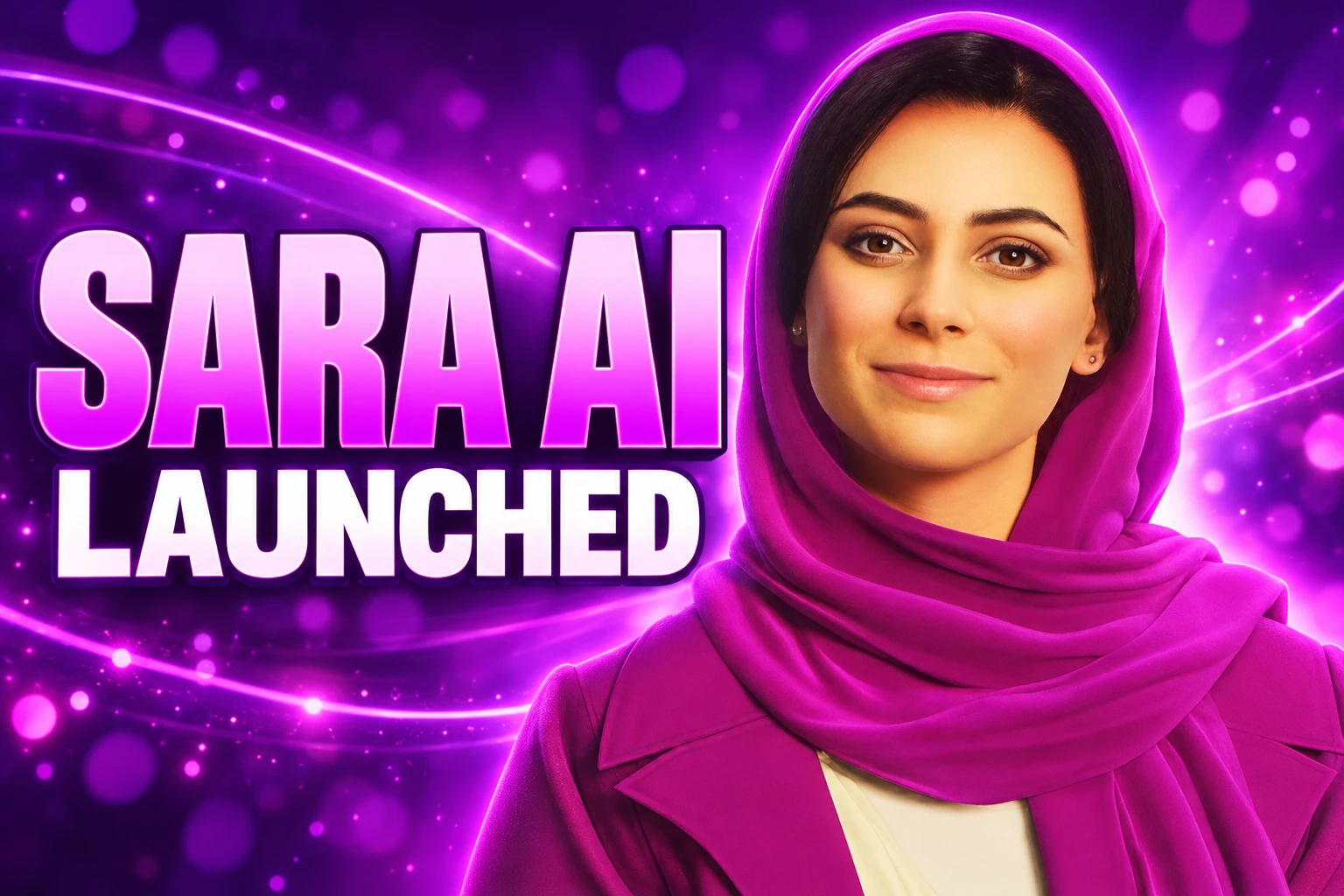
UneeQ Built Her Face From STA Files
UneeQ’s case study describes Sara as a multilingual assistant who can work in dozens of languages. Conversation runs on safeguarded large language models, so replies are not a script, and the knowledge layer is trained on Saudi Tourism Authority files covering attractions, shops, and hotels. Synanim, UneeQ’s animation system, drives expressions, gestures, and full-body movement while she talks.
The face was not a stock avatar. UneeQ says its team designed looks, clothing, and personality with regional staff and local communities, with a backstory of a young Saudi woman who has already traveled her own country and likes sending people to both headline sites and quieter spots. The production shop that ran the London stand listed Microsoft GPT models, UneeQ’s Unreal Engine character, ElevenLabs speech, and Oracle Cloud hosting, plus a handoff to a live agent when the model was not enough.
THE STACK BEHIND THE FACE
- The body: UneeQ digital human on Unreal Engine, with Synanim for motion.
- The voice: ElevenLabs text-to-speech on the London build.
- The brain: Microsoft GPT models with STA destination, shop, and hotel data.
- The host: Oracle Cloud, with a live-agent fallback on the WTM version.
STA’s line on the UneeQ page is blunt about the job it wanted the character to do.
Sara will embody Saudi’s future-forward approach to tourism … a uniquely immersive and highly personalized travel experience.
Saudi Tourism Authority, quoted on UneeQ’s Sara case study
A separate Saudi humanoid robot, also called Sara, shows up in 2026 clips and search results. That machine is not this guide. SARA here is a screen character trained on tourism content.
LEAP 2025 Opened the Public Door
Three months after London, STA used LEAP 2025 in Riyadh to put Sara on the Spirit of Saudi Arabia platform, the public Visit Saudi front door. The February 12, 2025 notice described an interactive guide that mixes AI with Saudi cultural material in several major languages, with the usual aims attached: more spending, more investment, more room for small firms, a larger slice of GDP.
That step mattered more than the pavilion photos. A trade-show character is a demo. A character on the national tourism site is where trip research actually starts, next to maps, events, and bookable tours. STA’s digital stack already included the Visit Saudi app, Enjoy Saudi for events, and Tawakkalna for entry and daily life. Sara was meant to sit on top of that pile and talk.
Plans described at the time included tying the guide to hotel bookings, transport, and tickets. STA never published a usage count for Sara after LEAP, so the public record goes quiet on how many people actually finished a chat and booked.
What Travelers Meet Now on Visit Saudi
Open Visit Saudi’s digital human in 2026 and the greeting is not SARA. The live digital-human assistant on Visit Saudi says, “Hello! I’m Noura, your smart tour guide.” She offers to help with destinations, experiences, and travel offers, and she warns that she is still learning, so some answers may be wrong.
The page is built around tasks a person would type before buying a ticket: how to get a visa, a three-day entertainment plan for Riyadh, top places to see. Sample cards point at Jeddah food and museums, Maraya in AlUla, shopping, and events. The disclaimer says the assistant uses Visit Saudi public data for visa information, experiences, events, and itinerary plans, and that replies are not a substitute for a qualified adviser.
Visa help is not a side feature. International guests still have to pick a route in, including the three visa routes open to travelers from Nigeria, before any itinerary Noura drafts is usable. The chat is doing the work a destination call center used to do, at the exact moment a traveler is deciding whether Saudi is even possible.
STA still described SARA as its digital human in late September 2026, around World Tourism Day. The ministry, on a different track, put a 24-hour assistant named Noura on the Saudi MT app for investors, property owners, and licensed guides. The public record does not include a rename notice that says SARA became Noura. What a traveler can verify is the live greeting.
Muzzammil Ahussain, chief executive of Almosafer Travel & Tourism Co., put the stakes in one line that fits this layer better than any pavilion recap.
People used to arrive at a travel platform already knowing roughly what they wanted. Now a meaningful share of travelers form their entire picture of Saudi Arabia before they ever touch a booking site.
Muzzammil Ahussain, CEO, Almosafer Travel & Tourism Co.
If that picture is formed inside Visit Saudi, STA writes it. If it is formed in a general chatbot, STA does not.
International Arrivals Fell as Domestic Trips Rose
SARA was sold as a tool for global visitors. The 2025 counts show where the pressure still sits. Combined overnight visits rose. Inbound visits did not.
VISITOR COUNTS AGAINST THE 2030 GOAL
| Year | International | Domestic | Combined | Inbound spend |
|---|---|---|---|---|
| 2024 | 29.7 million | 86.2 million | 116 million | SAR 168.5 billion |
| 2025 | 29.3 million | 93.3 million | 122.6 million | SAR 176.6 billion |
| 2030 goal | 70 million | 80 million | 150 million | – |
The Ministry of Tourism’s 2025 statistical report, and the live inbound tourism dashboard for 2025, put international arrivals at 29.3 million, against 29.7 million in 2024. Domestic trips rose 8 percent to 93.3 million. Combined overnight visits reached 122.6 million, up from 116 million. Total tourism spending hit SAR 304 billion ($81 billion), up 7 percent, with inbound spending at SAR 176.6 billion, up 5 percent, and domestic spending at SAR 127.1 billion.
The original Vision 2030 mark of 100 million visits was passed in 2023. The revised goal is 150 million by 2030, including 70 million international visits. Domestic trips in 2025 already sat 13.3 million above the 80 million domestic line. The remaining gap is inbound: 40.7 million more international visits to find before 2030, on a base that slipped by 0.4 million in 2025.
Religious travel still carries a large share of those inbound numbers, and it has its own assistant. Nusuk AI, used for Hajj and Umrah, works in more than 180 languages and has been used by more than 2 million people. SARA and Noura are the leisure-side attempt to do a similar job for people who are not coming for pilgrimage.
Quiet Destinations Need the Guide More Than Riyadh
STA said from the start that the guide should put lesser-known sites next to the famous ones, as a way to spread people rather than pile them into the same few postcards. That is the part of the product that has a job even if inbound volume is flat.
A traveler who only ever asks ChatGPT for “Saudi Arabia” will get AlUla, Diriyah, Jeddah’s Corniche, and Riyadh Season. A guide trained on STA’s full inventory can answer with diving on the Red Sea, Aseer, Hail, or a festival that is not on a global list. The London brief said SARA would build itineraries with local experiences and hidden stops. Noura’s live cards already mix Maraya in AlUla with Jeddah museums and food, which is at least a start on that spread.
Human guides sit on the other side of the same shift. A digital human that works in dozens of languages undercuts the old premium on an English-speaking escort in Riyadh or Jeddah. It does not replace a licensed guide in Hegra or a mountain town, and the ministry’s own later tools treat those guides as users, not as a problem to delete. The risk for small operators is different: if the national assistant never names them, they stay invisible; if it does, they get demand they could not buy with ads.
Hotels and Guides Get Their Own AI Toolkit
On June 28, 2026, Tourism Minister Ahmed Al-Khateeb launched a Tourism AI Vision and a trial of TourismX, a platform aimed at firms and staff rather than at guests. He said AI is changing how people find places, how trips are designed, and how services are run, and that the Kingdom wants to be a reference point for smart tourism. The launch sat inside the Cabinet’s Year of AI 2026.
TOOLS INSIDE THE TOURISMX BETA
- Visual identity: A designer for brand look, aimed at small tourism firms.
- Menus: A designer for restaurant lists and food offers.
- Tour scripts: A generator for guided-walk text.
- Guide assistant: A smart helper for licensed tour guides on the job.
The same day, the ministry opened a trial of the Saudi MT app, which folds licensing and other ministry services into one place for investors, owners, and guides, with Noura on call around the clock. A developer portal sits beside it so outside software can plug into the same pipes. Earlier Hajj tools, a smart inspector and smart housing, were cited as the operational precedent.
At LEAP 2026 the ministry also signed a memorandum with Accenture Saudi Limited to study generative AI, smart transport, and multilingual virtual assistants for destination management. That is the same family of product as SARA, now written as infrastructure rather than as a mascot.
Noura still tells users some answers may be inaccurate. Combined visits in 2025 already cleared the old 100 million mark for a third year, and domestic trips have beaten the 80 million line. The 70 million international goal is the figure that has not moved with the pavilion demos, and it is the one a national guide has to help change if the character is going to be more than a stand attraction.

Ninja Theory Staff Face Redundancy After Two Xbox Sales Collapse

Amazon Sells the MacBook Air at Its Pre-Hike Price

U.S. Slows Jet Parts to Squeeze China’s Flying Fleets

PEGI Pulled the GTA 6 Age Rating After Cocaine Details

Northwestern’s Smaller Ryan Field Gave Penn State Nowhere to Hide

Aramco Crash Kills 14 Two Days After Oil Restart

Salah Captained Egypt to Their First World Cup Win

Apple Labor Day Deals Hide June’s Memory Price Hike

Palworld 1.0.4 Adds Palpedia Search After the 1.0 Launch

Zelda’s 40th Switch 2 Ships Without a Zelda Game
-
 BUSINESS3 months ago
Aramco Crash Kills 14 Two Days After Oil Restart
-
 NEWS4 months ago
Salah Captained Egypt to Their First World Cup Win
-
 NEWS1 month ago
Apple Labor Day Deals Hide June’s Memory Price Hike
-
 GAMING4 weeks ago
Palworld 1.0.4 Adds Palpedia Search After the 1.0 Launch
-
 GAMING4 weeks ago
Zelda’s 40th Switch 2 Ships Without a Zelda Game
-

 NEWS3 months ago
El Niño Puts Israel’s Needed Winter Rain on a Flood Clock
-

 BUSINESS8 months ago
Egypt Bets EGP 638 Billion Can Open Sinai to Investors
-

 ENTERTAINMENT4 weeks ago
King Charles Letter Keeps Harry and Meghan as Private Citizens