
NEWS
Samsung Galaxy Studio Headphones Put the 3.5mm Jack Back
Samsung’s Galaxy Studio over-ear headphones leak an 870mAh cell plus 3.5mm and USB-C jacks, the analog port flagship Galaxy phones dropped years ago.

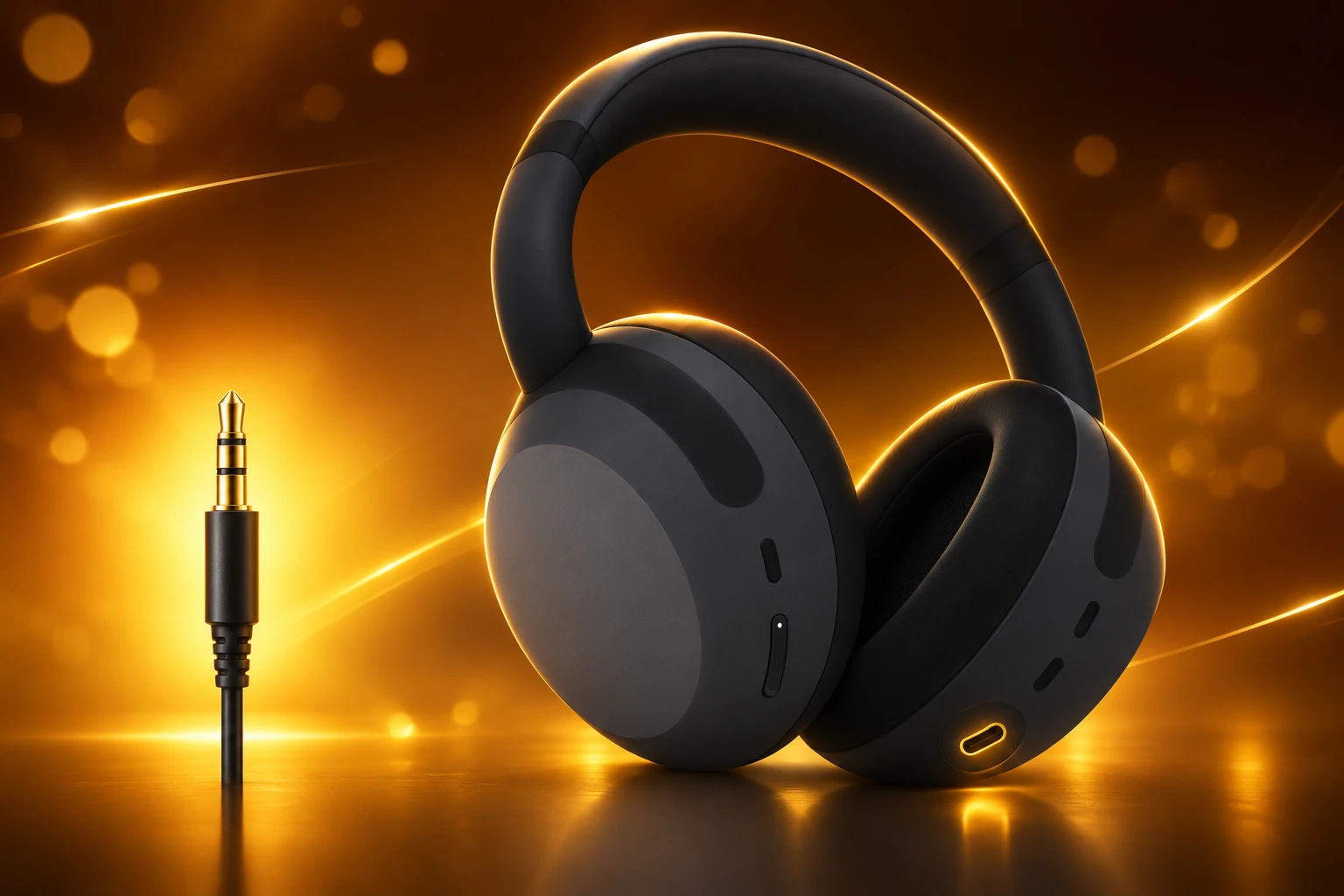
Samsung’s unreleased Galaxy Studio over-ear headphones list an 870mAh battery, a 3.5mm jack, and USB-C audio inside the One UI 9.5 beta. The files tag the pair as model SM-U700, with the internal names Galaxy H1 and Galaxy Studio.
Flagship Galaxy phones have not carried that analog port since the Note 10 in 2019 and the S20 line in 2020. The cups now put the jack, a USB-C cable path, and real volume keys at the center of the spec sheet, while playback hours are still blank.
Galaxy Studio Puts a Headphone Jack on the Cups
Tutorial screens in the beta show a classic headband and two large earcups. The drawings look close to Sony’s ULT WEAR, though they are teaching art, not retail renders, so colors and small contours can still change.
Samsung’s own copy in those screens says wireless listening is fine, then points users to a cable when they want higher quality and lower delay. The tutorial names a phone, a tablet, or a PC, and it calls out gaming, music, and movies as the jobs for a wire.
That split is the product. A Galaxy S-series phone has no 3.5mm socket to offer, so analog has to live on the accessory. USB-C covers the phone and a modern laptop. The mini jack covers older PCs, in-flight sockets, and anything else that still has a hole. Sony’s ULT WEAR already ship a stereo mini jack and passive operation. Studio adds USB-C audio on top of that analog path, which most Bluetooth flagships never bother to do.
The files do not say whether either cable ships in the box, and they do not give bit depth or sample rate for the USB path. They also do not say whether the 3.5mm jack keeps playing if the cell is empty, which is the quiet advantage of Sony’s passive analog mode.
An 870mAh Pack Meets Sony’s 30-Hour Rating
Diagnostic menus list 870mAh typical and 850mAh rated for the same cell. There is still no hour figure next to those numbers, which is why “big battery” is a guess, not a rating.
Sony’s current class leader publishes time, not a milliamp figure. The WH-1000XM5 is rated for 30 hours with noise canceling on and 40 hours with it off, on a 3.5-hour charge, at 8.82 oz. ULT WEAR uses the same 30-hour noise-canceling claim and stretches to 50 hours with it off, at 255 g. Both keep a mini jack that can run silent when the pack is dead.
BATTERY AND WIRED PATHS
| Model | Published power | Wired audio | Plays analog if empty |
|---|---|---|---|
| Galaxy Studio (SM-U700) | 870mAh typical, 850mAh rated; hours not listed | USB-C and 3.5mm | Not listed |
| Sony WH-1000XM5 | 30 hrs NC on, 40 hrs NC off; 3.5 hrs to charge | Stereo mini jack | Yes, passive |
| Sony ULT WEAR | 30 hrs NC on, 50 hrs NC off; 3.5 hrs to charge | Stereo mini jack | Yes, passive |
Studio’s extra move is the USB-C listening path, not a published stamina win. An auto power-off timer of 30, 60, or 120 minutes, plus a “not set” option, is how the software tries to stretch an unpublished cell. Until Samsung prints hours, the 870mAh figure is a size, not a trip rating.
Wear Detection Sends Calls Back to the Phone
The right cup does most of the talking. A touch pad handles playback and calls, and a physical noise-control button cycles the noise modes. Dedicated plus and minus volume keys sit on the left cup, which is the layout people reach for with gloves or with a pad that otherwise skips tracks.
TOUCH GESTURES ON THE RIGHT CUP
- Tap: Play or pause.
- Double-tap: Skip to the next track, or answer and end a call.
- Triple-tap: Go back to the previous track.
- Touch and hold: Launch an AI assistant.
Ambient sound can drop media volume so a voice nearby is easier to hear without pulling the cups off. Wear detection pauses music or video when the headphones come off and starts them again when they go back on. If a call is active, the software can send that audio to the phone or tablet speaker, which the files describe as an Auto Switch behavior.
Wireless extras already look like a Galaxy Buds checklist stretched over larger cups: ANC, Ambient sound, 360 Audio with head tracking, Auracast, a gaming mode, multipoint, an equalizer, Boost Dialogue, loudness normalization, Modes and Routines actions, notification reading, left/right balance, and a Find My beep. Head gestures and hands-free voice triggers are missing. Hold-to-talk for an assistant is still there.
The Level Over Playbook From 2014
Samsung has been here. It showed the Level Over over-the-ear headphones at Mobile World Congress in February 2014, then published a newsroom review on May 1, 2014. Those cups used 50mm bio-cellulose drivers, active noise canceling, and a touch pad for tracks, volume, and S Voice. They also kept a cable in the mix.
Unlike some other headphones, even if the battery runs out, it won’t stop the music; it will continue to play music just without the ANC function.
Samsung Global Newsroom, May 1, 2014
That dead-battery promise is the detail Studio has not repeated in the current files. Twelve years later, the new pair still has no published driver size, no weight, and no hour rating, while the software surface is already thick with tutorials.
FROM LEVEL OVER TO THE FCC GRANT
- February 2014: Samsung shows Level Over at Mobile World Congress, with ANC, a touch pad, and a cable path.
- 2019: The Galaxy Note 10 ships as a flagship without a 3.5mm port.
- 2020: The Galaxy S20 line follows; the S10 remains the last S-series phone with the jack.
- September 2026: SM-U700 and the Galaxy H1 name show up in Samsung apps.
- November 4, 2026: The FCC authorizes SM-U700 as a Bluetooth headset under ID ZCASMU700.
- November 18, 2026: One UI 9.5 beta files list the 870mAh cell, the 3.5mm jack, and USB-C audio.
The FCC grant dated November 4 names Samsung Electronics as the grantee, lists Bluetooth in the 2402-2480 MHz range, and reports a highest head SAR of 0.60 W/kg. External photos, internal photos, and the user manual sit under short-term confidentiality until May 1, 2027, so the cups in those exhibits are still locked.
Dedicated Tutorials Sit Inside One UI 9.5
The unusual part of this leak is how finished the software looks. Galaxy Studio already has dedicated tutorials, a diagnostics menu with a wear-detection test, battery readouts, button checks, animations, rename and reset tools, and software-update hooks. That is more than a placeholder string in a firmware dump.
Those diagnostics live in the same One UI 9.5 beta that still has the Galaxy S26 on last year’s clock, which is how a headphone spec sheet ended up inside a phone build. Auto Switch, Find My, and Modes and Routines are the hooks that make the cups feel like another Galaxy device rather than a generic Bluetooth hat.
Current files keep Studio out of the Advanced quality menu that mentions 96 kHz Ultra High Quality audio on some upcoming earbuds. Recaps that pin SSC UHQ or LC3 on these cups are ahead of the beta. The software is early, and that omission can still change, but it is not in the files now.
Sound is the gap the software cannot fill. The feature list is already long enough that buyers will judge these against Sony on comfort, clamp, and noise canceling, not on whether Find My can beep. Physical keys and a jack get Studio into the conversation. Drivers, pads, and a published hour rating decide whether it stays there.
What the Beta Files Still Leave Blank
Samsung has not announced Galaxy Studio, a price, or a ship date. A pairing with the Galaxy S27 line is still a rumor, not a filing. The hardware that is public is a software map plus a radio grant.
WHAT WE KNOW
- Identity: Model SM-U700, also labelled Galaxy H1 and Galaxy Studio in One UI 9.5.
- Cell: 870mAh typical and 850mAh rated, with no playback-hour figure.
- Ports: USB-C and 3.5mm wired audio, plus Bluetooth, ANC, and wear detection.
- US radio grant: FCC ID ZCASMU700, issued November 4, 2026, with photos sealed until May 1, 2027.
WHAT IS UNCONFIRMED
- Stamina and drivers: Hours, fast-charge claims, driver size, and weight are not in the files.
- Dead-battery analog: The 3.5mm jack may or may not play if the cell is empty.
- In the box: Neither cable is confirmed as a bundled accessory.
- Launch: An S27-window debut is unverified, and 96 kHz UHQ is excluded in current menus.
Until the May 1, 2027 confidentiality window on the FCC photos lifts, or Samsung puts the cups on a stage, the most complete picture of Galaxy Studio is still a phone software build. It already teaches the jack, the timer, and the wear sensor. It still will not say how long a charge lasts.

Jennifer Lopez and Mahershala Ali Describe a Pipeline They Cannot Buy

Lightsail Scatter Turns to Drag Far Above Starshot

Tallulah Willis Deletes a Bruce Willis Photo She Called Intimate

S&P 500 Futures Rebound Into a Holiday-Shortened Week

GTA VI’s Record Launch Still Needs the Same Fragile Grid

Aramco Crash Kills 14 Two Days After Oil Restart

Salah Captained Egypt to Their First World Cup Win

Zelda’s 40th Switch 2 Ships Without a Zelda Game

Apple Labor Day Deals Hide June’s Memory Price Hike

El Niño Puts Israel’s Needed Winter Rain on a Flood Clock
-
 BUSINESS5 months ago
Aramco Crash Kills 14 Two Days After Oil Restart
-
 NEWS6 months ago
Salah Captained Egypt to Their First World Cup Win
-
 GAMING3 months ago
Zelda’s 40th Switch 2 Ships Without a Zelda Game
-
 NEWS3 months ago
Apple Labor Day Deals Hide June’s Memory Price Hike
-
 NEWS5 months ago
El Niño Puts Israel’s Needed Winter Rain on a Flood Clock
-

 GAMING3 months ago
Palworld 1.0.4 Adds Palpedia Search After the 1.0 Launch
-

 NEWS4 months ago
Saudi Visa Routes Split Nigerian Travelers Into Two Speeds
-

 BUSINESS9 months ago
BAE’s 60-Year Saudi Franchise Now Runs Through Taif