
GAMING
Ken Kutaragi Calls the Disc Habit He Created a Mentality Issue
Ken Kutaragi calls PlayStation disc demand a mentality issue, even though cheap CD-ROMs built the brand and Sony is already closing old stores.

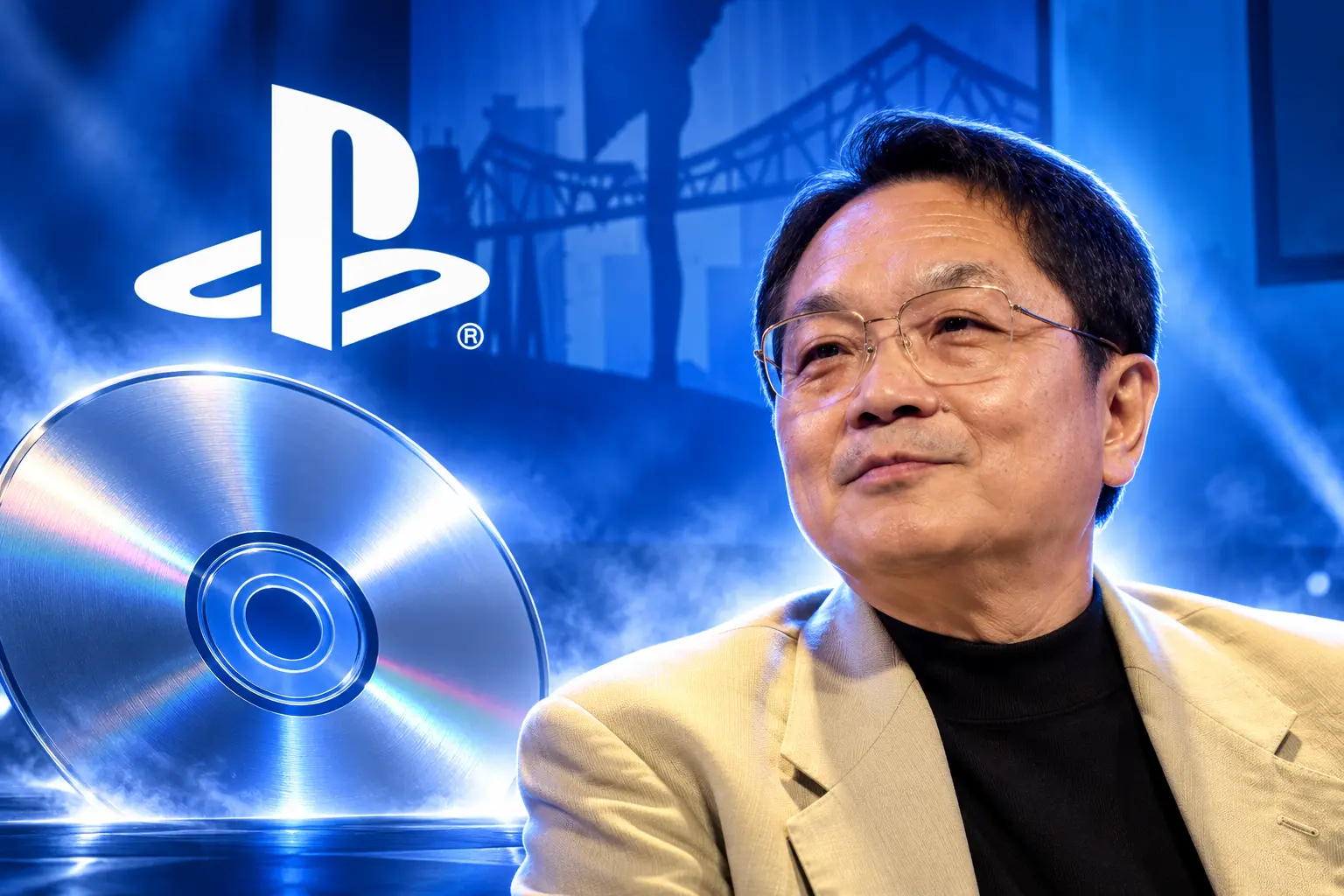
PlayStation founder Ken Kutaragi said in mid-October that wanting game discs is a mentality issue, and that keeping them in production is not economically reasonable. He said it in Middlesbrough, at the Game Republic New Horizons event, after Sony Interactive Entertainment had already pledged to stop making discs for new games from January 2028.
The line landed as a scolding of people who still buy a box. It came from the engineer who once used cheap, fast CD-ROMs to smash Nintendo’s cartridge business, and it arrived while Sony is winding down old digital storefronts that were supposed to last.
Kutaragi Calls Disc Demand a Mentality Issue
Kutaragi is 76. He left as Sony Computer Entertainment chairman and group CEO in 2007 and has held no Sony job since 2011. He now runs Ascent Robotics and Cyber AI Entertainment. He still talks like a man whose name is on the hardware, and the room still treats him that way.
He told the Middlesbrough audience that network access has changed the old PlayStation 2 and PlayStation 3 world, when being online was not the default. He said he knows why a plastic disc still stands in for owning a game. He also said that analogy should not survive contact with a phone.
I understand that physical discs have become a metaphor for ‘owning’ games. I really understand that mentality… But nobody thinks physical media is necessary for a networked device like a smartphone, for example, because people feel that they will keep their content. So it’s a mentality. I really understand why some people are upset, but I don’t think it’s economically reasonable. Maybe it’s a mentality issue.
Ken Kutaragi, PlayStation founder, Game Republic New Horizons, Middlesbrough
He added that Sony Interactive Entertainment now has many people who came from outside, including Gaikai and other streaming firms, and that they may treat PlayStation as a content terminal rather than a games console. “Maybe that’s how those people are thinking,” he said. “But this has caused some friction with game enthusiasts.”
He is not setting policy. Sid Shuman, Sony’s senior director of content communications, already set the date on July 1, 2026. New PlayStation games after January 2028 go to the PlayStation Store and to shops as digital codes only. Games already on disc, and games that still ship on disc before that month, are not pulled. That is a production cutoff for new releases, not a recall of the catalogue on shelves.
Physical Sales Are 2.86% of US Game Spending
Kutaragi’s money argument is easy to score if you look at dollars rather than polls. Circana’s Mat Piscatella, who tracks the US market, put spending on new physical game software at $1.5 billion in 2025, the lowest figure in the series that starts in 1995. That was an 11% drop from 2024, a milder fall than 2024’s 28% slide, and still a rounding error next to the rest of the business.
The Entertainment Software Association, working with Circana and Sensor Tower, put US spending on game content at $52.4 billion in 2025. Physical software was 2.86% of that content pile. Total consumer spend, with hardware and accessories counted, was $60.7 billion on games and hardware.
PREFERENCE VERSUS THE TILL
| Measure | Figure |
|---|---|
| Console players who prefer a disc or cartridge (YouGov, July 2026) | 51% |
| Console players who prefer a digital purchase | 32% |
| US spending on new physical games, 2025 (Circana) | $1.5 billion |
| Physical share of 2025 US game content spend | 2.86% |
Those two columns are different quantities, and that gap is the whole fight. A slim majority of console players still say they want a copy they can hold. Almost none of the money in the content market still moves through that copy. Digital full games, downloadable extras, microtransactions, subscriptions, and mobile sit in the other $50.9 billion of content spend, so the 2.86% slice is not a clean “full game, disc versus download” split.
Piscatella has said the slower drop is mostly the market nearing the bottom, with Nintendo’s Switch 2 helping to steady boxed sales. That is a floor, not a rebound Sony can staff a pressing line on.
He Once Used Discs to Undercut Nintendo
The irony is sitting in Sony’s own corporate history, not in a fan thread. In the early 1990s Kutaragi pushed a CD-ROM console after a Nintendo disc add-on collapsed. Then-president Norio Ohga backed him. Sony Computer Entertainment was formed on November 16, 1993, as a joint venture with Sony Music, the group that already knew how to press compact discs.
The first PlayStation went on sale in Japan on December 3, 1994, at 39,800 yen. Sony’s history chapter on the machine is blunt about why the format won. Cartridge runs took months to replace once they sold out. Because Sony Music already pressed audio CDs, PlayStation software could be turned around in a maximum of six days to fill a disc order, even in small lots, at a low unit cost. SCE also sold straight to retailers instead of through the old wholesale stack.
That was the original PlayStation pitch to publishers: more data than a cartridge, cheaper to make, faster to reprint, easier to own in bulk. The console passed 10 million units by the end of November 1996. Squaresoft’s move of Final Fantasy VII onto three CDs is the famous third-party proof, but the quieter proof is the pressing plant. Kutaragi did not stumble into discs. He used them as a weapon against a cartridge tollbooth.
Calling today’s leftover demand a mentality issue asks people to forget that the brand was built by making the owned copy cheap. The economics flipped. The founding trick did not.
Why Console Players Still Want a Copy They Can Keep
YouGov polled 1,500 US adults online on July 5, 2026, and found 471 people who play on a console or PC for at least an hour a week. Among console players, 51% of console gamers prefer discs or cartridges. Digital purchases came in at 32%, no preference at 14%, and subscriptions at 3%. PC players lean the other way, with 40% preferring digital and 32% still wanting a physical copy.
The reasons are not nostalgia for box art. They are a list of things a store login does not do.
WHY THE PHYSICAL BUYERS SAY THEY BUY BOXES
- Permanent ownership: 81% of those who prefer physical copies named a copy they keep as a reason.
- Fear of takedowns: 70% worry a digital game could become unavailable later.
- Used copies: 65% want the right to buy a game that already had an owner.
- Less internet: 56% value being able to play without a live connection.
- Collecting and lending: 52% like collecting, and half like lending or giving a game away; 46% want to sell or trade it after they finish.
Digital buyers, by contrast, pick speed. Immediate access leads at 54%, then play on more than one device at 41%, and easier discounts or a lower price at 40% each. One in seven digital preferers said they do not even own a machine that takes a disc.
Opposition to killing new boxed releases is broader than the collector club. 57% of the gamers in the sample oppose companies dropping discs and cartridges for new titles, including 38% who strongly oppose it. Only 12% support the move. Even 47% of people who prefer digital copies still oppose removing the physical option. 53% said they would be less likely to pick a system that cannot play physical games.
Among those who oppose a digital-only future, 65% said a guarantee that purchased games stay reachable would make the shift easier to live with. Lower digital prices followed at 55%. Kutaragi’s smartphone line assumes people already feel they will keep their content. YouGov’s holdouts are asking for that feeling in writing.
Sony Started Closing Old Stores the Same Week
On the same July 1 it posted the 2028 disc cutoff, Sony said it would start winding down the PlayStation Store on PlayStation 3 and PlayStation Vita from August 2026. That is the practical hole in “people feel that they will keep their content.” A download is a license on a store Sony can close. A disc from 2008 still boots if the drive lives.
Frank Cifaldi, executive director of the Video Game History Foundation, called the disc decision a hit to consumer rights, the resale market, and studios that still live on boxed editions. He has also said museums cannot treat a store download as a 50-year plan.
The industry needs to meaningfully come to the table on this issue, because asking museums to download a copy of Grand Theft Auto VI and hope it’ll run in 50 years is not a preservation solution.
Frank Cifaldi, executive director, Video Game History Foundation
The foundation’s 2023 study with the Software Preservation Network found that 87% of classic games are endangered in the United States, meaning pre-2010 titles that are out of print. Only 13% of that history was still legally for sale. In the samples, PlayStation 2 cleared 12%, Game Boy 5.87%, and Commodore 64 4.5%. Cifaldi noted that putting a disc on a shelf is already a weak archive when day-one patches change the game, and that the Entertainment Software Association has fought changes to copy-protection law that would make library work easier.
Boutique publishers said the same thing in plainer English. iam8bit called Sony’s move a blow to preservation, ownership, and choice, and said it would keep pressing physical editions as long as it could. Sony later told publishers they may still reorder discs for games that existed before the January 2028 line. That keeps reprints of the old catalogue in play. It does not create a disc for a 2028 launch.
FROM THE FIRST PLAYSTATION TO A STORE THAT CAN GO DARK
- December 3, 1994: PlayStation launches in Japan on CD-ROM at 39,800 yen, with disc reprints measured in days.
- 2007: Kutaragi steps down as Sony Computer Entertainment chairman and group CEO.
- July 1, 2026: Sony says new PlayStation games lose discs in January 2028 and that PS3 and Vita stores will wind down.
- August 2026: The PS3 and Vita store wind-down begins.
- Mid-October 2026: Kutaragi, in Middlesbrough, calls leftover disc demand a mentality issue.
- January 2028: New PlayStation releases go digital only; older disc SKUs remain reorderable.
The timeline is the argument. The company that used a pressed disc to beat a closed cartridge system is now asking players to trust a storefront it is already shrinking.
PlayStation as a Content Terminal
Kutaragi’s more useful remark was not the mentality line. It was the staffing note. He said current Sony Interactive Entertainment has many people from Gaikai and streaming companies, and that they may see PlayStation as a content terminal. He has been talking about games merging with the network since the PlayStation 2 era. In Middlesbrough he went further on hardware cost, saying machines are “super expensive” and that PCs now cost “the price of a car.” If firms squeeze enough out of AI and cloud computing, he said, “we won’t need any console,” then added that this was not an official Sony Computer Entertainment comment.
That is the second-order shift hiding under the disc fight. A console that is also a streaming dock does not need a tray. It also does not need a customer who can lend a copy, sell it, or keep it after an account lock. The used-game shop, the library sale, and the shelf of last-gen discs all sit outside that terminal. They were never a metaphor. They were a second market Sony does not tax.
The loudest public reading of his quote has been simpler than that, and ruder. People heard a founder telling paying customers their wish to own the file is a mental problem, while Nintendo still sells a cartridge and Microsoft’s Xbox is already mostly digital. The comparison to phones is the tell. Phone stores delete apps. Game stores delete listings. A cracked Blu-ray from 2018 does not need a login to prove you bought it.
27% of PS5 Consoles Sold Came Without a Drive
The hardware is already halfway there. Circana’s figures through the end of May 2026 show 27% of PlayStation 5 consoles sold in the United States came without a disc drive, against 52% of Xbox Series machines. Sony is not forcing a disc-less future on a base that still buys trays. A large minority already opted out.
The remaining boxed aisle is not evenly shared. In July 2026, Nintendo took 63% of US physical game spending, Sony 32%, and Xbox 4%. Niko Partners analyst Daniel Ahmad has pointed out that most of what is left on those shelves is Switch and Switch 2 software, which is why Nintendo has not followed Sony’s cutoff. Sony DADC, which still presses discs at Thalgau in Austria, later said 2028 volume would fall by about 10%, not collapse to a tenth of current output, because reprints of older PlayStation titles continue.
WHAT JANUARY 2028 CHANGES
- New releases: First- and third-party PlayStation games that launch from January 2028 ship with no new disc, only storefront and retail digital codes.
- Older discs: Games already out, or out before that month, keep their discs, and publishers can reorder those SKUs.
- The installed base: Existing PS5 disc drives still play the old catalogue; they will not get a pressed copy of a 2028 launch.
- The rival shelf: Nintendo keeps printing cartridges, and that is where the last fat slice of boxed spending already sits.
Sony can win the margin argument without winning the ownership argument. $1.5 billion is a bad reason to keep a factory humming for brand-new SKUs. It is also a bad reason to tell the 51% who still want a copy that the habit is in their heads, while the same company turns off stores that were sold as forever shelves. January 2028 will end new PlayStation discs. It will not end the need for a copy that still works when the store does not.

One UI 9.5 Beta Puts the Galaxy S26 on Last Year’s Clock

DBS Puts a 24/7 USDC Window Inside the Bank

European Startups Head for $81 Billion as First Checks Shrink

US Stocks Lost $1.3 Trillion Before Nvidia’s Beat

Home Depot Bets on Finance Chief Richard McPhail as CEO

Aramco Crash Kills 14 Two Days After Oil Restart

Salah Captained Egypt to Their First World Cup Win

Zelda’s 40th Switch 2 Ships Without a Zelda Game

Apple Labor Day Deals Hide June’s Memory Price Hike

El Niño Puts Israel’s Needed Winter Rain on a Flood Clock
-
 BUSINESS5 months ago
Aramco Crash Kills 14 Two Days After Oil Restart
-
 NEWS6 months ago
Salah Captained Egypt to Their First World Cup Win
-
 GAMING2 months ago
Zelda’s 40th Switch 2 Ships Without a Zelda Game
-
 NEWS3 months ago
Apple Labor Day Deals Hide June’s Memory Price Hike
-
 NEWS4 months ago
El Niño Puts Israel’s Needed Winter Rain on a Flood Clock
-

 GAMING2 months ago
Palworld 1.0.4 Adds Palpedia Search After the 1.0 Launch
-

 NEWS4 months ago
Saudi Visa Routes Split Nigerian Travelers Into Two Speeds
-

 BUSINESS9 months ago
BAE’s 60-Year Saudi Franchise Now Runs Through Taif