
AUTO
Harley Freezes Dealer Keys on 21,643 Touring Bikes
Harley froze delivery of unsold 2026 touring bikes over a gear sensor that can fake Neutral, while 21,643 sold machines carry no park-it order.

Harley-Davidson told its dealers they may sell 2026 touring bikes but cannot deliver them until a gear-sensor recall is finished. The campaign covers 21,643 U.S. motorcycles whose dash can show Neutral while a gear is still in.
Owner letters are set to mail November 16 through November 23, 2026, and Harley has issued no order to park the bikes. The company’s filing estimates that 0.1 percent of the machines actually have the fault, and it already lists two injuries that may be related.
Dealers Can Sell the Bikes but Cannot Hand Over the Keys
The split is already in writing. A November 6 bulletin to Harley-Davidson dealers worldwide, filed with the National Highway Traffic Safety Administration as campaign 26V730, treats unsold inventory as too hot to release and treats bikes already in garages as fine to ride.
In the interest of our customers’ safety, and as required by federal law, you may sell but not deliver any affected motorcycles until the recall remedy is complete.
Harley-Davidson Motor Company, dealer bulletin, recall 0194
That freeze landed the week of November 6, while registered owners wait for letters that begin the week of November 16. Replacement kits are scheduled to ship in waves in that same week, so a sold bike sitting at a shop can be held for a part that has not arrived. A bike that left the lot in July is still supposed to be ridden home.
Harley’s number for the campaign is 0194. Service Bulletin M1741 is the shop script. The work is a gear-position sensor swap at no charge, and the company says it will follow its general reimbursement plan for owners who already paid for a related repair. That does not change the odd part of the order: the unsold motorcycle is locked down, and the delivered one is not.
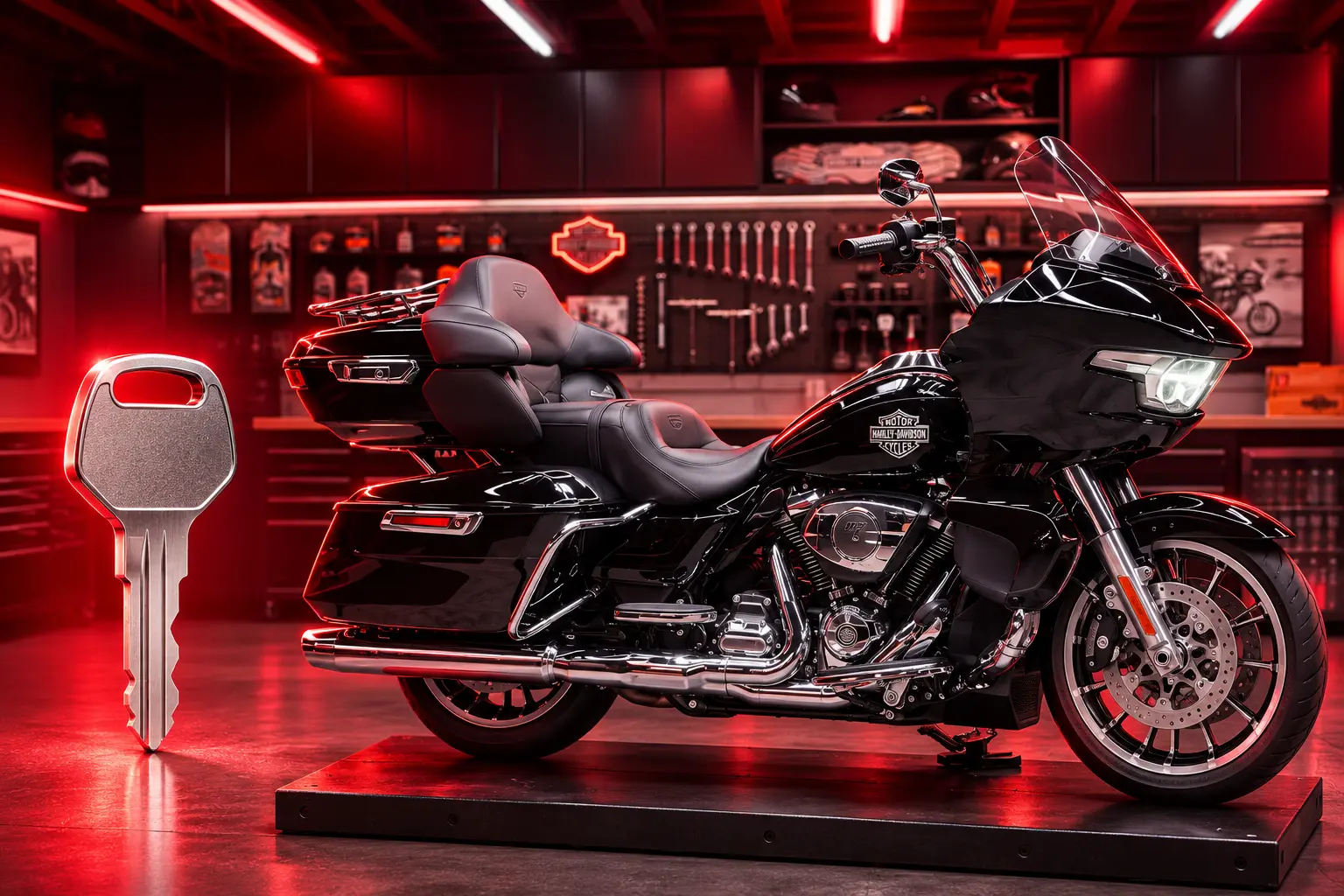
Plastic Flash on Part 32700166 Fools the Dash
The bad part is a gear-position sensor, part 32700166, made by SSI Technologies, LLC, a Tier 1 supplier in Janesville, Wisconsin. Harley says a supplier molding problem can leave plastic flash on the sensor, a thin ridge of extra material from the mold, and that flash can send the wrong gear signal to the engine control module.
The module then reports Neutral when the transmission is in gear. Harley’s words for the risk are plain. The condition “can allow unintended forward motion of the motorcycle, potentially increasing the risk of an injury.” The gearbox is not seizing. The dash is lying about what the gearbox is doing, which is the cue a rider uses at a light, both feet down, clutch hand letting go.
On a 2026 Road Glide the gear reading sits in a 12.3-inch Skyline OS cluster on a machine that Harley lists at 838 lb in running order, with a starting price of $27,999. A false Neutral on that bike is a heavy lurch, not a light stumble. Harley names two ways the fault can show itself before anyone lets the clutch out.
WARNING SIGNS ON THE DASH
- Flicker: The gear indicator jumps between Neutral and another gear.
- False N under power: The display reads Neutral while the motorcycle is being propelled forward.
- The stop-light trap: The N light is the cue used with feet down and the clutch released, which is when a false reading can let the bike move.
Harley has not told owners to leave the motorcycle parked. Until a dealer fits the new sensor, the practical rule is to confirm the transmission with the shift lever and the bike’s behavior, not with the letter N.
Harley Counted Two Injuries Against a 0.1 Percent Estimate
Harley’s Nov. 3 safety recall report puts the U.S. population at 21,643 and the estimated share with the defect at 0.1 percent. That arithmetic is 21.643, or about 22 motorcycles. The same report says Harley-Davidson “is aware of two injuries potentially related to this condition.” It gives no names, no dates, and no description of those cases.
THE RECALL IN FOUR FIGURES
- U.S. net: 21,643 motorcycles, all 2026 touring and CVO variants in the filing.
- Defect rate: 0.1 percent, or about 22 bikes if Harley’s estimate holds.
- Injuries on file: two, listed as potentially related, with no further detail.
- Shop fix: replace the sensor with a part made from a new tool that eliminates the flash.
Two injuries against a pool Harley sizes at about 22 defective bikes is a hard ratio if that estimate is right, and it is a thin one if the 0.1 percent figure is low. Either way, the company is recalling every VIN in the production window because owners cannot tell which motorcycle is in that small group until the dash lies.
By Harley’s own 2026 paper trail, this is not a giant campaign. A separate April filing on a blocked airbox breather listed 88,039 motorcycles. Recall 0194 is the smaller net, aimed at the company’s core baggers, and it still carries two injury files and a dealer delivery freeze.
Which 2026 Harley Models Are in Recall 0194?
Nine 2026 model codes are in the U.S. filing, all Grand American Touring or CVO baggers built from late October 2025 through August 3, 2026. The regular Road Glide and Street Glide account for 13,253 of the 21,643, or 61 percent. Four CVO variants add 2,853. The Road Glide Police fleet adds 329. Limited models add 5,208.
THE NINE MODELS IN THE U.S. FILING
| Model | Code | U.S. units |
|---|---|---|
| Road Glide | FLTRX | 7,794 |
| Street Glide | FLHX | 5,459 |
| Road Glide Limited | FLTRXL | 3,013 |
| Street Glide Limited | FLHXL | 2,195 |
| CVO Road Glide ST | FLTRXSTSE | 1,360 |
| CVO Street Glide Limited | FLHXLSE | 677 |
| CVO Street Glide ST | FLHXSTSE | 598 |
| Road Glide Police | FLTRXP | 329 |
| CVO Street Glide | FLHXSE | 218 |
Harley identified the VINs from production, inspection, and shipping records. The CVO Road Glide (the non-ST bagger) is not on the list, and neither is the Street Glide 3 Limited. A worldwide dealer bulletin also names 2025 Street Glide, Street Glide Ultra, and Road Glide units built for Brazil; those bikes sit outside the 21,643 U.S. count.
The 329 Police Road Glides are the quiet line in the table. They are built for agencies, and a false Neutral on a patrol bike is a problem at a curb, not on a Saturday ride. Harley’s U.S. filing still gives those machines the same remedy and the same absence of a park-it order as a CVO in a private garage.
Six Months Passed Between the First Shop Find and the Recall
Harley did not stumble onto this in November. The chronology in the Part 573 report runs 194 days from the first shop find to the executive sign-off, and the factory screening started well before the recall was approved.
FROM THE FIRST SHOP FIND TO THE LETTERS
- April 16, 2026: Harley’s Technical Subcommittee is told of plastic flash on the gear-position sensor of a 2026 Road Glide (FLTRX) in for service.
- April 30, 2026: The subcommittee holds its first meeting on the case.
- May 5 to October 1, 2026: Harley inspects quarantined sensors for flash and damaged spring clips, checks parts, and keeps watching the field.
- August 3, 2026: York Vehicle Operations in York, Pennsylvania, adds a screening step so sensors with flash are not installed on new bikes. U.S. production dates in the recall end on this day.
- October 1, 2026: The subcommittee sends the case to the Field Action Committee.
- October 20, 2026: The Field Action Committee sends it to Harley’s Executive Decision Authority.
- October 27, 2026: The Executive Decision Authority approves a voluntary recall. The two potentially related injuries are listed in this record.
- November 3, 2026: Harley files the Part 573 report. NHTSA logs it as 26V730.
- November 6, 2026: The worldwide dealer bulletin and Service Bulletin M1741 go out, and affected VINs become searchable.
- November 16 to 23, 2026: Owner letters are scheduled to mail, and recall kits begin wave shipments.
From April 16 to August 3, Harley was investigating and then changing the line. From August 3 to October 27, new bikes were being screened while older ones stayed in customers’ hands with the original sensor. The letters that close that gap start November 16.
Wave Shipments Begin the Week Owners Get Mail
Harley says dealers will replace the sensor with a new part made from a new tool that eliminates the flash. The repair is free. The catch for anyone booking a date is timing, not price. Kits ship in waves from the week of November 16, the same window as the owner letters, so a shop may have the campaign on the screen and an empty bin on the shelf.
Owners do not have to wait for the envelope. Harley says the VIN is stamped on the steering head and printed on a label on the right front down tube. The 17-character number is what both lookup tools want.
HOW TO CHECK A VIN NOW
- Company tool: Enter the VIN on Harley-Davidson’s VIN recall checker, which has listed campaign 0194 since November 6.
- Federal tool: Run the same number through the NHTSA recall lookup by VIN, campaign 26V730.
- Phone: Call Harley-Davidson customer service at 1-800-258-2464, or NHTSA’s Vehicle Safety Hotline at 1-888-327-4236.
- Shop: Call the dealer first. Wave shipments mean the part may not be on the shelf the day the letter arrives.
NHTSA posted the campaign to its own recall feed on November 10, naming the nine model codes and the false Neutral reading, with a link back to the federal lookup.
⚠️ Recall Alert
2026 Harley Davidson FLHXLSE, FLTRXSTSE, FLHXSTSE, FLHXSE, FLHXL, FLTRXP, FLTRX, FLTRXL, and FLHX motorcycles.
Recalled because neutral gear displays when transmission is actually in gear. https://t.co/XmZVtUTlc5— NHTSA Recalls & Ratings (@NHTSArecalls) November 10, 2026
The Letters Carry No Order to Park the Bike
Harley’s filing does not tell owners to stop riding. It does tell dealers not to hand over an affected motorcycle until the sensor is changed. That is the whole shape of recall 0194: a 0.1 percent parts problem, two injury files, a locked showroom, and an unlocked driveway.
Most of the 21,643 bikes will never show the fault if Harley’s rate is right. The ones that do may only show it when a rider is stopped, reading N, and letting the clutch out on a touring machine that weighs as much as a small car’s front end. Owner letters are scheduled to mail November 16 through November 23, 2026, and the kits travel in the same wave. Until a dealer fits the new sensor, Harley’s own warning is that the indicator can show Neutral while the motorcycle is being propelled forward.

One UI 9.5 Beta Puts the Galaxy S26 on Last Year’s Clock

DBS Puts a 24/7 USDC Window Inside the Bank

European Startups Head for $81 Billion as First Checks Shrink

US Stocks Lost $1.3 Trillion Before Nvidia’s Beat

Home Depot Bets on Finance Chief Richard McPhail as CEO

Aramco Crash Kills 14 Two Days After Oil Restart

Salah Captained Egypt to Their First World Cup Win

Zelda’s 40th Switch 2 Ships Without a Zelda Game

Apple Labor Day Deals Hide June’s Memory Price Hike

El Niño Puts Israel’s Needed Winter Rain on a Flood Clock
-
 BUSINESS5 months ago
Aramco Crash Kills 14 Two Days After Oil Restart
-
 NEWS6 months ago
Salah Captained Egypt to Their First World Cup Win
-
 GAMING2 months ago
Zelda’s 40th Switch 2 Ships Without a Zelda Game
-
 NEWS3 months ago
Apple Labor Day Deals Hide June’s Memory Price Hike
-
 NEWS4 months ago
El Niño Puts Israel’s Needed Winter Rain on a Flood Clock
-

 GAMING2 months ago
Palworld 1.0.4 Adds Palpedia Search After the 1.0 Launch
-

 NEWS4 months ago
Saudi Visa Routes Split Nigerian Travelers Into Two Speeds
-

 BUSINESS9 months ago
BAE’s 60-Year Saudi Franchise Now Runs Through Taif